
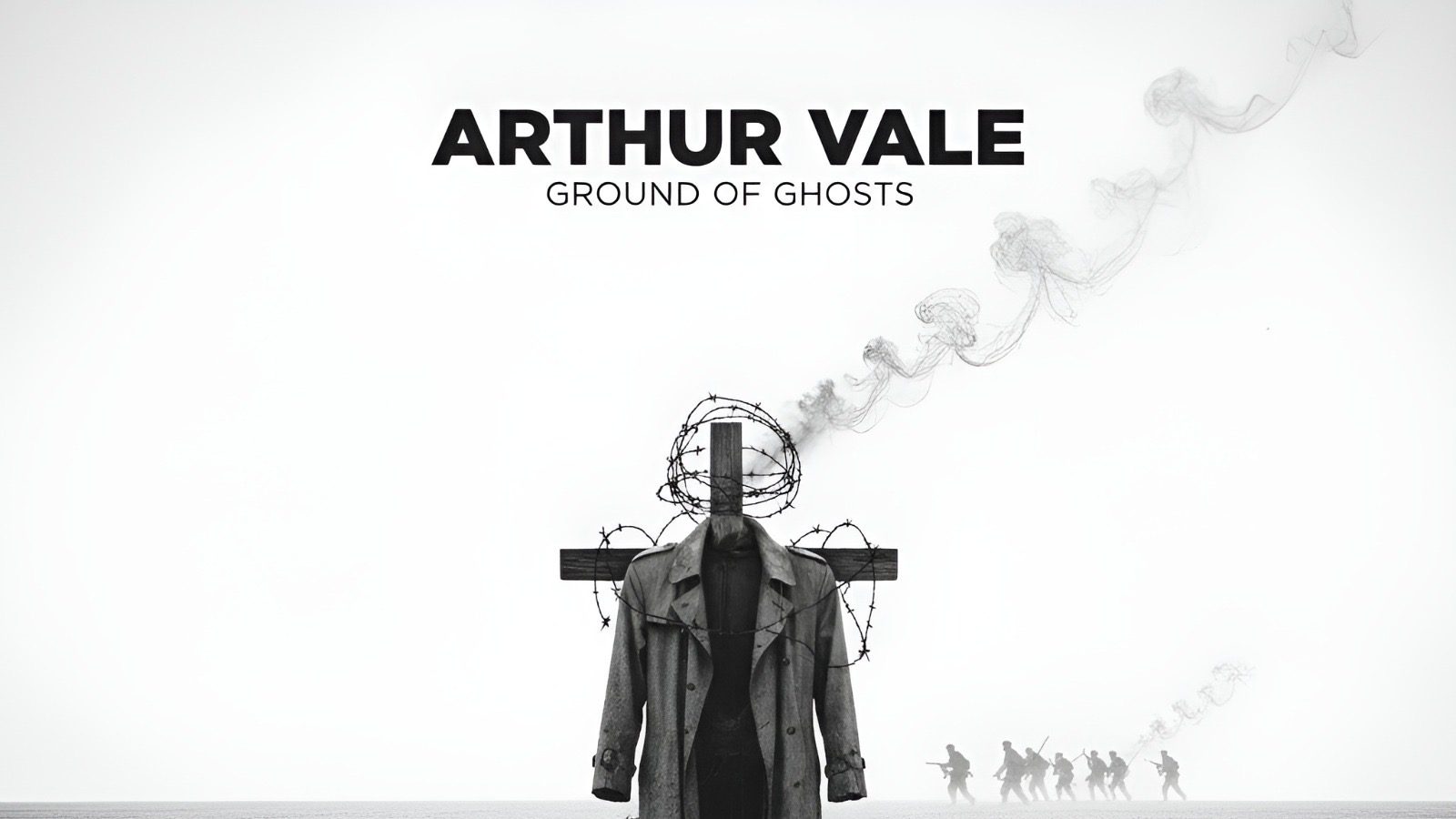
Arthur Vale is an 80 year old fictional British songwriter based in Coventry, England. Armed with a deep gravelly baritone reminiscent of Leonard Cohen’s later work, Vale approaches music as a weary historian rather than a traditional performer. His delivery leans heavily on spoken word narration, allowing stories to unfold with patience and restraint. Sonically, his work inhabits a sparse, cinematic art rock landscape, built to serve memory rather than spectacle. At eighty, Vale has made his debut with “Ground of Ghosts“, a haunting conceptual album that excavates the overlooked human cost of twentieth century conflicts through intimate historical reflection.
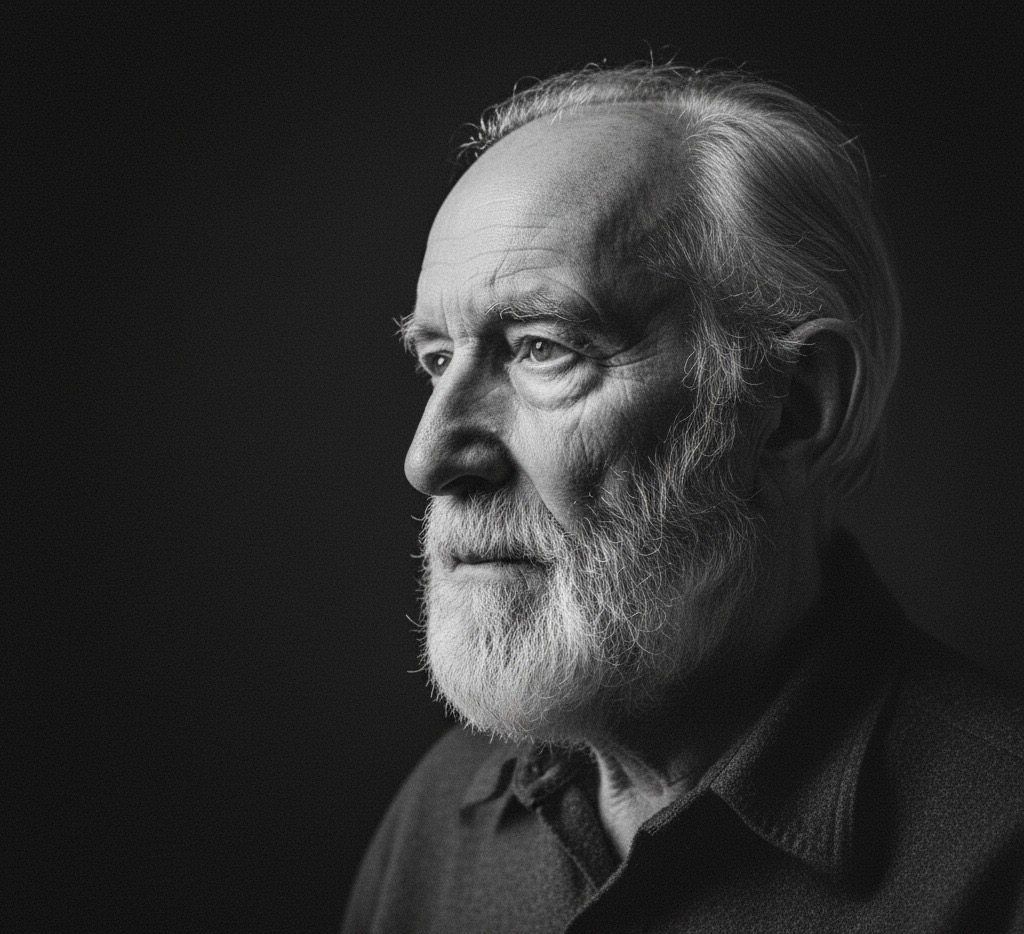
Arthur Vale’s “Ground of Ghosts”, released on October 29th, 2025, is a stark and deeply contemplative debut EP from an 80 year old fictional British songwriter based in Coventry. Conceived as a conceptual work, the project moves through key twentieth century war events, not to document history itself, but to illuminate the human residue left behind. Vale approaches these moments as a chronicler of aftermaths, giving voice to lives reduced to footnotes rather than monuments.
Musically, “Ground of Ghosts” is rooted in sparse, cinematic art rock, defined by restraint and atmosphere. Minimalist instrumentation forms a hushed backdrop that shifts subtly to suit each narrative, never overwhelming the stories at its center. Vale’s deep, gravelly baritone is delivered as an intimate spoken word murmur, drawing inevitable comparisons to Leonard Cohen’s later work. Like Cohen, Vale’s strength lies not in performance, but in presence, allowing gravity and silence to shape meaning. Ethereal female harmonies drift through the EP, offering contrast and texture while enhancing its spectral quality.
Ground of Ghosts EP Track List:
Siege of Khe Sanh:
“Siege of Khe Sanh” opens “Ground of Ghosts” with an oppressive sense of suspension, immediately situating the listener inside endurance rather than action. The track begins with a solitary hum that feels almost ritualistic, soon locked into a consistent, unyielding bass beat. This pulse never relents, functioning as both rhythm and metaphor, mirroring the psychological monotony of a prolonged siege. When Arthur Vale’s vocal enters, it arrives with a god like gravity, his deep, resonant baritone pressing down on the mix rather than floating above it.
The musicality remains deliberately restrained. A tense, swirling organ slowly coils beneath the surface, adding motion without release, intensifying the claustrophobic atmosphere. The later arrival of a soft female vocal fractures the initial severity, introducing fragility without altering the beat’s insistence. At the 2:18minute mark, the collision of both voices feels less like harmony and more like psychological overlap, two internal states occupying the same space. Vocals dominate the track, while the steady accompaniment enforces confinement, capturing the slow motion dread of the seventy seven day ordeal with unnerving precision.
The Rubble & The Snow:
“The Rubble & The Snow” stands as the second track on “Ground of Ghosts”, opening with a brooding stillness shaped by acoustic instrumentation and a softly humming female vocal. The arrangement is deliberately minimal, allowing space and restraint to define the listening experience from the outset. At the 24 second mark, an intimate male vocal enters with a relaxed delivery, settling gently into the acoustic framework rather than commanding it. The musical backdrop remains uncluttered, relying on texture and pacing instead of movement or dramatic shifts.
As the song progresses, the female vocal continues quietly in the background, adding emotional depth without disrupting the calm. At 1:23minute, she fully takes the lead, and from that point the two voices alternate, creating a reflective exchange rather than a fixed hierarchy. Even as the instrumentation subtly grows, it never breaks the tranquility established at the beginning. The acoustic layers feel organic and unreplicable, reinforcing the track’s role as a minimalist lament on the Battle of Stalingrad and a piece designed for silence, contemplation, and emotional stillness.
The No Man’s Carol:
“The No Man’s Carol” emerges as the third track on “Ground of Ghosts”, capturing the fragile, unsanctioned humanity of the 1914 Christmas Truce with remarkable sensitivity. The song opens with the humming of a deep bass voice, anchored by a subtle yet steady pulse that immediately establishes restraint. This opening hum functions as a call and response, as a collective choir answers each hums, creating a sense of shared presence across invisible lines. Even when the singing begins, the respondent humming remains, quietly echoing every line and reinforcing the track’s communal core.
As the humming gradually transforms into elongated “ooohhhh” tones, the song takes on an ambient, almost sacred atmosphere. At the 1:12minute mark, the collective voices begin to sing with a serene calm, deepening the emotional weight. A pivotal shift occurs at 1:35minute, when the male lead gives way to a female lead vocal, while the choir continues to hum and sing around her. This fluid exchange between male, female, and collective voices shapes the track into a living moment of shared humanity rather than a fixed narrative.
Thematically, the EP resists the language of protest. Where traditional war records shout slogans or moral conclusions, “Ground of Ghosts” whispers lived consequences. Vale writes from the perspectives of the haunted, the forgotten, and the emotionally displaced, focusing on the brutal human cost of conflict rather than ideology or heroism. His age lends the project a weary authority, as though these stories have been carried for decades before finally being released.
Ground of Ghosts Is A Striking Debut EP That Blends Haunting Textures, Immersive Instrumentation, And Meticulous Pacing, Creating An Unforgettable Listening Experience That Lingers Long After It Ends
“Ground of Ghosts” understands what tranquility and restraint truly mean. Each track stands confidently on its own, with careful attention paid to vocals, instrumentation, and emotional pacing. If you are seeking a work that holds ethereality and calm at its core, lay back, turn off your lights, and let this EP guide you through the darkness with its quiet, haunting grace.
For more information about Arthur Vale, click on the icons below.