
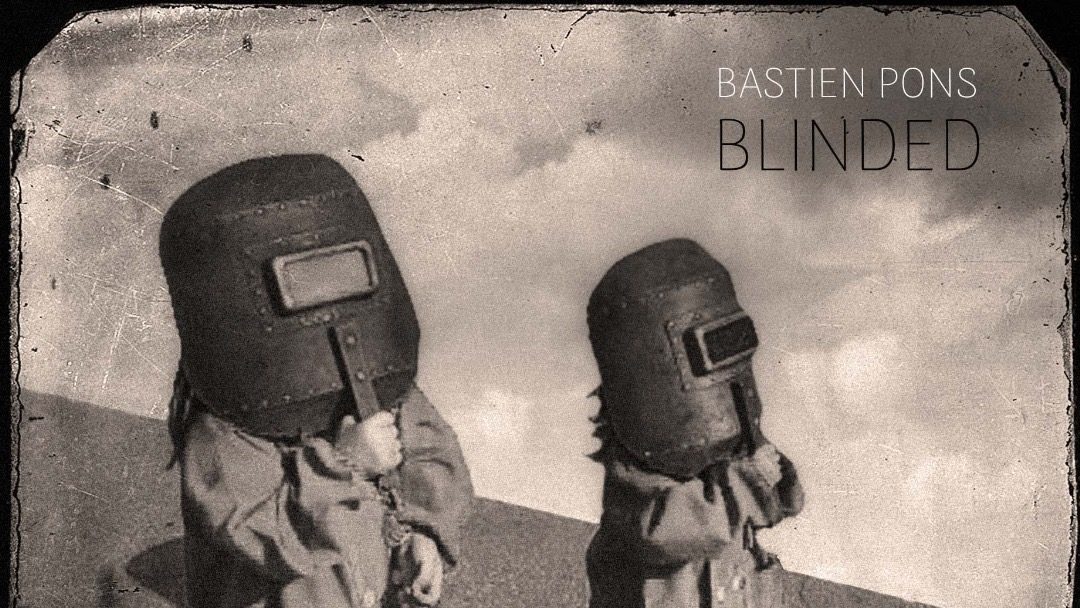
Bastien Pons is a French sound artist and black and white photographer known for creating deeply immersive sensory environments where audio and visual ideas breathe together. Trained in musique concrete under Bernard Fort, he approaches composition the way he approaches an experimental photograph. Texture, contrast, silence, grain, and negative space become expressive tools instead of background decoration. His influences range from industrial pioneers to ambient minimalists, giving his work a personal language built on tension, restraint, and sonic memory. Rather than composing to entertain, he constructs rooms that listeners inhabit. His sounds feel tactile, fragile, and cinematic. They do not demand attention. They reward surrender. This philosophy allows his work to drift between ambient minimalism, industrial noise, field recordings, and abstract sonic sculpture, creating experiences that feel sculpted rather than played.
“Black Clouds” released October 13th, 2025, as part of the album ‘Blinded‘, emerges as one of the most compelling demonstrations of Bastien Pons’ ability to sculpt sound into psychological environments rather than traditional musical space. From the moment it begins, the track envelops the listener in a dense field of low frequency drones that drift like slow moving storm fronts, immediately establishing an atmosphere of weight and suspended tension. These drones are not simply tonal beds placed beneath the mix, but meticulously shaped layers that expand and contract subtly, evoking the sensation of pressure accumulating around the listener. They occupy both the foreground and the background simultaneously, creating a multidimensional sense of sonic fog. The absence of a bright melodic line emphasizes the track’s commitment to emotional ambiguity, encouraging the listener not to follow a progression, but to inhabit a constantly shifting mood. Silence becomes as crucial as sound, outlining the drones with pregnant pauses that allow their decay and resonance to breathe.
As the track progresses, additional textures emerge like static clouds shifting across the sonic panorama. Faint metallic resonance flickers at the edges of the stereo field, never settling long enough to become familiar, but recurring frequently enough to insinuate presence. These metallic artifacts suggest industrial surfaces being tapped by invisible forces, adding a mechanical coldness to the mix. Meanwhile, layers of subtle static form a granular haze that wraps around the listener’s ears, reinforcing the sensation of being enveloped by something neither hostile nor comforting. Bastien Pons places each of these sounds intentionally, drawing from his background in musique concrete to emphasize tactility and spatial contrast. The careful interplay between organic noise and synthetic frequency produces an atmosphere that feels alive, constantly mutating without revealing its intentions.
Within this carefully constructed sound mass, there exists a careful management of dynamic range that refuses to compress the emotional landscape into a flat surface. The volume never spikes dramatically, nor does it collapse suddenly, but instead evolves through slow transitions that mirror the drifting movement of heavy atmospheric systems. The restraint in dynamic shifts keeps the listener in a state of anticipation rather than release, effectively prolonging the emotional tension. This is not a narrative of physical storm impact, but of the psychological weight that accumulates before the storm breaks. The absence of dramatic payoff aligns with Pons’ artistic philosophy, where the experience exists in the sustained moment rather than in climactic resolution. By deliberately withholding catharsis, he forces the listener to confront the internal space the track creates.
Rhythmic elements within “Black Clouds” are intentionally understated to the point of near nonexistence. Instead of traditional percussion, the listener encounters faint pulses, distant thuds, and the soft breathing of what feels like industrial machinery. These pulses are irregular, almost subconscious, suggesting motion without destination. They function as a fragile heartbeat, keeping the composition from collapsing entirely into ambient stasis. This unpredictable rhythmic ambiguity deepens the sensation of unease, as the listener cannot rely on familiar temporal anchors. The rare emergence of sub bass swells enhances this effect further, rising like tremors beneath the surface of the mix. Their vibration introduces a visceral element, subtly physical yet unobtrusive, expanding the track beyond purely auditory experience and into somatic perception.
The vocal contribution of Frank Zozky becomes the central human element within this soundscape, though even here, Pons rejects traditional narrative clarity. Zozky’s voice enters like a mantra, breathy and insistent, hovering with a clear note. The production blends his tone with surrounding frequencies, blurring his presence into a ghostly silhouette. The vocal approach reinforces the track’s meditative qualities, acting not as a guide but as a companion within the emotional suspension. It is less about message and more about presence, representing the internal voice that surfaces during moments of quiet psychological pressure. The repetition becomes hypnotic, subliminally inviting the listener deeper into the suspended environment.
Production techniques throughout “Black Clouds” demonstrate meticulous attention to the textures of decay and negative space. Ambient hiss curls around the edges of the mix like wind through an industrial corridor. Metallic clicks appear sporadically as if something unseen is shifting within the distance. These micro details prevent the composition from becoming static, constantly introducing new points of focus for attentive listeners. Reverb is used sparingly but effectively, stretching certain tones into the stereo field like elongated shadows. Rather than exaggerating spatial size, the reverb emphasizes emptiness between elements, allowing absence itself to speak. Each sound appears to have been field recorded or processed to preserve tactile grain, giving the track an almost photographic clarity that parallels Pons’ visual work.
When considered within the context of the album Blinded, “Black Clouds” operates as a distillation of Pons’ thematic concerns. The album explores perception, memory, and the emotional weight of silence, and this track embodies all three simultaneously. The sonic environment constructed here feels suspended outside of time, inviting the listener to slow down and accept the absence of conventional narrative or progression. The refusal to comfort or resolve mirrors the internal experience of waiting for something unnameable to change. In this way, the track does not attempt to offer answers or catharsis, but instead allows complexity to remain unprocessed. That lack of resolution becomes the emotional truth at its center.
Black Clouds is a Slow Moving Emotional Storm, Built From Pressure, Silence, And Ghostly Texture, Creating A Suspended Tension That Lingers Long After The Final Sound Fades Away
Ultimately, “Black Clouds” stands as a testament to Bastien Pons’ mastery of mood based composition. It is a piece that demands stillness, patience, and surrender. For some listeners, its lack of melodic contour or rhythmic structure may feel challenging, but this very resistance is its brilliance. It lingers after it ends, like the memory of a sky that never cleared, leaving the emotional residue of pressure without release. What remains is not a story, but a state: a suspended moment where silence carries as much weight as noise and the internal landscape speaks louder than the external. Through careful tonal sculpting, spatial awareness, and vocal abstraction, Pons offers an auditory environment that rewards deep attention and transforms passive listening into immersive habitation.
For more information about Bastien Pons, click on the icons below.