
Bastien Pons is not merely a composer; he is an architect of emotion and a sculptor of sound. Hailing from France, his artistry resides in the liminal space where audio meets visual, where field recordings are layered like photographic negatives, and silence becomes as tangible as steel. His creative foundation is rooted in two distinct yet interwoven disciplines: the stark, emotive world of black-and-white photography and the abstract, academic tradition of musique concrète. Pons’ sonic identity was shaped under the mentorship of Bernard Fort, a significant figure in the world of electroacoustic music. Under Fort’s guidance, Pons didn’t simply learn how to compose, he learned how to listen, how to unearth the emotional resonance buried within raw, everyday sound.
His training cultivated a practice where sound is not merely arranged, but carved, distorted, and revealed like light in a darkroom. But Bastien Pons’ vision is far from academic detachment. His work is intensely personal and tactile. With influences ranging from the surreal avant-gardism of The Residents and Meredith Monk, to the industrial darkness of Lustmord and Coil, to the experimental atmospherics of Andy Stott, Swans, and Esplendor Geometrico, his music forms a unique dialect of feeling, one that doesn’t merely play through speakers, but inhabits the body and mind like a haunting. Each of his compositions is a world of its own: introspective, textural, emotionally fragile, and spatially immersive. He approaches music the way a photographer approaches a still frame, through contrast, texture, framing, and exposure. His output is not designed for easy listening; it is meant to be experienced, felt, even wrestled with. A slow burn. A descent. A world behind the eyelids.
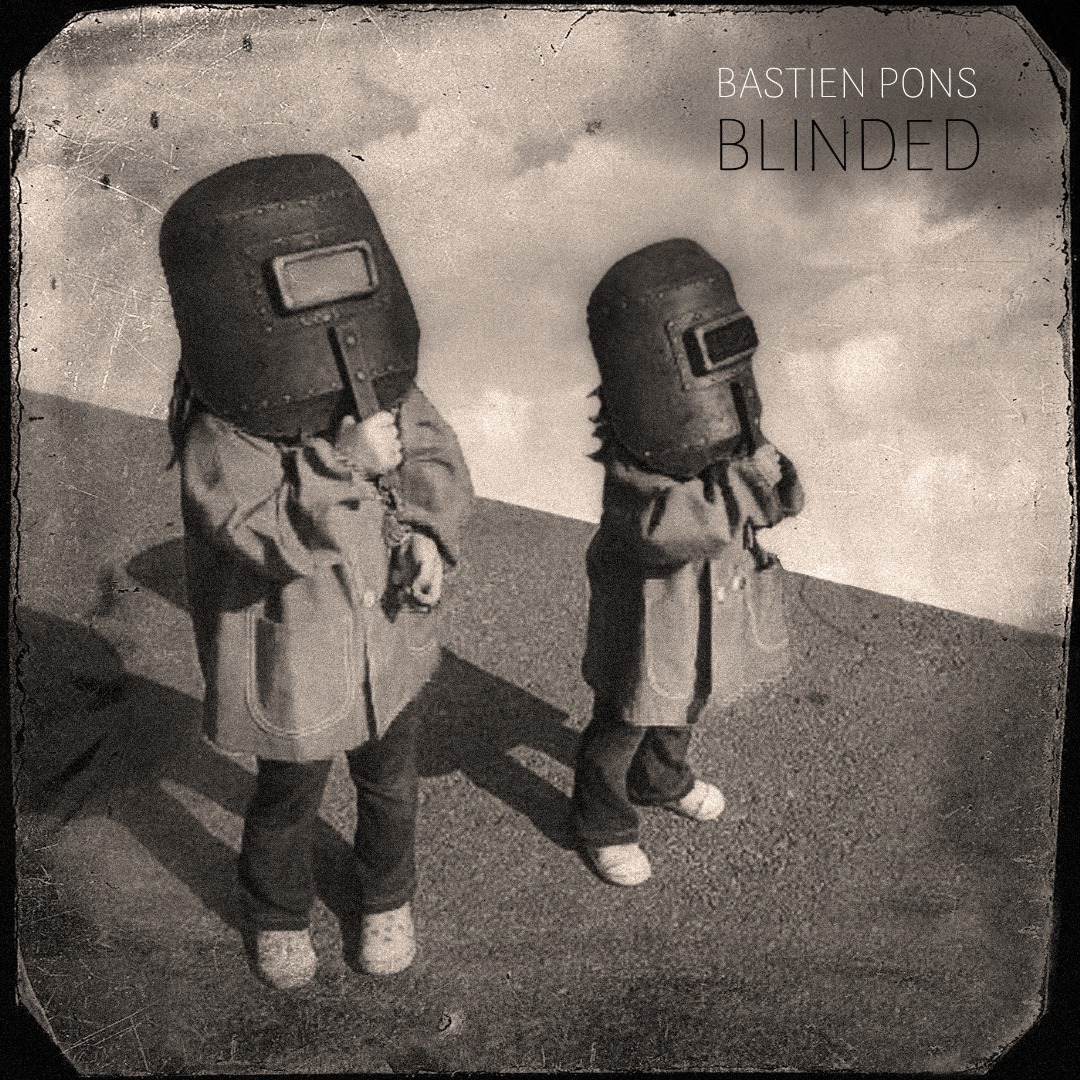
Released on June 13, 2025, Blinded marks the release of a haunting single from Bastien Pons, and it is far more than a song, it is a plunge into a sonic underworld, a space where perception begins to unravel and emotion takes shape through dissonance, distortion, and ambient decay. Like light breaking through thick fog or voices emerging from behind walls, Blinded does not follow conventional structure. It slowly materializes, immersing the listener in a soundscape that is raw, fragile, and confrontational. In Blinded, Bastien Pons transforms silence into pressure and sound into sculpture. This is not music designed to entertain or soothe; it’s crafted to engage, to pull the listener into an almost cinematic state of introspection and sensory immersion. Tones blur. Frequencies ripple. Memory and perception collapse into grainy textures that feel more like emotion than sound. It’s a daring introduction to an artist who doesn’t simply write music, he builds auditory environments meant to be inhabited, not just heard.
The single Blinded serves as a gateway to Bastien Pons’ full-length album of the same name, Blinded a unified sonic exploration that confronts how we experience the world not just through sound, but through the absence of it. The album is a meditation on perception and emotional fragility, deeply inspired by Pons’ background in black-and-white photography. In visual terms, it examines the interplay of shadow and light, of grain and blur; in sonic form, it uses ambient minimalism, industrial textures, field recordings, and musique concrète to craft a world that feels both eerie and intimate, vast and claustrophobic. Across the album’s runtime, Pons constructs a deeply tactile sonic environment, where every whisper, hum, clank, and drone contributes to a slow-burning narrative of internal reflection. Themes of blindness, both literal and metaphorical, run through the record like a pulse. It explores what we refuse to see, what remains unheard, and how silence can carry just as much emotional weight as sound. The album offers no easy resolutions, no neat conclusions. It invites the listener to surrender, to slow down, and to confront their own perceptions in the process.
From the very first second of Blinded, Bastien Pons plunges the listener into an eerie sonic landscape that refuses to follow traditional paths, opting instead for a slow, evocative unraveling of tone and tension. The track doesn’t begin in the way most songs do, it emerges, creeps, and takes form like mist rising from the floor of an abandoned cathedral. A collage of metallic whispers, dissonant drones, and reverberant, almost ghostly textures sets the tone for what is not a song in the usual sense, but a sonic art piece. It’s as if you’ve walked into a forgotten dream, where time warps and space feels unfamiliar. There are no melodies to guide you, no rhythmic patterns to hold onto, just the overwhelming sensation of being submerged in a soundscape that feels as tactile as it is auditory. The way Pons approaches the opening moments draws the listener into a liminal state where presence and perception slowly begin to blur, making it impossible to tell whether the music is beginning or you are just now becoming aware of it.
What immediately stands out in Blinded is the rich, layered complexity of its sound design, which showcases Bastien Pons’ deep understanding of texture, atmosphere, and emotional contrast. Every sound feels like it has a physical texture, like grains of sand scraping across a frozen mirror, or static fizzing through distant tunnels. The song is devoid of conventional hooks or chord progressions, yet it doesn’t lack motion. Rather, it moves like smoke: unpredictable, fluid, and immersive. There are moments where industrial elements, clanks, rumbles, and distorted fragments, collide with synthetic drones that seem to hover just above the frequency of conscious thought. The fragmented, muffled voices that surface intermittently seem like memories trying to claw their way through the haze. Every listen reveals new micro-details, from subtle frequency shifts to whispers buried in the background, suggesting that the track is alive, constantly mutating, and refusing to settle. This attention to microscopic detail is what gives Blinded its meditative yet unsettling power.
As the piece evolves, the title Blinded begins to reveal its true significance, not as a reference to darkness, but as a metaphor for sensory oversaturation and the collapse of clarity. Bastien Pons doesn’t paint silence as emptiness; instead, he turns silence into a force of pressure, something that looms, dense and imminent. The track captures that moment when light becomes too bright, sound too loud, thought too fast; when the mind becomes overwhelmed by the sheer volume of experience. About halfway through, a rising tension takes shape through thickening textures and low-end swells, like an emotional or sensory wave building without release. Rather than resolve with a clear climax, the sound mass diffuses into a dissonant fog, dissolving any expectation of catharsis. It’s a bold compositional choice that reinforces the feeling of internal fragmentation. This portrayal of sensory overload is not just heard, it is physically felt. Pons makes you inhabit this experience, rather than merely observe it.
Perhaps one of the most fascinating qualities of Blinded is its ability to be both confrontational and contemplative, demanding emotional presence while offering no easy entry points. The piece doesn’t try to comfort the listener or create passive ambiance; it instead creates an active space of confrontation with one’s own inner responses. You’re not led by melody or rhythm, but by intuition and instinct. The pacing is slow and deliberate, yet it carries immense emotional weight. What might first feel like chaos soon reveals itself as structured introspection, a sonic world with its own laws, where moments of quiet are loaded with tension and where every sound matters. The more time you spend with Blinded, the more it opens up. You start to notice the subtleties: the hiss of a decaying echo, the way a deep frequency swells like a pulse, the crumbling edges of processed sounds that feel like they’re aging in real time. The track invites, not forces, you to engage deeply with what you’re hearing and what you’re feeling in response.
The way Bastien Pons incorporates voice within this soundscape is especially striking, subtle, haunting, and emotionally charged despite being stripped of lyrical clarity. These aren’t voices that lead or instruct; they are echoes, memories, fragments of communication lost in translation. They take on the role of emotional ghosts, adding a human but unreachable presence to the piece. It’s as if someone is speaking from behind a wall of distortion, or from within a dream you can’t quite remember. This approach to vocalization transforms the human voice into an instrument of atmosphere rather than a conveyor of message. It resonates on a subconscious level, provoking feelings of longing, disorientation, or deep introspection. The lack of clear lyrical content does not reduce the emotional impact, it magnifies it, allowing the listener to project their own meanings and internal reflections onto the sound. In doing so, Pons turns abstract noise into something that feels intimately personal.
Blinded is a haunting sonic sculpture, where perception blurs and emotion pulses through immersive, shadowed sound.
Ultimately, Blinded stands as a profound and daring sonic exploration, one that resists categorization and challenges the very definition of what music can be. It is immersive, unsettling, cerebral, and at times even spiritual. Rather than building a song, Bastien Pons sculpts a space, a sonic sculpture filled with tension, nuance, and introspection. It doesn’t seek to entertain but to evoke, to disturb, and to reveal. The track rewards those who listen with intention and openness, offering an experience that is more akin to a sound installation than a radio-ready single. It feels perfectly situated in the realm of experimental ambient, musique concrète, and avant-garde art. For listeners with a taste for exploration, Blinded is a masterstroke, a slow-burning, emotionally loaded, and meticulously crafted sound environment that remains etched in the listener’s mind long after the last frequency fades into silence.
For more information about Bastien Pons, click on the icons below.