
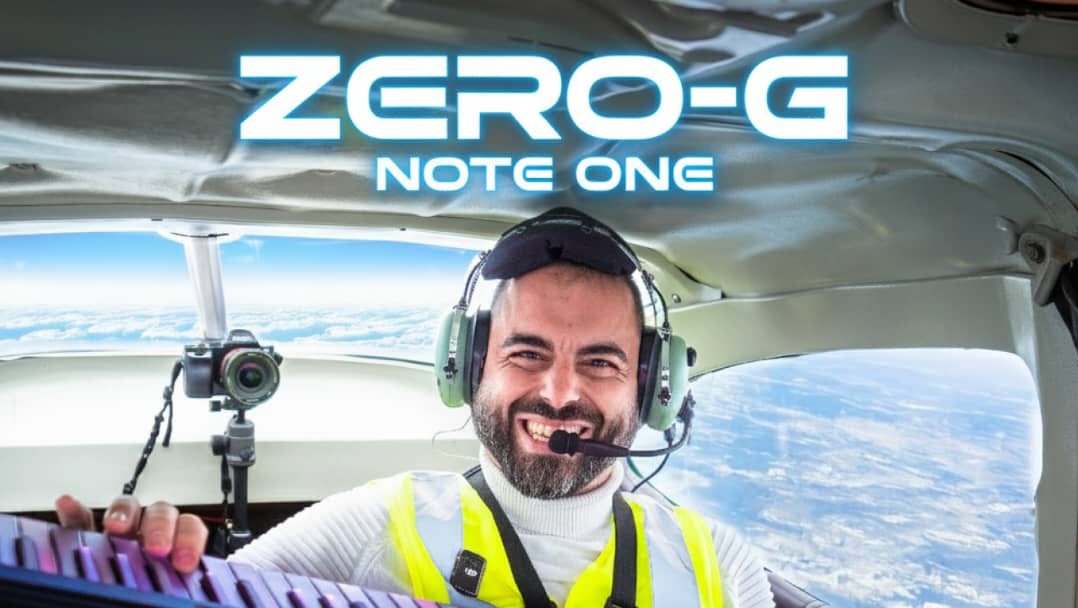
Dr. Leonardo Barilaro, widely known as The Space Pianist, stands at one of the rare intersections where art and aerospace engineering not only coexist but actively strengthen one another. His journey began remarkably early, at the age of six he discovered the piano, and by nine he was already looking upward, fascinated by astronomy. These two passions, music and space, did not simply run parallel in his life; they fused into the foundation of a singular artistic identity. The pivotal moment arrived at age twelve, when he envisioned something wildly ahead of its time: performing music in space. That vision would become the guiding constellation of his life’s work. As a musician, Barilaro trained rigorously, graduating from the Music Conservatory in Italy where he deepened his study of composition and developed an enduring fascination with synthesizers and electronic sound. He refined his technique under the mentorship of Jordan Rudess of Dream Theater, whose guidance further shaped his experimental edge and expressive approach.
Musically, Barilaro evolved into a polymath artist, crafting what he defines as Contemporary Space Music, a genre that merges piano, synthesizers, and bold experimental textures inspired by cosmic philosophy, scientific principles, and the unknown mysteries of human perception. Over time, his career expanded into a flourishing discography including four studio albums, five EPs, and numerous singles, and performances across Italy, Germany, France, the UK, the UAE, and beyond. His collaborative portfolio includes partnerships with world-class musicians such as Tina Guo, Steve Mazzaro, Yossi Sassi, Mariangela Demurtas, and Marco Minnemann. On the scientific side, Barilaro’s achievements are equally commanding. Holding a PhD in Aerospace Engineering from the University of Padua, he conducts research on hypervelocity impacts, space debris mitigation, mechanical measurements, fluid dynamics, aerospace systems, and high-energy impact materials. His academic output spans more than 25 publications and extensive involvement with multinational corporations.
His aerospace experience includes performing at Sweden’s ESRANGE Space Center during the SCRAT project, his first real space mission, and continues today through his leadership in innovative space-related research. Currently based in Malta, Dr. Barilaro serves as Senior Lecturer in Aerospace Engineering at MCAST, where he advances studies in space structures and materials. He is also responsible for one of the most ambitious artistic feats of the decade: the 2022 Space Piano Music Everyday project, where he released a brand-new track with a video every single day for a year, setting a world record. In 2023, he published his book Music from Space and became brand ambassador for Zanta Pianoforti luxury pianos. Leonardo Barilaro’s artistry has already reached space, literally. Twice, his compositions were streamed directly from the International Space Station, including as part of the ASTROBEAT mission, a scientific-artistic partnership featuring new compositions created with Grammy-nominated cellist Tina Guo and producer Steve Mazzaro.
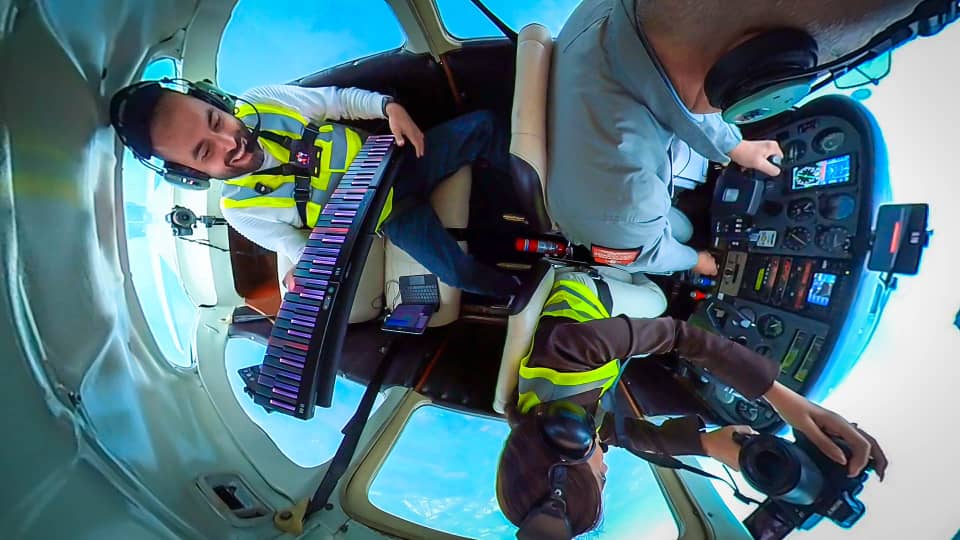
Through every project, Barilaro works toward one expansive vision: to inspire people across cultures and connect humanity to the awe of space. His ultimate dream remains crystal clear, to become the first pianist to perform a full concert on Mars and stream it back to Earth. On 14 November 2025, Dr. Leonardo Barilaro unveiled one of the most groundbreaking artistic-scientific projects ever attempted: “Zero Gravity, Note One”, the first EP in history to be recorded during a parabolic flight under real microgravity. This extraordinary release captures performances created aboard a modified Cessna 182 aircraft in collaboration with G0 Flight, led by Prof. Alessandro Barazzetti. Supported by a ROLI Piano M mounted on a custom-designed board, Barilaro performed in conditions where gravity fluctuated between hypergravity and complete weightlessness, transforming the cockpit into a miniature flying laboratory suspended between art and science.

Each track on the EP documents the physical and emotional reality of making music without gravity. Rather than resisting the instability, Barilaro embraced it, allowing zero-gravity motion, altered hand–eye coordination, and shifting perception to shape the music’s phrasing and texture. What emerged is not merely an EP, but the first true exploration of how human creativity behaves when freed from Earth’s pull. “Zero Gravity, Note One” marks a new chapter in Barilaro’s lifelong pursuit of Space Art, an artistic movement that unites scientific experimentation with imaginative expression. It stands as a bold step toward his ultimate dream: performing the first-ever piano concert in space. Released on his 42nd birthday, a number symbolically tied to “the answer to the Ultimate Question of Life, the Universe, and Everything”, the EP carries both artistic elegance and cosmic humor. And above all, it signals the beginning of a new frontier where music, exploration, and the human spirit rise together beyond our planet.
Zero Gravity, Note One EP Track List:
Star Wars – zero-g piano:
“Star Wars – zero-g piano” by Leonardo Barilaro opens the EP “Zero Gravity, Note One” with a bold and deeply atmospheric statement, immediately immersing the listener in the surreal world of weightless performance. The piece begins with a sparse, suspended tone that feels almost detached from gravity itself, each note drifting rather than landing. The phrasing is stretched, elongated, and fluid, carrying a sense of floating motion that mirrors the very environment in which the performance was created. Instead of the firm physical grounding typical of piano playing, the articulation has a softer, almost liquid quality; decays linger in an airy space, and the velocity of each keystroke feels subtly unpredictable, shaped by the shifting microgravity Barilaro was experiencing. This gives the melody an expressive wavering, the kind that suggests both human vulnerability and cosmic curiosity. From the first few seconds, the listener is made aware that this is not a traditional piano interpretation, it is a sonic documentation of a body navigating a world without weight.
As the performance deepens, the track takes on a more emotional color, evoking the adventurous sweep of Star Wars while reframing it through the delicate instability of zero-gravity. There is a striking interplay between the internal rhythm of Barilaro’s hands and the external forces tugging at his body during the parabolic flight. Some phrases rush forward with sudden buoyancy, while others slow into gentle, drifting arcs, almost as if the music were breathing in microgravity. The absence of a stable downward force alters the way chords bloom, giving them a spectral resonance that hovers in the midair of the track’s soundstage. The piece alternates between clear thematic gestures and moments of dreamy exploration, creating a dynamic textural landscape that feels cinematic yet intimate. Small nuances, slight hesitations, feather-light glissandos shaped by involuntary movement, floating pauses, become expressive musical events that would not exist under normal terrestrial conditions.
By its final stretch, “Star Wars – zero-g piano” evolves into a contemplative, almost philosophical experience, using the iconic theme’s essence to explore what music becomes when freed from physical constraints. The closing passages expand the emotional gravity of the piece, leaning into spacious harmonies that dissolve slowly as if suspended in a vacuum. The timbre remains warm but subtly unanchored, giving the final notes a drifting, luminous fade that captures both the fragility and the thrill of the zero-gravity environment. It feels less like a cover and more like a re-imagining, an experiment that transforms a familiar cultural motif into a study of human expression under extraordinary conditions. The track stands as a testament not only to Barilaro’s technical control amid chaotic physical forces but also to his artistic vision: demonstrating how a classic theme, reinterpreted in weightlessness, can resonate with new emotional and sonic dimensions.

Note One:
“Note One” by Leonardo Barilaro unfolds like a slow-blooming emotional experiment, a real-time improvisation shaped as much by Leonardo Barilaro’s inner state as by the unfamiliar physics of microgravity. The opening seconds are soft and quietly searching, built around delicate single-note phrases that feel like they are reaching outward, probing the weightless environment. The piano tone is warm but unusually fluid, there is a gentle instability in the attack of each note caused by Barilaro’s floating posture, giving the first melodic lines a fragile, breath-like quality. Instead of grounding the listener immediately in a motif, the piece begins as an atmospheric drift, where the spaces between the notes carry as much meaning as the notes themselves. These early gestures do not sit in the usual gravitational pull of a piano performance; they hover, shimmer, and evaporate with an almost vaporous decay that captures the physical sensation of being suspended mid-air. This fragile stillness sets the emotional tone: introspective, weightless, and profoundly intimate.
As the improvisation deepens, “Note One” expands into a richer harmonic vocabulary, moving from sparse single tones into fluid, exploratory chord clusters. Barilaro allows his phrasing to stretch into elongated arcs, shaped by the natural drifting of his arms and hands in zero-g. The result is a kind of floating rubato: the tempo breathes and contracts organically, guided by both instinct and physics. Midway through the track, subtle shifts in dynamics create emotional contours, the softer passages feel like whispered reflections, while the sudden, airy crescendos feel like the music momentarily catching a thermal current. There is a beautiful unpredictability here; sometimes the melody seems to aim upward, only to bend and dissolve into a cloud of glittering harmonics. Other times, the left hand offers gentle grounding chords that resemble emotional anchors, but even these are softened by the environment, lacking the firm percussive weight one expects from a piano. This middle section becomes the heart of the piece: a sonic diary entry written in real time, blending technical control with involuntary bodily movement, producing textures that could only exist under zero-gravity conditions.
In the final third, “Note One” moves toward a more defined emotional cadence, though it never fully abandons its floating, dreamlike state. Barilaro’s playing becomes slightly more intentional, as if he is gradually discovering a thematic thread amidst the atmospheric haze. The harmonies grow warmer and more resonant, building toward a quiet but meaningful culmination where the piano’s sustain hangs in the air like scattered particles of light. The closing progression does not resolve traditionally; instead, it fades with a luminous softness that mirrors the gentle descent after the parabolic weightlessness ends. Each lingering tone is allowed to expand fully before dissolving into silence, giving the ending a suspended, timeless quality. The final impression is that of witnessing a fleeting, unrepeatable moment, music shaped not only by human emotion but by altered physics. “Note One” stands as the EP’s most vulnerable and most honest offering: a pure, unfiltered improvisation where artistic intention and physical disorientation merge into a deeply expressive, beautifully weightless sonic experience.
Zero Gravity, Note One transcends Earth, fusing music, science, and human ingenuity, redefining creativity in the weightlessness of space.
“Zero Gravity, Note One” stands as a visionary breakthrough that transcends the boundaries of traditional music-making, offering a rare fusion of artistic expression, scientific inquiry, and human exploration that feels both pioneering and profoundly intimate. Leonardo Barilaro has not only created a sonic document of his zero-gravity experience but has opened a new creative frontier where music is shaped by physics, emotion, adaptation, and the raw vulnerability of performing without the familiar anchor of gravity. The EP feels like a blueprint for the future of Space Art, a demonstration that creativity is limitless when the artist dares to challenge the limits themselves. It invites listeners to step beyond passive hearing and instead experience the sensation of floating, drifting, and rediscovering sound as if for the first time. For enthusiasts of experimental music, for space lovers, for scientists curious about human performance in extreme environments, and for dreamers who believe in pushing beyond the possible, this EP is not just recommended, it is essential. It represents a bold first step toward a future where concerts will be performed in orbit, where art becomes a companion to exploration, and where music serves as a universal bridge between Earth and the cosmos. As a testament to vision, innovation, and courage, “Zero Gravity, Note One” should be embraced not only as a groundbreaking artistic achievement but as an inspirational reminder that the next era of music may very well be born among the stars.
For more information about Leonardo Barilaro, click on the icons below.