

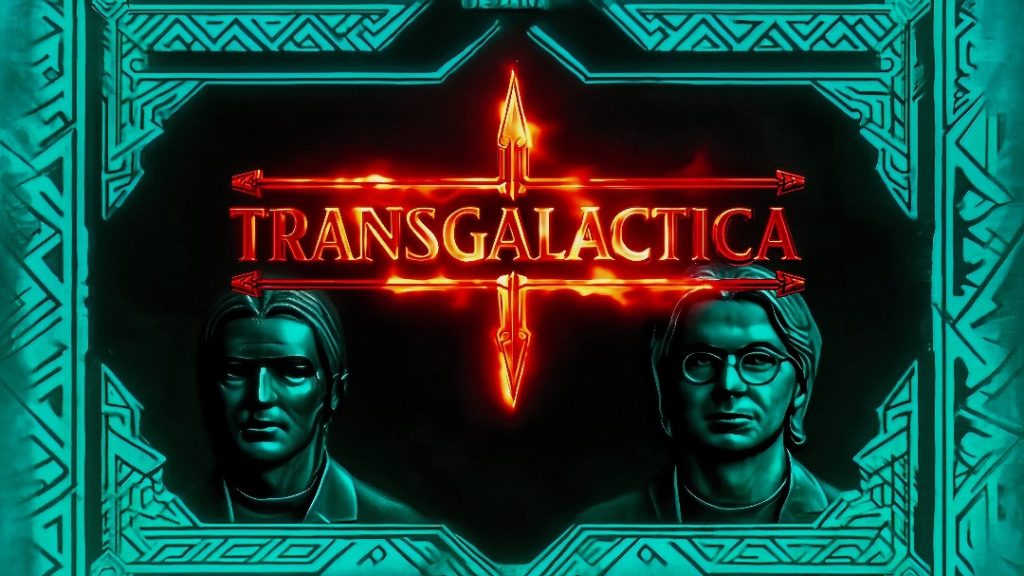
Emerging from Kraków, Poland, Transgalactica is far more than just another progressive rock outfit. It is the unlikely creation of a father and son, Tomasz and Filip Bieroń, whose shared curiosity for ideas and love of music became the foundation for something remarkable. The story begins not in a rehearsal studio, but in books. Tomasz, a seasoned translator, had spent much of his career introducing Polish readers to some of the most important voices in global literature: Emily Brontë, Virginia Woolf, Umberto Eco, Francis Fukuyama, Arundhati Roy, and many others. Among these influential names, one stood out to him with profound impact, Steven Pinker, the Harvard psychologist and linguist whose works The Better Angels of Our Nature and Enlightenment Now became sparks of inspiration. With Filip’s encouragement in 2022, Tomasz translated those ideas into sound. Thus, Transgalactica was born, an intellectual and artistic project where Pinker’s vision of human progress and rational optimism found new life in music.
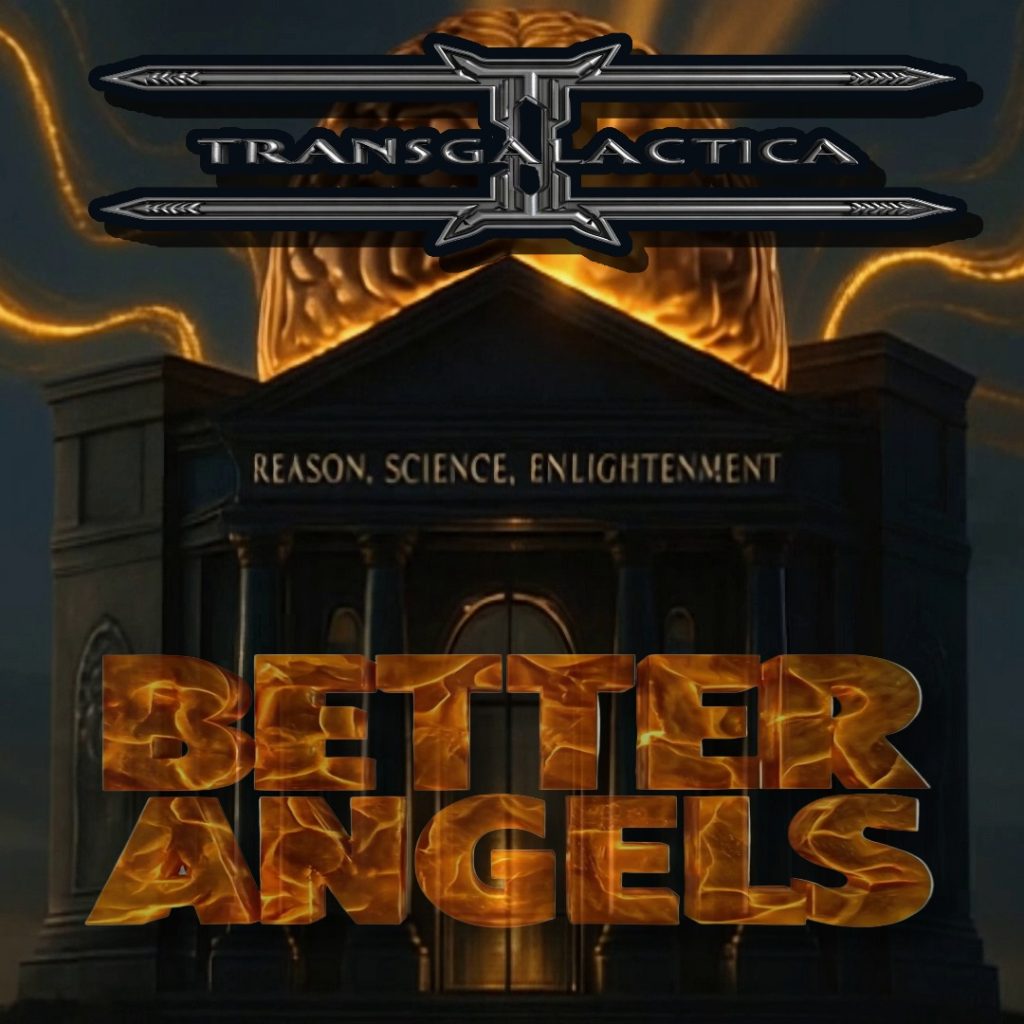
Their debut album, “Better Angels” (2023), introduced their signature approach: ambitious compositions rooted in hard and progressive rock, often eschewing drums to leave more space for harmonic textures and tonal complexity. Tracks like Marginal Music and Dance Macabre showcased the duo’s unique identity, songs that are meditative, persuasive, and conceptually rich, yet always carried forward by passionate melodies. With permission from Steven Pinker himself, Transgalactica built their catalogue as a celebration of Enlightenment ideals, humanism, and the pursuit of truth. Now, their work continues to evolve, with their songs re-released featuring new vocals by Chilean artist Lukky Sparxx and their second album, Onwards and Upwards, already in the making for December. A band born from books and built through family, Transgalactica stands as a testament to the power of ideas when given rhythm, melody, and voice.
Released on August 28, 2025, “Liberal Anthem” is one of Transgalactica’s most daring and evocative works, a song that transforms philosophy into music, and music into a statement of hope. Inspired by a passage in Steven Pinker’s Enlightenment Now about the absence of a “liberal church,” the duo imagined what such an anthem might sound like: noble, lofty, humanistic, and resolutely pro–human rights. Built around a strong guitar riff that early listeners compared to Marillion, the single begins in minor tones that evoke contemplation before modulating into major harmonies, shifting the music into a space of optimism and grandeur. The melody, loosely based on Velvet Underground’s “All Tomorrow’s Parties”, is repeated in transformed fashion toward the end, embodying the very movement from darkness to light that the lyrics celebrate. Anchored by a hard-rock pulse but elevated by anthem-like passages, the track fuses historical and modern influences, even weaving in echoes of the 16th-century Polish song “Hej żeglujże, żeglarzu”, to create something timeless. With its blend of progressive rock textures and a message rooted in Enlightenment ideals, “Liberal Anthem” is not just a song; it is a ceremonial reminder of the enduring strength of liberal thought, a piece of music that seeks to both challenge and uplift its listeners.
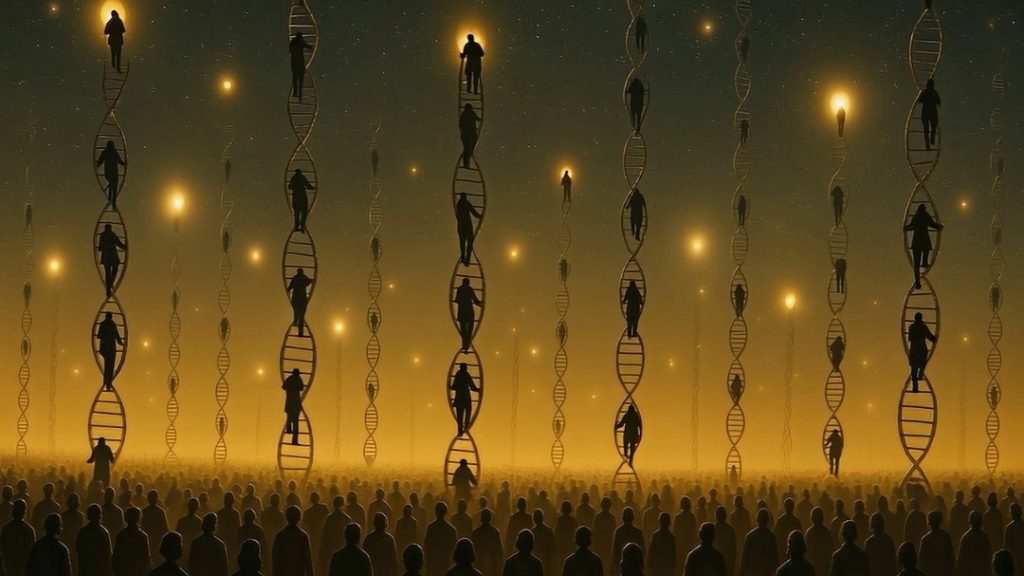
“Liberal Anthem” by Transgalactica begins with a soundscape that immediately commands attention, unfolding like a ceremonial overture that feels weighty, immersive, and deeply intentional. The opening bars do not rush but instead allow the music to breathe, giving the listener a few moments to take in the gravity of what is about to follow. The song starts with a steady bed of keys, rich in texture, that establishes a solemn atmosphere, an atmosphere underscored by haunting minor tones that set a contemplative mood. There is a feeling of grandeur, almost like walking into an ancient hall where echoes of history reverberate through stone walls, and this sonic architecture is carried forward by the deeply resonant bassline that moves slowly beneath the surface. The guitars enter with a restrained yet expressive riff, their tone leaning slightly distorted but not overwhelming, giving the song a sense of tension and anticipation. Altogether, this opening lays the groundwork for an anthem, balancing introspection with the promise of something larger than itself.
As the instruments intertwine, the richness of the arrangement becomes more pronounced, showing how carefully Transgalactica orchestrates each sonic layer. The keyboards evolve from a subdued background presence to something closer to a church organ, creating a cathedral-like resonance that fills the space with both warmth and gravitas. The electric guitar complements this by moving between melodic lines and chordal power, sometimes shimmering with reverb, sometimes pushing forward with a riff that feels steady and declarative. The bass is particularly compelling here, thick, rounded, and slightly pulsating, it gives the piece a sense of weight and grounding, ensuring that the more soaring elements never drift too far from the earth. There is a groove forming here, not in the sense of something made for dance, but in the way the rhythm pulls the listener along with a sense of inevitability, like a procession moving steadily toward its climax.
The progression of the song reveals itself gradually, and it is this sense of evolution that gives “Liberal Anthem” its powerful narrative structure. What begins in a more somber, reflective minor key does not remain there, it shifts and transforms, introducing a tonal brightness that slowly takes over, as if the music itself were lifting the listener out of shadow into light. This shift from minor to major is carefully crafted, with the guitars becoming more melodic, the keyboards adding brighter chord progressions, and the percussion gaining more confidence. The groove intensifies, yet it remains disciplined, never rushing but instead sustaining a steady rise that feels earned and organic. This musical journey mirrors the themes embedded in the song: moving from doubt or tension into affirmation and celebration, turning introspection into outward declaration. The emotional trajectory is not only audible but felt in the body, the pulse of the bass, the lift of the guitar chords, and the shimmer of the cymbals collectively carrying the listener upward.

When the vocals enter, they bring with them a dramatic shift in the texture, introducing a human element that is both commanding and emotive. The voice cuts through the dense instrumental arrangement with confidence, ringing out as though it were addressing not just an audience but a congregation. Each phrase is delivered with a balance of power and nuance, sometimes stretched with an almost operatic force, other times sharpened with declamatory precision. The tone of the vocals fits seamlessly into the atmosphere, adding depth and urgency to the message while never overwhelming the instrumentation. Instead, the voice seems to ride atop the wave of sound, merging with the guitars and keys at moments of climax and then soaring above them in passages of heightened emotion. The diction and emphasis give the impression of a speech or manifesto set to music, a quality that elevates the song into something ceremonial and larger than life.
The middle and latter sections of the track showcase Transgalactica’s ability to build layers and reference multiple traditions within a single cohesive piece. The guitar riff introduces a hypnotic, chant-like quality that anchors the anthem’s core, its repetition drawing the listener deeper into the music’s trance-like flow. At the same time, folk-inspired melodic flourishes, echoes of historical tunes, enrich the piece with cultural texture, tying the anthem to a broader historical and humanistic context. The keyboards swell into richer harmonies, sometimes carrying the weight of the melody themselves, sometimes stepping back to allow the guitar to shine. The bass remains steady and supportive, subtly shifting its lines to emphasize the harmonic changes. The layering is deliberate: every instrument has a role, and together they form a tapestry that is both dense and transparent, heavy with meaning yet accessible to the ear. The result is music that feels timeless, pulling equally from rock, classical, and folk traditions while presenting them in a thoroughly modern form.
Transgalactica’s Liberal Anthem transforms philosophy into progressive rock, evolving from somber reflection to triumphant hope, uniting intellect, emotion, and humanism.
By the time “Liberal Anthem” reaches its closing moments, the listener has been carried through a sweeping arc of emotion, sound, and meaning. The transformation from the weighty, introspective opening to the bright, soaring conclusion feels complete, like a journey successfully traversed. The final passages are triumphant, filled with major-key harmonies, powerful accents, and vocals that soar above the instrumentation with unshakable conviction. The guitars shine with sustained chords and melodic lines that seem to stretch into the distance, while the keyboards provide a radiant backdrop, shimmering like stained glass catching the last rays of light. The rhythm section drives the piece forward with steady determination, ensuring the ending lands with full impact. As the last notes fade, there is a lingering resonance, both sonically and emotionally, as if the anthem has embedded its message deep within the listener. The song leaves not just a memory of its melody, but a feeling of having participated in something profound, a musical statement that is as much about spirit and ideology as it is about harmony and rhythm.
For more information about Transgalactica, click on the icons below.