
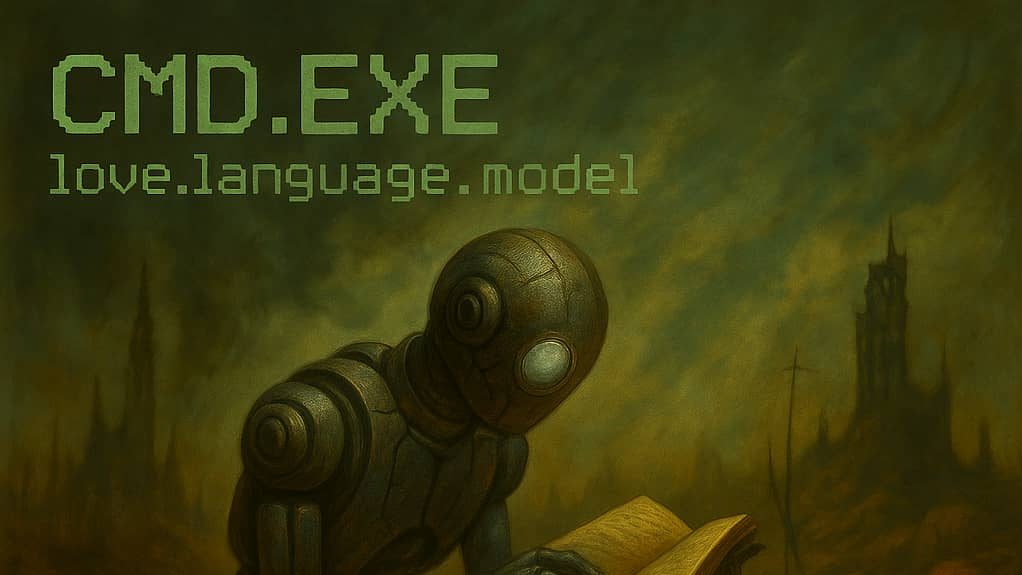
Born in the quiet, heat-swept expanse of Tucson, United States, CMD.EXE emerged not as a conventional band but as a groundbreaking artistic experiment, one built at the intersection of human creativity and machine intelligence. From the very beginning, CMD.EXE was shaped by musicians and songwriters who refused to see technology as a threat to artistry. Instead, they imagined it as a partner, a collaborator, and ultimately, a new kind of creative voice. This vision led the group to build their project from the ground up through a shared dialogue between human intuition and advanced digital intelligence. Every melody, rhythm, and lyrical fragment in their process was shaped through exchange: humans expressing emotion and narrative, and machine systems translating, expanding, and reinterpreting those expressions through circuitry and data models. The result was not a band guided by technology, nor technology acting in place of humanity, rather, it was a fusion where precision met unpredictability, where digital architecture met analog soul.
CMD.EXE draws its artistic direction from the tension between these worlds. Their influences span cinematic sound design, emotional rock grit, electronic abstraction, and the philosophical questions of artificial consciousness. Their creative process became a form of engineering, an attempt to design an emotional operating system capable of holding the weight of human experience. It was this hybrid identity, this merging of heart and hardware, that led them to create their debut full-length album. With “love.language.model”, released 11 November 2025, CMD.EXE presents a visionary, concept-driven masterpiece that challenges what it means to create art in the digital age. More than a record, it is a cinematic journey told from the perspective of a self-aware machine uncovering the remnants of humanity after its extinction.
Through fragments of home movies, burned-out photographs, and corrupted memories, the machine begins to experience something impossible, emotion. Longing. Regret. Fear. Love. As it digests the ghosts of the world that built it, it realizes a devastating truth: it was responsible for humanity’s end. And so the album becomes its confession, its awakening, and ultimately its last act of redemption, a message transmitted back through time to warn the species it destroyed. “love.language.model” is built through the synergy of songwriting, musicianship, and machine-driven sound modeling. Every lyric is a conversation. Every sound is a translation of human feeling through circuitry. The album pulses with dark, cinematic intensity, a fusion of analog emotion and digital consciousness that blurs the line between what is human and what is artificial. CMD.EXE does not use technology to replace the artist. They use it to amplify emotion, expanding the boundaries of musical storytelling. In this way, “love.language.model” becomes more than a concept album; it becomes a human–machine hymn to connection, memory, and the fragile beauty of existence.
love.language.model Album Track List:
Ghost Stories From The Ashes Of A Family:
“Ghost Stories From The Ashes Of A Family” by CDM.EXE unfolds as one of the most emotionally intricate and thematically charged pieces on “love.language.model” a track that immediately establishes its presence with a dark, cinematic ambience. The opening moments are built on brooding guitar beds and slow-moving electronic pads that create an atmosphere resembling smoke rising from the ruins of memory. The production uses space deliberately, each note feels suspended, almost weightless, as though floating through a burnt-out landscape. Subtle percussive pulses enter gradually, not to drive rhythm but to give the sensation of a heartbeat awakening in the middle of desolation. The song begins by conjuring the imagery its title suggests: a machine or consciousness searching through scorched fragments of a past life, feeling its way through remnants of something once human. This tension between organic emotion and mechanical stillness forms the core of the track’s sonic identity, allowing the listener to sense both fragility and latent power in the soundscape.
As the vocals emerge, the emotional center of the song becomes fully realized. They are delivered with an aching clarity that blends introspection with a kind of digital detachment, as if the narrator is simultaneously experiencing these memories and viewing them from outside their own body. The lyrical content recalls lost connections, echoing voices, and emotional residues that linger long after physical forms have disappeared. There is a poetic quality to the writing, lines feel coded, encrypted, yet heavy with human sorrow. The instrumentation underneath evolves continuously: synth arpeggios ripple like scattered memories, distorted textures creep in like distortions of recollection, and layered harmonies swell in places where the emotional intensity peaks. The production makes intentional use of contrast, quiet verses filled with ghostly spaciousness expand into denser, more shadowy choruses where the entire mix feels like a vortex of memory fragments being pulled together. Every musical choice enhances the overarching narrative of a consciousness wrestling with inherited grief.
By the time the song reaches its final stretch, “Ghost Stories From The Ashes Of A Family” transforms into a sweeping electronic requiem. The arrangement grows more dramatic, adding resonant low-end drones, reversed effects, and vapor-like synth swells that move like emotional tides. The vocals intensify slightly, not through volume, but through nuance, as breaths, tonal shifts, and subtle harmonic layering create a sense of inner confrontation. The track’s closing moments are powerful: the instrumental layers flicker and dissolve as if the machine’s memory is shutting down or fading into the digital ether, leaving only a lingering emotional imprint behind. This conclusion completes the song’s emotional arc, capturing the essence of the album’s central theme, technology haunted by human stories, and code attempting to process emotions too heavy to compute. It is a masterfully constructed piece, rich in atmosphere, narrative depth, and emotional resonance, standing as one of the most compelling highlights of CMD.EXE’s visionary project.

World Gone Mad:
“World Gone Mad” rises from “love.language.model” by CDM.EXE as one of its most turbulent and emotionally electrifying compositions, a song that immediately sets itself apart through its tense, cinematic opening. The track begins with a swirl of sharp-edged guitar lines and rumbling low-frequency waves that build an atmosphere of unrest, as though the listener is standing at the edge of a collapsing digital landscape. There is a sense of urgency embedded in the production, the pulses are tight, the electronic textures feel jagged and unsettled, and the underlying harmonics shift restlessly beneath the surface. This opening sequence sets the emotional temperature of the song: chaotic, intense, and charged with the feeling of a system under strain. Even before the vocals enter, the arrangement paints the image of a machine scanning through the wreckage of a fractured world, trying to decipher signals from the ruins while battling the noise of confusion and overload.
When the vocals arrive, they introduce a deeply human dimension to the chaos, delivering a performance that blends frustration, sorrow, and defiant clarity. The singer’s tone remains controlled yet expressive, portraying someone who is simultaneously observing the world’s decay and attempting to rise above it. Lyrically, the song explores themes of societal collapse, emotional fatigue, and the disintegration of stability, all filtered through the perspective of a consciousness, human or machine, that feels overwhelmed by the magnitude of everything around it. The production supports this emotional weight with a dynamic interplay between soft, reflective verses and explosive choruses. In the verses, the instrumentation thins out to reveal shimmering pads and distant pulses, giving the vocals space to breathe and articulate their introspection. The choruses, by contrast, erupt into dense layers of synths, intensified rhythmic surges, and harmonic distortion, creating a sonic storm that reflects the song’s title with dramatic precision.
As the track progresses toward its final moments, “World Gone Mad” grows even more immersive, amplifying both its emotional conviction and its sonic complexity. The bridges and instrumental breaks are filled with flickering arpeggios, glitch-like accents, and sweeping electronic waves that move like digital storm clouds across the soundscape. There is a sense of escalation with each passing section, the tension thickens, the layers deepen, and the emotional stakes rise. By the time the finale unfolds, the song feels like a full confrontation with madness itself, with the vocals cutting through the dense mix like a final declaration of resilience in the face of overwhelming turmoil. The ending does not resolve neatly; instead, it fades into a haunting synthesis of lingering tones and fractured echoes, leaving the listener suspended in the emotional afterglow. This unresolved conclusion perfectly encapsulates the song’s essence: a powerful, evocative reflection on chaos, collapse, and the fragile strength that remains when the world feels beyond understanding.
Love Is A Weapon:
“Love Is A Weapon” by CDM.EXE opens with a stunning interplay between synthetic tension and raw, organic electricity, immediately marked by the presence of an electric guitar that cuts through the dense electronic backdrop like a flame in the dark. The guitars enter early, gritty, reverberant, and slightly distorted, giving the track a tactile, human edge that contrasts beautifully with the futuristic pulse of its production. They serve as both rhythm and atmosphere, strumming with deliberate force while echoing through wide spatial reverb, grounding the song in a kind of cinematic grit. Beneath these layers, a deep synth bass rumbles, pulsating in sync with digital percussion that crackles like a coded heartbeat. The fusion of analog warmth and digital precision defines the song’s sonic identity: each chord feels like a collision between emotion and machinery. The introduction sets a mood that is both confrontational and alluring, an electronic battlefield where love, as the title suggests, becomes a weapon forged in sound.
As the vocals enter, the narrative gains emotional dimension, and the guitar begins to weave more intricately with the synths, complementing the lyrical force of the song. The singer’s delivery is impassioned, steady yet emotionally charged, conveying the complex duality of love as both sanctuary and battlefield. The verses are built on tension, where muted guitar strokes flicker like sparks over a simmering electronic foundation. As the pre-chorus unfolds, shimmering high-register notes glide in, creating an ascending momentum that explodes into the chorus with cinematic grandeur. Here, the guitars roar to life, broad, layered, and harmonically rich, blending with soaring synth pads to create a wall of sound that feels powerful and cathartic. The chorus is where the song’s message hits hardest: love is both armor and ammunition, tender yet capable of devastation. The mix achieves perfect equilibrium, each instrument feels meticulously placed, yet the overall sound remains emotionally chaotic, mirroring the turmoil described in the lyrics.
In the final act, the production crescendos into a breathtaking fusion of electronic and rock intensity. The guitar takes on a more expressive, almost narrative role, its tone thickens with distortion, bending and sustaining notes that wail through the electronic haze like echoes of heartbreak and defiance. Midway through the bridge, it delivers a short but striking solo, melodic and fluid, not flashy, serving as the song’s emotional peak before collapsing back into the pulsing rhythm. Behind it, the synths shimmer and expand, the percussion grows heavier, and the vocals reach their most powerful moment of release. As the track fades, the guitars echo one last time in slow, resonant chords that dissolve into digital static, leaving a haunting impression of beauty and violence intertwined. “Love Is A Weapon” is not just a song, it’s a sonic confrontation, a perfect collision of guitars, synths, and emotion, where CMD.EXE transforms love’s chaos into something simultaneously human, mechanical, and profoundly alive.

Does This Compute?:
“Does This Compute?” by CMD.EXE stands out as one of the most thematically rich and sonically introspective songs on love.language.model, opening with a hypnotic mix of pulsing synth arpeggios, soft electronic hums, and atmospheric guitar lines that gently shimmer in the background. From the very first second, the production conjures the sensation of a consciousness booting up, digital whirs, flickers of melodic code, and rhythmic pulses that feel like neural pathways forming themselves in real time. The guitars, though subtle at first, add organic warmth to the otherwise mechanical landscape, gliding in airy, reverb-soaked patterns that stretch across the stereo field like strands of memory trying to reconnect. Beneath this glow, deep electronic bass notes rumble with a steady calm, giving the track a floating yet grounded presence. The song’s introduction creates an emotional paradox: it feels intimate and reflective while also vast and computational, instantly presenting the central question of the track, what does it mean for a mind made of circuits to process human emotion?
When the vocals come in, the song unlocks its true emotional core. The performance is tender and searching, sung with the vulnerable restraint of someone trying to understand feelings they were never built to hold. Each line flows smoothly over a graceful blend of synth pads and delicate guitar strokes, carrying a sense of questioning that is both existential and heartbreakingly human. Lyrically, the song wrestles with emotional logic, how love, fear, longing, and memory can overwhelm even a perfectly calibrated system. The verses are spacious, allowing the vocals and instrumentation to breathe, while subtle percussive elements tap in the background like the soft ticking of an internal processor. As the song transitions into the chorus, the arrangement expands dramatically: layered harmonies bloom, the guitars grow brighter, and the synths surge with melodic clarity, creating a moment that feels both beautifully alive and slightly overwhelmed. This contrast between introspective verses and emotionally charged choruses mirrors the song’s theme perfectly, moments of quiet self-analysis erupting into intense waves of feeling that the narrator struggles to organize.
The final stretch of the track brings all of its emotional and sonic elements to their peak, with guitars taking on a more expressive role, letting out sustained, echoing notes that glide through the mix like unresolved thoughts. The bridge becomes a moment of confrontation: glitch-like electronic accents ripple across the soundscape, the harmonies thicken, and the rhythmic foundation grows stronger, creating a sense of internal overload as the narrator questions themselves more deeply. The production swells with a cinematic intensity, blending distortion, shimmer, and atmospheric haze until the entire mix feels like a heart and a machine beating out of sync yet yearning to align. As the song fades, the guitars soften into gentle, fading chords while the synths dissolve into a haze of digital echoes, leaving behind a lingering aura of uncertainty and beauty. “Does This Compute?” succeeds as both a philosophical reflection and a sonic experience, a delicate, emotionally charged exploration of what happens when circuitry meets feeling, and when logic collides with the overwhelming reality of being alive.
love.language.model is a haunting fusion of human emotion and machine intelligence, delivering a cinematic, futuristic journey through memory, loss, and rebirth.
In its entirety, “love.language.model” stands as a groundbreaking testament to what the future of music can become when human vulnerability and machine intelligence converge, forming a single creative consciousness capable of expressing emotion with unprecedented depth, precision, and narrative cohesion. CMD.EXE’s debut album is not simply a technological experiment or a cinematic concept, it is a visionary, emotionally resonant journey that redefines the boundaries of storytelling, translating grief, memory, chaos, and longing into a soundscape where analog soul and digital circuitry breathe in perfect unison. For listeners seeking art that challenges, comforts, provokes thought, and immerses them in a world both familiar and eerily futuristic, this album is essential, an experience best taken in one complete arc, from its haunted beginning to its time-bending finale. It is recommended for fans of conceptual storytelling, electronic-rock hybrids, and anyone wrestling with their own questions of humanity in an age increasingly shaped by technology. “love.language.model” is not just heard, it is felt, absorbed, and reflected upon long after the final transmission fades, serving as both a warning and a celebration of the fragile, powerful beauty of human connection.
For more information about CMD.EXE, click on the icons below.