

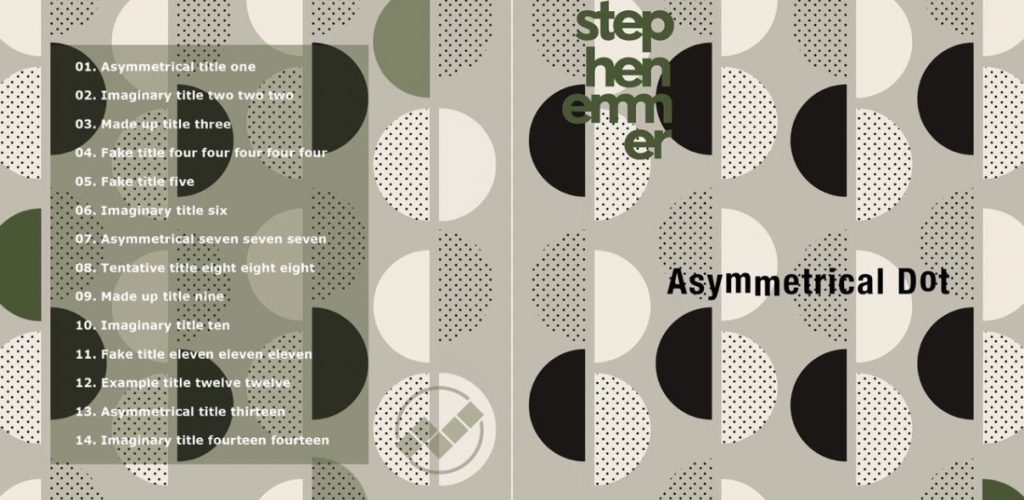
Hi everyone, it’s your host Faithfulness, and today I have with me Stephen Emmer from Amsterdam, Netherlands. Stephen Emmer is here to share more light about his expansive musical journey while diving into his latest original single, “Benja’s Birth,” a deeply personal composition inspired by life’s most intimate transitions. Released on February 27, 2026, this single forms part of his album “Asymmetrical Dot,” and arrives as a sonic reflection of both celebration and loss, shaped by the arrival of his grandson Benja and the passing of his mother. In Stephen Emmer’s words, “It’s the most personal soundtrack I could create to the cycle of life.” What does it mean for an artist to translate such contrasting emotional extremes into sound, and how does one sonically capture the beginning and end of life within a single creative vision? Let’s find out.
Welcome, Stephen Emmer. Before we begin our conversation, here is what you need to know about this remarkable composer and producer. Stephen Emmer is a genre-defying artist from Amsterdam known for his collaborative spirit and his fearless approach to blending cinematic, ambient, and orchestral influences into emotionally rich soundscapes. His work on “Benja’s Birth” sits within the larger framework of the album “Asymmetrical Dot,” mixed by Fernando Aponte and inspired by legendary figures such as Ryuichi Sakamoto, Ennio Morricone, Jóhann Jóhannsson, and Brian Eno. Released through Electric Fairytale Recordings, the project stands as a carefully constructed artistic statement that continues Emmer’s reputation for crafting music that exists at the intersection of storytelling and emotional reflection.

“Benja’s Birth” was born out of one of the most emotionally charged periods in Stephen Emmer’s life, where joy and grief coexisted in profound ways. The composition reflects the birth of his grandson Benja, a moment of renewal and hope, contrasted by the loss of his mother, a moment of deep reflection and farewell. Through this duality, Emmer explores the concept of the cycle of life, transforming personal experience into a universal sonic narrative. With its intricate blend of influences and emotionally grounded composition, the single stands as one of the most significant entries in his discography, offering listeners not just a piece of music, but a deeply human story told through sound.
Having this brief Introduction, I’m sure new and current fans must be excited about our Interview today.
INTERVIEW
Faithfulness: Stephen Emmer, your career has been defined by constant evolution and collaboration. Looking back, what would you say first pulled you into becoming a genre-defying composer rather than staying within a single musical lane?
Stephen Emmer: My mom was a dance teacher and as such she through these lessons gave me exposure to very diverse music: from Tchaikovsky to Jimi Hendrix, from Dave Brubeck via Miles Davis to The Beatles etc.
She was eclectic before that became a label!
Later on when I played in bands I often after a while got a little bored of always hearing those same three instruments being played in only a certain way. As a painter I wanted more colors to brush with. I also had more joy in composing than performing and I decided, against the industry grain, to lead an as much as possible varied musical life. I also agree with the saying by jazzman Duke Ellington: there are only two kinds of music: good music and not so good music. I second that emotion with all of my heart.
Faithfulness: You have worked across multiple artistic worlds and with diverse collaborators. How have these cross-cultural and cross-genre experiences shaped the way you now approach composing emotionally driven pieces?
Stephen Emmer: That I can now see and hear if a collaborator means what he or she is doing and if I can consequently feel it, and that’s more important I think than making it a preconceived affair.
And this truly works right through all genres, it’s kind of universal this way.
Faithfulness: Being based in Amsterdam, a city known for its rich artistic openness, how much of your environment influences the way you construct atmosphere and emotion in your music?
Stephen Emmer: The urban openness of mind surely helps. The melting pot of the population too. I think as a creator you carry all that psychological information deep and unknowingly in you and it can come when you express yourself through the music.
Faithfulness: Your work often carries cinematic qualities. At what point did you realize storytelling through sound was more powerful for you than traditional lyrical songwriting?
Stephen Emmer: I learnt this as for many years I made music for media such as film and TV and art installations and I started to realise autonomous sound can convey its own story by letting the listener draw its own visuals in the mind and this psychology I thought to be more powerful and magical at a certain point.
Faithfulness: Before we dive into the release, what personal or artistic principle has remained unchanged throughout your evolving musical journey?
Stephen Emmer: To never allow yourself to be comfortable in creating as the result mostly stays in the safety zone. I feel creation is ultimately about risk taking to progress and develop yourself further artistically.
Faithfulness: “Benja’s Birth” carries a deeply personal narrative. When you first began shaping this piece, did you set out to tell a story, or did the story reveal itself through the music?
Stephen Emmer: I set out to do so deliberately as I found an angle whereby I could structure the piece such that it simulates that period of nine months of growth and then finally: the arrival of the new baby on earth.

Faithfulness: The release is rooted in both joy and grief, marking the birth of your grandson and the passing of your mother. How did you balance these contrasting emotions without one overpowering the other sonically?
Stephen Emmer: By giving each event a separate piece with the relevant mood of joy and grief. Only when you listen to the whole album in one go you get a parade of mixed emotions.
Faithfulness: You’ve described this work as reflecting the cycle of life. How did you translate such an abstract and emotional concept into specific musical decisions like structure, pacing, and tone?
Stephen Emmer: To see how these emotions can literally shine through in your work is something I learned as a media composer where you have to learn to translate their intentions, ideas and emotional wishes into music. This time I could be my own ‘client’ and do this for myself 🙂
Faithfulness: The project draws inspiration from figures like Ryuichi Sakamoto, Ennio Morricone, Jóhann Jóhannsson, and Brian Eno. How did you ensure your own voice remained central while absorbing such strong influences?
Stephen Emmer: Good question. I think I did this by not literally copying or imitating their specific styles but rather learning from the techniques and the trademarks as the main characterizations of their music and then projecting that on my own taste and aesthetic musically speaking.
Faithfulness: With vocals recorded across Peru, Armenia, Portugal, and the USA, the process itself feels global. Did this geographical spread influence the emotional texture of the final piece in unexpected ways?
Stephen Emmer: Yeah but again only on an indirect level I think. Almost unconsciously the contributors brought their own cultural background and artistry with them through their performances. I do believe that is a hidden layer in a listening experience.
Faithfulness: The mix involved collaboration with Fernando Aponte, known for his work with Ryuichi Sakamoto. What did that collaboration bring out in the track that you might not have achieved alone?
Stephen Emmer: I am so busy composing that I tend to forget to put on priorities where the listener can focus too and this is exactly where Fernando is really good at: to help achieve clarity of the musical message and that felt very complimentary to my mindset.
Faithfulness: At what moment during production did you feel, “this is exactly what I needed to say with this piece,” if there was such a moment at all?
Stephen Emmer: I think that moment came when the structure finally mirrored the emotional arc I had envisioned from the beginning. It was less a sudden realization and more a gradual alignment where intention and sound met naturally and everything started to feel inevitable rather than constructed.
Faithfulness: You’ve mentioned the idea of “welcoming life” through music. What emotional response do you hope listeners experience when they hear this piece for the first time?
Stephen Emmer: That they somehow can relate to this universal theme we all experience sooner or later and then that it gives them comfort in their joy or grief.
Faithfulness: Looking ahead, you’re preparing for live performances with a touring band. How do you envision translating such an intimate and cinematic composition into a live experience?
Stephen Emmer: As what they now call small venues where it’s very intimate, where you can do deep listening. In Tokyo they actually now have deep listening bars! So it will be intense!
Faithfulness: Finally, when someone listens to “Benja’s Birth”, what truth about your life or philosophy do you hope remains clear within it?
Stephen Emmer: Panta rhei as the old Romans already said about this: everything flows and I’d like to add to this: let’s all join in this flow and don’t go against it. It’s better this way I think!
CHECK OUT THE RELEASE OF ‘Benja’s Birth’
HAVING LISTENED TO ‘Benja’s Birth’, HERE ARE MY HONEST THOUGHTS
Stephen Emmer’s “Benja’s Birth” is a restrained but emotionally loaded composition that succeeds more through texture than melody. It feels less like a traditional single and more like a personal reflection rendered in sound, and that choice works in its favor. The pacing is deliberately slow, but not empty; instead it creates space for the listener to absorb the emotional weight of its inspiration, from birth to loss. Instrumentally, the balance between piano, strings, woodwinds, and subtle electronics is handled with precision, giving the piece a cinematic depth without overstating any single element. While it avoids dramatic peaks, the restraint feels intentional rather than limiting, allowing the emotional narrative to unfold organically. As a listening experience, it lingers in a reflective space that feels honest, understated, and ultimately memorable in its quiet impact. Its strength lies in emotional honesty rather than complexity or excess. Very effective and immersive overall experience.
~ Faithfulness (Dulaxi Team)
Finally to our audience, I urge to listen to “Benja’s Birth“, add it to your playlist and be Inspired by it and on behalf of Dulaxi I like to appreciate you all by saying thank you everyone, See you on our next interview.
For more information about Stephen Emmer, click on the icons below.