
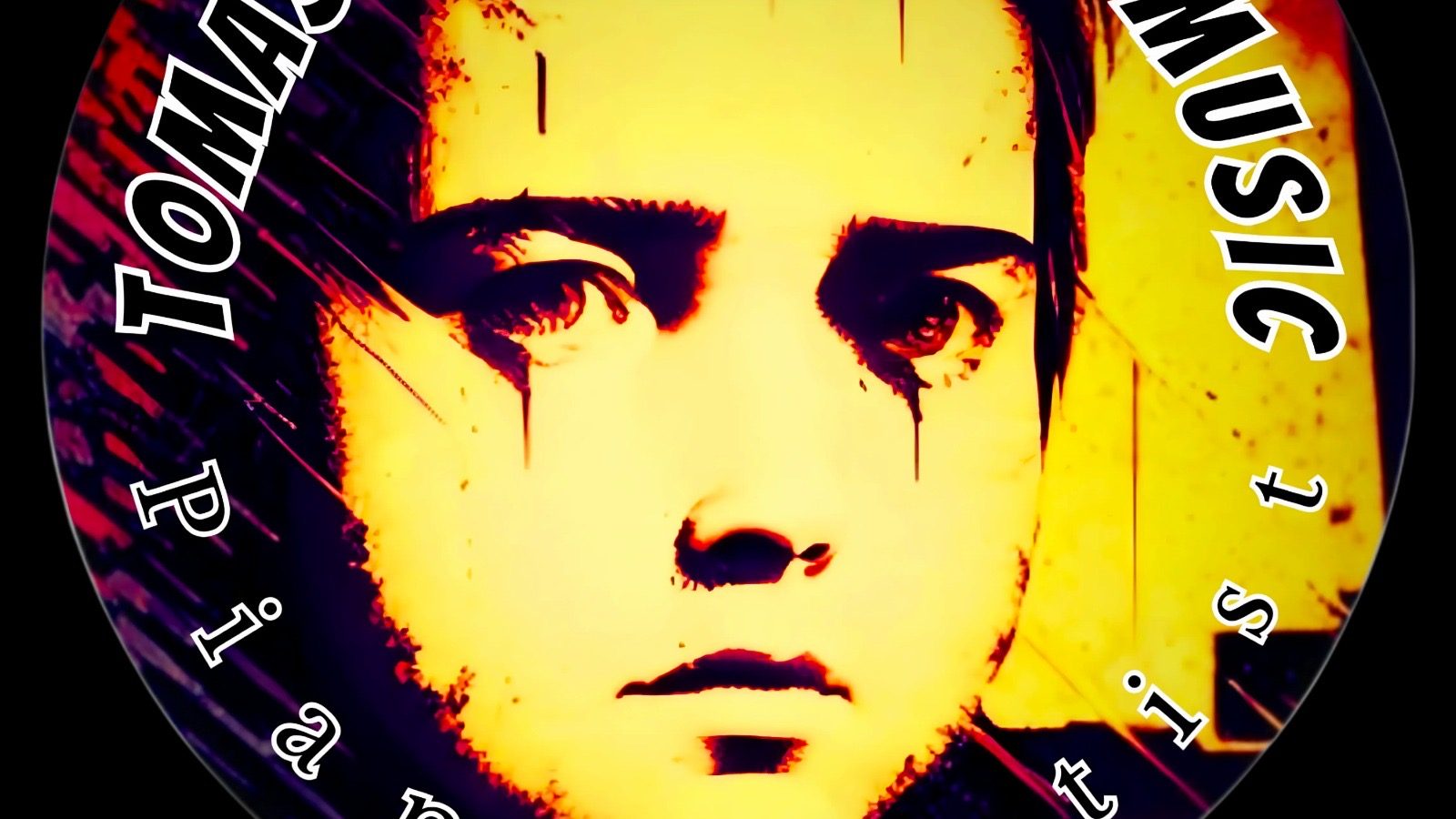
Hello everyone, it’s your host Faithfulness, and today I have with me Tomasz from Leszno, Poland. Tomasz is here to share insight into his expansive musical career while diving into his latest upcoming release, “Romanticism of Psychedelic Customs”. In Tomasz’s own artistic framing, his work reflects a deeply structured musical philosophy where polyphony becomes a living dialogue between voices, each line responding and evolving like celestial bodies within an integrated sonic universe. As listeners anticipate this release, one question naturally arises: how does Tomasz transform classical piano language into something that feels both modern, cinematic, and psychologically immersive?
Welcome, Tomasz. Before we begin, here is what you need to know about this remarkable artist. Tomasz is a prolific Polish composer, virtuoso pianist, poet, and published author of four art books, with over 30 albums released since 2018 across piano, vocal, cinematic, and electronic genres. His music has reached global audiences through social platforms, where listeners from all backgrounds connect with his distinctive timbres and expressive clarity, while his works are performed and studied internationally. His reach extends beyond recordings into performance, with concert appearances across England, Germany, and Poland, alongside broadcast features and repeated recognition from international media platforms such as Movingclassics.tv, which has named him “composer of the week” on multiple occasions.
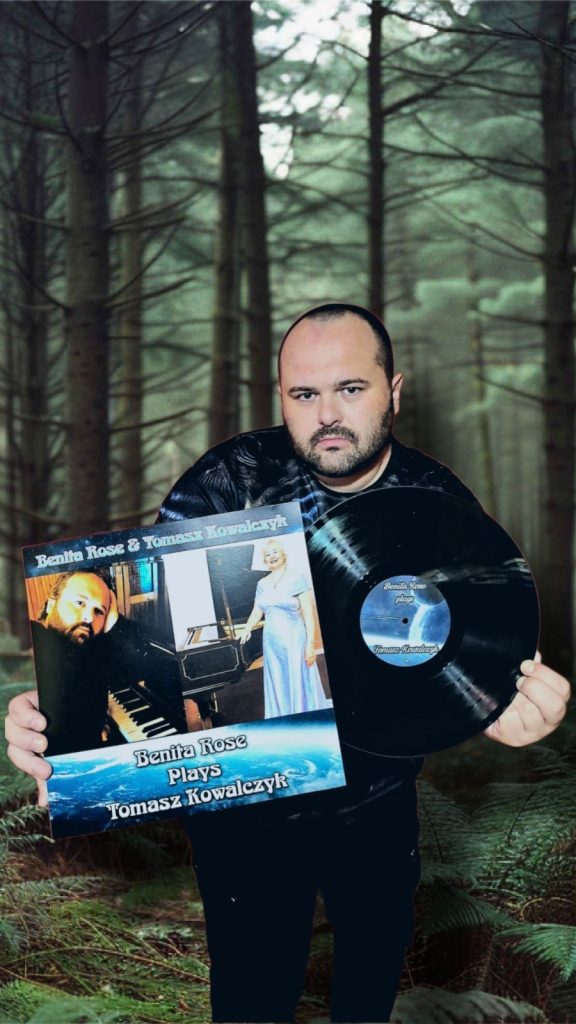
Tomasz continues to expand his artistic footprint through both solo and collaborative work, including interdisciplinary performances with visual artist Maciej Ciszek, where sound and painting merge into immersive live experiences. His compositional approach is often described through the lens of structured dialogue, where musical lines interact with one another in constant transformation rather than static repetition. This evolving artistic identity has also attracted the attention of internationally acclaimed pianist Benita Rose, whose upcoming 2026 world tour will feature Kowalczyk’s works, further amplifying his presence on the global classical stage. Together, these developments position “Romanticism of Psychedelic Customs” as part of a larger creative continuum, one that reflects both philosophical depth and a constantly expanding musical universe.
INTERVIEW
Faithfulness: Tomasz, you have built an extraordinary artistic career as a composer, pianist, poet, and author. Looking back to the beginning of your creative journey, what first inspired you to express yourself through so many different artistic forms?
Tomasz: Sound came first, as the entire universe is crystallized waves. For as long as I can remember, I have synesthetically nourished myself with melodies and harmonies that brought me euphoric and psychonautical joy. Words came later, as they had to be learned, but I also perceive them with the same energy; I hear their melody, harmony, and phrasing of meaning.
Faithfulness: Since 2018, you have released more than thirty albums spanning piano, vocal, film, and electronic music. What has driven such a remarkably prolific period of creativity, and how do you continue finding new ideas to explore?
Tomasz: These are compositions immortalized during this period, but which have been created throughout my life, etched in my heart and soul. I carry my works, locked within me as if in a piggy bank from which notes escape. For me, time is nourishment and fulfillment for art. While I wait, art grows within me, only to emerge at the end, like a previously undiscovered galaxy.
Faithfulness: Your music has reached listeners around the world through both live performances and social media. What has it been like watching your work connect with audiences from so many different cultures and backgrounds?
Tomasz: I feel wonderful that my audience is made up of people who love electronic music, film music, and vocal music. But I also greatly appreciate pianists, having met Benita Rose—a world-class and renowned pianist—who performs my music all over the world. It’s an indescribable feeling. I feel like a stars collector or a pearl diver.
Faithfulness: As someone who regularly balances composition and performance, do you feel most at home creating music in solitude or bringing it to life in front of an audience?
Tomasz: Lately, I’ve been focusing on working from home, writing down all my compositions in sheet music, and I’ve accumulated about 200. However, it’s only in front of an audience that I truly feel alive. I love the excitement of live performances; I always prepare for them thoroughly, not only to present my compositions as written, but also to use the opportunities afforded by time and improvisation to converse with the audience through sound.
Faithfulness: You have collaborated with visual artists, appeared on television, and earned recognition from respected musicians and critics. Which moments in your career have felt especially meaningful or transformative for you personally?
Tomasz: A turning point was definitely meeting Mr. Marek Sierocki, who presented my work on Poland’s largest television station, TVP. But also meeting Maciej Ciszek and Marcin Pawlak, with whom I’ve been collaborating for four years. Maciej Ciszek is a visual genius, while Marcin is a computer graphics and animation genius. Together, we understand each other perfectly—we experience the world in a very similar way. I consider us an incredible trio.
Faithfulness: Your latest video, “Romanticism of Psychedelic Customs”, carries a title that immediately sparks curiosity. What story, philosophy, or emotional landscape inspired this work?
Tomasz: The piece was written in February 2025 – during the Polish early spring. Polish early spring is a special time in Poland – it’s not yet associated with birds chirping or greenery – quite the opposite. Nature, steeped in winter depression, awakens from its slumber, people commit suicide at this time, people seek respite that can’t be found, so essentially, they live in a madness of hope. This is precisely psychedelic romanticism – tenderness and love that has no escape, is closed in on itself, trying to end itself. This piece is very special to me, as I experience this time of year in Poland drastically. Most of all, I’d like to escape to warm countries in February or March and do nothing. However, it’s impossible to abandon one’s responsibilities.
Faithfulness: The descriptions of your music often speak about polyphony, self-dialogue, and voices interacting within a larger musical universe. How do those concepts reveal themselves in “Romanticism of Psychedelic Customs”?
Tomasz: Entering the music theory and analysis of my piece, I would have to write an essay at this point. The piece is simultaneously polyphonic—meaning the equivalence of sounds, polytonal—where different keys overlap, and I would call it quasi-homophonic—where the melody forms the “most important” layer—although this is only a kind of illusion. In other words, I have encompassed the musical possibilities of many eras in this piece. Baroque polyphony, Romantic cantilena, and 20th-century atonalism/polytonality.
Faithfulness: Benita Rose has written extensively about the emotional depth and unique sonic colors found in your compositions. How does it feel to have an internationally acclaimed pianist interpret and champion your music in such a passionate way?
Tomasz: I consider the love for my music and Benita Rose’s interpretation of my music a miracle—especially considering that people today are “only” in love with Chopin. Benita demonstrates how deeply one can reach into the subconscious and superconscious through piano playing. Her interpretations are unique and incredible. She can find in one piece “a mother’s overprotectiveness towards a child who matures too quickly,” and in another, find and play a sentimental connection to the things we have destroyed as humanity. Benita’s playing is as close to my heart as Horowitz’s or Pletnev’s. It’s an old-school style that pays attention not only to the smallest detail but, most importantly, to the spirit of the music and its vitality.
Faithfulness: This release is presented as a video rather than solely an audio recording. What role does the visual element play in helping audiences fully experience the piece?
Tomasz: The video for this track—directed by Marcin Pawlak—reveals the psychedelic romanticism of our times. These images capture beauty and uniqueness, entangled and stifled by the toils of consumerism and the pursuit of money. We love nature, yet we allow it to be destroyed; we speak much of love, yet we suppress it in our hearts; we want to colonize other planets, yet we fail to care for our own. It is this psychedelic romanticism that is leading us to the collapse of civilization.
Faithfulness: There is a strong sense of imagination and symbolism surrounding your work. Were there any particular images, memories, literary influences, or artistic ideas that guided the creative process behind this release?
Tomasz: Yes. My music is neo-symbolic and neo-fauvism, but not exclusively so. I’m a lover of art history and literature. I love the monochromatic paintings of Rembrandt, Goya, Dante, and Marcel Proust. I spent a large part of my life immersed in books, while others were wasting their time playing. I’m a huge fan of Hieronymus Bosch and Ferdynand Ruszczyc. The list goes on and on—literature and painting are a huge and very important part of my life.
Faithfulness: Many listeners describe your music as balancing darkness and light, tension and hope. Was achieving that emotional contrast important to the identity of “Romanticism of Psychedelic Customs”?
Tomasz: The song’s duality is very noticeable. The middle section introduces one to nirvana and the conviction that everything will be alright. The two surrounding sections are the opposite – they speak of the fact that without effort, we achieve nothing. Of course, I’m summarizing everything here briefly. In reality, darkness and light are our superiors; they guide us, ensuring that we find ourselves in the right place. And tension and hope, as I mentioned earlier, are the only things we’ve been given to serve as a compass for cosmogony.
Faithfulness: Having explored such a wide range of musical styles throughout your career, what aspects of your artistic voice do you feel this release captures particularly well?
Tomasz: This is a collection of songs selected by Benita’s wonderful ear. I identify with all of them perfectly. Some songs are from last year, others from 10 years ago – but in all of them I am myself, showing my heart and soul.
Faithfulness: For someone discovering your music for the very first time through “Romanticism of Psychedelic Custom”, what do you hope they take away from the experience once the final note and image have faded?
Tomasz: That we create the future of music by transforming the most important lessons of past masters and geniuses into the present. Only this allows us to discover our own musical language, and thus create previously undiscovered forms and textures. That true music only comes into being when it sings of what the Universe whispers in its ear.
Faithfulness: Looking ahead, are there any creative projects, collaborations, or musical directions that you’re especially excited to pursue in the coming months?
Tomasz: Benita and I are focused on her world tour, during which she’s playing my compositions and also lecturing them to professional musicians. As I’ve already mentioned, I’m writing down the scores for the next few compositions myself. We’re also collecting and preparing for the release of our second album.
Faithfulness: Finally, after everything you’ve achieved as a composer, performer, and artist, what continues to inspire you to sit at the piano and create something new?
Tomasz: Marcus Tullius Cicero said, “If you have a garden and a library, you have everything you need”—and having a piano is simply beyond the pale of happiness. In my free time, I grow herbs, enjoy nature, love cooking, meeting wonderful new people, and spending time listening to undiscovered or little-heard music, like those by Medtner, Moszkowski, or Bortkiewicz.
CHECK OUT THE RELEASE OF ‘Romanticism of Psychedelic Customs’
HAVING LISTENED TO ‘Romanticism of Psychedelic Customs’, HERE ARE MY HONEST THOUGHTS
“Romanticism of Psychedelic Customs” is a bold collaboration between composer Tomasz and pianist Benita Rose that fuses Romantic expressivity with avant-garde abstraction. The piano functions as both narrator and atmospheric force, drifting through suspended tonal centers and shifting harmonic landscapes. Kowalczyk avoids traditional resolution, instead crafting fluid textures where notes seem to dissolve into memory and unstable perception. Rose delivers a refined interpretation, balancing precision with emotional ambiguity while revealing the piece’s hidden architecture through nuanced touch and micro-dynamic control. Directed visually by Marcin Pawlak, the performance is framed in immersive sound imagery that emphasizes resonance, decay, and spatial depth. The work ultimately reimagines Romanticism as a living, psychedelic language of sensation, thought, and introspective listening experience. Across its evolving sound world, it invites listeners into deeply personal, reflective engagement experience.
~ Faithfulness (Dulaxi Team)
Finally to our audience, I urge to listen to “Romanticism of Psychedelic Customs”, add it to your playlist and be Inspired by it and on behalf of Dulaxi I like to appreciate you all by saying thank you everyone, See you on our next interview.
For more information about Tomasz, click on the icons below.