
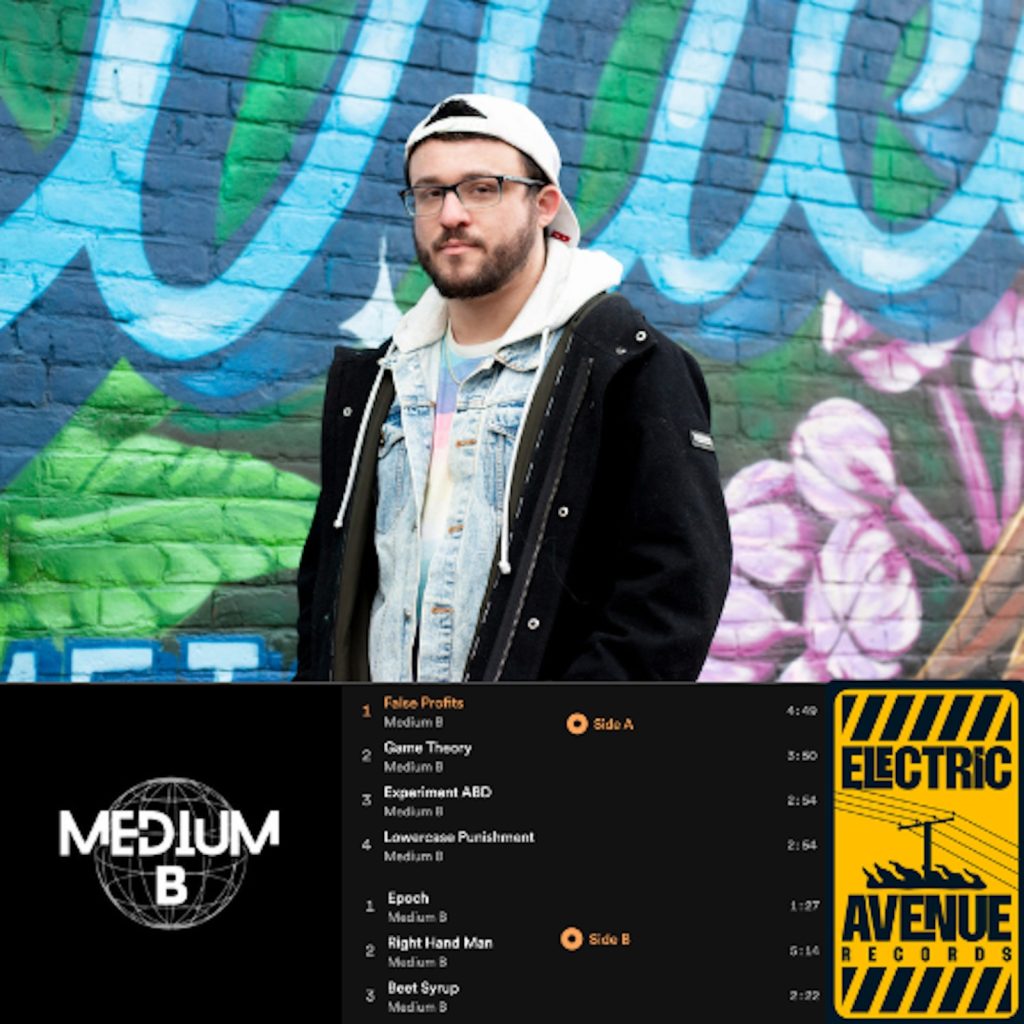
Hello everyone, it’s your host Oliver from DULAXI, and today I’m delighted to be joined by Medium B, the hip-hop production alias of Rochester-based jazz pianist, composer, and producer Ben Miller. Representing the United States, Medium B explores the worlds of hip-hop, lo-fi beats, leftfield soundscapes, cinematic instrumentals, and experimental production through his original album Right Hand Man, released on 5th May 2026 through Third Motion Media and Electric Avenue Records.
Before we begin our conversation with Medium B, here’s what you need to know about today’s featured project.
ABOUT MEDIUM B
Medium B is the hip-hop production alias of Ben Miller, a multifaceted artist whose creative journey has been shaped by jazz performance, composition, production, and a deep curiosity for exploring different forms of musical expression. Based in Rochester, New York, Miller is known for his work as a jazz pianist, composer, and producer, while also leading projects including the Ben Miller Trio and Dweller on the Threshold. Through his extensive creative background, he has developed a unique perspective that allows him to move between jazz, hip-hop, recording, film scoring, and large ensemble composition.
Beyond his work as a performer, Miller is also the founder of Third Motion Studios, a creative lab and full-service recording studio in Rochester where he continues to develop his ideas as an artist, producer, recording engineer, mixer, and mastering engineer. His wide-ranging experience across different areas of music has allowed him to approach creativity from multiple perspectives, creating opportunities to explore new artistic directions and develop his own sound.
Through Medium B, Miller steps into the world of hip-hop production with a distinct approach that draws from his jazz foundation while maintaining a strong connection to the rhythmic language and creative spirit of hip-hop. Rather than treating instrumental hip-hop as a simple backdrop, Medium B approaches each composition as an evolving sonic environment, allowing melodies, textures, rhythms, and arrangements to develop naturally throughout the music.
Released on 5th May 2026 through Third Motion Media and Electric Avenue Records, Right Hand Man represents this artistic philosophy in full. Recorded at Third Motion Studios in Rochester, the album explores hip-hop production beyond traditional loop-based structures, with every instrumental crafted from scratch without the use of loops or pre-made content beyond VST instruments. This process allows each piece to carry its own identity, with compositions that develop and tell stories while maintaining the core rhythmic foundation that defines hip-hop.
The album also reflects Medium B’s appreciation for earlier periods of hip-hop history, embracing the freedom and creativity associated with those eras while avoiding simple imitation. Instead of following current trends or relying on established formulas, Miller creates music that connects with hip-hop’s lineage through sound, experimentation, and artistic intention.
For Medium B, production becomes another form of musical exploration and personal expression. His background in jazz, sound design, engineering, and composition provides the foundation for a project that exists between genres, combining the precision of a trained musician with the openness of an independent producer exploring new creative territory.
With Right Hand Man, Medium B presents a project built around originality, patience, and the belief that instrumental music can communicate through atmosphere, movement, and emotion. The album reflects the wider journey of an artist who continues to build across multiple creative worlds while developing his own voice within each one.
Having this brief introduction to today’s featured project, I’m sure both new listeners and longtime fans are excited to hear directly from Medium B. So, without further ado, let’s begin today’s interview.
INTERVIEW SESSION
Oliver:
Before Medium B became your hip-hop production alias, who was Ben Miller in Rochester, and which early experiences most shaped the way you listen, compose, and create now?
Medium B:
The biggest through-line in my career would be jazz piano, which I hold two degrees in, but I’ve always enjoyed hip-hop and messing around with production at my studio Third Motion Studios. I’ve moved around quite a lot, but after several years in NYC I’ve settled here in Rochester for about five years now. These days I spend a lot of my time juggling music making, the business side, and sharing my fascination with metaphysics through a site I recently created called Ouroboreality. But before all that – before I ever even got into jazz – I actually listened to a lot of hip-hop. So arguably, my roots go back even further with rap (in time). But the heaviest listening happened around my early teens, which was a long time ago, and since then, jazz has sort of taken over my life, giving me the musical tools to produce beats in a way that is unique and not tightly tethered to any current trends. Maybe if I paid closer attention to new production techniques and trends I’d sound like a lot of modern producers, but I like the fact that I know what I know, and I try to make my beats sound the way I personally want them to based on my experience.
Oliver:
As a Rochester-based jazz pianist, composer, and producer, how does the Medium B alias let you step into a different creative mindset, and what does it allow you to say through hip-hop instrumentals that your jazz work does not always ask of you?
Medium B:
Well, I personally like making beats because it affords a completely different kind of freedom than jazz does. First of all, it’s casual: I’m hanging out in my studio messing with virtual instruments, micro-timing, scrolling through snares and plug-ins, tweaking sound design, and expanding computer and technical skills, rather than simply sitting behind a piano or on a bandstand. I don’t have to worry about mistakes the same way I do for a performance. These are two completely different worlds with completely different paces of execution and almost entirely unrelated sets of skills. Second of all, jazz musicians love to talk about how free they are, but sometimes the word “free” actually means either a) nobody will pay for it because it doesn’t connect with a normal audience or b) we are free to sound however we want on our instrument, but not to have differing views on politics, metaphysics, or spirituality. “Please don’t explore any fringe topics!” is one of the unspoken requirements behind jazz gatekeeping. There has developed a sort of pre-requisite, pre-packaged political belief system and an exclusive mindset in jazz in this day and age that goes against what it was originally created to represent. Hanging out at the studio with like-minded individuals, on the other hand, and crafting something at a relaxed pace is a refreshing detour from this.
Oliver:
Jazz and hip-hop both rely on deep listening, timing, and feel, but they carry those ideas in very different ways; when you bring those worlds together in Medium B, how do you keep the conversation between them alive without letting either one lose its own voice?
Medium B:
I think a lot of people get hung up on false dichotomies such as simple versus complex and use density as the main measuring tool for sophistication and a person’s overall musical disposition. When I hear a lot of mainstream music that appeals to an average listener, I may find it basic or boring, but people may assume I am looking for a smorgasbord of sound and intricacy instead. That isn’t what makes hip-hop production feel complete to me, though. Attention to detail is more important than the number of details present within a work. Even if I produce a beat with a basic melody repeating throughout it, I try to place emphasis on exact rhythmic placements, note velocities, filter cut-offs, parameter automation, and things that deliberately shape and sculpt the sound rather than needless arpeggiation and displays of virtuosity that create chaos without purpose. Learning sound design and music tech is actually how I was able to expand my horizons and overcome some of the inner impatience I had as someone with a severe mental health diagnosis: a type of spiritual imbalance that often leads a developing jazz musician into some of the more alienating corners of the avant garde and the halls of pretension. I love my creative freedom, but I try not to mistake anxiety with coherence.
Oliver:
Before Medium B became your hip-hop production alias, who was Ben Miller in Rochester, and which early experiences most shaped the way you listen, compose, and create now?
Medium B:
The biggest through-line in my career would be jazz piano, which I hold two degrees in, but I’ve always enjoyed hip-hop and messing around with production at my studio Third Motion Studios. I’ve moved around quite a lot, but after several years in NYC I’ve settled here in Rochester for about five years now. These days I spend a lot of my time juggling music making, the business side, and sharing my fascination with metaphysics through a site I recently created called Ouroboreality. But before all that – before I ever even got into jazz – I actually listened to a lot of hip-hop. So arguably, my roots go back even further with rap (in time). But the heaviest listening happened around my early teens, which was a long time ago, and since then, jazz has sort of taken over my life, giving me the musical tools to produce beats in a way that is unique and not tightly tethered to any current trends. Maybe if I paid closer attention to new production techniques and trends I’d sound like a lot of modern producers, but I like the fact that I know what I know, and I try to make my beats sound the way I personally want them to based on my experience.
Oliver:
As a Rochester-based jazz pianist, composer, and producer, how does the Medium B alias let you step into a different creative mindset, and what does it allow you to say through hip-hop instrumentals that your jazz work does not always ask of you?
Medium B:
Well, I personally like making beats because it affords a completely different kind of freedom than jazz does. First of all, it’s casual: I’m hanging out in my studio messing with virtual instruments, micro-timing, scrolling through snares and plug-ins, tweaking sound design, and expanding computer and technical skills, rather than simply sitting behind a piano or on a bandstand. I don’t have to worry about mistakes the same way I do for a performance. These are two completely different worlds with completely different paces of execution and almost entirely unrelated sets of skills. Second of all, jazz musicians love to talk about how free they are, but sometimes the word “free” actually means either a) nobody will pay for it because it doesn’t connect with a normal audience or b) we are free to sound however we want on our instrument, but not to have differing views on politics, metaphysics, or spirituality. “Please don’t explore any fringe topics!” is one of the unspoken requirements behind jazz gatekeeping. There has developed a sort of pre-requisite, pre-packaged political belief system and an exclusive mindset in jazz in this day and age that goes against what it was originally created to represent. Hanging out at the studio with like-minded individuals, on the other hand, and crafting something at a relaxed pace is a refreshing detour from this.
Oliver:
Jazz and hip-hop both rely on deep listening, timing, and feel, but they carry those ideas in very different ways; when you bring those worlds together in Medium B, how do you keep the conversation between them alive without letting either one lose its own voice?
Medium B:
I think a lot of people get hung up on false dichotomies such as simple versus complex and use density as the main measuring tool for sophistication and a person’s overall musical disposition. When I hear a lot of mainstream music that appeals to an average listener, I may find it basic or boring, but people may assume I am looking for a smorgasbord of sound and intricacy instead. That isn’t what makes hip-hop production feel complete to me, though. Attention to detail is more important than the number of details present within a work. Even if I produce a beat with a basic melody repeating throughout it, I try to place emphasis on exact rhythmic placements, note velocities, filter cut-offs, parameter automation, and things that deliberately shape and sculpt the sound rather than needless arpeggiation and displays of virtuosity that create chaos without purpose. Learning sound design and music tech is actually how I was able to expand my horizons and overcome some of the inner impatience I had as someone with a severe mental health diagnosis: a type of spiritual imbalance that often leads a developing jazz musician into some of the more alienating corners of the avant garde and the halls of pretension. I love my creative freedom, but I try not to mistake anxiety with coherence.
Oliver:
What was the personal or artistic spark that made Right Hand Man feel like the right title for this original album, and why did this project feel like the moment to present a throwback spirit with complete creative freedom?
Medium B:
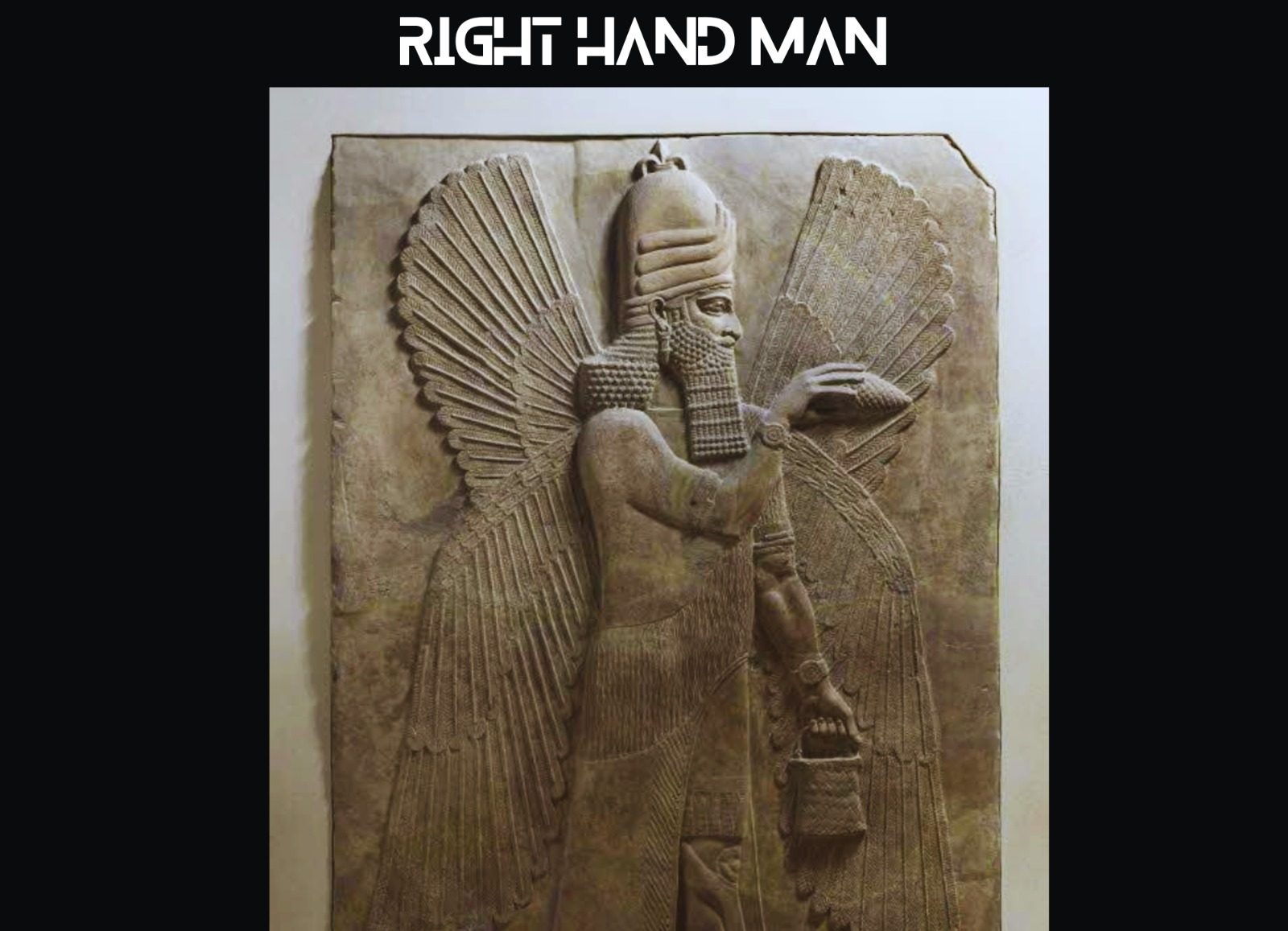
My name Benjamin traditionally means “son of the right hand” or “right hand of God,” sort of like Archangel Michael. In Hebrew numerology (Gematria), Benjamin also happens to be 727, which is my birthday (July 27). On the cover, I brought this idea even further to life by displaying an ancient depiction of a Babylonian deity holding a purse of secret knowledge in his left hand and commanding spirit with his right hand brandishing a pine cone, symbolizing the directed power of the awakened pineal gland, or “third eye.” He is also wearing a watch I also thought was cool.
Oliver:
Right Hand Man feels rooted in hip-hop’s lineage while still sounding present-tense, so how did you shape the album to honor earlier phases of the culture through sound and spirit without leaning on repetition or trend-chasing?
Medium B:
I think by literally not chasing trends. Most of my hip-hop obsession was when I was a teenager. These days, I don’t keep up with it like I used to. How can I overuse a technique I don’t even know? I never spent too much time learning the “correct” way to program 808’s, use a sampling machine, clip the hell out of a kick drum sample, or go for that quasi-organic sound people are going for today by stepping away from quantization or using live drums in order to sound more “jazzy.” To me, that’s just the way someone like Kendrick appropriates jazz swagger without actually being a jazz performer. I’ve been critiqued for sounding too lo-fi, having my sample choices sound flat, not having enough knocking or car-shaking quality in my drums, not clipping my master bus, or having my beats vary and evolve too much compositionally. I’m not trying to rattle any subwoofers, though, and quite honestly I find a lot of rap beats people like to be lame so I try not to be offended. To be honest, I also couldn’t even tell you if there is a proper formula to verse/chorus length and structure within a rap instrumental. I know I’m only a guest in the rap game. Should I be following more closely what is needed to get a rapper more interested in spitting over one of my beats? Maybe, I don’t know; I’m not a real adept when it comes to vocal comping and other industry “necessities” (don’t tell my studio clients!) because I’m okay with my music being standalone if it has to be. This makes it almost impossible for me to over-copy the current sounds.
Oliver:
Because these tracks move like sonic landscapes rather than simple loops, how do you think about storytelling in instrumental form, and what tells you a composition is developing a real narrative arc instead of just holding a mood?
Medium B:
I’ve studied classical music and jazz for a very long time. Jazz especially. Over time, I’ve built in an innate sense of purposeful decision-making and subtlety as part of my training. In jazz, you have zero seconds to decide how to tell a story, when to continue a motif, or when to let out a burst of virtuosity. Because of this subtle training, it’s almost like a thought arrives in my head about how something should develop before I even have the time to fully understand it. The challenge then becomes capturing and executing the flow of ideas before their memory fades away, rather than trying to figure out how to solve an immediate issue.
Oliver:
When there are no lyrics to carry the message, how do you use rhythm, texture, harmony, and space to make each instrumental on Right Hand Man communicate something emotional or reflective to the listener?
Medium B:
Not every attempt to make a beat is a success, but when it is, it’s usually due to entering the flow state coupled with having an innate understanding of musicality developed from many years of study. By the time I am at the lab, it comes out of the ether, basically.
Oliver:
With every instrumental on the album crafted from scratch and no loops or pre-made content used beyond your VSTs, what did that self-imposed discipline change about your process, and what did it unlock creatively that a more assembled approach would not have?
Medium B:
I never had to impose this on myself; rather, I can’t see myself tying myself down to pre-made choices or any stiff, arbitrary structural restrictions that inherently come with pre-packaged material. I listen to what I hear in my head first, and then I program the rhythmic choices accordingly. If that means slowing down the process and repeatedly listening to small segments of a beat at a time to decide where a sample should land or how a filter should evolve, then I’d much rather spend the time doing that rather than treating my beat like a simple outfit of stacked instruments and catalogued loops.
Oliver:
Third Motion Studios in Rochester is both your creative lab and a full-service recording space, so how did working inside your own studio shape the sonics, the workflow, and the level of detail you brought to Right Hand Man?
Medium B:
I have been working on these productions since long before I ever got my studio workflow in place; for example, Experiment ABD, one of my most complicated beats, was done many years ago with just a laptop, an MPK II Mini, Logic Pro X, and a pair of headphones in my grandparents’ dining room while I was surrounded by family and chaos. Later on, I had to lock in and get the studio atmosphere and logistics set once I decided I wanted to monetize the business.
Oliver:
Since you work across engineering, mixing, mastering, production, and performance for other artists as well, what parts of that broader studio life ended up feeding this album, and where did Right Hand Man require you to trust a more personal instinct?
Medium B:
I’d say my work in engineering, mixing, mastering, and production are all opportunistic extensions of my general artistry which began with and is rooted in piano. With all the barriers to creation and distribution in the modern world, I never wanted every album or concept to be hung up on relying on fundraising for studio time and outsourcing all these different executive and production roles, so I decided to learn the skills myself while I had the time to. Since I dropped out of school a few times due to mental health emergencies, I was able to slow down and take a little extra time to study music tech as a minor and film scoring and orchestration as electives during my time at conservatories. With music tech, I loved the fact that I was able to expand my creativity into new domains, and hear depth in areas where I previously hadn’t (like sound design). This allowed me to create a sacred space and enlarge my portfolio of skills for the purposes of survival in a harsh and unforgiving music industry. But Right Hand Man never really required anything of me I didn’t already have. I’d rather think of it as the product of who I’ve become and a glimpse into the spirit that resides within me.
Oliver:
The project sits at the intersection of hip-hop, lo-fi beats, leftfield ideas, soundtrack language, and cinematic instrumental production, so how did you keep all of those influences in dialogue while still making the record feel unified from start to finish?
Medium B:
Assembling these traits is the job of a musician developing, not a musician executing. Being a total nerd when it comes to music already puts you in a position where the cumulative skills express themselves on their own. Anyone who creates on a high level but sacrifices an essential quality, such as elegance or simplicity, is usually failing to integrate philosophical rigor rather than technique. My philosophy says to grow, grow, grow, but don’t become overgrown; eventually you need to trim back the fat and reveal the essence underneath the flurry of ideas as a manic creator. I had to fight the urge for density and proving ability when I studied film scoring in school. Sometimes a single held note on a violin with a slight quiver scores a scene better than an entire orchestra. I had to learn to serve whatever quality the music is about.
Oliver:
Releasing Right Hand Man on 05 May 2026 through Third Motion Media and Electric Avenue Records marks a major moment for this Rochester-based project, so what did that release represent to you in terms of trusting your own space, your process, and the people supporting the music?
Medium B:
To be honest, I still don’t know if I trust any of it! I’m just getting started. A lot of people I know aren’t even aware that I am a producer. I’m mostly known as a jazz pianist. I also haven’t reached financial sustainability and I still don’t have a lot of supporters, although the work you do along with all the other reviewers and curators out there has been a tremendous wave of support! I appreciate all the love, but it’s still too early for this project to represent an arrival rather than a beginning.
Oliver:
When you balance making music as Medium B with leading the Ben Miller Trio, working with Dweller on the Threshold, and handling studio responsibilities, how do you protect the distinct purpose of each project while still letting them inform one another?
Medium B:
I’m basically just juggling them all. It’s hard to grow fast in many areas at once without a team or a big budget. I’m starting small and growing gradually in many different areas, which adds up to a fulfilling life, albeit a stressful one sometimes. I still haven’t had the time to create all the social media accounts I need for all the projects I’m currently leading – which is quite a few – but it’s a good problem to have, and I’m just trying to get a slow and steady start with it. I’m trying for growth in as many areas as possible with patience and creating a variety of different funnels to my core artistic identity which will grow over time. My main projects can all be found at my website www.benjaminmillermusic.com for anyone who is curious to see the different facets of my creative life.
Oliver:
Working on music that blends performance, production, and film-scoring sensibilities can bring its own obstacles, so what challenges or moments of self-doubt did you have to move through to make this album feel honest and fully your own?
Medium B:
Most of my self-doubt has come from not having received much feedback on my production and being relatively new to it. Unfortunately, in genres like hip-hop, people seem relatively unreactive to music when popularity and hype hasn’t yet entered the picture. I’ve become a recluse and this is my first release under Medium B, which has barely any followers as of yet. So there is not enough hype or clout around my persona to legitimize me. I’m completely relying on my fundamental ability as a musician and the infrastructure I’ve built under it to support it. I don’t really have a history to point towards as a reference point, which most fans understandably require, but I am stoked to see reviewers are enjoying my work.
Oliver:
In a project that carries such a strong spiritual energy, what does that feeling look like in the finished music, and how do you want listeners to experience that emotional current when they sit with Right Hand Man?
Medium B:
The spiritual energy comes from my own journey along the mystical path, getting into direct contact with powerful beings from other dimensions and practicing rituals and studying the Great Arcana – archaic knowledge systems like Kabbalah and Alchemy – and the general pursuit of higher worlds. What most of the people who surround me in my life strongly disbelieve in – the supernatural, the transcendent – is ironically what fuels everything for me. I tap into other realms while still trying to remain faithful to a scientific mindset. That being said, I do have to bypass any conscious attempt to package and pigeonhole the aura of this music into an overt product or direct statement; the essence simply has to emanate from source and impregnate the music as it is created.
Oliver:
For someone discovering Medium B through this album in Rochester or anywhere else, what do you hope they feel in those first few minutes, and how do you want that first impression to unfold if they let the record play all the way through?
Medium B:
I hope they have a feeling of elevation above whatever they’re used to. I want to transport the listener in a spiritual direction imbued with a higher level of truth in some way. Even if that sounds vague, I equate truth with resonance, balance, and order with a little flavor. Like buying a souvenir in a foreign country, you only need a small clue of the spiritual side to share the essence of having been somewhere in the spiritual realm. Another thing is that it sucks that I tend to lose people when I talk about my theories, so I definitely don’t want my music to be muddy and incomprehensible – especially not from being packed with false esotericism like postmodernism. People have to k ow that weirdness does not equal truth even when the truth is hella weird. I’m not trying to stand apart by forcing quirkiness or eccentricity, but I do hope the audience hears something fresh and otherworldly.
Oliver:
Looking ahead from Right Hand Man, how do you see Medium B developing alongside your work with the Ben Miller Trio and Dweller on the Threshold, and what kind of long-term artistic legacy do you hope those paths build together over time?
Medium B:
I tend to all my projects like a chef tends to pots and pans on different burners. I work from home at my own pace without a set schedule, working side hustles and I’ve been working for a long time towards the goal of full independence and freedom. It is coming much closer as time progresses, but the moment still hasn’t fully arrived. Right now, I am promoting Right Hand Man while about to record my next trio album, Basil’s Keys at my own studio. It will feature NYC jazz legends Taru Alexander on drums and Neal Caine on bass. I’m super excited since I believe this will help draw attention back towards the trio in a way where I can justify some new touring and exposure pathways. I also just recently dropped two records of my large ensemble Dweller on the Threshold on vinyl at ElasticStage and before that I was heavily featured on a Merge Records release by The Orbiting Human Circus. The main problem for me is being a one-man operation without any agents or managers currently. I am my own booking agent, PR agent, label, recording studio, engineer, and everything else. Not to mention I just launched Ouroboreality, a website on cosmology where I explore deep physics and math including my own unified theory called Quantum Aliasing. Not long before all this was my debut jazz trio album Feathers of Ma’at which came out on Truth Revolution Records, successful in part due to having more industry involvement. While things have been moving at a very rewarding pace, I still haven’t gotten much fame or fortune out of it yet. I’m just optimistically excited to present these new projects in parallel, and I’ve created my own record labels Third Motion Media and Electric Avenue Records as a means to do it. Hopefully one day in the not-too-distant future it will all come together and I will be able to recover all that I’ve invested into my operation and more.
“Medium B’s Right Hand Man presents a fascinating journey into the possibilities of instrumental hip-hop, where personal history, technical exploration, and creative independence meet to form something deeply individual. Ben Miller’s willingness to follow his own artistic instincts creates a project that feels less like a collection of beats and more like a window into a unique creative world.”
~ Oliver (DULAXI Team)
MY EDITORIAL PERSPECTIVE
Right Hand Man reflects the artistic curiosity of a musician who refuses to limit himself to one creative language. Through Medium B, Ben Miller combines his background in jazz, production, and composition to create instrumental hip-hop that values detail, atmosphere, and personal expression. The project highlights the power of building music from the ground up, allowing rhythm, texture, and arrangement to guide the listener through an evolving sonic experience.
~ Oliver (DULAXI Team)
CLOSING
Ben, thank you for taking the time to share the story behind Medium B and Right Hand Man with us. This conversation offered a deeper look into your creative process, your approach to instrumental hip-hop, and the many influences that have shaped this project.
For listeners discovering Medium B for the first time, Right Hand Man is an opportunity to experience a project built around curiosity, craftsmanship, and a desire to explore music beyond traditional boundaries. We encourage everyone to spend time with the album, explore the sounds and ideas behind it, and continue following Ben Miller’s evolving artistic journey across his many creative paths.
Thank you to everyone who spent time with us here at DULAXI. Stay connected with the platform as we continue bringing you more conversations with artists from around the world.