
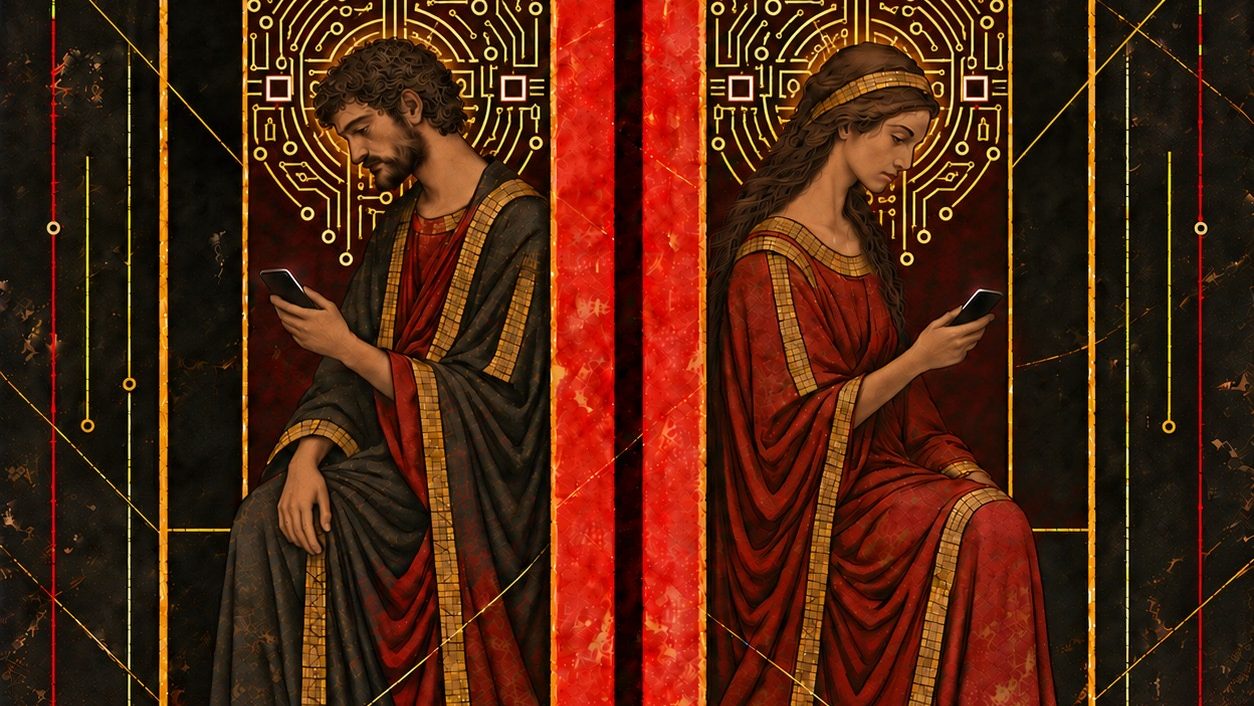
Hello everyone, it’s your host Oliver from DULAXI, and today I’m delighted to be joined by Chamelleont, the Athens-based artist behind the solo project of the same name. Blending experimental rock with electronic elements, Chamelleont recently introduced his debut album, Dead Lines, released on 13th November 2026. Across eleven carefully sequenced tracks, the record examines identity, truth, time, and the complicated relationship between certainty and possibility. With its unconventional production approach and philosophical narrative, the album marks an interesting return to music for an artist who spent twenty years away from his band days. Before we begin our conversation with Chamelleont, here’s what you need to know about today’s featured project.
About Chamelleont
Based in Athens, Greece, Chamelleont is the solo project of an artist who returned to music after spending twenty years away from his earlier experiences with a band. During that period, his musical activities had involved experimenting with live music and electronic rhythm sections, but his return has brought a different perspective to songwriting and creative expression. Influenced by artists such as Jacob Bellens, Twenty One Pilots, Sonic Youth, and Gogol Bordello, he draws inspiration from a broad musical spectrum, combining elements of experimental rock, alternative rock, and electronic music.
Released on 13th November 2026, Dead Lines is Chamelleont’s debut album, presenting an eleven-track conceptual narrative built around identity, truth, time, and certainty. Its sequence begins with questions of personal identity before gradually exploring the deterioration of truth, reaching a central turning point through “Deadlines” and “A Singularity.” The narrative subsequently shifts towards the different ways certainty can manifest through religious belief, community, and social structures, with “World Is A Sphere,” “Places We Lived In?,” and “Trickle Down” examining these ideas from different perspectives. The album concludes with “Alexander,” which considers whether the pursuit of certainty can ultimately destroy the possibilities that remain available to us.
The album’s creation process was as unconventional as its conceptual direction. Chamelleont began composing during his daily commutes, using his phone microphone to capture melodies, humming, singing, and whistling. These recordings became the foundation for further development in a makeshift home studio located in his seven-year-old son’s bedroom, where he worked with a Røde microphone, a Gretsch guitar, and a laptop. The production also involved extensive use of customised Suno models and studio editing, allowing him to develop arrangements from his original vocal and guitar contributions. While the lyrics, vocals, and songwriting remained entirely human, AI-assisted production helped him realise the instrumental arrangements of what he describes as his imaginary band.
Completed over four intensive months of daily work, Dead Lines represents Chamelleont’s renewed relationship with music and his exploration of the possibilities offered by combining traditional songwriting with contemporary production technology. His approach involved considerable experimentation, customisation, and editing rather than simply accepting the first available AI-generated results. With the album now available, Chamelleont’s return to music offers an interesting opportunity to examine how personal experiences, philosophical questions, and unconventional creative methods can come together in a single artistic statement.
Having this brief introduction to today’s featured project, I’m sure both new listeners and longtime fans are interested in hearing directly from Chamelleont about the ideas, decisions, and experiences behind this release. So, without further ado, let’s begin today’s interview.
INTERVIEW SESSION
Oliver:
After spending twenty years away from the band environment and returning to music with a different perspective on life, what personal experiences or changes in your outlook have most influenced the way you now approach creativity and self-expression?
Chamelleont:
The most important factor was having people around me that believed that I could and I should engage my creative side again.
Oliver:
You describe Dead Lines as a reflection on your relationship with time and the changing nature of identity. How has the person you are today changed the way you understand yourself compared with the person who was making music twenty years ago?
Chamelleont:
This question is so to the point! I can say this: the person I was twenty years ago believed that being misunderstood was a proof I was making art. I now realize that art is firstly an act of communication.
Oliver:
Your musical interests bring together artists such as Jacob Bellens, Twenty One Pilots, Sonic Youth, and Gogol Bordello. These artists have very different approaches to sound and expression. What particular qualities do you connect with in their work, and how have those connections shaped your own creative identity?
Chamelleont:
And those are just a few names off the top of my hat! I love music that does not conform to canon. The connecting line among those artists – and many others I appreciate – is to have something new to say. Genre, language, or theme is not that important to me.
Oliver:
You have returned to music as a solo artist after previously working with a band. What has been the most significant difference between creating music collaboratively in the past and having control over the creative direction of a project like Chamelleont?
Chamelleont:
If I put the two approaches on a scale, I cannot say lies – the energy that is generated in a band cannot be matched by a solo project. It is like comparing a dialogue to a monologue. I wish I had the people (and the time) to have made music like these songs, or any music, collaboratively!
Oliver:
The title Dead Lines suggests boundaries, limitations, and perhaps the way time can shape our decisions. What does the title represent to you personally, and how does it connect with the central ideas explored throughout the album?
Chamelleont:
the idea of titling the album ‘Dead Lines’ was born pretty late, when most of the songs had already shaped in their final form. I felt that it represented a thread in the songs – the exploration of boundaries in our past and futures, in our communication and in our identity.
Oliver:
The album follows a carefully arranged conceptual structure, beginning with questions of identity, moving through the decline of truth, and eventually challenging the value of certainty itself. At what point did you realise these songs could form a connected narrative rather than simply exist as individual pieces?
Chamelleont:
It came pretty early. The first songs were rearrangements of previous songs, in an exercise of restyling them to a sonic esthetic I was exploring. Then I realized my songs were all about questions – questions that raised around my age. And collecting questions became the thread.
Oliver:
Tracks such as “Deadlines” and “A Singularity” appear to mark an important turning point in the album’s progression. What makes these two tracks central to the story, and how did you approach positioning them together to create that particular moment in the listening experience?
Chamelleont:
In the arc of the sequencing of the album, Deadlines is the moment where a doubted self identity forms, and then starts corroding, disintegrating. A Singularity restarts from a sort of out-of-self experience, which then gels in the collectivization of experience.
Oliver:
You explore how certainty can take different forms, including religious belief, community, and social structures. In “World Is A Sphere,” “Places We Lived In?” and “Trickle Down,” how did you approach examining these different ideas, and what connections did you want listeners to recognise between them?
Chamelleont:
I truly put some thought in exploring how the concept of certainty defeats itself in different scales. World is a Sphere is about the feeling of owning any certainty becomes radicalized thought. Places We Lived In? looks at how we arbitrarily judge social circles as real or unreal. Trickle Down sees those individuals lose themselves in the collective of economical hierarchy.
Oliver:
“Alexander” brings the album towards a final philosophical question: whether the pursuit of certainty can destroy possibility. Why did you choose to end the record with this idea, and what do you hope listeners are left considering after hearing the final track?
Chamelleont:
This thought has been with me since I can remember: that choosing, doing, is mostly about rejecting alternatives. So freedom is real only before acting. But it doesn’t mean we shouldn’t act at all; we should accept that there is no freedom for us to have done something ‘differently’. So, I hope listeners take it as a song about acceptance, more than doubt.
Oliver:
Your songwriting process often begins during your daily commute, where you use your phone microphone to capture melodies, humming, singing, and whistling. How does working in that everyday environment affect the ideas that come to you, and what makes those moments useful to your creative process?
Chamelleont:
I did exploit the only idle time I have in my life – commuting – to reconnect with my creative side. Mostly because it was a space where I would be on my own. It became to be the wind-up befoee and wind-down after work.
Oliver:
You developed much of the album in your seven-year-old son’s bedroom, using a Røde microphone, a Gretsch guitar, and a laptop. That is quite an unusual setting for creating a conceptual album. How did you turn such a personal, makeshift recording space into an environment where you could realise the sound you had in mind?
Chamelleont:
Well, obviously my son was not in there with me during the sessions! This was – still is – a completely side project in my everyday life. And at the end of the day, my limitations forced me to rely on using AI to realize the sound I was imagining.
Oliver:
You have spoken about using Suno’s custom models and studio editing to develop arrangements from your own vocal and guitar recordings. Since you wanted to avoid relying on random AI-generated results, how much experimentation, editing, and decision-making went into making sure the finished arrangements reflected your original intentions?
Chamelleont:
An unbelievable amount of time. To be honest, I didn’t feel early on that producing music with Suno was nothing more than playing a game. Then I understood I could customize and tweak the generations enough so that they could sound more and more what I actually imagined. Having played in a traditional band, I would compare that to painting – you lay your lines and colors on a white canvas. Using Suno is more like sculpting from a marble block – you must carve the material in the shape you look for.
Oliver:
You make an interesting distinction between the human elements of the album and the technology used to complete its production, explaining that the lyrics, vocals, and songwriting remained human while the rest was developed with what you describe as an imaginary band. How do you define the creative relationship between your own musicianship and the technology involved, and where do you draw the line between assistance and artistic control?
Chamelleont:
After I had customized my models enough, it truly started feeling like I had a band that had slowly developed a musical language. The vocal and lyrics generation of AI is still heavily lacking. I think we complemented each other well enough.
Oliver:
Completing eleven tracks over four months of daily work sounds like an intensive commitment, particularly when you were carefully developing each arrangement rather than accepting the first available result. What was the most difficult creative decision you faced during that period, and was there a particular moment when you felt the album had finally come together?
Chamelleont:
I did archive two songs that I had worked for weeks, because I couldn’t bring them to the level of the rest of the album. But working with AI assistance is particularly hard in another direction – is to resist to the bonanza. Pulling the brake on ‘trying a new idea’ approach, and focusing on ‘bring this idea into its unavoidable expression’ took the most commitment.
Oliver:
Returning to music after such a long break must have brought a different set of expectations and challenges. What did the process of completing Dead Lines teach you about your abilities, your patience, and the kind of artist you want to be at this stage of your life?
Chamelleont:
I finally discovered I can invest focus in fleshing out a song, instead of accepting the first draft as good enough. But mostly, I have no expectations of success. My objective was making an album that I would enjoy listening to from start to end. Getting to see other people enjoying as well was a complete, unexpected surprise.
Oliver:
You currently describe Chamelleont as a solo project without a live setup, although you have not ruled out bringing the music to the stage. What would need to happen creatively or practically for you to translate an album built through this combination of guitar, vocals, electronic production, and AI-assisted arrangements into a live performance?
Chamelleont:
on the good side, I surely could think of rearranging this music for a live act, with real musicians. But what is the hard constraint, at this moment, is the time. And in no case I would try to replicate these songs as they sound in this form with a live act – art is allowed to change and adapt to the form of its expression. I would readapt the arrangements to as ‘analogic’ as possible, by preference. I’m already exploring putting these songs in a guitar and voice form.
Oliver:
With Dead Lines exploring subjects such as identity, truth, community, and the limits of certainty, listeners may connect with the record in very different ways depending on their own experiences. What kind of personal response would mean the most to you, and is there a particular question or feeling you hope people carry with them after listening?
Chamelleont:
I truly cannot identify a particular response that would mean most to me. What I hope, is that a listener feels – or thinks – while listening. I find amazing to hear any reaction, either to elements I willingly put in the songs, or new reads that I didn’t think about.
Oliver:
Now that you have completed this eleven-track statement and re-established your relationship with music, what direction are you most interested in exploring next? Do you see Chamelleont continuing to develop through conceptual albums, experimenting with different production methods, or moving towards an entirely new creative approach?
Chamelleont:
I surely would like to experiment further. At the same time, I’m working on arranging music in a simplified setup – something that I could achieve without a band – bare vocals and guitar, maybe piano. On the other side, the most experimental sides of Dead Lines are the ones I would probably base any future AI-assisted production on.
“After twenty years away from music, Chamelleont returns with an album that turns everyday moments into creative possibilities, using an unconventional production process to explore some of life’s most difficult questions about identity, certainty, and the choices that shape our existence.”
~ Oliver (DULAXI Team)
EDITORIAL PERSPECTIVE
What makes Dead Lines particularly interesting is the relationship between its philosophical structure and the unconventional process behind its creation. The progression from personal identity towards collective belief gives the eleven tracks a clear sense of direction, while the use of customised AI-assisted production introduces another dimension to Chamelleont’s return to songwriting. His willingness to reconsider the arrangements for a more stripped-back live format also reveals an artist who does not view a finished recording as the only possible expression of a musical idea.
~ Oliver (DULAXI Team)
CLOSING
Our conversation with Chamelleont has offered a closer understanding of the experiences, questions, and creative decisions behind Dead Lines. From rediscovering his relationship with music after twenty years away to developing an unconventional recording process that combines human songwriting with AI-assisted production, his story reveals a willingness to approach creativity from a different perspective. His reflections on identity, artistic communication, certainty, and the freedom of accepting our choices also provide an interesting context for experiencing the album beyond its individual compositions.
A special thank you to Chamelleont for taking the time to speak with DULAXI and for sharing the thoughts and experiences behind this release. We encourage readers to listen to Dead Lines, explore its eleven-track narrative, and discover the different questions it raises along the way. You can also follow Chamelleont’s creative journey through the links provided below.
Thank you for joining us for another DULAXI interview. We look forward to bringing you more conversations with artists, musicians, and creative minds from different parts of the world. Until next time, keep discovering new music and supporting the people who create it.