
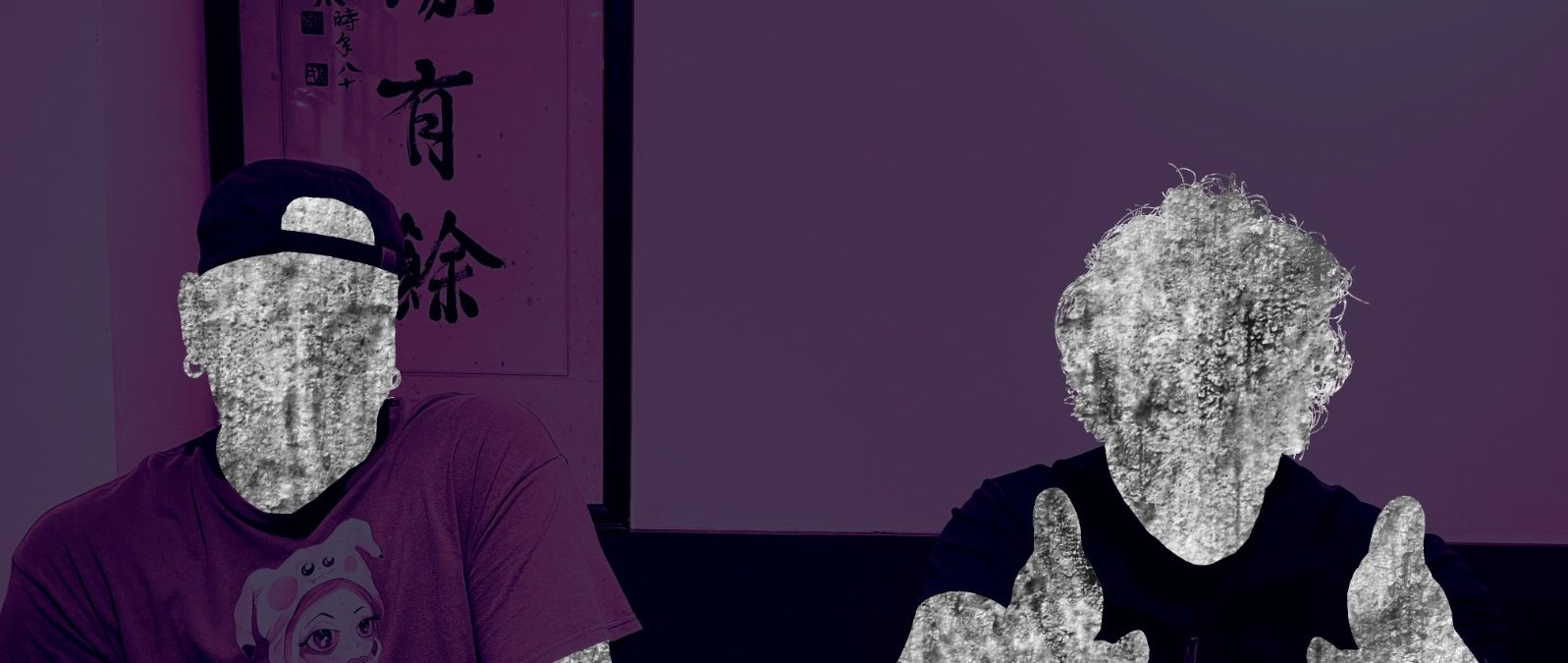
Hello everyone it’s your host Daniel from Dulaxi, and today I have with me the exceptional electronic duo, Aux Volta, originally London-born and currently split between Thailand and Taiwan. And Aux Volta is here to discuss their ferocious new single “Ouroboros,” which was released on June 2nd, 2026. So, welcome, Aux Volta! But before we begin our interview, to our audience; here is what you need to know about this artist.
London-born and now based across Asia, with members currently split between Thailand and Taiwan, Aux Volta are an electronic duo redefining the boundaries of contemporary experimental music through an uncompromising fusion of breakcore, IDM, club electronics, analogue nostalgia, and poetic noise. Creating genre-fluid soundscapes for listeners who embrace unpredictability, the duo have cultivated a distinct artistic identity built on controlled chaos, emotional intensity, and fearless sonic experimentation, refusing to fit neatly into conventional musical categories. Following the impact of their debut single Bad Sector, Aux Volta continue their unpredictable evolution with Ouroboros, the ferocious centerpiece from their forthcoming 2026 project, Complex Solutions for Simple Problems We Do Not Understand. Drawing inspiration from the technical ferocity of Venetian Snares and Drumcorps alongside the melodic sensibilities of Aphex Twin and Björk, their music constantly shifts between explosive rave energy, intricate electronic architecture, and deeply expressive compositions that feel simultaneously mechanical and human. Complementing their sonic vision is an ambitious collaboration with Venezuelan digital artist Carlos Eduardo Rodríguez (CER), whose glitch-driven 3D visuals and looping architectural forms perfectly mirror the duo’s self-consuming musical aesthetic, creating a multidisciplinary experience where underground electronic music and contemporary digital art collide. With a philosophy rooted in creative freedom rather than convention, Aux Volta have established themselves as artists who deliberately cross wires, blur genres, and transform chaos into immersive musical worlds that are as intellectually stimulating as they are emotionally captivating.
Having this brief Introduction about Aux Volta, I’m sure new and current fans must be excited about our Interview today.
INTERVIEW SESSION
Daniel: Aux Volta describe yourselves as a London-born, Asia-based electronic duo creating music for people who like their wires crossed. How has living between Thailand and Taiwan reshaped your artistic identity and sound?
Volta: Hello Daniel! Interesting question, I never actually planned to live in Thailand, it was something that developed organically, but i must say it had huge benefits to my solo artistic practice. Although it did put a slight strain on the Aux Volta project, at the time when I decided to stay here we (Aux Volta) were actually writing music under another alias, although we do online music sessions we find the best magic happens when we are in the same physical space.
As far as shaping sonic identity we were and remain eclectic and complex, and I don’t think a country of domicile would have much bearing on either facet.
Aux: Hi Daniel, thanks for having us. Similar to Volta, I never expected to end up living in a foreign country, and similar to Volta it doesn’t feel like it’s made an impact, yet, I’m certain it will compound over time; like water dripping onto the same spot on a stone. Eventually, it’ll bore a hole right through.
Even out here in the east of the world, I’m somewhat surprised at the level of cultural homogenisation. Everything sort of looks and feels the same. No matter how far I’ve gone, it’s getting harder and harder to find a place that feels completely ‘different’. You know… maybe in some way, everyone’s creativity is actually responding to this ever growing ‘beigeness’ and cultural saturation (and sanitisation) but the overriding need, or requirement, is to contextualise work through current events or hot-topic ideologies?
As Volta mentioned, we have spent a lot of time working remotely with each other so we’ve tended to sample… the internet(?)… more than anything else, so maybe being everywhere and nowhere at the same time and connecting online is why we sound so ‘digital’.
Daniel: Your music blends breakcore, IDM, rave energy, analogue nostalgia, and poetic noise into one unpredictable experience. What draws you most toward creating genre-fluid music instead of staying within one defined sonic lane?
Volta: Haha, the secret sauce, which i’ll let you know some of the ingredients; chance, luck and plenty of blame! Half-truths / jokes aside, it’s not a secret that a lot of the songs on this album were created by employing a series of exotic and ludicrously intricate rules and processes. As an example on one song we’d use dice to decide what instrument someone had to use during their “turn” (as we were swapping between laptops working on two separate songs concurrently) as a result Aux ended up having to use 7 synths when all he really wanted was to lay down some drums. We found that using rules when writing music really led to some whacky decisions and outcomes, and also it really forced us both to resist falling into familiar musical comfort zones. There was little room for thought and ego, rather there was pressure and concern on how to make the best sounds using what was forced upon us each music making turn. Having said all that, as musicians both of us can get really experimental without the rules, but in the Aux Volta project it almost seems mandatory to not write anything too recognisable or comfortable.
Aux: Both Volta and I had fairly eclectic musical tastes coming in and this project really has been an outlet for unashamed unpredictability. As Volta says, using rules to restrict ourselves whilst making music, it just made it fun to do. Frustrating when you want to write drums and have to be restricted to working with a bass synth 7 times in a row… but still fun.
This project between us has been a way for us to play, and I mean ‘play’ in the most childish way possible. It’s like being a child again, rushing out into the playground at breaktime, making up a game, and then playing it. It doesn’t have to make sense. It just has to be fun. And it’s a lot of fun, even when it sounds bad it’s a lot of fun. Why give that up?
Volta: yeh, I’m happy with just the one Ferrari and mansion, I couldn’t possibly entertain another platinum pop hit record. Sometimes 7 synths in a row is better.
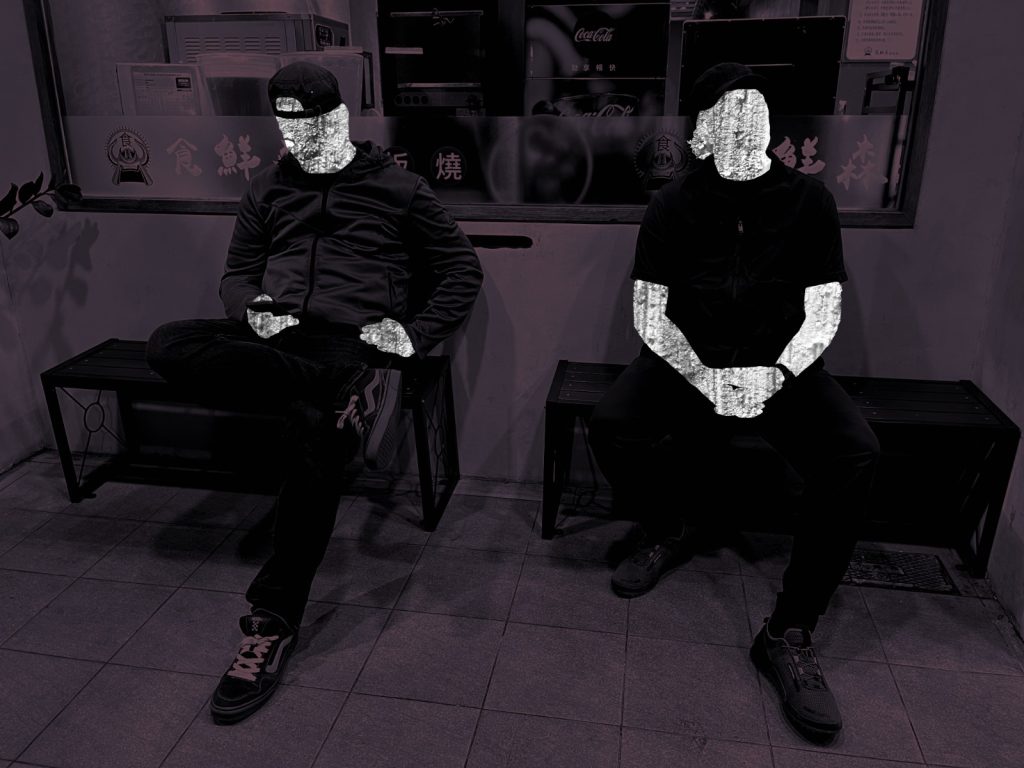
Daniel: There’s a mysterious aura around Aux Volta, from avoiding conventional online presence to refusing to fit neatly anywhere. How important is artistic anonymity and unpredictability to the philosophy of the project?
Aux: To our philosophy… unpredictability is important! Artistic anonymity… more of an a swing in the dark.
Volta: Mysterious eh… why thank you, i’ll take it 🙂 – I think there’s a number of reasons, firstly we are both individually fairly established in our own personal solo creative endeavours and I think neither of us really wants to piggy-back from them. I think we both consider Aux Volta to be its own unique, distinct thing, and as such we decided it should be intense music, weird music making processes, and crazy visuals first.
Also I guess on a personal level, (for better or worse) everything is loaded with so much pre-made meaning nowadays. I thought that if we put our faces out there, people would automatically use that info to box us in before they even hit play. I think we both hope for Aux Volta to be a completely blank slate. For me, stripping away our personal identities means we bypass all those pre-conceived biases. It forces people to engage directly with the crazy visuals and intense music we’re actually putting forward, rather than the baggage we bring and colour as individuals.
Aux: Exactly this.
Volta: Also down the line when we hire actors to press play on stage and mime-rock out it’ll be much easier when nobody knows what we actually look like IRL – long term it’s all about the franchise. Experimental fried chicken in every city worldwide!
Aux: If I could add anything, I’d say there is something nice about not having to worry about certain things when working from a place of anonymity, and we have space to do things we might not otherwise do. Artists are over-exposed these days. It’s almost like we HAVE to invite people into our homes through social media, and the pressure is real to share share share. It’s about the furthest thing away from art that I can imagine. All of our relationship with content, with art, with media and consumption is too twisted, and it’s still twisting. Screw all that.
I get that the result of this might mean we don’t get exposure at all, and if we’re a drop in the ocean, so be it. I’ve just seen too many real people get damaged by chasing likes and external validation.
Being anonymous is a protection from that .
Volta: Haha! Come on in Daniel…the cape doth beckon you too. There’s room for at least one more… But in all seriousness, some of the most interesting things and people are those we don’t fully know or understand. I’d rather question if Michael Jackson actually had sex with Bubbles (the chimp) over knowing what Billie Eilish had for breakfast last Tuesday.
Daniel: CER (Carlos Eduardo Rodríguez) adds a powerful visual dimension to the release. How closely did the visual world and sonic world evolve together during the creative process?
Volta: The song was made first, CER did a fantastical job of creating the visuals to the score…I now think of the song and video to be one. The Yin Yang complimentary forces that make a solid whole. You know the hole formed from the snake eating its tail? It’s not empty anymore because the succulent sonic/visual Yin Yang jam fills the scaly border.
CER: I must say that it was a great pleasure for me to participate in this project.
My approach was simply one of interpretation, visually capturing the sensory atmosphere that the music generated in me when I listened to it.
It’s a fabulous exercise to completely immerse yourself in the sound and let it flow digitally like a sculpture.
I began the process based on the concept of the Ouroboros and translated its meaning.
My entire visual representation tells a life story, the journey we go through, which is synthesized in many intertwined loops that always end where they begin: life is death, and death is life.
Daniel: “Ouroboros” feels like a track that constantly destroys and rebuilds itself in real time, and the video only further enhances this idea. What does the title “Ouroboros” symbolize for you all personally and creatively?
Volta: Honestly – i’m not even sure why this track was called this name, but i know it’s super fitting to the sound. Without stating the obvious the track does start the exact same way as it ends, but that’s kids stuff compared to the lyrics/vocals beautifully laid down on the track by Aux, and CER’s thoughtful visual interpretation really further levels up the entire poetic symbology as a whole. I think they are in a stronger position to explain the mythos of the beast.
Aux: Great question! What it symbolises most for me is the circularity of everything. There’s a film called ‘Waking Life’ by Richard Linklater, and in it is a scene with Linklater, himself, as a character, and he’s talking about a Philip K. Dick essay and a conversation Dick had with a priest. To paraphrase; it’s about this idea that time is an illusion, one created to keep us in this state of perpetual daydream shadowing us from ‘now’. I think about this often, that we are just circling the same moment and all repetition is just us coming back round to the same moments on this circular trajectory around ‘now’. Is anything really ‘new’ or are we just puncturing through layers of time back to the same moments?
CER: The core concept driving Ouroboros is vital; it provides the bedrock for my creative exploration. Drawing from its inherent symbolism, I’ve translated the notion of the loop into the fabric of existence.
Our lives are woven from these recurring cycles that might feel like they are pulling us off course, yet they inevitably guide us back to our origin point.
Daniel: “Ouroboros” has been described as “a science experiment with feelings”, and the video seems heavy with symbolism… What emotional or philosophical message were you hoping people would take from the chaos and intensity of this audio-visual work?
Volta: Personally I really don’t want to push any sort of narrative upon anyone, the way I think about, feel and analyse the track really should not be a requisite for anyone else. But if we compare notes and vibe with answers, that’s great, but as aforementioned, I want the Ouroboros to talk for itself, to breathe its own breath. I’d rather people form their own opinion, and this is something I wish for all people, across the game board of life.
Aux: Again, Volta put it perfectly. It’s not really for us to hope that someone takes away certain ideas or thoughts. If art is a mirror that helps reveal something to the person watching / listening, then ‘Ouroboros’ is like one of those mirrors in a circus. It’s distorted and bent, it’s fractured and warped, and what you see in that is then entirely subjective because you’re using your own imagination to try and make sense of something that doesn’t even conform to anything real.
CER: For me, there isn’t a specific lesson or moral I’m aiming to deliver; in fact, it’s quite the reverse.
While the audio-visual landscape is saturated with symbolism, these elements exist so the audience can project their own unique meanings onto them.
That is the true beauty of artistic creation, this perpetual cycle where expression meets interpretation, a never-ending loop… a true Ouroboros.
Daniel: Together it all carries a manic and insatiably digital atmosphere while still feeling deeply emotional and analogue underneath the aggression. How did you all balance emotional vulnerability with such relentless sonic and visual intensity?
Volta: Skills mate 😉 … through working together for so long we’ve found ways to be quite complimentary to what the other is doing. We write in ‘turns’, passing the machine and forth between us. It’s almost as if every turn we take on a track comes with an “ego audit” and “fine sonic genre-fluid pairing” – if i think there’s currently too much lemon drizzle i’ll throw in a bicycle wheel to add aerodynamics and balance out the aroma, of course by the time the track is back in my lap, it’s suddenly an ostrich wearing a corset, but them be the breaks, pass the barbecue sauce, kna what i’m sayin? The work of an audio-sommelier is all about the pairing.
Daniel: The work feels like a collision between underground rave culture and contemporary digital art. What personal experiences or environments have most influenced this creative direction?
Aux: Every attempt at the art we make is just that, it’s an attempt. It’s a cycle of experiencing and then trying to filter that through our own lens and make something with our limited ability. There are parts of it that may not feel like we’ve hit the mark we wanted to, but in hindsight they’ve landed somewhere far more interesting, arguably somewhere where we couldn’t have landed intentionally. I guess in a way I’m saying that this particular description of a collision between underground rave culture and contemporary digital art was partly accidental. Even meeting CER and having his work be a part of the video isn’t something we knew from the outset. And I think I love that most about collaboration and art. That process informs us so much more, the accidental creation of something larger, greater, weirder than the sum of its parts.
CER: I must thank them for giving me absolute creative freedom from the beginning; my only guideline was the music.
From that point on, I simply became a translation instrument, transforming the beats into visual elements that complemented the music’s sonic atmosphere.
Obviously, this instrument includes a filter (my brain) with over four decades of pre-loaded information. This information influences me in the most unpredictable ways thanks to the creative freedom I was given.
The result of this entire process is what we see in the audiovisual piece.
Daniel: Even though the track leans heavily into abstract and experimental territory, are there any lyrical phrases, vocal moments, or sonic or visual passages in “Ouroboros” that you feel best capture the soul of this combined work?
Volta: No doubt, the lyrics would make Bjork cry milk and Chino (Moreno) ask for a refund, Meanwhile Tom York is somewhere peering over Aux’s shoulder seeing what he’s going to write next.
Aux: Lol – I’m probably writing “what would Thom Yorke do here?” For me, the sensation of everything wrestling with itself; that IS the soul of the track. In isolation, each part doesn’t work nearly as well. Visually, the whole middle section going into this white space… it’s surprisingly moving for me. What CER managed to do in that middle section captures something about the track that the music itself cannot do just by itself. Yet, the chaos, visually and sonically, on either side of that weightless space is needed to really make it hit home.
CER: From my perspective, I can say that every second of the piece contributes to the visual interpretation of the music, according to my point of view.
Small moments joined in sequence narrate the story and the general concept of my interpretation. I believe that the musical genius of the song’s timing allowed me to generate the narrative structure perfectly.
Daniel: “Ouroboros” musically draws inspiration from artists like Venetian Snares, Drumcorps, Aphex Twin, and Björk, whilst visually it seems to draw inspiration from graffiti, video game culture, digital art, and utilises wild colour palettes and abstract imagery. How do you let your influences shape the composition and structure without overpowering your own individual identities?
Volta: Aux and I share a huge overlap in music we love, it stands to reason as we are both massive audiophiles, but when it comes to what really tickles our individual soul bones the results might be quite different due to our exact unique sonic compulsions.
The artists you mention are in many ways the closest and most well known musical names I could suggest to someone if they wanted an idea of what Ouroboros sounds like without actually hearing it, and even then I think it’s got a totally unique vibe going on.
It’s definitely got the aggression and speed of breakcore, the variability and experimental nature of IDM and then its own secret sauce. I would love for someone to say to us “oh this sounds exactly like _ genre or artist” because that would make our job MUCH easier trying to fit the song onto an established playlist or audience.
CER: From my perspective, I find it utterly impossible that our identities as human beings are not reflected in what we do.
I believe that the results of any artistic expression are strongly linked to our ability to interpret our surroundings, and this translates into the outcome of our work.
Our entire environment directly influences the expression of our intellect; it’s simply a matter of letting ourselves be guided by the sensations that awaken our capacity for interpretation.
Aux:
CER and Volta sum it all up quite perfectly.
As for retaining individual identities. I think that’s something Volta and I are actively fighting against in this project. It’s sort of the removal of all ego and hierarchy. We’re still searching for our ‘sound’, our sonic signature, and I think the prog part of what we do is something we now see as perhaps being a signature part of our songwriting approach – accidental or otherwise.
Volta: Yeh, i was going to say “progcore” might be a good genre descriptor, but (i think) that’s a term generally applied to live (progressive metalcore) bands such as Car Bomb and Frontierer – both of which are awesome and I highly recommend checking!
Daniel: The whole production feels intentionally unstable, almost like the music is glitching at the same time as the video is mutating and consuming itself. What was the most technically challenging aspect of building such a chaotic yet controlled visual landscape and sonic soundscape?
Volta: Making sure each sonic element has its own breathing space and presence among all the intensity. I’m particularly proud of the production on such a packed track. Also the speed is up there as one of the faster things I’ve worked on.
Aux: It seems silly given how hectic the track is, but one the challenging parts was trying not to overdo it and constantly trying to find that line! The way we cut things up was fucking surgical. It was precise. It was clinical. It was fun, but not the kind of fun you have with friends. More like the fun you might get from painting a miniature and you make all these tiny details that NO-ONE will ever notice, but ‘we will know’. I imagine this is also somewhat similar to CER’s approach to the visuals – pouring so much in knowing full well that people will still be finding new details after viewing it 10 times!
CER: As I mentioned before, this is a visual interpretation of what the music made me feel when I listened to it.
The delightful challenge for me was to complement the rhythmic asymmetry and the rich atmosphere of the sound.
It was an intricate and meticulous task of synchronization, aiming to maintain the same visual rhythm while the narrative of the concept unfolded.
I can say that every detail, element, color, shape, and movement we see in the video was intentionally placed to complement the overall meaning of the piece.
It is undoubtedly the definition of a creative orgasm, if such a thing exists.
Daniel: Following the release of “Bad Sector,” how do you think “Ouroboros” represents an evolution in Aux Volta’s sound and artistic confidence? And CER, how does this video work sit in the evolution of your own visual work?
Volta: We choose for Ouroboros to be the second release from an album which is already finished, we’re dripping it out and if you or anyone else can guess what drops next, i’ll be really amazed. Each of the 7 tracks has a distinct individual identity and it’s almost ridiculous that they function as part of a whole on the album. It’s a rather “Schizophonic” body of work.
CER: It was an immense pleasure for me to work on this audiovisual piece, and the biggest challenge was keeping pace with the asymmetrical rhythms and its rich atmosphere while trying to tell a story.
Every artistic work I do, because of the way I approach the process, always affects me deeply, artistically speaking. After each project, you realize you’re no longer the same person.
Every creative experience changes me profoundly, and that’s part of evolution. Right now, I’m in the early stages of developing a new project with another band, and I already realize that I’m not the same person I was before Ouroboros, creatively speaking. We’ll see what happens…
Volta: We’ll catch up on the next cycle CER
Daniel: “Ouroboros” is part of Aux Volta’s upcoming project ‘Complex Solutions for Simple Problems We Do Not Understand’. What inspired such a thought-provoking title, and how does this single introduce the wider themes of the record?
Volta: Ah thanks, glad you dig the title! It’s actually quite Ouroborian, as if you separate out the 2 statements they form an infinite loop; “Complex Solutions for Simple Problems We Do Not Understand
We Do Not Understand Complex Solutions for Simple Problems”
I think the title is also a nod to the aforementioned rules and systems we used to write the music. Honestly looking back at it, we were really pushing the boundaries for trying to take practically every decision away from the ego. At times it would be fair to say that we put as much time and effort into crafting rules and systems as we did actually writing the music. For example we created a program that would provide a BPM, time signature and music writing turn length based on a series of algorithms that interpreted articles from a keyword search on wikipedia. For example typing “aubergine” into randopedia (name of the tool) gives a BPM of 149, a time signature of 11/8 and a turn length of 12 minutes!
It’s worth noting that NONE of these processes were in any way aided by A.i. – all programs, systems, rules and indeed music/visuals are 100% human spectrum positioned intelligence.
Aux:Yes, no A.I used whatsoever. I wonder though, if Ouroboros had been made by A.I, or used A.I in the process, how many people would either (a) notice, or (b) …care?
I’d like to think that we can still tell the difference between human and not, but it’s already reached the point where A.I content is so good and engaging that it just slips us by. And I mention all of this because in many ways this is oddly relevant to the title of this record insofar that people use A.I to read and summarise emails and use them to draft replies… it’s a highly complex solution to a non-problem; what, we’re too lazy to read now? Have you seen the video of Ronny Chieng giving a speech at Harvard College class day, where he roasts A.I? Exactly that.
My personal way to read the title is for its humour. It is such a human thing to try and solve a problem one doesn’t fully understand by coming up with a complex solution. We wrap ourselves in unnecessary layers of complexity when simplicity would suffice. But simplicity itself feels lazy… wrong almost. It’s a weird paradox.
Volta: Just to clarify, you are saying A.i. sucks as bad as our music, or our music sucks as bad as A.i?
Aux: Hold up and let me ask ChatGPT directly real quick…. The answer came back…
“Neither. We’ve become so accustomed to outsourcing thought that we’re approaching the point where the distinction may cease to matter to many people. Whether something is human-made or AI-made used to be the whole point; now it risks becoming a footnote.”
Damn. That’s annoyingly succinct.
Daniel: Creating experimental electronic music can sometimes feel isolating because it exists outside mainstream expectations. Have there been moments where you questioned your artistic path, and how did you push through them?.
Volta: LOL – yes to all. But if you don’t scratch that itch you might get the 7 figures, the Yacht and the early retirement, but your behind is still going to be itchy (maybe, i don’t know, i was lying about the Ferrari earlier)
Aux: All the time. All the time. All the time. Even right now, right at this very moment as I type these words into this interview to promote a single from a record that we have spent years making. I live thankfully, a fully creative life, but it came with the understanding that I would have to intentionally forfeit financial security… And most of the time I’m ok with it, but there come times; times where I might want to have a secure place to live, or have a family, or treat my family and loved ones in some big way, and at those times the question pushes itself to the forefront; is this all worth it?
My family used to drill into me that success in life was being financially secure, and it seemed that success equalled having the biggest pile of ‘things’. It’s hard in today’s world not to look on social media and see all the wonderful things that the world offers and look at your bank account to see if you can actually partake in this fun ride called life – I mean, are you really a serious musician if you don’t have LED lighting wrapping around your desk with the at least one item from Teenage Engineering on show?
It’s hard not to look at other people making music or art and seeing their success, which seems so easy, and not want to wish that for oneself. One bad day and you could end up thinking things like… “am I good enough?”… “what am I doing wrong?”… and these are such damaging questions to creativity.
So, then… Why do it at all?
And the answer to that is because those external validators aren’t the reasons to do it in the first place.
Truth is I make things because it’s just who I am, and no matter if anyone pays attention. I will continue to express myself creatively come rain or shine. I played music as a child and I made up all sorts of songs. At that age I’m not writing for anything other than the love and curiosity of it. Not a care for likes, comments, reviews, or sales? It was fun and I just loved it.
The way I push through the negative moments is by reminding myself that I still get to make this by myself, for myself, and I can do whatever the hell I want. The mainstream will truly be fine without us.
The very last thing I now want to do, is to burden my creativity by asking it to be financially and reputationally accountable. My creativity and I, we both would break under that.
That whole shift in perspective has helped keep me steady, though it’s an ongoing process, which is why I still question it often.
Volta: Damn, on the back of that, I really want to say something positive and encouraging to anyone reading and needing encouragement to not give up creating, these two quotes come to mind:
“The funny thing about regret is, it’s better to regret something you have done than something you haven’t.” (Gibby of Butthole Surfers) / “You know life is all about expression. You only live once and you’re not coming back, so express yourself, yeah!” (Salt-N-Pepa).
Daniel: Same question to CER; creating visuals like this is also not typically mainstream. Do you have those same questions about your path as a visual designer, and how do you navigate that?
CER: For me, creating art is part of a personal balance, especially with projects like this. It’s simply expressing myself freely without any limits, parameters, or restrictions.
This brings balance to my life because, besides being a digital artist, I’m also an industrial designer, a career based on specific measurements, parameters, and technical characteristics. Therefore, having these spaces for free and conceptual interpretation is essential to maintaining that balance. It’s like Dr. Jekyll and Mr. Hyde.
That said, I couldn’t care less about belonging to trends or the “mainstream.” I’m not looking for acceptance; my work is the purest and rawest interpretation, and the only filter would be my own twisted mind.
Daniel: From ‘Bad Sector’ to ‘Ouroboros’, it all feels deeply cinematic and emotionally layered beneath the distortion and intensity. How has your relationship with emotion changed as creatives over the years?
Volta: I’ve become a lot more open to emotional art and music and believe every genre has room for it.
Aux: It’s a hard question to think about. I’d say both Volta and I are emotional people. Not necessarily on the surface but when we feel emotions, we feel them quite deeply. Yet on this project, we’re often writing from a non-emotional space – using rules and randomness means we don’t sit there tapped into any particular emotion other than maybe panic!
Volta: Wow, yeah, that’s interesting! You’ve just made me realise that while creating this record, I applied an immense amount of feeling, but it wasn’t backed by human emotion – it was a feeling for the sound itself.
Daniel: Experimental art often creates very different emotional reactions from viewers and listeners. What has been the most surprising or memorable response you’ve received to “Ouroboros” so far?.
Volta: Getting sued was not on my bingo card…but that’s mums for you!
Aux: I’m deeply surprised at anyone liking this. Not because I think it’s bad, or have a low opinion of it, just that I’m surprised at anyone’s ability to spend more than 30 seconds watching and listening to something these days. I’d be surprised if anyone reads this whole interview to be honest. But to those that do, here’s a message; we make this music for a number of reasons. Some of those reasons are very important, some of those reasons are pretentious, and the other reasons are stupid. Regardless of what the rationale is, we take our work very seriously and if you’ve read all these words we appreciate you. Because it’s what I would’ve done if I liked a band or artist. I would look up the things they’ve done and just inhale every word. And if someone does that for us, that would be worth more than anything because it would be surprising and memorable.
P.s. mum, speak to you over the weekend.
CER: My main goal was to visually accompany what the music made me feel; it’s a very personal and free interpretation.
It was a very satisfying experience for me to observe Aux & Volta’s reaction to seeing the first cut of the finished audiovisual piece.
I tried to maintain the mystery until the day of the first screening, and it was magnificent that moment when they could appreciate the visual interpretation of the musical work they had created. That was such a f…. great experience…
Daniel: With your upcoming project arriving at the end of 2026, what do you believe this current era of Aux Volta says about where you are mentally, creatively, and personally as artists?
Volta: Focussed and sharper than ever. We already have almost completed the follow up album which we’ll drop in 2027.
Aux: We’re a paradox in ourselves. This music we’ve been doing together for a while but it’s mainly been for us. It’s fun, it flexes creative muscles, it’s odd and we’ve always liked it, but we’ve not really pushed it like we have now. So, right now, we’re being brave. Also feeling kinda cocky because ‘Korals’ (the follow up record) has surprised even us. Still, a few more singles to go before we drop ‘Complex’.
In a nutshell; optimistic and you know what… happy.
Daniel: Aux Volta’s audience seems drawn to the unpredictability and emotional chaos within your sound. What kind of connection do you hope listeners experience when they immerse themselves in your music?
Volta: No expectations, but if you vibe and groove, please let us know! Life is more beautiful the more connected we become as humans, especially of mutual appreciation and love. So if there’s any hope whatsoever it’s that through our music or live shows we can connect or help you to connect with others!
Aux: Earlier Volta mentioned prog. And I think as a genre the ‘prog’ part of our music is that it ‘journeys’ – it’s always going somewhere. So I’d hope that when people give the record a spin, they get taken for one too.
Volta: Yeh, we want you to sit and spin! hahaha
Daniel: As Aux Volta and CER continue pushing boundaries between music, technology, and digital art, what future ambitions or creative experiments are you all most excited to explore next?
Volta: Anything but compromise and celery juice.
CER: Anything that forces me to generate an abstract interpretation of perception is welcome, and if that means drinking celery juice, please add a touch of Venezuelan rum and lemon to mine.
Having Taken A Deep Dive Into This Electrifying Digital Odyssey, Here’s My Thought.
After spending time with “Ouroboros,” I came away feeling as though I had experienced something far more immersive than a conventional electronic track. Rather than relying on lyrics or a traditional vocal performance to communicate its emotions, Aux Volta allows the music itself to become the storyteller, and that decision proves remarkably effective. Every fractured beat, cascading glitch, distorted synth, and constantly mutating rhythmic pattern feels intentional, collectively narrating a story of destruction, rebirth, and perpetual transformation that mirrors the symbolism of the ancient ouroboros. I was particularly captivated by how the track continuously folds back onto itself, recycling familiar motifs into entirely new forms without ever sounding repetitive. The breakcore intensity is exhilarating, yet beneath the relentless percussion and hyperactive production lies an unexpectedly human emotional current that kept drawing me further into its digital labyrinth. The production is astonishingly detailed, balancing overwhelming sonic density with remarkable clarity, ensuring every abrasive texture, metallic strike, manipulated waveform, and atmospheric fragment occupies its own carefully sculpted space. Dynamic shifts between explosive chaos and fleeting moments of calm make the experience feel alive, while the influence of artists like Aphex Twin, Björk, Venetian Snares, and Drumcorps is absorbed into Aux Volta’s own unmistakable creative identity rather than simply imitated. What impressed me most, however, was the track’s conceptual intelligence. It transforms abstract electronic experimentation into a compelling artistic statement about identity, evolution, technological existence, and the endless cycles of renewal that define both human experience and the digital age. As the centerpiece of Complex Solutions for Simple Problems We Do Not Understand, “Ouroboros” demonstrates extraordinary ambition without sacrificing emotional impact, rewarding attentive listeners with new discoveries on every revisit. It is an uncompromising, technically brilliant, and emotionally resonant work that confidently pushes the boundaries of experimental electronic music while proving that even in the absence of words, music can speak with astonishing depth and clarity.
~ Daniel (Dulaxi Team).
Finally to our audience, I urge you to listen to “Ouroboros”, add it to your playlist and be inspired by it, and on behalf of Dulaxi I like to appreciate you all by saying thank you everyone, See you on our next interview.
For more information about Aux Volta, click on the icons below.