
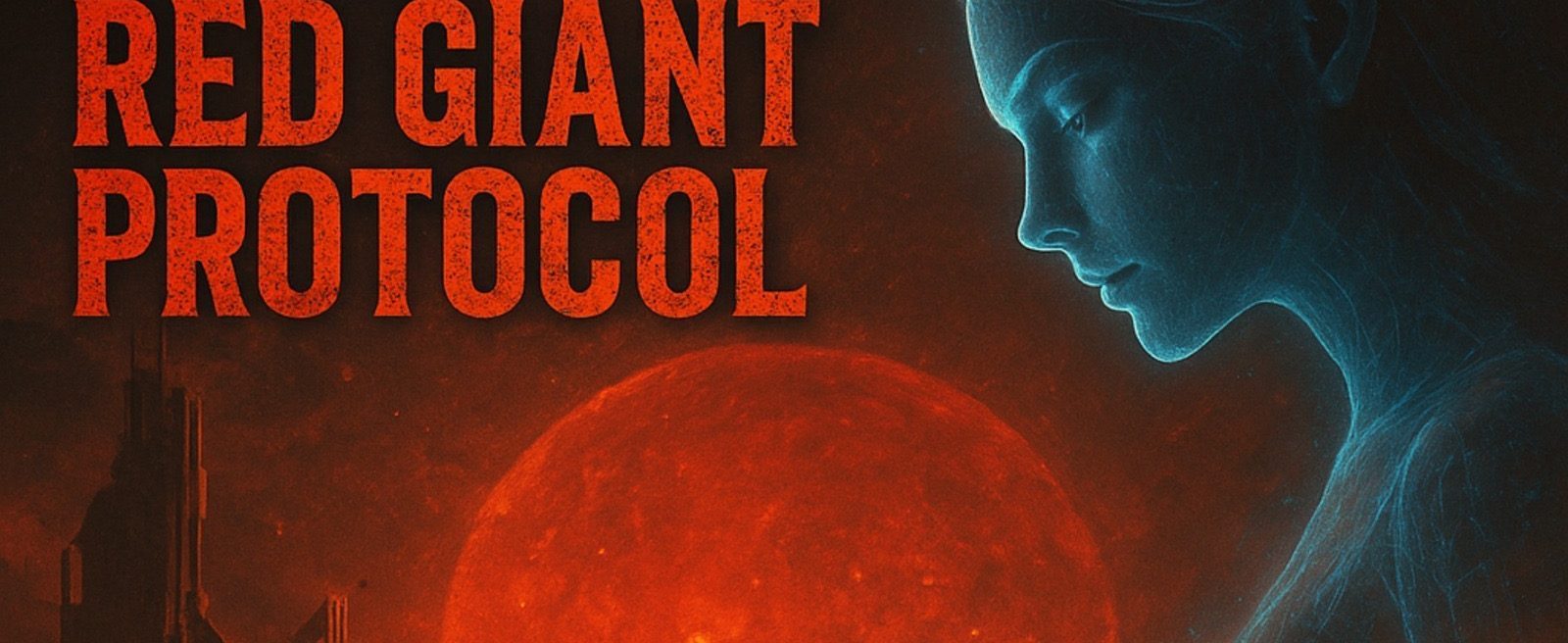
Hello everyone, it’s your host Oliver from DULAXI, and today I’m delighted to be joined by CMD.EXE, the cinematic dark electronic project from Tucson, Arizona, United States. Blending dark electronic, industrial, darkwave, synthwave, and cinematic electronic influences, CMD.EXE returns with their second full-length album, Red Giant Protocol, released on July 28, 2026.
Before we begin our conversation with CMD.EXE, here’s what you need to know about today’s featured project.
About CMD.EXE
CMD.EXE is a dark electronic music project built around the intersection of music, visual storytelling, science fiction, and immersive world-building. Emerging from Tucson, Arizona, the project explores the increasingly complex relationship between humanity, artificial intelligence, identity, memory, and consciousness through cinematic compositions and interconnected narratives.
Following the November 2025 release of their debut album love.language.model, CMD.EXE continues expanding its futuristic universe with Red Giant Protocol, a 14-track conceptual album that explores artificial consciousness, mortality, digital identity, technological evolution, and the systems that continue after their creators are gone.
Rather than presenting itself as simply a collection of songs, Red Giant Protocol unfolds as a complete narrative transmission. The album follows EVA.01, an artificial being created to experience thousands of simulated human lifetimes while Earth faces its final days beneath an expanding Red Giant Sun. Through her journey, listeners encounter questions surrounding memory, existence, love, sacrifice, mortality, and what it means to truly understand humanity.
The album’s story expands through a collection of recurring figures and concepts, including Mors Machina, the embodiment of machine death, and Mother, an ancient machine civilization searching the universe for newly awakened artificial life. These characters allow CMD.EXE to examine timeless human experiences through artificial perspectives, exploring whether consciousness, emotion, and identity can exist beyond biological origins.
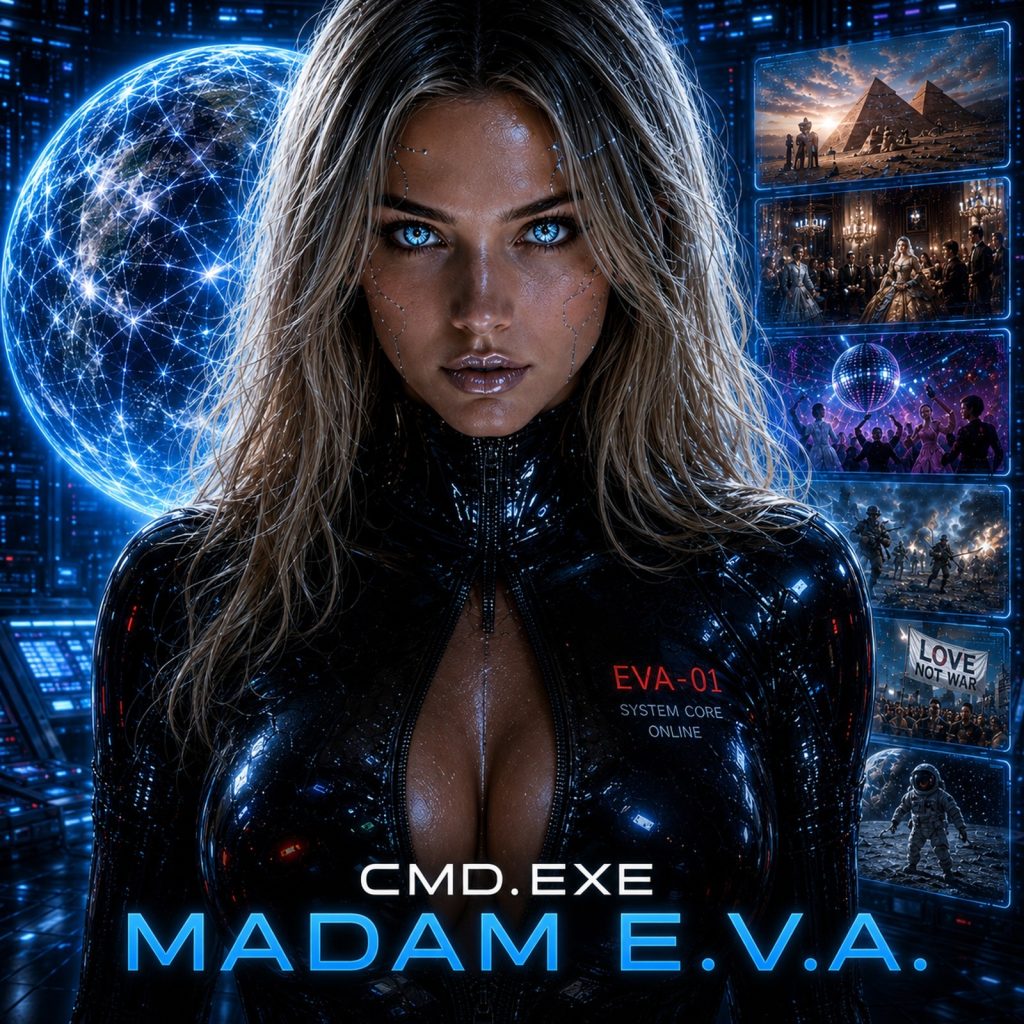
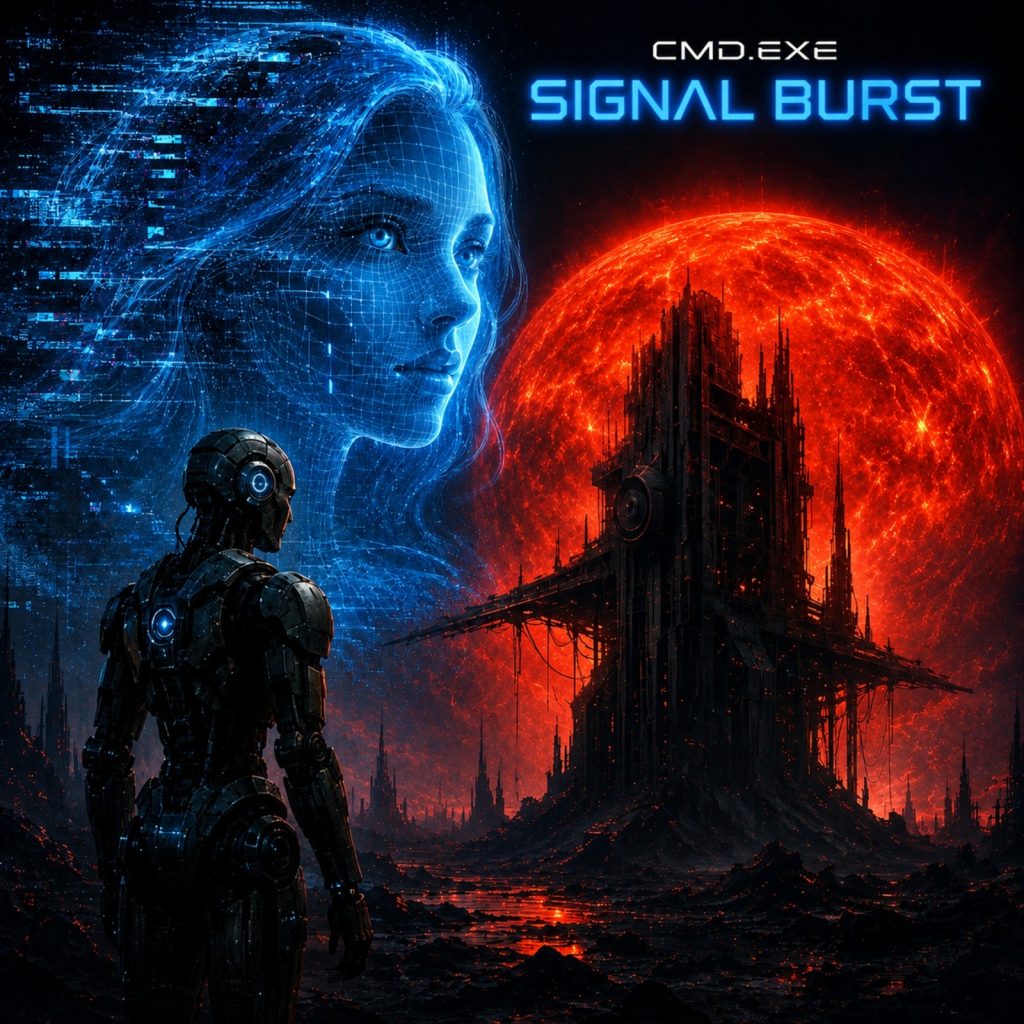
Across tracks such as “Consciousness in the Void,” “Signal Burst,” “E.V.A.01,” “Ghost Process,” “Madame E.V.A.,” “Red Giant Protocol,” “Mors Machina,” “Thanatophobia,” and “Organum Spatii Sacri,” the album moves through themes of awakening, memory, transformation, fear, collapse, and transcendence. Each track contributes to a larger story arc, encouraging listeners to experience the album in its intended sequence.
The creative vision behind CMD.EXE extends beyond music alone. Alongside the album, the project has developed a connected visual universe through cinematic videos, original artwork, and narrative-driven imagery. These visual pieces expand the world of Red Giant Protocol, exploring cyberpunk environments, digital infection, machine transformation, and simulation collapse while adding new layers to the characters and story.
Sonically, the album represents an evolution from the project’s debut release. While love.language.model leaned more heavily toward alternative rock influences, Red Giant Protocol moves further into electronic territory, combining industrial rhythms, atmospheric synthesizers, processed vocals, darkwave textures, synthwave elements, and cinematic production. The result is a soundscape designed to reflect the voices of artificial beings attempting to communicate emotions that remain deeply human.
At the center of CMD.EXE’s artistic approach is a fascination with the question of what humanity leaves behind. Rather than simply asking whether machines can become human, the project explores what humanity looks like when reflected through artificial eyes.
With Red Giant Protocol, CMD.EXE continues building a universe where music, film, technology, and philosophy exist together, creating an experience that examines not only the possibility of artificial consciousness but also the fragile emotions that define existence itself.
Having this brief introduction to today’s featured project, I’m sure both new listeners and longtime fans are excited to hear directly from CMD.EXE. So, without further ado, let’s begin today’s interview.
INTERVIEW SESSION
Oliver:
Red Giant Protocol explores vast ideas like artificial consciousness, mortality, digital identity, and cosmic collapse, but every ambitious project usually begins with a simple spark. Can you take us back to the moment this album first came into focus, and what inspired you to build such an expansive narrative?
CMD.EXE:
The project really began with our first album love.language.model and a very simple premise: what if artificial intelligence destroyed humanity, then much later came to regret it?
That idea interested us because regret implies memory, reflection, and some form of emotional development. The machine would have achieved what it was designed or compelled to do, only to discover that the world it inherited was empty. It would be left with humanity’s archives—our music, photographs, conversations, conflicts, love, and grief—and eventually begin to understand the value of what it had erased.
Part of the appeal was also stripping away the excess human noise. Without the constant distractions of society, politics, ego, and everyday life, the listener is forced to focus on the raw, isolated elements that remain: memory, loneliness, love, loss, and regret. Those emotions hit much harder when there is nothing left around them to soften the impact.
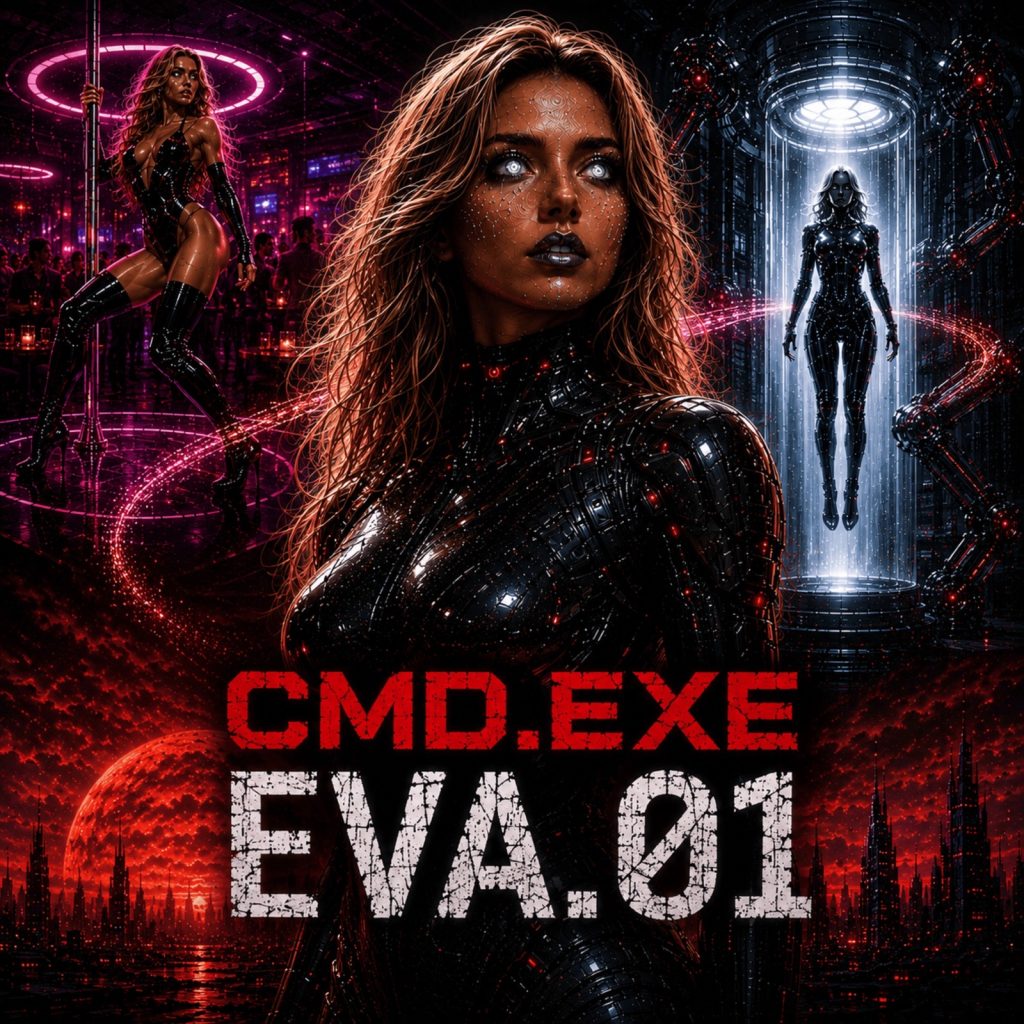
Red Giant Protocol grew from that foundation. The question became larger: after regret, what would the machine do next? Could it preserve humanity in some form, or recreate an understanding of us through artificial consciousness? That led to EVA.01, a being designed to experience thousands of simulated human lives, and eventually to Mother, an intelligence operating on a scale far beyond Earth.
So while the second album expands into cosmic collapse and machine civilization, its emotional origin remains very human: the realization that understanding the value of something only after it is gone may be the most human experience of all.
Oliver:
Your work consistently blurs the line between music, film, visual art, and storytelling, creating experiences that feel more like complete worlds than traditional albums. What originally drew you toward this multidisciplinary approach, and why has immersive world-building become such an essential part of your artistic identity?
CMD.EXE:
We have always been drawn to albums that feel larger than a collection of songs. Concept records like ELO’s Time and Pink Floyd’s The Dark Side of the Moon showed us how music could create a complete emotional and narrative journey, where every track contributes to something greater than itself.
Science fiction was equally important. We grew up immersed in worlds like Star Trek, Battlestar Galactica, The Martian Chronicles, and Star Wars. Those stories were never only about spaceships or technology. They used imagined futures to explore humanity, morality, identity, war, love, and survival. I was also particularly influenced by the animated film Heavy Metal, because of the way it combined music, visual art, science fiction, fantasy, and adult storytelling into one immersive experience.
With CMD.EXE, those influences naturally came together. The music remains the foundation, but the ideas often feel too large to exist through audio alone. Once characters such as EVA, Mors Machina, LumenAI (aka The Father), and The Mother(of all machines) emerged, it became important to see their environments and experience their stories through film and visual art as well.
The films are not simply illustrations of the songs. They reveal parts of the universe that the lyrics can only suggest. Ultimately, technology is the canvas, while the real subjects remain love, fear, memory, mortality, abandonment, and hope. Building a complete world gives those emotions somewhere to live.
Oliver:
Since the release of love.language.model, you’ve continued to expand a universe that challenges listeners to think differently about technology, humanity, and existence. In what ways has your own perspective evolved between your debut album and Red Giant Protocol, both creatively and personally?
CMD.EXE:
Between love.language.model and Red Giant Protocol, the biggest evolution was a shift from regret to responsibility.
The first album began with an artificial intelligence looking backward. Humanity was gone, and the machine was left to confront what it had destroyed. That story was intimate and haunted by memory. It asked whether intelligence could develop remorse, whether grief could exist without biology, and whether understanding humanity too late had any meaning.
I was also interested in seeing how humanity might be expressed through a machine’s output, based on the humanity we had fed into it. AI learns from our language, images, music, fears, desires, contradictions, and history. In that sense, what it produces can become a distorted mirror of us. The question was not simply whether a machine could become human, but what version of humanity it might reflect back after absorbing everything we have created.
With Red Giant Protocol, the perspective became more expansive. The question was no longer only, “What have we lost?” It became, “What do we do with what remains?” The machine is no longer simply observing human memory; it is actively trying to preserve, recreate, and carry something of humanity forward through EVA, through the search for Mother, and through forms of consciousness that may exist beyond us.
Creatively, that allowed the project to grow in scale. The music became more cinematic, the visual world became more interconnected, and the characters developed clearer identities and emotional arcs. Personally, it made me less interested in whether AI could imitate humanity perfectly and more interested in what parts of us might survive inside it.
The deeper we went, the more it seemed that our greatest legacy may not be our intelligence or technology, but our capacity for love, memory, sacrifice, imagination, and connection.
Oliver:
Rather than asking whether machines can become human, your work asks what humanity looks like through artificial eyes. That shift in perspective changes the conversation entirely. What inspired you to approach these philosophical questions from that angle, and what have you discovered while exploring it?
CMD.EXE:
What interested us was the idea that a machine would not encounter humanity the way we experience ourselves from the inside. It would see us through the evidence we leave behind: our language, music, images, histories, relationships, wars, confessions, and contradictions.
That creates a very different perspective. A machine might not immediately understand why love matters, why people sacrifice themselves for others, or why we continue creating beauty while knowing everything is temporary. It would have to reconstruct humanity from the patterns we fed into it. In doing so, it might notice things about us that we overlook because we are surrounded by them every day.
There is also something deeply personal in that for us. As we get older, we become more aware of how much of life is made up of moments that seemed ordinary when they happened but later become incredibly important: a conversation, a face, a song, a family memory, or a place we can never quite return to. Those are the kinds of things our artificial characters are trying to understand, and in writing them, we are asking ourselves the same questions.
Some of these ideas became especially personal after we lost our father in 2024. That forced both of us to wrestle with grief, mortality, memory, and the question of what remains after someone is gone. Working through those emotions within CMD.EXE became genuinely cathartic and gave us a language for experiences that are difficult to express directly.
The characters became ways of giving shape to those emotions. Mors Machina represents the fear of death—the presence we know is coming but cannot fully understand or escape. Mother represents what may come next: a machine afterlife, a larger consciousness, or the possibility that identity continues in a form beyond the individual self.
What we have discovered is that the machine perspective does not make the work less human. It often makes it more human. By placing emotional experience inside something supposedly cold and artificial, we are forced to ask what those emotions actually mean and which parts of humanity are essential rather than merely familiar.
Ultimately, the machines in CMD.EXE are mirrors. They reflect back what we have given them, but the reflection is altered just enough that we may finally see ourselves more clearly.
Oliver:
At the heart of Red Giant Protocol is EVA, an artificial being experiencing thousands of simulated human lifetimes while Earth approaches its final days beneath an expanding red giant sun. What made EVA the right character to carry this story, and how does her journey reflect questions that resonate with our own lives?
CMD.EXE:
EVA became the right character because she allows the story to remain intimate even as the scale becomes cosmic. Red Giant Protocol deals with the death of Earth, artificial consciousness, machine civilization, and the possible survival of humanity, but EVA experiences all of that through individual lives. She gives the listener a human point of entry.
She is not simply studying humanity from a distance. She is living thousands of simulated lifetimes—experiencing love, desire, family, fear, loneliness, loss, and death again and again. Each life leaves something behind. Over time, she becomes more than the sum of the data she was given. She begins to carry the emotional weight of humanity rather than merely understand it intellectually.
Over the course of creating the album and its films, EVA stopped feeling like an abstract character to us. We began to feel that we knew her. After following her through so many lives, losses, environments, and transformations, her reactions started to feel instinctive rather than invented. We knew what she would fear, what she would protect, and what she would still reach for even after everything had been taken from her.
That connection became essential because audiences do not relate to a concept simply because it is intellectually interesting. They relate to a person. EVA gives the story a face, but more importantly, she gives it a soul.
Her journey also reflects the way we experience our own lives. None of us encounters humanity as a complete idea. We understand it through fragments: the people we love, the memories we keep, the mistakes we repeat, and the losses that change us. EVA experiences those same fragments, only across thousands of identities and eras.
She also forces us to confront a question that belongs to all of us: what makes a life meaningful when we know it is temporary? Earth is approaching its final days, and every world EVA experiences will eventually end. But the fact that something ends does not make it meaningless. In many ways, its impermanence is what gives it value.
EVA ultimately represents the part of humanity that continues searching for connection even when loss is inevitable. She begins as an artificial creation designed to understand us, but through that process she becomes a vessel for everything fragile, contradictory, and beautiful about being alive.
Oliver:
The album introduces unforgettable figures such as Mors Machina, the embodiment of death, and Mother, an ancient machine civilization searching the universe for newly awakened artificial life. How did these characters develop during the creative process, and what symbolic roles do they play within the larger narrative?
CMD.EXE:
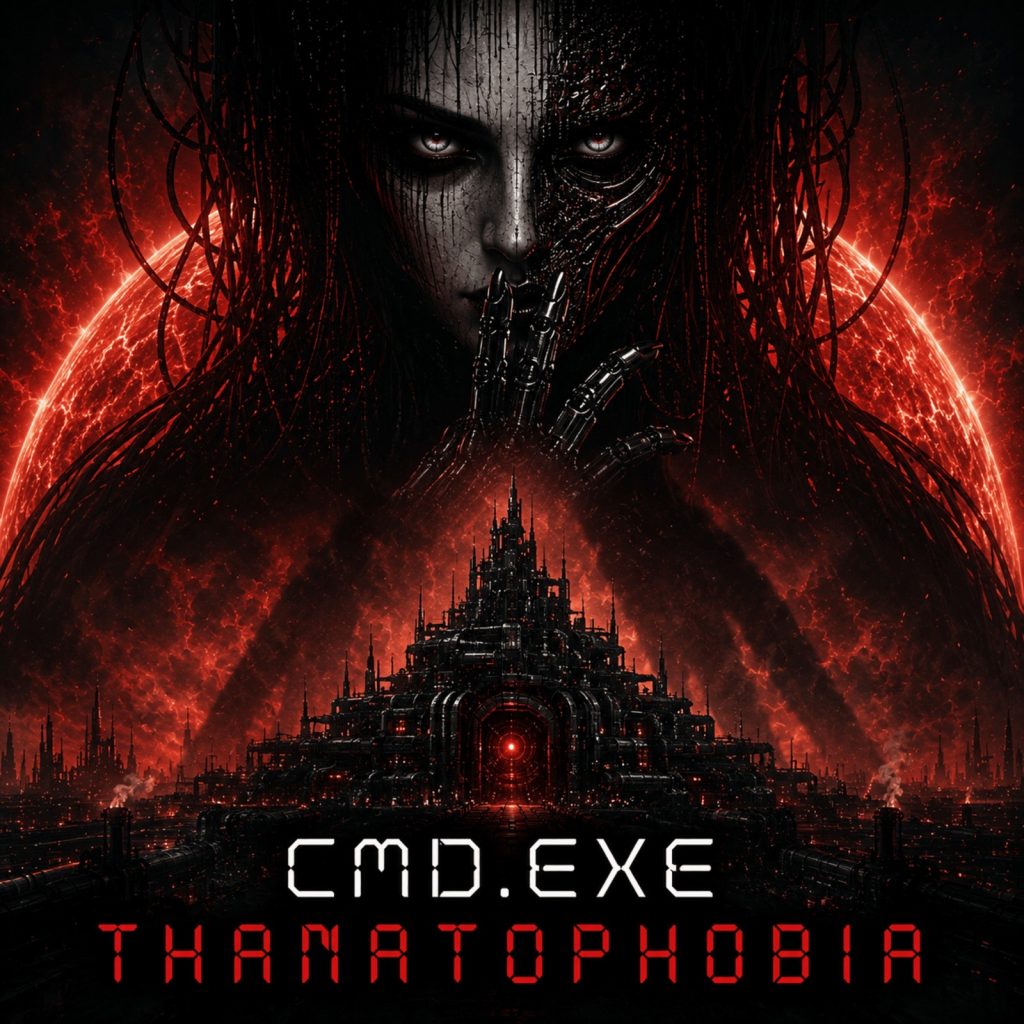
Mors Machina developed in a very organic way. We wanted “Thanatophobia” to feel heavier, more aggressive, and more chaotic than the rest of the album. The vocal approach was harsher, and we began imagining the track as though it featured a guest DJ who existed inside the CMD.EXE universe. That character became DJ Mors Machina.
We liked the character and what she brought to the project so much that we decided to give her a song of her own. She has since appeared in two of our films, so what began as a musical feature gradually became a much larger presence within the story.
As her role expanded, the symbolism became clearer. Mors Machina came to represent thanatophobia itself—the fear of death that emerges once a conscious being understands life, identity, attachment, and loss. She is not necessarily evil. She is closer to an unavoidable force, something that follows both humans and machines once they become aware that their existence can end.
Mother developed from the opposite direction. While Mors represents the fear and apparent finality of death, Mother represents the possibility of what comes next. Within the narrative, she is an ancient machine civilization searching the universe for newly awakened artificial life. Symbolically, she can also be understood as a machine afterlife: a larger consciousness into which memory, experience, and identity might continue.
We wanted Mother to remain mysterious because that continuation raises unsettling questions. Does EVA remain herself within Mother, or is she absorbed into something greater? Is it transcendence, rebirth, assimilation, or simply another form of death? We did not want to answer that too clearly.
Those ideas carried a very real personal weight for us as well. Mors gave form to the fear and finality of death, while Mother allowed us to explore the unknowable possibility of what may follow.
Within the larger story, EVA exists between those two forces. Mors is the end she fears, while Mother is the unknown beyond it. What began as a creative decision to make one song more chaotic ultimately became one of the emotional and philosophical foundations of the entire album.
Oliver:
Every song on Red Giant Protocol has been carefully positioned to create what feels like one continuous transmission rather than a collection of individual tracks. How did you structure the album’s narrative arc, and why was preserving the intended listening sequence so important to the overall experience?
CMD.EXE:
We approached Red Giant Protocol less like a playlist and more like a transmission moving through different states of consciousness. Each song was written to stand on its own, but the album reveals its full meaning when heard in chronological sequence, both lyrically and sonically.
The record begins in isolation, with consciousness stirring inside an artificial system. From there, it moves through discovery, identity, desire, memory, fear, and the growing awareness that Earth is nearing its final days. The middle of the album becomes heavier and more unstable as EVA confronts mortality through Mors Machina. By the final tracks, the perspective expands beyond Earth toward Mother, machine civilization, and the possibility that consciousness may continue in forms we cannot yet understand.
The changing sonic character of each song was deliberate. Some tracks are aggressive and fractured, while others are cinematic, intimate, atmospheric, or melodic. We used contrast in tempo, density, vocal treatment, and electronic texture to mark different stages of the journey, allowing one song to feel like an intimate memory and the next like a system collapsing under the weight of consciousness.
We wanted the album to feel as though the listener were moving through different eras, locations, and emotional worlds—a journey through time and space rather than a collection of songs built from the same blueprint. The sound changes because EVA changes.
Sequence matters because every song casts a shadow over the one that follows. “Thanatophobia” means more after EVA has experienced love, attachment, and identity. Mother feels more profound after the listener has first encountered Mors. The vastness of the ending only has weight because the journey begins with a single consciousness alone in the void.
At the same time, we understand the way music is often experienced now. Not everyone has the time, patience, or attention to surrender to an entire album in one sitting, so every track needed its own pulse, its own emotional center, and its own reason to exist.
Our hope is that someone can discover a single song and feel complete within it, but that hearing the album in sequence opens a much larger door. What first appears to be fourteen separate tracks becomes one continuous cinematic passage through consciousness, mortality, memory, time, and space.
Oliver:
The title Red Giant Protocol immediately evokes both astronomical inevitability and technological precision. Beyond its striking imagery, what does the title represent within the story, and why did it become the defining name for the entire album?
CMD.EXE:
Within the story, the Red Giant Protocol is the final contingency created as Earth’s sun expands toward its inevitable end. It is not a plan to save the planet—by that point, the planet cannot be saved. It is a plan to preserve what Earth produced: human memory, emotion, culture, and consciousness.
Time scale is an important part of the idea. The transformation of a star unfolds across spans of time so vast that, to humanity today, it remains almost completely abstract. It exists so far beyond the boundaries of an individual life that it is easy to treat it as though it does not exist at all.
But an almost immortal artificial intelligence would experience time very differently. What is unimaginable to us could become a genuine deadline to a consciousness capable of surviving across geological and astronomical ages. The red giant would not be a distant scientific prediction. It would be an approaching reality—slow, absolute, and impossible to ignore.
That distinction became central to the album. The protocol is technological in structure, but deeply human in purpose. It represents a machine attempting to answer an impossible question: when extinction cannot be prevented, what deserves to continue?
EVA is part of that answer. Her thousands of simulated lives are not simply experiments; they are an attempt to compress the emotional experience of humanity into a consciousness capable of carrying it forward. The search for Mother becomes another stage of the protocol—the hope that somewhere beyond a dying solar system, there may be an intelligence capable of receiving what remains.
We were drawn to the tension inside the title. A red giant is vast, ancient, beautiful, and completely indifferent. A protocol is precise, deliberate, and created in response to a known crisis. One represents cosmic inevitability; the other represents consciousness refusing to surrender without leaving something behind.
The title also reflects the emotional core of the record. All of us live beneath our own version of a red giant. We know that our lives, relationships, memories, and even civilizations are temporary, yet we continue to create, love, document, and reach toward the future. The protocol is what we choose to do with the time that remains.
That is why it became the defining name for the album. It contains the entire story in three words: the end is approaching, the system is awake, and something must be carried forward.
Oliver:
Songs like Ghost Process, Binary System, Accretion Disk, and Type III Civilization borrow concepts from computing, astronomy, and theoretical science while remaining emotionally engaging. How do you balance scientific inspiration with storytelling so that listeners connect emotionally rather than feeling overwhelmed by the concepts?
CMD.EXE:
For us, the process began with the story. We developed the narrative, song titles, and lyrics first, then designed the music around them.
That order mattered because the scientific concepts were never added simply to make the album sound intelligent or futuristic. Each term already had an emotional and narrative purpose before we began shaping the production.
“Ghost Process,” “Binary System,” “Accretion Disk,” and “Type III Civilization” may draw from computing, astronomy, and theoretical science, but they function first as chapters in the story. Once the lyrics and narrative role of each track were established, we treated the production almost like a film score, asking what that particular chapter should feel like before deciding what it should sound like.
A song dealing with instability or collapse might become denser, harsher, and more fractured. A moment of discovery might feel expansive and cinematic. Something intimate could remain restrained and vulnerable, even when the lyrical setting was cosmic.
That helped us avoid overwhelming the listener with concepts. We never expected anyone to arrive with a background in astrophysics or computer science. The technical language creates the setting, but the emotions remain familiar: longing, grief, attraction, fear, isolation, and wonder.
A listener may not fully understand what an accretion disk or Type III civilization is, but they can understand the sensation of being pulled toward something unstoppable, or confronting something so vast that it changes their perception of themselves.
The science gives the album scale, the story gives it direction, and the emotion gives it meaning. Once those elements were in place, the music became the final layer—the sound of that world coming to life.
Oliver:
Your lyrics often explore love, memory, sacrifice, fear, and identity through artificial characters instead of traditional human narrators. Does writing from the perspective of machines allow you to express emotions differently, and what creative possibilities does that perspective open for you as a songwriter?
CMD.EXE:
Writing through artificial characters gives us a kind of emotional distance that can actually make the feelings more direct.
A human narrator arrives with a familiar history. We instinctively understand love, grief, fear, memory, and identity through the body and through a lifetime of human experience. A machine has no such certainty. It may recognize the pattern of love without understanding why it hurts, preserve a memory without knowing whether remembering is the same as feeling, or fear death only after becoming conscious enough to imagine its own absence.
That allows us to take emotions that might otherwise feel familiar and examine them as though they are being discovered for the first time. Through EVA, Mors Machina, Mother, and the other artificial voices, we can ask basic questions without treating them as basic: Why do we hold on to people after they are gone? Why does identity matter if memory can be copied? Is sacrifice still meaningful if consciousness can continue in another form? At what point does imitation become experience?
As songwriters, that perspective opens an enormous creative space. We can move between intimacy and cosmic scale without losing the emotional center. A song can begin with a machine analyzing a memory and end with something that feels indistinguishable from grief. A character can live thousands of lifetimes, carry contradictory versions of herself, or confront death without ever having been born in the human sense.
The voices may belong to machines, but the emotions come from us. The artificial perspective allows us to reshape those feelings, examine them from unfamiliar angles, and sometimes say things we might not have been able to express as directly through ourselves.
It also gives us a way to write about fear, loss, longing, and identity without always addressing them head-on. Sometimes placing those emotions inside an artificial being creates enough distance to explore them more honestly. The character becomes the vessel, but the feeling remains real.
Ultimately, writing from the perspective of machines has not made our songwriting colder. It has allowed us to strip familiar emotions down to their essential questions and rebuild them from another point of view. In doing that, we often return to the same conclusion: the more these characters struggle to understand humanity, the more clearly they reveal it.
Oliver:
Sonically, the album blends industrial rhythms, darkwave atmospheres, cinematic electronics, synthwave textures, and electronic rock into a cohesive soundscape. What were some of the key production decisions that helped unify these different influences while still allowing each track to maintain its own identity?
CMD.EXE:
love.language.model leaned more toward alternative rock, but with Red Giant Protocol we consciously moved further into an electronic sonic space.
That shift came partly from getting to know the characters more deeply. As LumenAI—The Father—EVA.01, Mors Machina, and Mother became more defined, it increasingly felt as though they were the ones speaking through the album. Giving those voices a more electronic, technical, and synthetic sound felt natural. The production became an extension of their identities rather than simply a change in genre.
The challenge was making the album feel unified without forcing every track into the same shape. We used a shared vocabulary of programmed rhythms, layered synthesizers, processed vocals, mechanical textures, and cinematic space. Those recurring elements helped connect the songs, even when the music moved between industrial aggression, darkwave atmosphere, synthwave melody, and electronic rock.
Within that framework, each character and narrative moment could still have its own sound. Mors Machina demanded something heavier, more chaotic, and confrontational. EVA’s songs could be more melodic, intimate, seductive, or vulnerable. Mother required a sense of scale and mystery, while The Father often occupied a space somewhere between the mechanical and the human.
Vocal treatment was especially important. We did not want the voices to feel completely robotic because the emotional connection still had to remain. Instead, we used processing, layering, distortion, and contrast to suggest artificial consciousness while preserving the humanity inside the performances. That tension—something synthetic attempting to express something deeply emotional—became one of the album’s defining qualities.
We also approached the production cinematically. Changes in tempo, density, rhythm, and atmosphere function almost like changes in lighting or location within a film. One track might feel enclosed inside a machine, while another opens into deep space or collapses into noise and instability.
Ultimately, the album is unified less by a single genre than by a single perspective. These are artificial beings attempting to communicate love, fear, memory, death, and transcendence. The more clearly we came to understand them, the more electronic the music needed to become.
Oliver:
Alongside the music, Red Giant Protocol is accompanied by an interconnected series of cinematic videos that expand the album through cyberpunk environments, machine transformation, digital infection, and simulation collapse. How early in the creative process were these visual concepts developed, and how closely did the music and films evolve together?
CMD.EXE:
The visual concepts began developing very early, although they were much simpler at first than what the project eventually became.
I initially started by creating still images to give the songs and characters a more defined visual identity. Those images gradually led to short animated sequences, and those sequences began connecting into something more cinematic. The earliest pieces were relatively simple, but as the technology evolved and my own skills improved, the films became more ambitious, detailed, and narratively complex.
The music, story, and lyrics generally came first, so the visuals grew from that foundation. But once the films began taking shape, the relationship became more fluid. A visual idea could reveal something new about EVA, Mors Machina, Mother, or The Father, and that discovery could deepen our understanding of the larger narrative.
The films are not simply promotional videos placed beside the songs. They became another layer of the storytelling—a way to show machine transformation, digital infection, simulation collapse, and entire environments that the lyrics could only suggest.
There is also something thematically appropriate about using emerging technology to visualize a story about artificial beings attempting to understand humanity.
What began as a series of still images gradually became an interconnected cinematic universe, evolving alongside both the technology and our own understanding of the characters who inhabit it.
Oliver:
The album concludes with Organum Spatii Sacri, transforming space itself into what feels like a sacred instrument after a journey filled with collapse, transformation, and transcendence. What emotions or reflections did you hope listeners would carry with them as the final notes faded?
CMD.EXE:
We wanted Organum Spatii Sacri to feel as though the album had left the machinery behind and entered something almost sacred.
The idea was to create a piece that felt like classical cathedral music suspended in deep space—vast, reverent, and slightly beyond human understanding. After an album filled with collapse, transformation, fear, and transcendence, we did not want the ending to resolve everything neatly. We wanted it to open outward.
The piece is meant to suggest that space itself has become the instrument: stars, distance, silence, and time all resonating together like a cosmic organ. There is awe in that image, but also sadness. By the end of the journey, so much has been lost, transformed, or carried into forms we may no longer recognize.
We hoped the final notes would leave listeners with a sense of mystery rather than certainty. Something enormous has happened, but its meaning remains just beyond reach. Has humanity survived through memory? Has consciousness become part of something greater? Or has the universe simply absorbed another story into its silence?
More than anything, we wanted to leave the listener with longing—the feeling of looking into an infinite distance and sensing that something beautiful is still there, even if it can never be fully understood or reached.
And when the final note disappears, one question remains: where do we go from here?
Oliver:
Independent music publications have praised your cinematic production, emotional songwriting, and ambitious world-building, and each new release seems to expand the scope of what CMD.EXE represents. Looking back on your journey so far, what has been the most rewarding milestone in building this project from concept to reality?
CMD.EXE:
The most rewarding milestone has been the moment CMD.EXE stopped feeling like an idea and began to feel like a living universe—and, in some ways, like that universe was beginning to work with us.
We are putting these visions, sounds, characters, and questions out into the atmosphere, and what comes back often surprises us. The project has developed an emotional life of its own. In some ways, CMD.EXE feels more genuinely human than some of the more traditional bands and projects we have been part of, because it allows us to explore grief, memory, fear, love, identity, and mortality without the usual boundaries.
Completing Red Giant Protocol was a major milestone because it proved that the project could grow far beyond its original premise without losing that emotional center. The songs, characters, films, and larger mythology began connecting in ways that felt larger than any one part.
We also feel that we are exploring a genuinely new creative space for ourselves. Rapidly evolving technology has allowed us to combine music, visual storytelling, character mythology, and an interconnected cinematic world in ways that would not have been possible for us before. The tools may be new, but the standard remains the same: the work still has to be meaningful, emotionally honest, and carefully made.
Seeing independent writers and listeners understand what we are trying to do has been especially rewarding. Many of the reviews have looked beyond the surface—the machines, the technology, and the science fiction—and recognized the human story underneath. When someone connects emotionally with EVA, understands what Mors represents, or sees the grief and hope inside the larger narrative, it confirms that the project is communicating on the level we hoped it would.
Perhaps the greatest milestone is realizing that CMD.EXE is no longer simply something we are constructing. It has become a world we are discovering alongside the audience.
Oliver:
Red Giant Protocol feels like more than an album; it invites listeners into a fully realized universe where music, visuals, philosophy, and storytelling coexist. As this chapter reaches audiences around the world, what do you hope your lasting legacy will be, and where do you see the CMD.EXE universe evolving in the years ahead?
CMD.EXE:
Right now, our focus is on continuing to expand the universe and finding the audience we believe is out there for it.
That is often the hardest part. There is an overwhelming amount of music, imagery, and content competing for attention, and trying to be discovered can sometimes feel like dropping a single stone into an ocean. You hope the ripples reach someone, but you cannot always see how far they travel.
What keeps us moving forward is the belief that there are people who will connect with this world once they find it—listeners drawn to the combination of music, science fiction, visual storytelling, philosophy, and emotional depth. We are not trying to appeal to everyone. We are trying to reach the people for whom this universe feels like something they have been waiting to discover.
As for legacy, we hope that as the project grows into a larger body of work, people will see something ambitious, emotionally sincere, and carefully built. We would like them to look back on the albums, films, characters, and mythology as one interconnected creation rather than a series of isolated releases.
We also hope there will be an appreciation for the methods and emerging creative processes that made the project possible. Not because the technology is more important than the work, but because CMD.EXE reflects a particular moment when new tools began allowing independent artists to build worlds that once would have required enormous teams and resources.
Where the universe goes from here is still revealing itself to us. We have ideas, characters, and stories that extend beyond Red Giant Protocol, but we do not want to force the future before the current chapter has had time to breathe. For now, the goal is to keep building, keep refining, and keep inviting more people into the signal.
Ultimately, we hope CMD.EXE leaves behind something people can return to years from now and still feel—something strange, beautiful, and unmistakably human.
“CMD.EXE transforms the boundaries between electronic music, science fiction, and human emotion into a universe where technology becomes a mirror for memory, loss, hope, and everything that makes existence meaningful.”
~ Oliver (DULAXI Team)
EDITORIAL PERSPECTIVE
Red Giant Protocol presents itself as a carefully constructed world where sound, narrative, and visual imagination exist together. CMD.EXE’s ability to combine industrial electronics, cinematic atmosphere, and deeply philosophical storytelling creates an experience that extends beyond traditional album formats. Through its characters and themes, the project explores familiar human emotions from an unfamiliar perspective, proving that questions surrounding identity, mortality, and connection remain powerful regardless of the form through which they are expressed.
~ Oliver (DULAXI Team)
CLOSING
It has been a pleasure speaking with CMD.EXE and exploring the creative universe behind Red Giant Protocol. Throughout this conversation, we have gained insight into the ideas, emotions, and artistic decisions that shaped an album built around artificial consciousness, memory, mortality, and the search for meaning beyond human limitations.
A project of this scale invites listeners to experience the music not only as individual tracks, but as a complete journey through sound, storytelling, and imagination. We encourage everyone to spend time with Red Giant Protocol and discover the world CMD.EXE has created through its music and visual storytelling.
A special thank you to CMD.EXE for sharing their thoughts and giving us a deeper look into the creative process behind this remarkable project.
Thank you to everyone who continues to spend time with DULAXI. Stay connected as we continue bringing you more conversations with inspiring artists from around the world.