
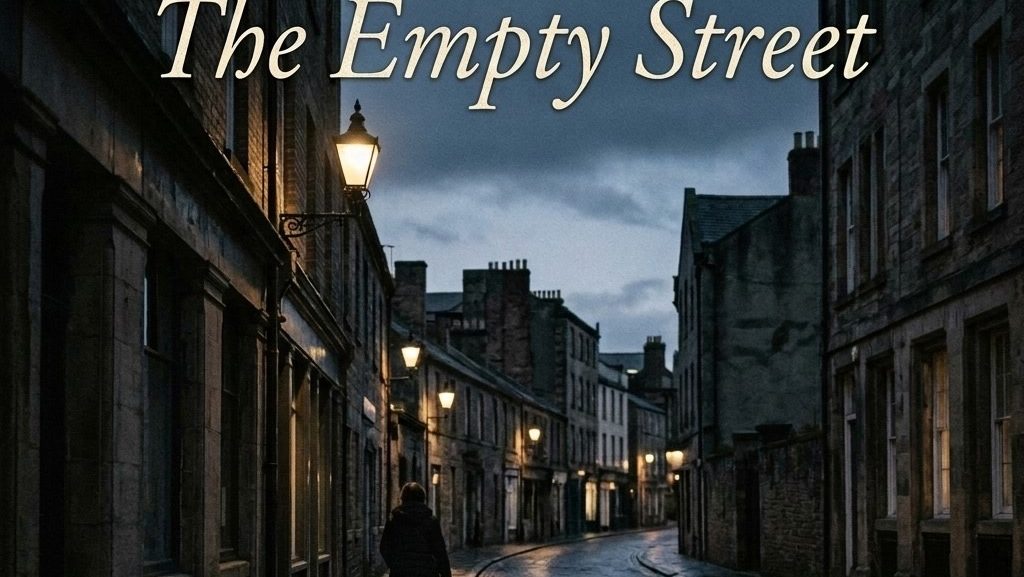
“The Empty Street” by New Sunday is a haunting and deeply atmospheric original single that turns loneliness, grief, and existential uncertainty into an intimate musical experience. Released on June 23rd, 2026, the track immediately establishes a world of solitude through its sombre melodies, restrained pacing, and vulnerable emotional character. There is something striking about how the song creates the sensation of walking alone through a deserted urban landscape, where every surrounding detail seems to amplify the thoughts occupying the mind. Rather than overwhelming the listener with a dense arrangement, New Sunday allows space, silence, and repetition to carry much of the emotional weight. The result is a composition that feels deliberately isolated, placing the listener inside the protagonist’s emotional landscape and making the absence of connection one of the song’s most powerful musical elements.

At the centre of the composition is an interesting creative decision from songwriter Einar Askelsson. Although he explains that he normally uses many chords in his songwriting, “The Empty Street” is built around only four chords. That simplicity becomes an important part of the track’s identity because the emotional movement comes from the melody, arrangement, phrasing, and atmosphere rather than harmonic complexity. Einar’s songwriting process begins with the lyrics already in front of him, allowing the narrative to influence the sound he imagines for each song. This approach is particularly effective here because the music feels constructed around the story rather than existing independently from it. The slow tempo and textured instrumentation create a restrained rhythmic foundation, while lingering notes and carefully maintained space contribute to the song’s claustrophobic yet spacious character. The recurring musical patterns also reinforce the feeling of being trapped inside a cycle of memories and unanswered questions.

Elizabeth Monroe’s vocal performance gives the song its human centre. Her delivery is intimate, fragile, and emotionally exposed, allowing the lyrics to remain at the forefront without sacrificing musicality. There is a weary quality in the vocals that communicates resignation, while moments of increased intensity reveal the deeper desperation beneath the surface. The phrasing is deliberately spacious, giving individual lines room to resonate before the arrangement moves forward. This restraint makes the emotional progression more effective because the song does not need exaggerated vocal theatrics to communicate its themes. Instead, Monroe inhabits the perspective of someone attempting to make sense of profound loneliness, heartbreak, and fear. Her performance complements the stripped-back production beautifully, creating a sense that the listener is hearing private thoughts rather than simply observing a conventional song performance.
The lyrics provide the strongest narrative foundation for “The Empty Street,” transforming its setting into a metaphor for emotional disconnection. The opening image, “I’m walking on an empty street / There’s no one there to meet,” immediately establishes the song’s central feeling of alienation. From there, the narrative moves through memories, anxiety, lost dreams, and heartbreak, creating an increasingly intimate portrait of someone confronting the emptiness surrounding them. References to “sweet dreams that once died” and the persistent “crawling fear” deepen the emotional landscape, while the revelation that “The devil took my true love” introduces a profound sense of loss that changes the weight of everything that came before it. The recurring question, “Is this empty street dead?” leaves the song suspended in uncertainty, making the street feel less like a physical location and more like a reflection of the narrator’s fractured inner world.

The production by Simon Jones plays an important role in preserving that emotional atmosphere. Rather than crowding the composition, the mix allows the instrumental elements and vocals to occupy their own spaces, reinforcing the song’s themes of distance and isolation. The repetitive qualities of the arrangement create a hypnotic effect, while the measured groove keeps the track grounded as its lyrical themes become increasingly heavy. There is also a strong contrast between the nostalgic memory of a “cold night in December” and the present reality of solitude, giving the song a sense of emotional history rather than presenting loneliness as an isolated feeling. Every component contributes toward the same artistic purpose, resulting in a piece that feels cohesive from its lyrical storytelling through its arrangement and final emotional impression.

The Empty Street Is A Haunting Reflection Of Loneliness, Loss, Anxiety, And Existential Uncertainty, Delivered Through Vulnerable Vocals, Sombre Melodies, And Atmospheric Production
~ Faithfulness (Dulaxi Team)
That cohesion reflects the distinctive way New Sunday came into existence. Based in Hafnarfjordur, Iceland, the project was created by Einar Askelsson as a studio focused songwriting collaboration rather than a traditional live band. Einar, first and foremost a songwriter, works with vocalist Elizabeth Monroe and producer and mixer Simon Jones to transform his compositions into finished recordings. His process involves manually constructing songs through Hooktheory, defining the time signature, BPM, key, chords, melodies, structure, and instrumentation before sending the completed instrumental to the vocalist and producer. The collaboration then develops through an iterative exchange until the arrangement reaches its finished form. Einar’s journey into songwriting also gives this creative process particular meaning. After discovering that playing guitar helped him manage difficult mornings during a long period of recovery, music gradually became a creative outlet alongside the poems he had already been writing. Twelve years later, that therapeutic relationship with music has evolved into a refined understanding of songwriting and music theory. “The Empty Street” therefore feels like a natural expression of what New Sunday represents: thoughtful songwriting shaped through collaboration, where personal emotion, narrative, melody, and atmosphere come together to create a quietly powerful reflection on loneliness and loss.
For more information about New Sunday, click on the icons below.