
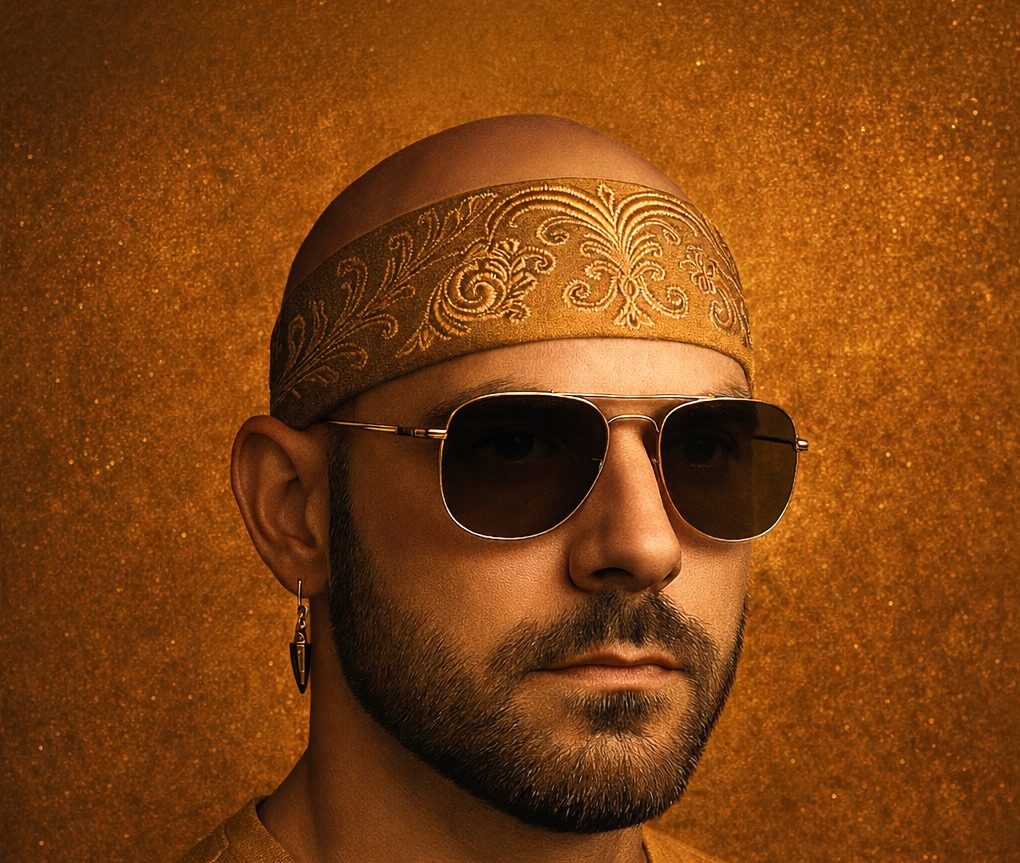
Hello everyone, it’s your host Daniel from Dulaxi, and today I have with me the exceptional songwriter, performance artist, and genre architect Neo Brightwell from Philadelphia, Pennsylvania, United States. And Neo Brightwell is here to discuss his recent lead single “Break Me Like a Promise” which is set for release on June 21st, 2026. So, welcome, Neo Brightwell! But before we begin our interview, to our audience; here is what you need to know about this artist.
Neo Brightwell is a Philadelphia-based songwriter, multilingual poet, performance artist, and genre architect whose distinctive creative vision has given rise to what he calls Moonshine Disco, a compelling fusion of Americana grit, queer gospel, outlaw pop, Disco-Americana, and cinematic storytelling. Renowned for crafting mythic, soul-struck narratives that bridge roots music and rebellion, Brightwell weaves the sacred and the outlaw into a singular artistic voice, creating songs that feel both deeply personal and universally resonant. His lyrics, often described as poetic, haunted, and redemptive, transform lived experience into powerful musical testimony, carrying the conviction of gospel and the honesty of hard-earned truth. Across albums released in multiple languages, he has steadily cultivated a growing international audience spanning the United States, Brazil, Europe, the Middle East, and Southeast Asia, while earning recognition from independent music publications and literary circles for his emotional authenticity, interwoven storytelling, and expansive artistic world-building. His upcoming single, “Break Me Like a Promise,” set for release on June 21st, 2026, serves as the lead offering from his forthcoming album Burn Bright, Stay Free, arriving on November 13, 2026. The song embodies Brightwell’s signature approach to songwriting, turning heartbreak into movement through pulsing basslines, intimate lyricism, and a vocal performance that balances confession, communion, and emotional release. More than a standalone release, the track opens the door to a larger narrative universe where songs echo and evolve across projects, inviting listeners into a long-form journey of vulnerability, resilience, truth, and transformation. Through his genre-defying artistry and emotionally immersive storytelling, Neo Brightwell continues to create music that does not merely ask to be heard, but to be felt, lived in, and returned to long after the final note fades.
Having this brief Introduction about Neo Brightwell, I’m sure new and current fans must be excited about our Interview today.
INTERVIEW SESSION
Daniel: Neo Brightwell is described as a genre-defiant songwriter crafting “Moonshine Disco.” How did you arrive at that sound, and what does the term personally mean to you as an artist?
Neo Brightwell: Moonshine Disco arrived accidentally and then refused to leave.
For years I felt like I was writing songs that belonged in different sections of a record store at the same time. One song wanted the emotional inheritance of country music. Another wanted the physical release of disco. Another was borrowing architecture from poetry. Another was carrying gospel DNA without belonging to any church I recognized.
Eventually I stopped trying to solve the contradiction.
I realized the contradiction was the sound.
The “moonshine” part carries outlaw energy, improvisation, hidden fire, survival outside approved structures. The “disco” part carries movement, collective release, queer joy, sweat, glamour, and the radical act of remaining visible.
Together they create a space where grief and celebration can occupy the same room without apologizing to each other.
More than a genre, Moonshine Disco gave me permission to stop fragmenting myself artistically.
Daniel: Your music blends Americana grit, queer gospel, cinematic storytelling, and literary songwriting. How do you balance those influences without losing the emotional core of your identity?
Neo Brightwell: I don’t spend much time trying to balance influences.
I spend most of my time trying not to lie.
The emotional center has to arrive first. Everything else just shows up to serve it.
I’ve never sat down and thought, this verse needs more Americana or this chorus needs more poetry. Usually I’m trying to understand why a particular feeling won’t leave me alone.
The influences arrive afterward because they’re already part of the way I understand the world.
Country music taught me how to tell stories. Poetry taught me what to leave unsaid. Gospel taught me that repetition can become transcendence.
The emotional core remains the same.
The vocabulary changes.
Daniel: Your work has been gaining attention across multiple regions including Brazil, Europe, the Middle East, and Southeast Asia. What has it been like watching such emotionally personal music resonate with a global audience?
Neo Brightwell: It’s one of the most surprising things that has happened in my career.
I remember opening my listener data and seeing people connecting with these songs in places like Brazil, Ukraine, Egypt, Indonesia, Saudi Arabia, France, and the Netherlands. On paper those audiences have very little in common culturally.
Yet they were responding to many of the same songs.
That taught me something important.
People often assume universality comes from writing broadly. I think the opposite is usually true.
The more honestly you describe a specific loneliness, fear, longing, or hope, the more likely somebody halfway around the world recognizes their own reflection inside it.
A song written in Pennsylvania somehow ends up helping somebody in Cairo, São Paulo, Kyiv, or Jakarta make sense of their own life for three minutes.
I still haven’t found a way to explain that.
I’m grateful I don’t have to.
Daniel: “Break Me Like a Promise” feels deeply vulnerable while still carrying the energy of movement and survival. What emotional experience first inspired the creation of this song?
Neo Brightwell: The song came from a realization that caught me off guard. I had gone through a heartbreak and noticed something strange: life kept happening anyway. I’d be laughing with friends and suddenly remember the loss. I’d be driving somewhere ordinary and feel it arrive again without warning. I’d make coffee, answer emails, hear a song in a grocery store, and there it was again.
The heartbreak wasn’t replacing life. It was living alongside it. That fascinated me.
Most breakup songs stop at devastation. I became interested in the body that keeps moving afterward. The version of ourselves that still dances, still shows up, still chooses participation even while carrying grief. The song lives in that tension, not denial, not recovery, but motion.
Daniel: One of the most striking lines in the song is, “If you leave, leave something honest…If you love me, break me like a promise.” What does that lyric represent to you emotionally and spiritually?
Neo Brightwell: For me, that lyric is a request for reality. Relationships end for all kinds of reasons. That’s part of being human. What leaves the deepest scars is often not the ending itself. It’s the confusion surrounding it. The conversations that never happen. The truths that arrive six months too late.
The lyric asks for something harder. If this is ending, let it end clearly. Leave me with reality instead of ambiguity.
Spiritually, I think there’s a kind of mercy in being fully known, even when the truth hurts. Especially when it hurts.
Daniel: The song asks whether heartbreak can happen honestly rather than destructively. Why was it important for you to explore truth and tenderness instead of bitterness?
Neo Brightwell: Because resentment explains everything too quickly. Life rarely edits itself that neatly. I’ve heard people describe former partners as villains five minutes after telling stories about how deeply they loved them. Most human relationships are far messier than that. I’m interested in the space where affection and disappointment coexist.
Where gratitude survives even after something breaks. As I’ve gotten older, I’ve become less fascinated by assigning blame and more interested in understanding what remains when certainty disappears.
Some of the most compassionate moments in life happen while something is ending. I wanted to write from there.
Daniel: There’s a powerful contrast in the song between heartbreak and dancing forward through pain. How did you approach turning emotional rupture into something rhythmic and alive?
Neo Brightwell: Honestly, I wasn’t trying to transform pain into joy. I was trying to tell the truth about what survival actually feels like.
I’ve spent enough time in queer spaces to know that dancefloors are rarely as simple as they appear from the outside. People arrive carrying grief, fear, loneliness, uncertainty, heartbreak, hope.
Then the music starts. For a few minutes all of those things occupy the same body simultaneously. That’s what interested me.
The rhythm isn’t denying the rupture, the rhythm is carrying it. The beat becomes proof of continuation. The heart is broken, the heart is still beating.
Daniel: “Break Me Like a Promise” serves as the lead single for Burn Bright, Stay Free. In what ways does this track introduce the themes and emotional direction of the full album?
Neo Brightwell: “Break Me Like a Promise” is probably the front door into the emotional world of “Burn Bright, Stay Free”. The album is interested in embodiment. Earlier records often looked outward, toward systems, mythology, survival, collective history, public pressure. This record turns closer to the skin. It asks different questions.
What happens when freedom becomes personal instead of political? What happens when survival is no longer the entire story? What happens when intimacy becomes the risk?
The album still carries Moonshine Disco’s larger themes, but the camera moves closer. The mythology remains, you can see fingerprints on it now.
Daniel: The production is built around pulsing basslines, intimate lyricism, and what feels like a confessional vocal delivery. How did you shape the sonic atmosphere of the record in the studio?
Neo Brightwell: I wanted the production to feel physical, touchable, close enough that listeners could hear breath, hesitation, weight, movement. The bass became important because I wanted the songs to live in the body rather than simply in the head.
Whenever a mix became too polished, I usually preferred the version that still sounded human. More than once I preferred the take where somebody’s chair squeaked or a breath landed imperfectly.
Small imperfections often carry more emotional information than perfection does. The goal was never flawlessness, the goal was presence.
Daniel: Your voice throughout the track feels somewhere between a sermon, a spell, and a late-night confession. Was that vocal tone intentional from the beginning, or did it naturally emerge during recording?
Neo Brightwell: A little of both. I’ve often described my writing as living somewhere between those three traditions. A sermon asks people to stay long enough to understand something. A spell suggests language can alter reality. A confession says: I didn’t know where else to put this truth.
Most of my songs occupy that intersection naturally. By the time I reached the microphone, the voice was already living there. The recording process simply removed some of the distance.
Daniel: Your catalog is described as an evolving long-form narrative where songs echo and transform across albums. How intentional are those connections when you’re writing and sequencing your music?
Neo Brightwell: Very intentional. I think of albums as conversations rather than products. Certain images, questions, tensions, and symbols keep reappearing because life itself revisits unresolved subjects. The songs are speaking to each other across time.
Sometimes listeners notice those connections immediately. Sometimes they only become visible several records later. I enjoy both experiences. I’m less interested in creating isolated moments than building a body of work where each piece changes the meaning of the others.
Daniel: Compared to your earlier releases, what does “Break Me Like a Promise” reveal about where you are emotionally and creatively at this stage of your journey?
Neo Brightwell: I think it reveals greater trust, trust in intimacy, trust in simplicity, trust that a smaller moment can carry enormous emotional weight.
Earlier work often operated on larger symbolic scales. I’m still interested in those spaces, but lately I’ve become fascinated by ordinary moments that quietly contain entire emotional universes.
A conversation in a kitchen, a hand resting on a steering wheel, the silence after someone leaves. Sometimes those moments reveal more than an elaborate mythology ever could.
Daniel: Your music often transforms survival, silence, and lived experience into something poetic and communal. How has your personal journey shaped the honesty listeners hear in your songwriting today?
Neo Brightwell: Over time I became less interested in appearing strong and more interested in being truthful. Life eventually teaches you that performance has limits. At some point you either begin telling the truth or spend enormous energy avoiding it.
I chose the first option. That doesn’t mean every song is autobiographical. It means every song tries to be emotionally honest.
The goal is not self-disclosure, the goal is recognition, I want listeners to hear something and think: I thought I was the only person who felt that way.
Daniel: Many listeners connect with the themes of surviving tenderness, especially queer listeners and people navigating faith, identity, and heartbreak. How important is representation and emotional truth in your art?
Neo Brightwell: Representation matters because visibility matters, but emotional recognition matters even more. I never want people to feel reduced to categories inside the work. I want them to feel seen as complete human beings, with contradictions, desires, fears, tenderness, flaws, all of it.
For many queer people, visibility has historically carried consequences. There is something powerful about creating art that refuses shame without reducing itself to slogans. The goal isn’t simply to be seen, the goal is to remain fully human while being seen.
Daniel: Your lyrics have been described as “scripture carved from firelight.” How do poetry, mythology, and spirituality influence the way you write songs?
Neo Brightwell: Poetry teaches me precision, mythology teaches me scale, spirituality teaches me attention. Together they create a framework for exploring experiences that are simultaneously personal and universal.
I’m interested in the places where ordinary life begins feeling larger than itself.
A kitchen can become a cathedral, a dancefloor can become a form of prayer, a conversation can become a reckoning. Not because reality becomes magical, because reality was already carrying more meaning than we initially noticed.
Daniel: As an independent artist building a distinct world around your music, what challenges have you faced in staying authentic while growing your audience internationally?
Neo Brightwell: The biggest challenge is resisting simplification. The larger an audience becomes, the stronger the temptation to become easier to explain. But I don’t think art exists to become smaller in order to fit available categories.
The challenge is finding clarity without reduction. The practical challenge, of course, is occasionally answering emails across six time zones and forgetting what day it is.
But creatively, I’ve tried to stay committed to the complexity that created the work in the first place. Growth matters, integrity matters more.
Daniel: Since the release of “Break Me Like a Promise,” what reactions or messages from listeners have stayed with you the most?
Neo Brightwell: The messages that stay with me are usually the simplest. One listener wrote that they played the song three times before realizing they were crying. Another told me they danced to it while packing boxes after the end of a relationship.
Those messages stay with me because songs rarely change circumstances. They change how people move through them. Whenever somebody says, “I thought I was alone in this until I heard that song,” I’m reminded why music matters.
Recognition is powerful, especially between strangers.
Daniel: Your music feels designed not only to be heard, but deeply felt and revisited over time. What do you hope listeners carry with them after experiencing this song?
Neo Brightwell: I hope people leave feeling slightly more inhabitable to themselves. Not fixed, not healed. Just more able to remain present inside their own lives.
I hope somebody hears the song on a Tuesday they thought they were going to spend feeling broken and leaves it feeling slightly larger than when they pressed play.
More able to remain open, more able to survive contradiction. More willing to believe that tenderness is not weakness.
If the song creates even a few minutes of that experience, it has done its job.
Daniel: With “Burn Bright, Stay Free” arriving later this year, what can listeners expect from the album that expands beyond what they’ve heard in “Break Me Like a Promise”?
Neo Brightwell: Greater emotional range.
The single explores heartbreak and vulnerability, but the album also moves through desire, freedom, joy, memory, intimacy, resilience, aging, embodiment, and connection.
It’s warmer, more physical, more immediate. The mythology remains, but it’s closer to the skin now.
The record spends less time staring at distant horizons and more time inhabiting the life happening directly in front of us.
That shift changes everything.
Daniel: Looking ahead, what future creative goals, collaborations, or artistic directions are you most excited to explore as Neo Brightwell continues to evolve?
Neo Brightwell: I want to keep expanding the conversation rather than repeating myself. That could mean new musical forms, new languages, literary projects, visual work, theatrical work, collaborations with artists whose perspectives challenge my own. The goal has never been reinvention for its own sake. The goal is continued discovery.
I’m still interested in the same fundamental questions: identity, survival, longing, freedom, belonging, transformation.
I’m just finding new rooms to ask them in.
As long as there are questions I don’t fully understand, I’ll probably keep making things in an attempt to meet them.
Most of the time the answer isn’t waiting in the light. It’s sitting in a chair somewhere beyond it, asking me to come closer.
Having Immersed Myself In The Emotional Honesty And Reflective Heart Of “Break Me Like a Promise,” Here’s My Thought.
Having spent time with “Break Me Like A Promise,” I found myself drawn not only to its heartbreak narrative but also to the remarkable way Neo Brightwell transforms emotional loss into something alive, moving, and strangely liberating. The song is built around a deeply human question, whether love, when it reaches its end, can leave behind honesty instead of illusion, and every aspect of the composition serves that purpose. Brightwell’s vocal performance feels intimate and unguarded, existing somewhere between a confession, a sermon, and a late-night conversation with oneself. There is a raw sincerity in the way he delivers each line, allowing vulnerability to become the emotional engine of the track rather than a fleeting sentiment. Lyrically, the song explores the fragile territory between devotion and departure, confronting heartbreak without bitterness and choosing truth over comfort. Musically, the track flourishes through its smooth Americana folk identity, anchored by warm acoustic guitar work that carries the harmonic foundation with gentle, flowing strums. The tender percussion adds a subtle pulse that keeps the song moving forward without disturbing its reflective atmosphere, while the pulsing bassline introduces a quiet sense of momentum that mirrors the emotional resilience embedded within the narrative. I particularly admire how the production embraces restraint, giving every instrument room to breathe and allowing the emotional weight of the song to emerge naturally rather than through dramatic flourishes. The interplay between acoustic textures, understated rhythm, and Brightwell’s expressive vocal presence creates a soundscape that feels both grounded and cinematic. What resonates most is the song’s refusal to collapse under the weight of heartbreak; instead, it turns pain into motion, loss into rhythm, and vulnerability into strength. “Break Me Like A Promise” is a beautifully crafted piece of songwriting that proves heartbreak does not have to end in destruction, it can become a pathway toward clarity, acceptance, and emotional truth, all while maintaining an irresistible sense of movement and grace.
~ Daniel (Dulaxi Team).
Finally to our audience, I urge to listen to “Break Me Like A Promise”, add it to your playlist and be inspired by it and, on behalf of Dulaxi I like to appreciate you all by saying thank you everyone, See you on our next interview.
For more information about Neo Brightwell, click on the icons below.