
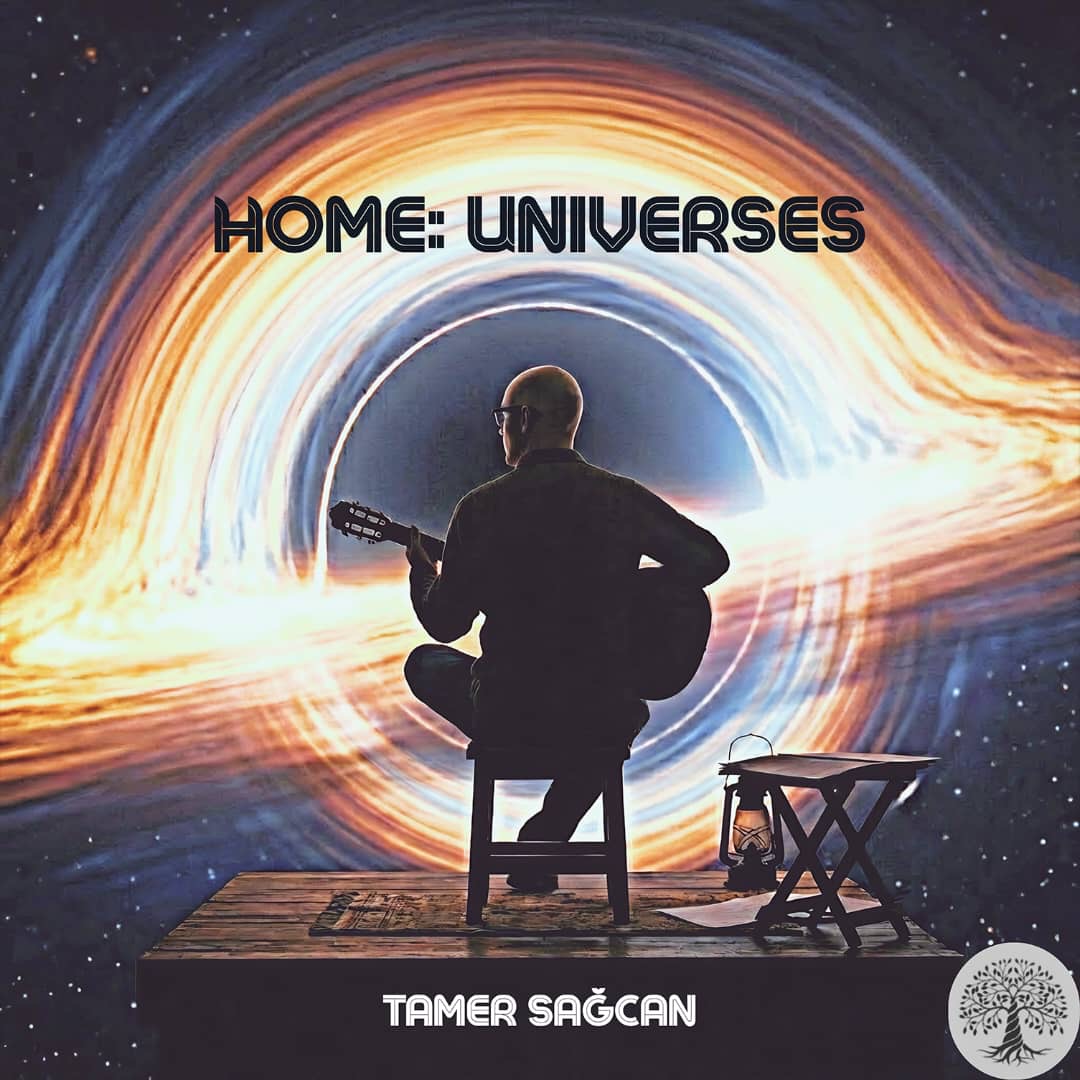
Tamer Sağcan’s “Home: Universes” released 24th April, 2026 presents itself as a cinematic expansion of his ongoing Home Trilogy, functioning less as a conventional album and more as an evolving sound-world. Positioned as the second chapter, it deepens the conceptual framework introduced in Home: Roots, shifting from intimate familial reflection into a broader cosmological inquiry. Across thirteen instrumental compositions, Sağcan constructs a listening experience rooted in neoclassical guitar, ambient design, and cinematic orchestration. The result is an immersive continuum where structure dissolves into atmosphere, and each track feels like a passage through an unseen dimension rather than a discrete composition. It is meditative yet expansive in scope, designed to unfold gradually rather than demand attention.

At its core, the album is defined by the classical guitar, which functions as both anchor and narrator within vast atmospheric architectures. Sağcan’s phrasing is precise and unhurried, often unfolding in modal progressions that resist traditional resolution, reinforcing a sense of uncertainty and exploration. Surrounding these guitar lines are layers of orchestral and ambient textures that behave less like accompaniment and more like environmental forces, shifting, swelling, and receding like cosmic weather. The production favors depth over immediacy, allowing silence and resonance to become compositional elements in their own right. Dynamic movement is subtle but deliberate, guiding the listener from near-intimate acoustic spaces into dense cinematic saturation. Even at its most expansive, the music retains a fragile human core, ensuring emotional clarity remains intact within abstraction.
Home: Universes Album Track Reviews:
Enterstellar:
“Enterstellar” opens “Home: Universes” as a restrained yet immersive entry into Tamer Sağcan’s expansive sonic world. Built around delicate classical guitar arpeggios, the track uses generous ambient reverb to suspend each note in a floating, weightless space. Rather than relying on traditional rhythm, it unfolds through pulse-like phrasing where silence becomes an active structural element, shaping the flow as much as the sound itself. Harmonically, the piece remains sparse and open, centered on modal ambiguity and unresolved chord voicings that evoke quiet curiosity rather than resolution. As it progresses, soft synthetic pads and distant atmospheric layers gradually emerge, expanding the sonic field without disrupting its calm center. These additions feel like distant cosmic signals forming on the horizon, suggesting movement beyond the audible. Dynamics stay subtle throughout, with emotional intensity building through layering rather than volume. The result is a sense of weightless emergence, as though awareness is awakening mid-motion within an already unfolding universe.
Eridanus:
“Eridanus” deepens “Home: Universes” into a darker, more introspective sonic landscape, shifting away from the luminous openness of “Enterstellar” toward a grounded sense of cosmic uncertainty. The track is anchored by low-register classical guitar motifs that feel more deliberate and structured, moving through minor tonal centers and unresolved cadences that resist emotional closure. Unlike the floating sensation of the opening piece, here the phrasing carries a subtle rhythmic intent, suggesting navigation through an unseen vastness rather than departure into it. Beneath the guitar, ambient orchestration thickens into slow-moving harmonic beds that feel gravitational, pulling the listener inward rather than outward. A defining characteristic of the composition is its use of negative space, where silence becomes tension rather than absence, suspending each phrase in anticipation. The emotional tone is introspective without becoming melancholic, instead evoking existential uncertainty shaped by scale and distance. “Eridanus” transforms exploration into a psychological experience, where space feels immense, indifferent, and profoundly unknowable.
Gravity:
“Gravity” serves as the emotional anchor within this sequence on “Home: Universes,” shifting the focus from cosmic expansion to intimate inward reflection. Built around warm, close-miked classical guitar, the track emphasizes tactile detail and human presence, allowing each pluck and resonance to feel immediate and unguarded. Its harmonic language is intentionally simpler than the surrounding compositions, relying on gentle, repeated tonal resolutions that evoke the sensation of returning home after moments of drifting uncertainty. Rather than emphasizing spatial vastness, the piece draws attention inward, creating a grounded emotional center within the album’s broader cosmological narrative. The arrangement remains sparse throughout, with soft ambient pads and faint harmonic echoes appearing only to support the guitar’s phrasing rather than expand it. This restraint produces a sense of controlled stillness, where motion feels reduced to the rhythm of breathing. Flowing in rubato rather than strict meter, “Gravity” prioritizes emotional elasticity over structure. Its power lies in contrast, offering reflection, stability, and human balance within an otherwise expansive sonic universe.

Aeterna:
“Aeterna” serves as a resolved yet expansive emotional culmination within “Home: Universes,” offering not a dramatic finale but a gentle dissolution into continuity. The classical guitar returns as the central voice, though its character feels transformed, shaped by a more open tone, extended reverb tails, and layered harmonic resonance that expands its spatial presence. The composition unfolds through long-form phrasing, allowing each musical idea to fully decay before the next emerges, reinforcing a profound sense of timelessness and suspended perception. Harmonically, it leans toward subtle major-mode resolution with delicate modal inflections, creating warmth without slipping into sentimentality. This balance gives the track a feeling of arrival that resists final closure, instead suggesting integration into a larger, ongoing whole beyond narrative structure. Ambient layers are refined to near translucency, with soft orchestral pads, faint harmonic shimmer, and sustained textures that blur the boundary between sound and silence. Emotionally, “Aeterna” embodies acceptance of infinite continuity, where home becomes not a destination but a distributed state of being across memory and space.
Itinerarium:
Itinerarium is a masterclass in atmospheric minimalism, functioning as a deliberate, immersive soundscape that prioritizes texture over traditional song structure. As part of the Universes project, the track eschews conventional rhythm or complex melodic progression, opting instead for a hypnotic, slow-evolving electronic foundation that evokes a profound sense of space and internal exploration. The composition operates as a sonic meditation, creating a meditative environment that demands deep, focused listening from its audience. The track functions as an immersive electronic soundscape that prioritizes texture, ambient space, and a slow, hypnotic development over traditional song structures. By stripping away the human voice, the composition allows the listener to fully engage with the layered electronic environment, which evokes a sense of vast distance and internal reflection. The music relies on steady tones, creating a meditative experience that centers purely on the power of the instrumentation to guide the listener’s journey.
Ex Nihilo:
Ex Nihilo is a profound exercise in minimalist, ambient electronic music, masterfully crafting an atmosphere of vast, empty space that slowly unfolds into complexity. The production prioritizes textural depth, utilizing layered synthesizers and subtle, evolving rhythmic pulses to build an immersive, meditative soundscape. By avoiding traditional song structures, the track invites the listener to lose themselves in the deliberate interplay of lingering drones and delicate, percussive flourishes that mirror the concept of creation arising from nothingness. The emotional resonance of the piece is found in its precise, patient pacing and the intricate management of sonic density. Rather than relying on melodic hooks, the composition creates a sense of movement through the gradual layering of sounds, providing a feeling of expansion and contraction that feels both mechanical and deeply organic. The final, soft conclusion serves as a point of resolution, leaving behind a lingering, introspective quietude that cements the track as a powerful, singular experience in atmospheric sound design.
Beyond its sonic language, “Home: Universes” functions as part of Sağcan’s broader Eleyrrha Universe, connected to his 19-book science fiction saga The 19th Phase. Serving as an unofficial soundtrack to ANAD, it embeds musical ideas within a layered cosmology inspired by Altaic mythological structures and the concept of a seventeen-layered universe. Each composition operates as a narrative node within a larger existential map, where sound becomes storytelling through tone, atmosphere, and symbolic resonance rather than linear narrative. The album invites the listener into a mythic framework where meaning is felt rather than explained, and where music acts as a bridge between imagination and structure.
Home: Universes Is A Cinematic Instrumental Journey Exploring Cosmic Vastness, Emotional Intimacy, And The Search For Meaning, Where Sound Becomes A Living Space Of Reflection And Continuity
~ Faithfulness (Dulaxi Team)
Tamer Sağcan is an Ankara-based composer, classical guitarist, novelist, and legal professional whose artistic journey began with guitar lessons at sixteen and evolved through decades of composition written alongside a legal career. What began as private musical sketches gradually expanded into the foundation of his creative identity, now fully realized through the Home Trilogy. “Home: Universes” stands as its most expansive chapter, continuing his transformation of long-held compositions into a living, interconnected artistic universe that merges music, literature, and cosmology into a unified expressive vision.
For more information about Tamer Sağcan, click on the icons below.