
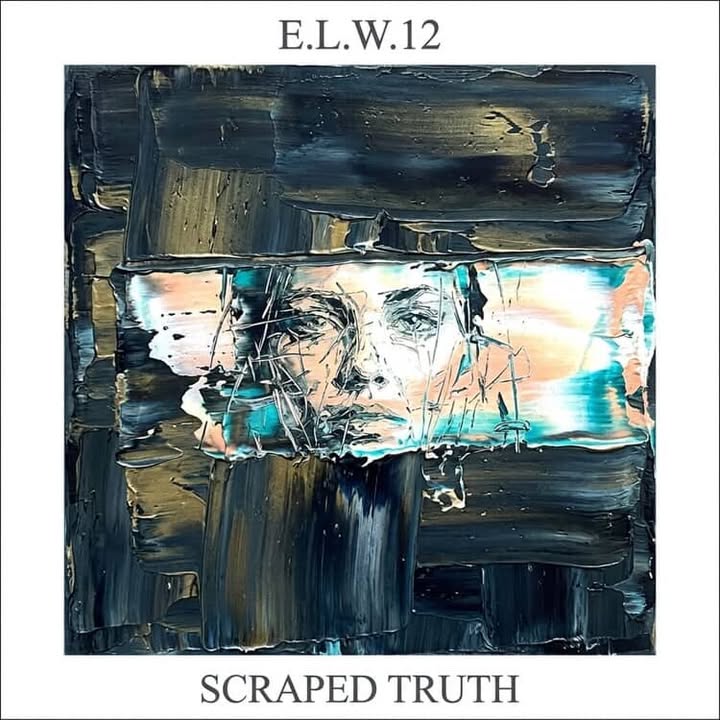
Hello everyone it’s your host Daniel from Dulaxi, and today I have with me the exceptional E.L.W.12 from Markkleeberg, Germany. And E.L.W.12 is here to discuss the release of his highly anticipated album “Scraped Truth” which will be released on June 5th, 2026. So, welcome, E.L.W.12!. But before we begin our interview, to our audience; here is what you need to know about this artist.
E.L.W.12 emerges from Markkleeberg, Germany, as a deeply introspective and authenticity-driven electronic artist whose work is rooted in personal exploration, emotional honesty, and a deliberate departure from polished mainstream conventions. Shaped by early influences from bands like Erasure and Depeche Mode yet ultimately transformed by the raw vulnerability of the independent music scene, E.L.W.12 crafts melodic pop-infused electronic soundscapes that prioritize feeling over perfection, using music as a vital counterbalance to everyday life and a medium for processing lived experiences. Following the release of his debut album “Fast Lane” on November 14, 2025, which introduced listeners to his self-expressive and emotionally resonant style, he returns with “Scraped Truth,” set for release on June 5th, 2026, an ambitious and unflinching body of work that encapsulates his artistic philosophy of stripping away societal illusions to reveal uncomfortable, often overlooked realities. Created primarily within a home studio using modern digital tools yet guided entirely by his own creative vision, the album marks a significant evolution in his process through the incorporation of genuine vocal productions and a groundbreaking long-distance collaboration with a vocalist over 8,000 kilometers away, reinforcing his belief in emotional connection beyond physical limitations. At its core, E.L.W.12’s artistry is defined by fearless observation and reflection, translating themes such as moral fragility, societal pressure, and the quiet disintegration of identity in an overstimulated world into immersive sonic narratives, with standout moments like “Fighter in a cap” and “This is not love (Fading Signal)” embodying the emotional depth and philosophical weight that define both the artist and his uncompromising musical journey.
Having this brief Introduction about E.L.W.12, I’m sure new and current fans must be excited about our Interview today.
INTERVIEW SESSION
Daniel: As an artist emerging from Markkleeberg, Germany, what
defining moments in your personal journey gave you the confidence to finally share your music with the world?
E.L.W.12: Many years ago, I was part of a band, but I was always the introverted one in the background. I was the one writing the songs while the others took the stage and engaged with the audience. When I left the band, I walked away from music entirely.
The turning point didn’t come until last summer, triggered by a very painful event
involving a close friend that I do not wish to dwell on further. Anyone who listens to
my first single Sticks & Stones might be able to sense that pain. In that moment,
music suddenly became a necessity again, a way to process what was happening
and to find a language for the unspeakable. That ultimately gave me the courage not just to make music again, but to make my thoughts accessible to others. I hope to create a moment for listeners to reflect on these things.
Daniel: Your sound draws influence from bands like Erasure and Depeche Mode, how have these inspirations shaped your emotional and melodic approach to electronic pop?
E.L.W.12: To be honest, I do not see any direct influences from Depeche Mode or Erasure in my music. I feel it would be quite presumptuous to place myself anywhere near them.
These artists are unreachable icons to me who have accompanied me throughout my life, but my own sound follows a different path. Perhaps my preference for their
melodies flows in somewhere subconsciously, but there is no conscious decision to sound like them. My focus is more on finding my own electronic language that draws from my very personal experiences.
Daniel: You emphasize authenticity over commercial appeal; how does that philosophy guide your decisions when creating and releasing music?
E.L.W.12: To me, authenticity and success are not mutually exclusive at all. In fact, I believe that truthfulness is the actual key to truly reaching people. There is no guaranteed formula for planning success anyway, so I prefer to focus on what I can actually control. That is my music and the honesty within it. In practice, this also means that I do not submit to the typical rules of streaming. I do not want to sacrifice song intros or the building of moods just to avoid being skipped after ten seconds. Nor will I shorten songs to under three minutes simply because attention spans seem to be exhausted by then. I might consciously lose some listeners that way, but I accept that. I am a rather quiet and reflective person, so this kind of authenticity flows into my work naturally. My goal is for the music to reach the right people.
Daniel: “Scraped Truth” is described as an unflinching examination of uncomfortable realities, what core message did you want
listeners to confront through this album?
E.L.W.12: My goal is not to depress the listener, but rather to break through a certain sense of complacency. I want to encourage people to think more deeply about things, to form their own opinions and then to stand by them, even when it gets uncomfortable. But the album is not just heavy material. To me, it is a mixture of very serious themes and moments of lightness. Scraped Truth means peeling away the superficial layers to get to the core, but life consists of both, the harsh realities and the brighter moments. Perhaps the core message is simply an invitation to look closely and not be satisfied with easy answers.
Daniel: The title itself suggests peeling back societal facades; can you explain how this idea is translated into the album’s lyrics and themes?
E.L.W.12: The idea for the title came about through a collaboration with a graphic designer friend. After hearing the songs, he created images in the style of Gerhard Richter; abstract graphics with thick, layered coats of paint. To me, these images felt as if they were trying to cover something up in every song. This is exactly what I observe in our society every day: we cover up truths so we do not have to get to the core of the matter. In my lyrics, I try to peel back these facades. I choose a very direct language, avoiding flowery metaphors, to contrast appearance with reality. A song like “This Is Not Love” does exactly that: it takes the facade of a supposed relationship and exposes the underlying violence. For me, music is like the designer’s palette knife, used to make the hidden truth visible again.
Daniel: Tracks like “Fighter in a cap” carry deep personal weight, what specific emotions or experiences shaped this standout moment?
E.L.W.12: Fundamentally, my songs are not autobiographical. Personally, I am a very happy and content individual. However, I seem to have sensitive antennae for the struggles and conflicts in my environment or during brief encounters. Many song ideas arise from observations, reading articles, or watching reports. Sometimes I notice that a topic gets stuck in my mind and occupies me for quite a while. That is usually the point where the topic is in great danger of ending up in a song. With these tracks, I often know from the very beginning exactly how they should sound. That is certainly not always as easy with the 25th song about love.
“Fighter in a Cap” is the prime example of this. The song was created after just a few
seconds of eye contact with a young woman on the street. I did not know her, but in her gaze, I sensed an enormous strength in the midst of a serious health challenge.
My real driving force is a deep sense of empathy. Even if it may sound unrealistic, I
would love to take away the pain or injustice from anyone finding themselves in a difficult situation. I feel for the victims and the vulnerable who need support. However, there is a clear other side to this for me: while I treat every person with respect, even if I do not share their views, I feel the utmost contempt for people who use, hurt, or humiliate others. Music is my way of expressing this solidarity with some and clear rejection of others. This album is my attempt to translate this deep humanity and the associated anger over injustice into sound.
Daniel: “This is not love” (or “Fading Signal”) questions interpersonal norms, what inspired you to challenge these
commonly accepted ideas?
E.L.W.12: With This Is Not Love, the impulse came from conversations with my wife about her work in the social sector, which gave me insights into human struggles that shook me deeply. In such moments, it becomes clear that the core problem is often the silence: many victims find no way to speak about their experiences because shame or manipulation isolates them. I see my role as taking a stand and giving the affected individuals a voice. At the same time, it is a clear message to the perpetrators: your tactics, whether gaslighting or isolation, do not remain hidden, and there is no justification for them.With Fading Signal, on the other hand, it is about a very personal experience. About three years ago, I myself was far beyond a red line professionally. During the day, I functioned perfectly and maintained the facade, but at night, massive doubts arose about how I would even manage the next day. I didn’t tell anyone the truth back then, not even those closest to me, because I absolutely did not want to appear weak. I’m sure I was often unbearable during that time, but that was preferable to me than revealing my perceived weakness.Fortunately, I found a way out of this crisis, but today I see many people who are likely stuck in exactly this phase. Through my own experience, I know the internal battle they are fighting with themselves. Even if they cannot or do not want to reveal themselves, one can often exert a conscious influence and relieve some of the pressure on these people without requiring a direct admission. My goal is to sharpen the perception of how we can make the path to a solution easier for each other without exposing anyone.
Daniel: Across the album, themes like fading in an overstimulated world and fragile morality appear, were there any particular lines or lyrical moments that you feel capture this essence most powerfully?
E.L.W.12: There are four moments on the album that make these themes almost physically tangible for me.Regarding the theme of overstimulation and fading in this world, these lines stand out: ’Mouth moves in the mirror / Lagging by a frame’ from Fading Signal. This line describes that technical and deeply human moment of burnout. You are still functioning like a machine, but your inner self is delayed. Both temporally and emotionally; you are no longer in sync with yourself.
’You’re reading every flinch / Like subtitles on my bones’ from See-Through Skin. In a world trimmed for perfection, this describes the extreme opposite: a radical honesty where you no longer have a protective layer, and every tiny tremor becomes readable to others.
As for fragile morality, these lines capture the essence of the album: ‘I used to think
rules were like railings to hold / now they’re lines in the sand’ from And What Part Of This Is Me?. For me, this is the most powerful image for the loss of values. Things you used to hold onto have become fleeting today, vanishing with the next gust of wind.
‘I’m shrinking to fit in your frame’ from “This Is Not Love”. This line shows how fragile one’s own moral integrity becomes when lost in toxic structures. You give yourself up piece by piece to fit into a frame imposed on you from the outside.
These moments represent the ‘Scraped Truth’ for me. They expose the places where it hurts, but also where we are most honest.
Daniel: Your production process involves deconstructing and rebuilding sounds using modern DAWs, how do you balance technical experimentation with emotional storytelling?
E.L.W.12: To be honest, I see my technical skills as being in a state of intense transformation. After my last album, it was clear to me that I had to evolve musically, and that journey is far from over. One of the biggest challenges has been moving away from the heavy AI influences of previous releases. It’s a tough road because I have to compensate for a lack of experience, patience, and, I’ll say it quite openly, talent with sheer dedication. For me, a modern DAW isn’t an end in itself; it’s simply the tool that allows me to travel this path in the first place Sometimes it feels almost ‘backwards’ with me: I have the lyrics and the emotional vision first, and then I struggle to layer the right music underneath. I’m right in the middle of a learning process, figuring out how to expand my skills to support these stories sonically as precisely as possible.
Even though I enjoy the fact that ‘ear and heart’ always come before complex music
theory for me, I want to eventually unite and correctly use all the skills in my toolkit.
Technical experimentation is essentially an attempt to push my own boundaries and deficits bit by bit, so that the music can eventually match the depth of the lyrics.
Daniel: This project marks your first use of genuine vocal productions instead of samples, how did that shift impact the
overall sound and depth of the album?
E.L.W.12: I am deeply convinced that the shift to ‘genuine vocals’ was the single greatest catalyst for the evolution of this album. I am infinitely grateful to Tise and Rebecca for embracing this experiment, as it changed everything. But of course, I was suddenly faced with problems I had never encountered before. With samples, everything is static and perfect, but with real recordings, different opinions on interpretation suddenly clash. You struggle with the sonic integration, often the vocals are far too ‘dry’ compared to the electronic music. The timing isn’t as perfect as a machine’s, and you have to painstakingly find the right balance.This became particularly clear through the different ways of working: Fortunately, I was able to spend many hours on-site with Tise, honing the nuances directly. In contrast, the song with Rebecca was created remotely without us ever meeting. We couldn’t just re-record a line on the fly.
There were moments in that process where I was so frustrated that I almost gave up on the song.
In the end, however, I feel that these voices are exactly what give the songs their true character. I don’t know if it’s just me because I know the difficult road we took to get here, but I truly hope the listeners can feel that extra depth and soul. It’s this human touch that turns a production into a genuine conversation.
Daniel: The long-distance collaboration with a vocalist over 8,000km away is remarkable, what creative and technical challenges did you face, and how did you overcome them?
E.L.W.12: The collaboration with Rebecca was one of the greatest creative tests of my career so far. 8,000 kilometers of distance isn’t just a number on a map; it means the complete absence of the immediate energy you usually share in a studio. The biggest challenge was communication. When you aren’t sitting across from each other, it’s almost impossible to explain subtle nuances in interpretation. I would send her versions, she would send back recordings, and initially, our visions were far apart.
There was a point where I was so frustrated that I almost gave up on the song because we just couldn’t find a common language and I was hitting my technical limits. But why didn’t I give up? Because as soon as I heard Rebecca’s voice, I saw the scenes of the song playing out before me. For me, she perfectly embodies that sincere, vulnerable person who loves too much and therefore remains silent about the things that bother them. Combined with her wonderful vocal timbre, there was exactly that touch of uncertainty that I associate with our story. What saved this process was our human connection. From the very beginning, we had a very
pleasant, respectful, and trusting exchange. That was the foundation that allowed me to learn to let go of control. Instead of forcing Rebecca into my rigid mold, I began to see her interpretation as a unique quality in itself. Even though we have never met and much remained ‘in a fog,’ a real connection has grown: we still write to each other very regularly in a truly wonderful way. Perhaps that is exactly where the magic lies. With this song, I can best understand how it feels to a listener because I feel much the same way: I am listening to someone who is familiar and likable, yet remains somewhat of a mystery.
Daniel: You’ve described music as a counterbalance to your professional life, how has that duality influenced your discipline and creativity as an artist?
E.L.W.12: This duality is actually the engine behind everything. My professional life often requires structure, logic, and clear decisions. Qualities that give me the necessary discipline to stick with my music as well. However, I keep both worlds very distinct: my job is the daily ‘duty,’ whereas music is the ‘freestyle’, the creative reward. In music, I am allowed to do everything that has no place in my professional routine: I can doubt, experiment, and above all, make mistakes. There are no ‘red lines’ here, except for the ones I set for myself. Sometimes, duty leaves less room for the freestyle than I would like. But since no one is pushing me, I simply accept that. The time I spend with music is incredibly beneficial for finding a clear boundary between these two lives. But one thing must not be overlooked: besides work and music, there are the most important people of all; my family. They deserve the most space and come before everything else. For me, the true art of discipline is managed by doing justice to all three areas without losing myself. Music is the valve that helps me stay balanced and focused.
Daniel: Discovering the independent music scene seems to have transformed your perspective, what lessons from those
underground artists reshaped your identity?
E.L.W.12: Discovering the independent music scene has profoundly influenced my thinking in two specific ways. First, these artists are incredibly approachable. You enter into a genuine, natural exchange. Since I often doubt what I’m doing, it’s a wonderful experience to suddenly receive feedback from someone whose own work I deeply respect and who has the professional competence to truly help me grow. That gives me a tremendous sense of confidence. And it’s just as rewarding to return the favor: being able to offer suggestions myself or simply provide another artist with much needed motivation. It’s a reciprocal relationship based on eye-level communication.
Second, I deeply value the strong solidarity within this community. There’s no room
for envy here. We genuinely celebrate each other’s completed works, playlist placements, or streaming milestones. This kind of openness, sincerity, respect, and
solidarity has shaped my artistic identity, because it showed me how vital a supportive environment is. But it goes beyond music: actually, this is exactly the kind of behavior I would like to see more of in many other areas of our society. In the indie scene, I found what often seems to be lost elsewhere.
Daniel: Your work reflects bravery and vulnerability, was there a
moment during this project where you had to push past personal hesitation to stay true to your vision?
E.L.W.12: In terms of content, I never really had any personal reservations. Even though the album emanates a deep vulnerability, I don’t see that as a flaw. In a polished world full of feigned perfectionism, bravery and vulnerability are much more important attributes to me for showing personality and strength on every level. My real hesitation lay elsewhere: how far can I go when speaking for others? Can I presume to speak in the voice of victims whose pain and trauma I have never experienced firsthand? A concrete example is Graveyard of Morality. The song centers on the Epstein scandal, for me, one of the most heinous criminal complexes of recent decades. I am disgusted by the hypocrisy with which this scandal is covered up in high social circles. It is an unbearable spectacle of victim-blaming, denial, and cowardly lies, even though the names of those responsible are actually known. My hesitation was about whether I, as an outsider, had the right to address this trauma so explicitly. It felt borderline. But ultimately, my decision was clear: I do not want to be part of the silence. When justice fails and perpetrators are protected, the least I can do is take a clear stand. With this album, I shed that hesitation even more consistently, following the path of radical honesty I’ve always pursued to its very limit.
Looking away was simply no longer an option for me.
Daniel: Compared to your debut album “Fast Lane,” how would you describe your artistic evolution leading into “Scraped Truth”?
E.L.W.12: First, I have to gently correct you on the chronology, With the pace of my releases, it’s easy to lose track! My debut album was Noir Circuit, followed by Artificial Love (which features Fast Lane) and Unfiltered.
The evolution toward Scraped Truth was, above all, a journey away from my own
impatience. In the past, I often felt driven; for this album, I deliberately took much
more time. A decisive factor was Tise Henriksen. We met in January and found a
wonderful foundation for collaboration. While on previous albums I still felt a longing to follow only my own ideas in my quiet little room without outside comment, I truly enjoyed Tise’s input on this project. He influenced and enriched my work significantly.
This also involves a certain musical maturity: I had to ask myself whether I really wanted to force attention for a song with too much bass pressure and inconsistent flows, or whether ‘a little less of everything’ actually gives the song more in the end.
I’ve already touched on the other important technical differences, such as moving
away from AI influences and the shift to genuine vocals, in our previous points. In
conclusion, I believe every album and the time in which it is created has its own story and is, ideally, an evolution. I think every artist sees it that way – at least I haven’t met anyone yet who consciously says they want to stagnate or regress and still release something new :-). At its core, it’s always about this progress. Whether that is audible and successful in the end is for the listeners to decide.
Daniel: You describe yourself as an observer of society, how has this mindset influenced the way you interpret everyday
experiences into music?
E.L.W.12: That’s an interesting point because my process actually almost always begins visually. Before I record a single note, I usually already have a theme, a story, and above all, a clear image in my mind’s eye. For me, observing is about far more than just what you see at first glance. It’s about what lies beneath or what it becomes in my thoughts. A theme doesn’t have to be obvious to everyone; it emerges when you engage more deeply with a situation and refuse to comfortably just accept what your eyes convey at face value. I’m looking for the story under the surface. This internal image dictates the direction: it determines the mood, the character of the voice, and the entire sonic implementation. However, one shouldn’t forget: on the album, you only hear the results where this transfer wassuccessful. What no one hears are the many attempts where the internal image and the sound ultimately didn’t align. Those sketches remain under lock and key for now. If I’m honest, I sometimes even think I’m a better observer than I am a musician. But it’s exactly this quality that helps me find the emotional substance of a song. Only when the image and the mood form a truly compelling unity can a song emerge that I feel truly comfortable with.
Daniel: How have early listeners or those close to the project responded to the raw honesty and themes presented in “Scraped
Truth”?
E.L.W.12: I have to distinguish between two groups when it comes to the reactions. First, there are the people I met for the first time while working on the album. I often get positive feedback from them regarding the lyrical approach. Though I remain realistic: music is usually perceived as a complete work. There are songs on Scraped Truth that can be discovered deeply through the lyrics, but also tracks where that poetic depth isn’t necessarily the main focus, and that’s perfectly fine. My close circle of friends, on the other hand, who have known me for a long time, weren’t really surprised by the honesty. In my songs, I’m essentially saying the same things I would say during a deep conversation at a barbecue. For them, it was more the unexpected musical turns that were surprising. Tracks like See-Through Skin, What if we did, or Minor League Gods caught them off guard because they explore new sonic territory. But the most wonderful experience for me was a moment with my wife in the car. She is definitely my toughest critic and normally doesn’t share my taste in music at all. While the new songs were playing in the background, she eventually said – without knowing they were mine, that she really liked the music. To me, that was the ultimate accolade! Though, maybe it was just a tactic so that I’d end up paying later at the furniture store …
Daniel: Do you find that audiences connect more with the emotional vulnerability or the conceptual themes within your
music?
E.L.W.12: To be perfectly honest, I try not to take myself or my messages too seriously. You have to stay realistic: out of 100 listeners, probably 95 just let the music wash over them. For them, a combination of many different influences, the beat, the mood, the moment, determines whether they like the song or have completely forgotten it after three tracks. And that’s perfectly fine; music is allowed to just be a companion. But then, there are perhaps those five listeners who look closer. They hear and understand more than just the surface and engage with everything the song brings to the table in its entirety. These are the people who build a genuine connection to the music because the song offers them more than just four minutes of entertainment. I know from direct feedback in the past that one of my songs can truly mean something to a listener in a specific situation. And that is exactly the core of what I want to achieve. I produce the songs so that the 95 percent have a good time, but I hide enough substance and emotional truth within them for the five percent who want to dig deeper. Ultimately, I do all of this for that specific connection.
Daniel: With “Scraped Truth” marking a significant milestone, what direction do you see your sound and artistic exploration
taking next?
E.L.W.12: At the moment, the question of what comes next is really just a quiet hum in the background. My priority right now is for Scraped Truth to be released and find its way to the listeners. I’m not a fan of making big, rigid plans for the near future this early on. I prefer taking things step by step. Of course, I’ll continue to put time into music almost every day, but I see this album more as a significant milestone on a path that doesn’t have a strictly defined destination. For me, it’s about becoming more confident in my musical craft and continuing to optimize the approaches I’ve started.
The collaboration with Tise Henriksen opened a whole new door for me, and I
certainly want to further explore that added value in the future. I also definitely plan to repeat the experiment with Rebecca, at least, we both share that intention. Whether that’s actually a good idea remains to be seen … (with a wink regarding the technical hurdles). My goal is to maintain this sense of curious composure and simply see where the next idea leads me. I want to let things grow organically. If you focus too much on a fixed destination, you often miss the exciting turns along the way. For now,
I’m just enjoying the fact that this album is finished and sounds exactly the way I
envisioned it.
Daniel: Are there any upcoming projects, collaborations, or creative ambitions you’re currently working toward that listeners
should anticipate?
E.L.W.12: When talking about creative ambitions, the topic of collaboration is definitely at the top of my list. I’m certainly not ruling out further collaborations; quite the opposite. But the truth is: it has to feel right and familiar. In these types of projects, the interpersonal connection is just as important to me as the creative result itself. There needs to be a genuine spark for something real to emerge. At the same time, I’ve noticed that with every release, my personal standards for my own work continue to rise. It doesn’t necessarily get easier to write something that completely convinces me. But I’ve experienced this feeling after every cycle: you think for a moment that you’ve said everything there is to say, and then the process starts all over again. I’m very relaxed about letting myself be surprised by what comes next. Instead of working toward a distant goal or a specific major project, my focus is on the daily evolution of my sound. Listeners can trust that I’ll keep at it, but at my own pace and only when the result meets my own steadily increasing expectations.
This project stands as a bold and unfiltered exploration of the uncomfortable realities often ignored in everyday life, with its title perfectly capturing the artist’s mission, stripping away society’s polished surfaces to reveal the raw, imperfect truths beneath. Through a series of immersive electronic compositions, the album navigates profound themes such as the fragility of human morality, the weight of individual struggles in modern society, and the quiet feeling of fading within an overstimulated world. Among its defining moments are “Fighter in a Cap,” an emotionally charged piece born from a deeply personal experience, and “This Is Not Love” (also known as “Fading Signal”), which challenges commonly accepted ideas surrounding human relationships. The production process mirrors the album’s boundary-pushing nature, highlighted by a unique long-distance collaboration with a vocalist over 8,000 kilometers away, demonstrating that genuine emotional connection can transcend both distance and technology. Primarily recorded in a home setting, with select sessions in a friend’s studio, the album was brought to life through a hybrid workflow of modern DAWs and digital tools, maintaining full creative control while embracing original vocal recordings over traditional sampling.
Finally to our audience, I urge to anticipate the release of “Scraped Truth”, add it to your playlist when it’s released and let the deep rooted message of E.L.W.12 resonate within you. On behalf of Dulaxi I like to appreciate you all by saying thank you everyone, See you on our next interview.
For more information about E.L.W.12, click on the icons below.