
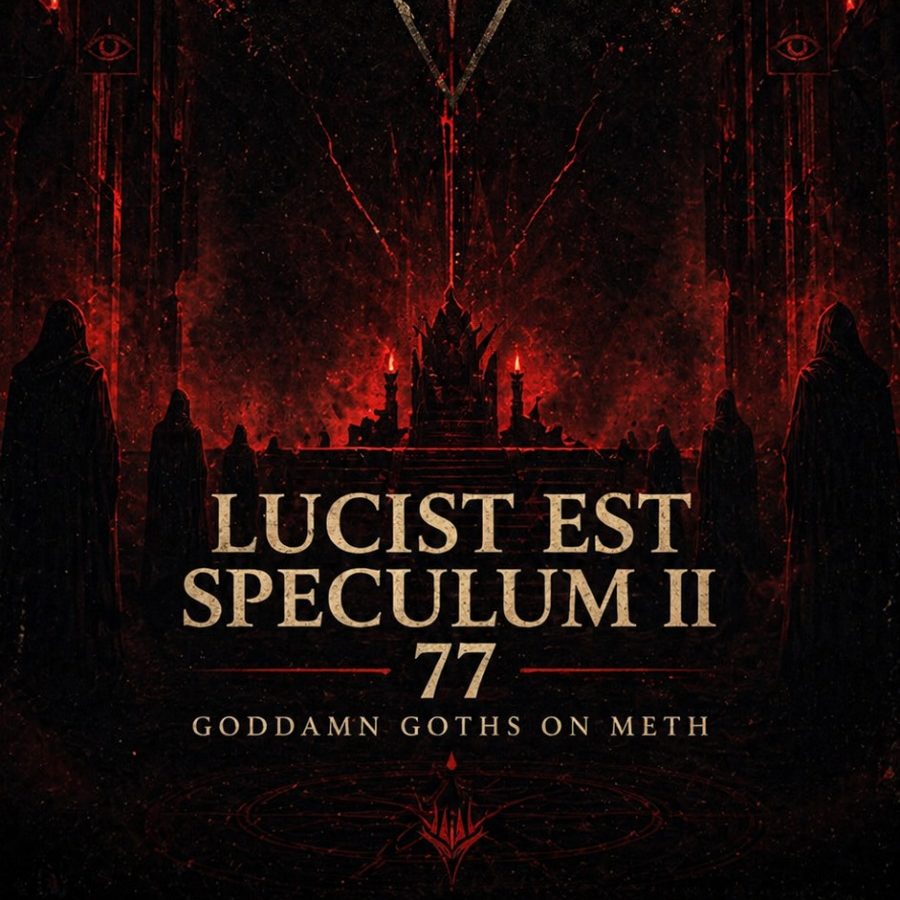
Hello everyone, it’s your host Daniel from Dulaxi, and today I have with me the exceptional experimental music project GODDAMN GOTHS ON METH from Colorado, United States. And GODDAMN GOTHS ON METH is here to discuss the recent original album “Lucist Est Speculum II 77”, which was released on May 1st, 2026. So, welcome, GODDAMN GOTHS ON METH! But before we begin our interview, to our audience; here is what you need to know about this artist.
Emerging from Colorado, United States, GODDAMN GOTHS ON METH is the uncompromising experimental music project of Robert Bryant, an artist whose work thrives at the intersection of industrial, post-punk, darkwave, ritual ambient, and outsider experimental music. Rooted in noise, damaged synths, surrealism, dark humor, and a fiercely independent DIY ethos, Bryant has built a long-running project that rejects conventional genre boundaries in favor of immersive sonic worlds shaped by atmosphere, emotional pressure, and conceptual depth. Drawing inspiration from punk, outsider art, occult symbolism, philosophy, psychology, and altered states, his releases are designed less as traditional albums and more as structures that listeners experience and move through, where repetition, fracture, and abrupt tonal shifts become deliberate artistic devices. Beyond his own vision, GODDAMN GOTHS ON METH flourishes through collaborations with a rotating collective of contributors within the GGOM/Lucist orbit, each helping to construct unified yet distinct creative chambers while preserving the project’s haunting coherence. This artistic philosophy reaches a new level with the release of “Lucist Est Speculum II 77,” the ambitious 35-track album released on May 1st, 2026, which serves as a darker and more severe second chamber within the wider Lucist 77 series. Through themes of white-light initiation, coded dread, symbolic judgment, and psychological descent, the record reinforces Bryant’s commitment to creating music that is vivid, unsettling, emotionally immersive, and unapologetically original, inviting listeners into an experience where sound becomes both ritual and revelation.
Having this brief Introduction about GODDAMN GOTHS ON METH, I’m sure new and current fans must be excited about our Interview today.
INTERVIEW SESSION
Daniel: GODDAMN GOTHS ON METH, how did you originally conceive the identity and philosophy behind the Lucist 77 series, and where does this second chamber fit within that wider vision?
GODDAMN GOTHS ON METH: I think the Lucist 77 series is basically about growth, but growth through misreading, projection, and correction. Lucist Est Ranch 77 came out of a much more external, half-mythic understanding of systems I didn’t actually understand yet. Before I joined the lodge, a lot of what I brought with me was conspiracy residue, small-town lore, outsider fear, and uninitiated opinion, UFOs, lizards, Illuminati, satanic shapeshifters, all the usual “if it’s secret, it must be evil” starter pack. Ranch 77 still carries that projected mythology. It’s what the structure looked like from outside the fence.
As the series kept going, the records got more inward. Less about projected folklore, more about atmosphere, reflection, and what the architecture actually feels like once you stop throwing your own panic onto it. By the time I got to LUCIST EST SPECULUM II 77, I wasn’t interested in “exposing” anything, because I’d already realized there wasn’t really anything to expose in that simplistic way. You can describe the outer mechanics of a rite, the symbols, the staging, the tokens, the handshakes, but that still doesn’t give an outsider the actual meaning of the experience. That part doesn’t live out there.
So LESII77 feels like the final chamber in the series because it’s where the fantasy burns off. It’s harsher, more severe, and less romantic about ignorance. It’s less about mystery as an object and more about consequence as an internal condition. In that sense, the whole Lucist series is really about growth: starting with projection and ending somewhere more inward, more judgmental, and more honest.
Daniel: Your project blends industrial, post-punk, ritual ambient, and outsider experimentation. How do you personally define the core artistic direction of GODDAMN GOTHS ON METH beyond genre labels?
GODDAMN GOTHS ON METH: With a name like GODDAMN GOTHS ON METH, the project was never really built to stand there asking for tasteful genre classification. Beyond the tags, the core of it is me taking material that people already project all kinds of fear, stigma, certainty, and fake depth onto, and playing with it until it starts misbehaving. Industrial, post-punk, ritual ambient, noise, damaged synth music, that’s all in there, but I don’t think in terms of allegiance to genre. I think in terms of pressure, mood, and what kind of psychological room a piece is building.
A lot of GGOM is about refusing the default tone people bring to loaded subject matter. I like serious material, I just don’t trust seriousness as a costume. So I’d rather let the work be funny, ugly, bleak, theatrical, sincere, and a little embarrassing all at once than pretend I’m curating sacred relics for polite adults. Genre is useful, but it’s not the boss.
Daniel: With a rotating cast of collaborators shaping different “chambers,” how do you maintain a unified creative identity across such a diverse network of contributors?
GODDAMN GOTHS ON METH: I usually think in terms of presence more than feature spots. I’m not bringing people in just to decorate tracks or stack names for the hell of it. I’m thinking about what kind of force that room needs. Some collaborators bring weight, some abrasion, some glamour, some damaged beauty, some weird sideways energy that shifts the temperature without breaking the structure.
The way it stays unified is that the world of the record is still mine. The sequencing, the atmosphere, the pressure, the visual logic, the pacing of how things open up or close in, that all has to hold no matter who steps into a given chamber. So even when the voices and textures change, the building stays the same. I want each collaborator to feel distinct, but not like I accidentally stitched together five different albums and called it cohesion because I ran out of better excuses.
A lot of it is also knowing who fits which room. I’m not asking everybody to do the same job. Some tracks need tension, some need rot, some need beauty, some need a kind of internal wreckage. Once I know what the track needs, the collaborator usually makes more sense as part of the structure instead of just a guest appearance with a cool alias.
Daniel: Lucist Est Speculum II 77 is described as a 35-track descent rather than a conventional album. What was the guiding idea behind structuring it as a psychological or symbolic journey?
GODDAMN GOTHS ON METH: I structured it that way because I didn’t want LESII77 to act like a normal album where each track walks in, gives a neat little speech, and exits before it ruins the furniture. I wanted it to feel like moving through a place, rooms, thresholds, false entries, bad hallway decisions, fragments that act like warnings, and full tracks that feel like you can actually stand inside them long enough to regret it. The 35-track format gave me enough space to build that kind of descent without making every idea wear a suit and pretend it was born to be a complete statement.
Psychologically, I was interested in how something can start as atmosphere and slowly become pressure. Symbolically, it’s the same thing: the first door looks like light, then the deeper you go the less neutral any of it feels. So the album moves from entry into consequence, from projection into correction, from “I think I know what this means” into “maybe the structure has been doing something to me the whole time.”
I also just like long records when they earn their length and behave like architecture instead of a storage unit. Some tracks on LESII77 are full rooms, some are thresholds, some are damage, some are just the sound of the building getting meaner. That was the guiding idea — not 35 songs because I’m hoarding tracks like canned food, but 35 pressure points arranged into one sealed structure.
Daniel: The opening track “ABRAHADABRA (Gnashing of Teeth)” and the closing “First Door Was Light” feel like ritual bookends. What narrative or emotional transformation connects these two points?
GODDAMN GOTHS ON METH: I think those two tracks are connected by the difference between calling something up and realizing it was never standing at a safe distance in the first place. “ABRAHADABRA (Gnashing of Teeth)” opens the album like a hostile invocation. It’s the first word, the first doorway, the first dramatic gesture. There’s still some sense there that maybe you’re entering the structure on your own terms, or at least that the light means something welcoming. Even with the teeth already showing, it still has that charged “the rite begins” energy.
By the time it gets to “First Door Was Light,” that idea is dead. The ending is really about realizing the light was never the answer, it was just the entrance. The first door looked illuminated because that’s how these things get you to walk in. By then the album has already moved through pressure, recognition, judgment, and witness, so the closer isn’t offering comfort. It’s more like the last correction. That line, “In the sunlight something else is, and I want you to see,” is not supposed to feel reassuring. It’s more like one last gesture toward whatever was sitting under the bright version the whole time.
So the transformation between those two points is basically this: the opener still believes in entry, the closer understands consequence. One is the door being pushed open. The other is realizing the door was part of the trap, or at least part of the architecture that changed you once you stepped through it.
Daniel: The album explores the idea that “symbols stop guiding and start judging.” How does that concept manifest across the lyrical themes and sonic design of the project?
GODDAMN GOTHS ON METH: I think that idea got personal for me because a lot of this record comes from the feeling of old beliefs, old projections, and older versions of yourself getting frozen in time and thrown back in your face as proof that you’re still the same person now. That’s part of what I mean when I say symbols stop guiding and start judging. They stop being things you move through and start being used like evidence against you.
A lot of people go through phases where they half-believe weird things, chase bad theories, project meaning onto stuff, or get stuck on ideas that don’t hold up later. That’s part of being a person, and ideally part of growth. The uglier version is when those old phases get dragged back out and treated like your final form, basically, “look how stupid you were then, so obviously you’re still that stupid now.” That’s zero-growth thinking.
So lyrically and sonically, the album leans into that pressure. Repetition stops feeling reassuring and starts feeling accusatory. Certain phrases come back heavier, not because they mean the same thing, but because context has twisted them. A sound can start as atmosphere and end up feeling like harassment. I wanted the album to feel like the moment where something stops being a mystery and starts acting like a file somebody kept on you.
Daniel: Were there any specific lyrical lines or recurring phrases within the album that you feel best capture its emotional or philosophical core?
GODDAMN GOTHS ON METH: Yeah, there are a few lines that feel load-bearing to me, but I don’t think the core of this album always shows up in the cleanest or most quotable sentence. A lot of LESII77 works more like damaged testimony. It’s less “here is the message” and more “here is the transcript after the room got to it.”
One of the clearest lines for me is “I don’t have darkness / I only burn in darkness.” That gets close to the emotional center of the record. Darkness isn’t being treated like a costume or an identity badge there. It’s more like a condition you’re already inside of, something acting on you rather than something you wear. Alongside that, “I never wear the darkness white” matters because it gets at the refusal to sanitize things, or bleach damage into something more respectable than it really is.
Then near the end there’s “In the sunlight something else is, and I want you to see.” That line matters because by that point light doesn’t mean innocence anymore. It’s not simple revelation. It’s more like the point where the bright surface stops protecting whatever was underneath it the whole time.
And then there are lines that feel important precisely because they sound like broken witness statements. In “Animal Under the Vanity Light,” “I’m dead and alive” hits that split-state feeling the album keeps returning to. In “Witness Room,” something like “You could hang your father there, and they’d knock him down” feels like a piece of testimony from inside a chamber where authority, inheritance, and judgment are all being warped at once. Same with “The front door, what door did he always refer to”, that sounds like somebody trying to report the structure while already trapped inside its language.
So I think the emotional and philosophical core of the album lives partly in the clearer lines, but also in the phrases that survive the distortion. The record is full of language that sounds like it’s trying to testify after the fact, but the room has already gotten to the evidence.
Daniel: With 35 tracks built as “rooms and thresholds,” how did you decide when a sonic idea should become a full track versus remain a transitional or fragmented element?
GODDAMN GOTHS ON METH: A lot of that came down to whether the idea felt like a room you could actually stand inside, or just a doorway, warning, or pressure change on the way to somewhere else. Not every sound earns the right to become a full track. Some ideas are stronger when they just bruise the sequence a little, shift the temperature, or make the next room hit harder. I didn’t want 35 tracks that all behaved like complete statements and exhausted themselves trying to prove it.
Usually I could tell by how much internal gravity the idea had. If it felt like it could hold atmosphere, tension, contradiction, and its own kind of logic for more than a minute without turning into dead air, it probably wanted to become a full track. If it was more like a crack in the wall, a bad hallway turn, a coded interruption, or a pressure point, I’d let it stay fragmented. Sometimes the fragment is the whole point. Making it bigger would just be putting shoulder pads on a ghost.
A lot of the sequencing was built that way. Some tracks are there to pull you in, some are there to tighten the screws, and some are there to make the listener realize the emotional rules just changed. So the decision wasn’t really “is this finished enough to deserve a title?” It was more “what job does this thing do in the building?” Once I knew that, the form usually made the decision for me.
Daniel: In building this album through DIY environments and pressure-driven production, what role did imperfection or rawness play in shaping the final sound?
GODDAMN GOTHS ON METH: Imperfection was doing a lot of the heavy lifting. With LESII77, whenever something got too cleaned up, too balanced, or too politely “professional,” it usually lost the feeling and started sounding like it wanted a grant. I didn’t want that. I wanted pressure, abrasion, room tone, fatigue, and the sense that the thing had actually lived somewhere before it got to you.
Working DIY helped because the environment kept leaking into the record whether I invited it or not, and most of the time that made it better. Rough edges, accidental ugliness, things being slightly cracked or crowded, that stuff gave the album teeth. I’m not saying every mistake is sacred. Some mistakes are just embarrassing in a boring way. But some imperfection is where the human signal lives. If you sand all of it off, you don’t get transcendence, you get expensive wallpaper.
So rawness wasn’t just something I tolerated, it was part of the design. Not because I wanted the album to sound unfinished, but because I wanted it to sound like it had actually been through something. A cleaner version probably would’ve sounded more respectable, but I’ve never trusted respectability that much as an artistic achievement. Sometimes “clean” just means the weird part died in editing.
Daniel: How did you approach balancing repetition, fracture, and abrupt tonal shifts so the album still feels like one continuous sealed structure rather than scattered experiments?
GODDAMN GOTHS ON METH: A lot of it was sequencing and knowing that not every rupture is supposed to feel random just because it’s abrupt. I wanted the album to have fracture in it, but not chaos for its own sake. Repetition, tonal shifts, and broken transitions all had to feel like they belonged to the same building, even when they were kicking different doors open inside it.
Repetition was one of the main ways I held it together. Even when the record changes tone hard, certain rhythms, textures, phrases, and kinds of pressure keep coming back, so the listener still feels the same architecture underneath the shifts. The fracture matters because it keeps the album from becoming too comfortable, but the repetition matters because it keeps it from just flying apart like a shopping cart with one wheel missing.
The abrupt shifts were usually there to change the emotional weather, not to show off how unpredictable I can be. If a track suddenly gets harsher, emptier, brighter, or more warped, it still has to feel like the same sealed environment reacting to itself. That was the real balance: letting the record behave badly enough to stay alive, but not so badly that it forgets it’s all one structure.
Daniel: During the creative process, what was the most difficult “chamber” or section of the album to complete, either conceptually or sonically?
GODDAMN GOTHS ON METH: Honestly, the hardest chamber was usually the lighter material. The darker stuff is almost easy for me. That territory comes naturally. Pressure, dread, abrasion, damaged atmosphere, that’s cake. The harder part is when I want something to carry more movement, more accessibility, or more of a pop instinct without it turning into something generic or fake.
Growing up, my version of “pop” was already warped. The Cure, Depeche Mode, Siouxsie and the Banshees, that was my pop fix. To a lot of normal listeners, that probably would have already sounded dark, strange, or a little creepy. Later, when I ended up playing in a top-40 cover band for money, I got exposed to a whole different idea of what radio-friendly music actually meant. That opened something up for me, because I realized melody, catchiness, and immediacy weren’t the enemy, I’d just been defining them through a much darker lens.
So on this album, the harder sections were often the ones where I was trying to let some of that lighter instinct in without losing the pressure. Blending those worlds in a way that still sounded like GGOM was harder than making the severe stuff. The darkness behaves for me. The lighter material is where I have to negotiate more.
Daniel: Over the course of your career, how has your understanding of sound as a form of narrative or psychological space evolved?
GODDAMN GOTHS ON METH: I think my understanding of sound as narrative has changed by getting less literal and more honest about how my brain actually behaves, which is not always a triumph of engineering. A lot of the narratives in my music are personal inside jokes, private link systems, or connections that make total sense to me in the moment and probably look like a raccoon built them to somebody else. I have a real tendency to connect things that may or may not belong together. Sometimes that creates something emotionally true, and sometimes it’s just me forcing a bridge because I wanted the bridge to exist badly enough.
So I don’t think I’ve mastered that in some grand, mystical sense. I’m just more aware of the scam now. Earlier on, I probably thought narrative had to mean clearer plots, cleaner concepts, more obvious connections. Over time I’ve gotten more interested in sound as psychological space instead, how repetition, sequencing, abrasion, tonal shifts, and atmosphere can make someone feel like they’re moving through a place, even if the actual story logic is warped, partial, or only half-reporting itself.
That’s probably the real evolution. I still use narrative, but I trust mood, pressure, and emotional architecture more now than neat explanation. Sometimes the story is in the lyrics, sometimes it’s in the arrangement, and sometimes it’s just in the feeling that one room leads to another even if, afterward, nobody could draw you a reliable floor plan without lying a little.
Daniel: What personal experiences or philosophical ideas most heavily influenced the darker and more judgment-focused tone of this record?
GODDAMN GOTHS ON METH: A lot of the darker and more judgment-focused tone came from living with ongoing auditory pressure, intrusive thought loops, and that general lovely feeling of being watched, interpreted, accused, or psychoanalyzed by a committee that never goes home. I didn’t want to flatten that into some neat metaphor, because for me the pressure is the point. The album comes out of what it feels like to live under that kind of scrutiny, where even your older beliefs, your mistakes, or half-formed phases of yourself can get dragged back in and used like evidence.
Philosophically, I was thinking a lot about growth and the way people get trapped in outdated versions of themselves. The ugliest kind of judgment isn’t just “you were wrong.” It’s “you were wrong once, therefore you are permanently that person.” That’s zero-growth logic, and it’s all over this record. That’s where a lot of the language of witness, correction, chambers, and recognition gone wrong comes from.
So the tone of LESII77 came partly from personal pressure and partly from thinking about what it means to live under a verdict that never updates. Once you’ve had enough experience with that, the darker side of the album doesn’t really need to be invented. It’s already standing in the room waiting for you to hit record.
Daniel: How do you see your growth as an artist between earlier works in the Lucist 77 series and this more severe second chamber?
GODDAMN GOTHS ON METH: I think the biggest growth is that the earlier Lucist material came more from projection, fascination, and outsider imagination, while LESII77 comes from a place that’s more inward, more severe, and less interested in flattering my own dramatic bullshit. Lucist Est Ranch 77 still carried a lot of that external mythology for me, conspiracy residue, folklore, symbolic overreach, the mind filling in blanks with whatever weird garbage it can find nearby. I don’t say that with shame exactly, because that phase was real and it had its own energy. But it was still me staring at the structure mostly from outside the fence and acting like the fence was the mystery.
With LESII77, the work got harsher because I got less enchanted by my own projections. The growth wasn’t “now I’ve solved everything,” because that would be embarrassing and false. It was more that I stopped needing the fantasy version to carry all the weight. This record is less about the thrill of the symbol and more about what happens once you’ve been inside the room long enough for it to stop looking decorative. So the second chamber feels more internal, more psychological, and more willing to deal with consequence instead of just mood.
Artistically, I’ve also gotten better at trusting structure instead of trying to over-explain the weird object in the middle of the table and hoping people clap because it’s mysterious. Earlier on I probably leaned harder on concept, atmosphere, and the pleasure of the strange thing itself. Now I’m more interested in pressure, pacing, damaged testimony, and how the pieces actually behave together as one sealed structure. So the growth between the earlier Lucist work and this one is basically the difference between projection and correction. One is fascinated by the door. The other has already walked through it and is dealing with the bill.
Daniel: Has working with collaborators like Indigo Harper, The Kreptik, and others changed how you approach authorship and creative control?
GODDAMN GOTHS ON METH: Yeah, it changed my relationship to authorship, but probably not in the usual “I learned to let go” way people say in interviews. If anything, it made me think less in terms of ownership as a single voice and more in terms of authorship as architecture. I’m still the one building the structure, setting the pressure, deciding the sequencing, and making sure the whole thing behaves like one sealed world. But the collaborators changed how I think about presence inside that world.
Part of what interests me is the blurred line between collaborator, alias, character, and function. I like when a voice feels distinct but not fully separate, like it belongs to the same organism wearing a different face for a while. So working with people like Indigo Harper, The Kreptik, and the others pushed me further toward thinking of tracks as chambers that need a certain force in them, rather than songs that just need an extra feature because that’s what people do now.
So I’d say it changed my creative control by making it less about dominating every surface detail and more about protecting the identity of the building. I still want a unified GGOM world, but I don’t need every room to speak in exactly the same tone to prove it belongs to me. In a weird way, collaboration made the authorship feel more precise, not less. It clarified that creative control isn’t about flattening every voice into one; it’s about making sure all the different presences still sound like they were born under the same roof.
Daniel: Do you feel this project represents a turning point in your artistic identity, or more of a continuation of your established direction?
GODDAMN GOTHS ON METH: I’d say it’s both, but more of a turning point in a structural sense. LESII77 feels like a turning point because it’s the last release in the Lucist 77 series, so it closes a specific body of work even though the ideas behind it will absolutely keep bleeding into whatever comes next. I don’t see it as me abandoning that world so much as finishing a particular chamber of it.
The Lucist material will still influence future GGOM work because it changed how I think about structure, symbolism, atmosphere, and psychological space. That doesn’t just disappear because the series wraps. At the same time, I do think ending the Lucist 77 arc gives me room to stop circling the same architecture and let the next phase mutate into something else.
There may still be side paths later, B-sides, leftover material, or related releases, and I also think some of the other presences around the project, like Indigo Harper, Diezrz Coffins, Dark Skanks On Crank, and others, may eventually release their own Lucist sessions in some form. So I don’t think the world is dead. But this release does feel like the end of a specific run, and that makes it a turning point whether I intended that or not.
Daniel: How have listeners and early audiences responded to the intensity and structural density of Lucist Est Speculum II 77?
GODDAMN GOTHS ON METH: I think it’s been received pretty well so far, which is encouraging considering it’s a 35-track record built like a hostile building inspection. It’s actually been my most listened-to album so far, so clearly at least some people were willing to walk into the structure instead of seeing the track count and filing a restraining order.
What I’ve noticed is that people seem to split into two camps. Some respond to the atmosphere first, the pressure, the claustrophobia, the general feeling that the room may or may not like them. Others seem more drawn to the architecture, the recurring language, the chambers, the bookend logic, the sense that it’s not just a pile of songs but a structure that keeps folding back on itself. Either response makes sense to me. I never expected everyone to come out holding the same floor plan.
So I’d say the reaction has been encouraging. For something this dense, this long, and this deliberately severe in places, the fact that people are staying with it at all is a good sign. That tells me the density isn’t just pushing people away, it’s giving them a reason to come back and get lost in it again on purpose.
Daniel: Do you think fans engage more with the emotional atmosphere of the album or its underlying conceptual architecture?
GODDAMN GOTHS ON METH: I think most people probably engage with the emotional atmosphere first, which is probably for the best. The pressure, the tone, the claustrophobic feel, the general sense that the album may or may not be quietly judging them, that all lands before anyone starts drawing diagrams on a napkin. Atmosphere is the first contact point. It tells people whether they want to stay in the room or back slowly toward the exit.
The conceptual architecture usually kicks in later. Once somebody has spent more time with the record, that’s when the chambers, recurring phrases, bookend logic, and internal structure start surfacing more. So for me it’s less a competition than a sequence: atmosphere gets people in, architecture is what keeps the whole thing from turning into a cool fog machine with commitment issues.
That’s the balance I wanted. I never wanted it to feel like homework disguised as a record, but I also didn’t want it to be pure mood with no bones under it. If somebody comes for the atmosphere and stays long enough to notice the structure, then the album probably did its job.
Daniel: Moving forward, how do you plan to expand the GGOM / Lucist world beyond this release in terms of sound, visuals, or structure?
GODDAMN GOTHS ON METH:
I think the Lucist expansion after this is less about adding more chambers and more about leaving the last chamber through a different door than the others. LESII77 feels like the end of a specific run, so I’m not that interested in pretending the next move is just “more red hallway, more symbols, more chambers, keep walking.” The point of ending a structure is that it should change the route out of it.
So the Lucist world will still bleed into future GGOM work, but probably in a more indirect way. The influence will stay in the architecture, the pressure, the way I think about sequencing, symbolic recurrence, and psychological space. But I’d rather let the next phase mutate than keep photocopying the same ritual room and calling it expansion.
Visually, I think there’s still a lot of life left in the world, alternate chambers, side materials, possible Lucist sessions from some of the other presences around the project, maybe B-sides or related offshoots down the line. But structurally, I think this release closes the main door on that series. Whatever comes next should feel like it passed through Lucist, not like it’s still begging to be let in.
Daniel: Are there any upcoming projects or directions you are already exploring that continue or diverge from the “second chamber” concept introduced in this album?
GODDAMN GOTHS ON METH: Yeah, there are definitely directions already forming that continue some of the second chamber logic while also getting away from its exact costume. LESII77 feels like the end of a specific Lucist structure, so I’m not interested in pretending the next move is just “more chambers, more red light, more symbolic hallway maintenance.” The point of finishing a structure is that it should change the route out of it.
That’s part of why Janctum Lot 33 makes sense to me as a next direction. It still carries some of the pressure, warped logic, and symbolic residue that Lucist taught me how to use, but it pushes those things into a different kind of world. Lucist is sealed, ritualized, and interior. Janctum Lot 33 feels more local, broken-social, absurd, and contaminated by everyday life, less like a chamber and more like a damaged town with its own dialect, petty mythologies, bad wiring, and people who should never have been trusted with a community narrative in the first place.
So I’d say the next phase continues the psychological architecture but diverges in tone and terrain. If Lucist was a formal descent, Janctum Lot 33 feels more like stepping out of the last chamber through the wrong exit and finding out the outside world is just a different kind of curse with worse signage.
Having Experienced This Immersive And Conceptually Rich Journey Through “Lucist Est Speculum II 77,” Here’s My Perspective On Its Dark, Symbolic, And Uncompromising Artistic Vision.
Listening to “Lucist Est Speculum II 77” felt less like sitting through an album and more like entering a carefully constructed psychological world where every sound, texture, and moment served a greater purpose. I was immediately struck by how fearlessly GODDAMN GOTHS ON METH commit to their artistic vision, refusing to dilute the experience with conventional structures or easy accessibility. Instead, the album unfolds as an immersive narrative that steadily pulls me deeper into themes of identity, judgment, memory, isolation, spiritual unrest, and fractured perception. The industrial production is intentionally abrasive, yet I found remarkable beauty within its chaos, as distorted electronics, warped synths, eerie ambience, mechanical percussion, cavernous reverbs, and suffocating layers of noise combine to create an atmosphere that is hauntingly cohesive rather than simply overwhelming. What impressed me most was the consistency of the album’s emotional and conceptual direction. Even across its expansive 35-track runtime, every transition feels purposeful, every repetition reinforces the psychological tension, and every minimalist passage strengthens the narrative instead of interrupting it. The rotating collaborators enrich the sonic landscape without ever disrupting the unified identity of the record, allowing the album to maintain a singular voice from beginning to end. I particularly admired how the project transforms industrial experimentation into a form of storytelling, where sound itself becomes the language through which fear, introspection, vulnerability, and existential uncertainty are communicated. Rather than offering clear resolutions, the album invites reflection, encouraging me to confront discomfort while appreciating the meticulous craftsmanship behind its symbolic world-building. By the time the experience reaches its conclusion, I was left with the impression of having travelled through a dark yet fascinating artistic landscape that rewards patience, deep listening, and open interpretation. For me, “Lucist Est Speculum II 77” is an uncompromising, intellectually engaging, and emotionally resonant body of work that demonstrates the power of conceptual music to challenge, immerse, and leave a lasting impression long after the final moments have faded.
~ Daniel (Dulaxi Team).
Finally to our audience, I urge you to listen to “Lucist Est Speculum II 77”, add its songs to your playlist and be inspired by them, and on behalf of Dulaxi I like to appreciate you all by saying thank you everyone, See you on our next interview.