
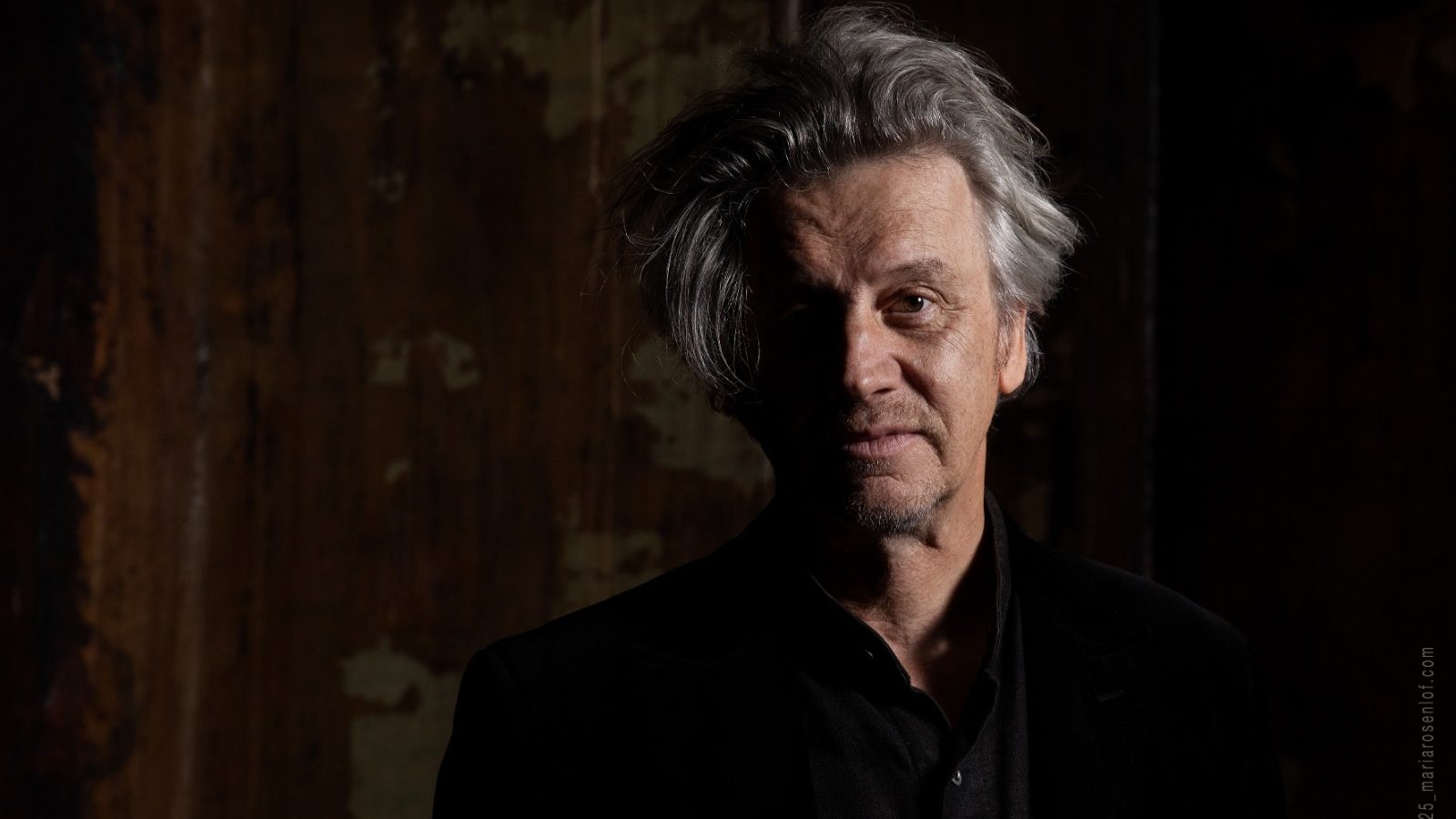
Hello everyone, it’s your host Faithfulness, and today I have with me Hägerstrand from Helsinki, Finland. Hägerstrand joins us at a pivotal moment in his ongoing artistic journey as we dive into his latest original EP, Sjögräs Vol. 2, released on 15th May 2026. This second volume continues the expanding “Sjögräs” concept, a body of work that blends acoustic expression with a subtle rock edge shaped by cinematic instincts and a deeply narrative approach to songwriting. As the project evolves, it raises a compelling question about what happens when songs feel less like compositions and more like memories already embedded in the listener’s mind.
Welcome, Hägerstrand. Before we begin, it is important to understand the artistic path that brings him here. Hägerstrand is a Finnish composer and multi-disciplinary musician whose career spans solo work, band collaborations, theatre compositions, and film scoring. Over the years, he has performed and recorded with projects such as Good Evening Manchester, Gycklarnas Afton, and Jupiter Park, while also contributing to major stage productions across Nordic national theatres. His film work includes compositions such as Lärjungen, Finland’s Oscar submission in 2014, and his broader career has earned recognition including the Sally Salminen Prize and a nomination for the Nordic Council Music Prize.
With Sjögräs Vol. 2, Hägerstrand continues the trajectory established in the first volume, extending a conceptual world that will eventually culminate in a multimedia concert experience scheduled for 2027. The EP moves through contrasting emotional landscapes where acoustic storytelling is shaped with a cinematic lens, and even without full lyrical clarity the emotional intent remains unmistakable. From intimate rhythmic passages to more expansive narrative-driven compositions, the work carries the imprint of a composer equally fluent in film, theatre, and songcraft while exploring identity, origin, and memory as quiet forces shaping each piece.
Having this brief Introduction, I’m sure new and current fans must be excited about our Interview today.
INTERVIEW
Faithfulness: Your journey spans bands, solo work, theatre, and film composition. When you reflect on that wide creative path, what still feels like the core of who you are as an artist?
Hägerstrand: The short answer is; the songwriting part. Creating something, with emotional significance, out of thin air. That’s what matters most to me.
Faithfulness: You’ve performed and collaborated across different projects like Gycklarnas Afton, Good Evening Manchester, and Jupiter Park. How have those experiences shaped your instinct when writing music today?
Hägerstrand: I think I’ve learnt something from everyone I’ve ever played with. My role in various bands has been very varied, and I have tried to master all these roles as best I can. Now that I act as band leader, I welcome the creativity that each person can contribute. Admittedly, it is important to have a strong vision of where the music is heading, but just as important is the realisation that you are making music together with other people and that you remain open to new ideas.
Faithfulness: Your background also includes composing for Nordic national stages and film projects like Lärjungen. How does storytelling for screen and theatre influence your songwriting?
Hägerstrand: I think this comes across in my lyrics and the way I write them. I’ve moved from vague, mood-based lyrics to a more specific, narrative style. All the songs included in the Sjögräs project can, in terms of subject matter, be briefly described in a couple of lines. However, the lyrics are still full of metaphors, symbols and ambiguities. For example Egen lägenhet is not really about an apartment/flat in the physical sense.
People often say that my songs and melodies sound cinematic. That’s probably especially true of the songs that make up Sjögräs
Faithfulness: Having worked in both band environments and solo artistry, where do you feel most creatively free, and why?
Hägerstrand: I like both. In a band setting, I can focus more on my guitar playing and on making the band sound and function as well as possible. As a solo artist, I’m in the spotlight and it’s my job to connect with the audience.
Faithfulness: Your Åland-Karelian roots are part of your identity. In what ways do they continue to surface in your music, even when it’s not directly intentional?
Hägerstrand: We are all shaped by our upbringing and our roots. I can, of course, point to a few things that have influenced me and that can be traced back to specifically Ålandic or Finnish musical expressions. But. I would never have got into music if it weren’t for the English bands of the 1960s. That’s where it all started for me. I discovered them 10-15 years later, of course, but to me it was new. It threw me out of step with the times, in a way, because for a long time I listened to nothing but English 60s music.
Faithfulness: “Sjögräs Vol. 2” has been described as cinematic and emotionally immersive. When you were building these four tracks, what kind of inner world were you trying to create for listeners?
Hägerstrand: It’s hard to describe or explain. It all stems from the guitar riffs I often start with when I’m writing songs. They contain a kind of inner world that I try to delve deeper into as I work out the melody and lyrics. As I continue to arrange the other instruments and build the soundscape, it’s important to be attentive. You don’t want to stray from that original feeling. It’s all very intuitive, and I can only hope that the listener experiences the same thing as I do
Faithfulness: The EP moves through very distinct tones from samba-swing in “Egen lägenhet” to mariachi elements in “Ring min mamma.” What guided those stylistic shifts while still keeping the project cohesive?
Hägerstrand: Several of the songs on *Sjögräs* have gone through a long creative process. *Egen lägenhet* started off at a completely different pace – much slower – but didn’t feel right until it was given its current samba groove. The samba also fits well with the song’s underlying meaning. At other times, it is the context that determines the songs’ arrangements. Perhaps you want a bit more variety compared to the song before or after. In the case of ‘Ring min mamma’, I think the mariachi trumpets were simply included because the song would have been too sad without them. The feeling is, after all, that you can’t ring your mum. There’s no one to answer, and that’s how it will be for all eternity.
Faithfulness: “Ett litet liv,” featuring Ella Grüssner, touches on the final moments of a rock icon’s life. What drew you to such a delicate and emotional narrative?
Hägerstrand: The song is about the thoughts running through John Lennon’s mind in the moments before the taxi stopped outside the Dakota building, where he was subsequently shot. In the song, he plays with the idea that he could have lived a simpler life. Been someone else, somewhere else, with his life as a unwritten piece of paper
Faithfulness: “I lagens namn” carries a strong sense of resistance and commentary on the world today. What sparked the emotional urgency behind that track?
Hägerstrand: I lagens namn celebrates everybody who dare to stand up against injustice and stupidity, even when it is dangerous and feels as though everyone else is against them. This has always been one of the roles of art, whether it be the written word, visual art, music or something else. It is particularly true right now and for the times ahead. Long live Pussy Riot!
Faithfulness: You’ve mentioned the idea of songwriting as something almost inevitable once heard, like it has always existed. Do these songs feel that way to you during the writing process?
Hägerstrand: It varies. Some songs come about effortlessly. It’s almost as if you’re simply plucking them from thin air. Others can take a long time. Sometimes several years. As a composer, you might have a tendency to love the ones that come easily a little more, but in terms of quality, there’s no difference. One that’s taken a lot of work can ultimately be just as good as one that took three minutes to write.
Faithfulness: The “Sjögräs” project is leading toward a multimedia concert experience in 2027. How does that long-term vision influence how you structure the music now?
Hägerstrand: As for the planned releases, there’s no difference. I’m planning the tracks in groups of four to suit the EP format. However, there will be major changes to the multimedia performance. Particularly regarding the musical arrangements and the chronology. For example, we will have a string section from the Stockholm Institute of Music Education taking part. They, along with a guest vocalist, will perform from a separate stage, and a musical dialogue will be incorporated between the stages.
Faithfulness: Many listeners may not understand every lyric, yet still feel the meaning deeply. How important is emotional translation beyond language in this EP?
Hägerstrand: That’s interesting. I can’t know what a listener with no knowledge of Swedish feels when they listen to Sjögräs’s songs. But I hope they’re a bit like me, and I love listening to music from other linguistic cultures. Through the expression, the listener somehow senses what’s being told. If you want to know specifically, just go to Genius, copy the lyrics and deep translate them
Faithfulness: Compared to “Sjögräs Vol. 1”, what feels like the biggest evolution in your approach on this second chapter?
Hägerstrand: To be perfectly honest; mixing using the two-bus technique
Faithfulness: After exploring such a layered and cinematic body of work, what do you hope listeners carry with them once the final note fades?
Hägerstrand: The feeling of having made a new friend. Of having discovered a whole new world to step into. And I hope they make the effort to step into it again and again. It’s on the third listen that things really start to happen.
Faithfulness: Looking ahead to the upcoming “Sjögräs” concert experience, what excites you most about bringing this world to life on stage in a fully immersive form?
Hägerstrand: I think it’s the feeling of having created something unique. The feeling of sharing this special thing with so many others for the first time.
Having said that, I reckon there’ll be so many cues and technical details to keep track of that I’ll probably be happy if I can just remember the right lyrics for the right song.
CHECK OUT THE RELEASE OF ‘Sjögräs Vol. 2’
HAVING LISTENED TO ‘Sjögräs Vol. 2’, HERE ARE MY HONEST THOUGHTS
“Sjögräs vol. 2” by Hägerstrand, released May 15th, 2026, is a musically restrained EP built on atmosphere, texture, and patient arrangement. Across four tracks, acoustic guitar forms the core harmonic language, often played in sparse, open voicings that emphasize resonance and space over melodic density. These foundations are expanded through subtle rock inflections and carefully layered ambient elements, giving the EP a quiet but immersive sonic depth. The production favors gradual evolution rather than abrupt change, with instruments entering and fading in a way that feels structurally intentional and unforced. Percussion is minimal and textural, serving more as rhythmic framing than propulsion, while strings and synth layers extend harmonic weight without overwhelming the acoustic base. Vocals are integrated into the instrumentation, delivered with subdued phrasing that prioritizes tonal blend over prominence. Across the EP, Hägerstrand maintains strong cohesion through consistent timbral restraint, allowing shifts in dynamics to emerge naturally through layering, spacing, and careful control of intensity throughout.
~ Faithfulness (Dulaxi Team)
Finally to our audience, I urge to listen to “Sjögräs Vol. 2“, add it to your playlist and be Inspired by it and on behalf of Dulaxi I like to appreciate you all by saying thank you everyone, See you on our next interview.
For more information about Hägerstrand, click on the icons below.