
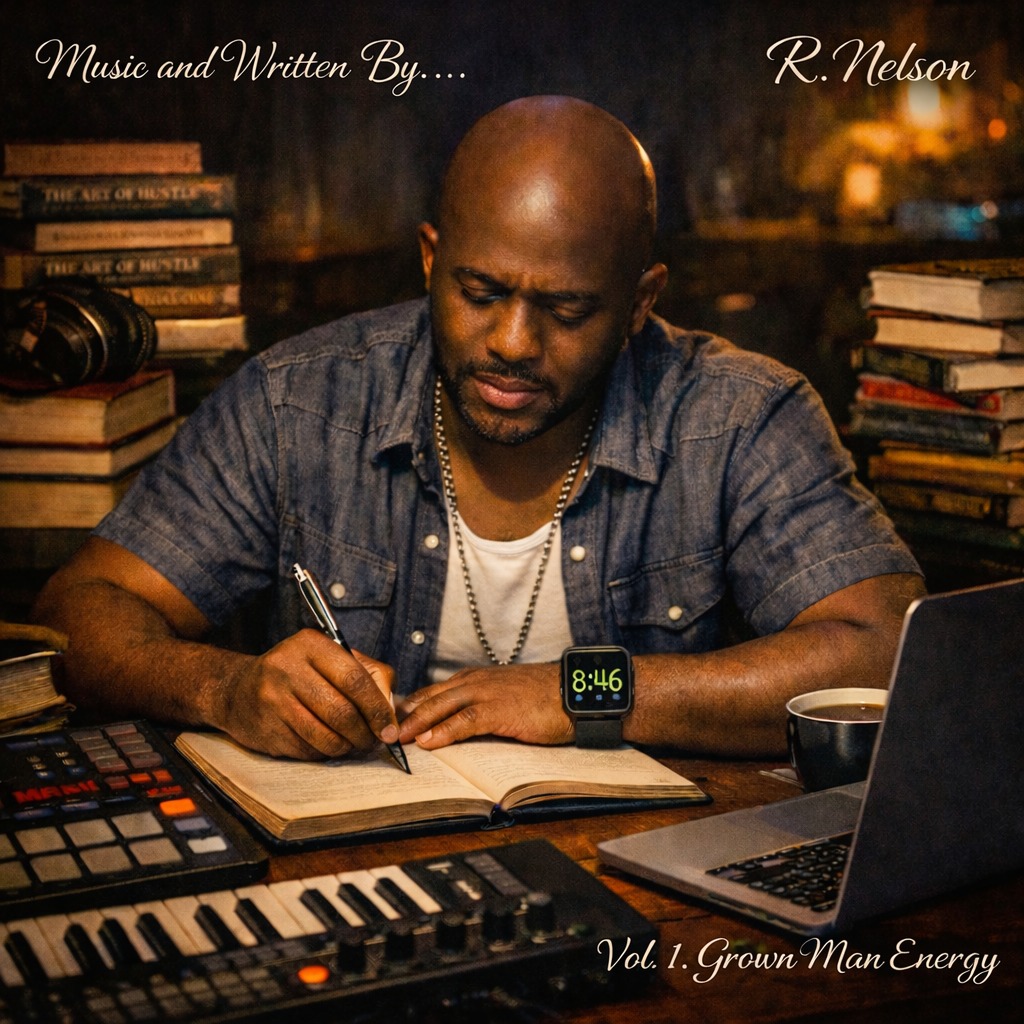
Hello everyone, it’s your host Tehillah from DULAXI, and today I’m delighted to be joined by R. Nelson, an independent R&B artist, songwriter, and producer from Washington, D.C. Known for blending contemporary R&B, neo-soul, soul, and alternative influences with deeply personal storytelling, R. Nelson joins us to discuss his latest release, Songs and Music by R. Nelson, Vol. 1: Grown Man Energy, released on July 24, 2026.
Before we begin our conversation with R. Nelson, here’s what you need to know about today’s featured project.
About R. Nelson
For R. Nelson, music has always been about more than individual songs. It has been about capturing experiences, emotions, and moments that often remain unspoken. Through his work as a songwriter, producer, and independent recording artist, he has built a creative identity centered around vulnerability, reflection, relationships, and personal growth.
Based in Washington, D.C., R. Nelson draws inspiration from the rich cultural and musical history surrounding him, combining the storytelling traditions of classic soul with modern production approaches. His music explores the complicated spaces between confidence and uncertainty, connection and distance, strength and sensitivity. Rather than chasing trends, his work focuses on creating honest musical experiences rooted in human emotion.
His latest project, Songs and Music by R. Nelson, Vol. 1: Grown Man Energy, represents a carefully structured 11-track concept album that unfolds like a complete story rather than a collection of separate songs. Across four acts, the album follows the emotional journey of a relationship, moving through attraction, hope, commitment, heartbreak, reflection, and acceptance.
The project began reaching audiences through a chapter-by-chapter release strategy, with singles including “Gravity,” “Do I Deserve Love?,” and “Unable to Love” introducing different stages of the album’s larger narrative. Each release offered listeners a glimpse into the emotional world R. Nelson was building before the full project arrived.
Written and produced entirely by R. Nelson, Grown Man Energy combines contemporary R&B, neo-soul, soul, and alternative influences while maintaining a strong focus on storytelling. The album explores questions of love, self-worth, emotional responsibility, and the process of becoming a better version of oneself.
The title itself reflects the central philosophy behind the project. Rather than presenting maturity as something automatically gained through age, R. Nelson explores growth as something shaped through experiences, challenges, mistakes, accountability, and self-reflection. Through songs such as “Gravity,” “Do I Deserve Love?,” and “Unable to Love,” the album examines different emotional stages within a larger personal journey. The closing piano-driven epilogue, “Or Maybe,” leaves listeners with reflection rather than a traditional resolution, embracing the reality that some moments in life do not end with simple answers.
Beyond his music, R. Nelson has expanded his creative vision through Nelson Creative Group, LLC and its music division, Ashy Knuckle Productions. Through these platforms, he continues developing a broader creative world built around music, media, apparel, and authentic expression.
His approach combines traditional songwriting with modern creative tools, including AI-assisted workflows, while keeping personal experiences and emotional honesty at the center of his process. For R. Nelson, technology can support creativity, but the foundation of every song remains the human story behind it.
Having this brief introduction to today’s featured project, I’m sure both new listeners and longtime fans are excited to hear directly from R. Nelson. So, without further ado, let’s begin today’s interview.
INTERVIEW SESSION
Tehillah:
Your music is deeply connected to themes of relationships, self-worth, vulnerability, and personal growth. Before we explore Songs and Music by R. Nelson, Vol. 1: Grown Man Energy, who is R. Nelson beyond the artist, and what personal experiences have shaped the way you understand love, emotional maturity, and human connection?
R. Nelson:
(Laughs.) Man, this is a very loaded question. You ain’t playing no games right off the top, huh?
First, let me make one clarification. RJ Nelson is the businessman and founder of Nelson Creative Group. R. Nelson is the artist. While those worlds work together, they come from two different parts of me.
I’m the kind of person who can sit back, watch what’s happening around me, and decide whether I need to interact or simply learn from the moment. I live life one moment at a time, and I’ve always looked at life as both a journey and a book. Every experience becomes another page, another chapter, another lesson.
As far as what shaped my understanding of love, emotional maturity, and human connection, that’s actually the side of me most people around me never really get to see. They may know me for what I do, but they don’t always see what I carry with me. The joy, the pain, the victories, the disappointments, the heartbreaks, and the moments of growth have all become part of how I see the world and, ultimately, how I write.
One of the biggest lessons life has taught me is that everything exists in contrast. Where there is sunshine, there will also be rain. Where there is light, darkness exists as well. You can’t truly appreciate one without experiencing the other. I think that’s true of love, too. The difficult moments don’t just test us, they teach us. They shape our character, deepen our empathy, and remind us that growth often comes from the places we’d rather avoid.
That’s the perspective I bring into my music. I’m not interested in pretending life is only one thing. I want to tell the whole story, because that’s what being human is.
Tehillah:
Coming from Washington, D.C., a city with such a rich history of culture, storytelling, and musical expression, how has your environment influenced the way you see yourself as a songwriter and the kinds of stories you feel responsible for telling through your music?
R. Nelson:
Washington, D.C. is a very unique place. People often think about the politics first, but it’s so much more than that. It’s a city with a rich culture, incredible diversity, and a deep musical history. It’s Go-Go central itself, baby! (Laughs.) But it’s also the hometown of one of the greatest singers to ever pick up a microphone, the late, great Marvin Gaye. Growing up around that kind of musical legacy, it’s hard not to be inspired.
Being from D.C. has definitely shaped me as a songwriter because it’s a place where you’re constantly exposed to different perspectives. Every neighborhood, every conversation, and every person has a story. Those experiences taught me to pay attention, to observe, and to appreciate that everyone is carrying something you may never see on the surface.
The stories I like to tell are often the ones people experience but don’t always talk about. The uncomfortable conversations. The questions about self-worth. The heartbreak. The uncertainty. The moments of growth. Those are all part of being human, yet we often keep them to ourselves.
That’s what I hope my music does. I want to create songs that give people permission to have those conversations and realize they’re not alone in what they’re feeling. If someone hears one of my songs and thinks, “I’ve been there,” then I’ve done my job as a songwriter. To me, that’s what storytelling is about. It’s not just telling my story. It’s helping someone recognize a piece of their own.
Tehillah:
Your journey as an independent artist has expanded beyond just creating songs, with Nelson Creative Group and Ashy Knuckle Productions becoming spaces where you build your own creative world. What inspired you to take control of your artistic direction in this way, and how has building your own platform changed your relationship with music?
R. Nelson:
(Laughs.) Wow! You ain’t holding back! I love these questions so far.
Believe it or not, owning my own business has been a dream of mine since I was a kid. Fast forward to earlier this year, and I found myself handling requests across different areas of music. That’s when I realized if I was serious about building a career, I needed my own label or imprint. That’s how Ashy Knuckle Productions was born.
Around that same time, I was studying artist deals, record labels, and the relationships between artists and labels. I kept thinking, “The label gets what… and they didn’t even do the work?” (Laughs.) I’d rather learn every part of the business myself, understand how it all works, and build something that gives me the freedom to create on my own terms.
Then I remembered I already had another brand, Team Mumbo Sauce, which actually started back in 2021. I could have operated both independently, but I wanted them connected. That’s when Nelson Creative Group became the parent company, not just for Ashy Knuckle Productions and Team Mumbo Sauce, but for future ventures like Sound Off Media.
I have to say, the fact that you already knew about Nelson Creative Group and its relationship to Ashy Knuckle Productions is outstanding because it’s still in its early stages. I’m really just getting started.
Owning my own platform has been one of the most liberating, exhausting, rewarding, and educational experiences of my life. Fixing aircraft wasn’t even this tough. (Laughs.)
Today I’m signed to myself twice, as R. Nelson and Geese Da Goon. I control my masters, negotiate my licenses, and decide how my music is used. I actually had a situation where someone had an unauthorized copy of one of my songs. Another DJ told me, “That’s just how DJs do.”
That’s when RJ Nelson, Founder of Nelson Creative Group, had to step into the room. (Laughs.) Up until that point, they’d only seen the artist. They weren’t expecting the businessman. I explained my licensing policy, my expectations, and the responsibilities that come with using someone else’s work.
At the end of the day, I put my blood, sweat, tears, experiences, and emotions into these songs. If I’m willing to invest that much of myself into creating them, then I have an obligation to protect them. Building my own platform isn’t just about ownership. It’s about accepting responsibility for everything I create and making sure it’s treated with the same care I put into making it.
Tehillah:
Your work often explores the space between confidence and vulnerability, showing that emotional strength does not mean avoiding difficult feelings. How has your understanding of what it means to be a “grown man” evolved throughout your own life, and how did that reflection become the foundation of this album?
R. Nelson:
(Laughs.) Life is a funny teacher, isn’t it? The more I think about it, the more I realize you simply live… and you gain experience. Goodness, I sound like a gamer. (Laughs.) But it’s true.
You love. You experience loss. You have great days and terrible ones. You get hurt. You survive. And if you’re fortunate enough, you learn the lesson life was trying to teach you all along. Those experiences begin shaping the adult you’ll eventually become.
That’s why I chose the title Grown Man Energy.
“Grown” represents the experiences that shape us. Maturity isn’t something you’re handed because you’ve reached a certain age. It’s something earned through living, learning, failing, getting back up, and continuing to grow.
“Man” speaks to the responsibilities, character, and accountability that separate being a boy from becoming a man. It’s about having the courage to look in the mirror before pointing the finger somewhere else.
And then there’s “Energy.” (Laughs.) I know I’m about to go dictionary on you here, but energy is defined as the capacity to do work. I love that definition because the kind of energy I’m talking about isn’t just emotion. It’s what you put into the world. It’s your actions. Your presence. The way you treat people. The way you respond when life isn’t fair.
When you put those three words together, it’s not just a title. It’s a philosophy.
It’s a philosophy that says life is going to teach you. It’s going to challenge you. It’s going to humble you. The question isn’t whether those things will happen. The question is what kind of person you’ll become because of them.
That’s the foundation of this album. Every song explores a different lesson, a different stage of growth, and a different moment where the protagonist has to decide who he’s becoming. Grown Man Energy isn’t about pretending you’ve figured everything out. It’s about committing yourself to the lifelong process of becoming a better man.
Tehillah:
Your sound blends contemporary R&B, neo-soul, soul, and alternative influences while prioritizing honest storytelling over following trends. How would you describe the artistic identity you have developed, and what elements do you believe make a R. Nelson record instantly recognizable?
R. Nelson:
(Laughs.) You know, at least with this project, I didn’t really have a particular game plan in mind. Honestly, I said to myself, “I’ve spent years writing music rooted in skate culture, and I wanted to challenge myself by making an R&B album.” This entire project became a challenge to myself.
One thing a lot of people didn’t know about me is that I genuinely enjoy writing. And I’m not just talking about songwriting. I love stories, editorials, reviews, poems, and fan fiction. I even have the structure for a screenplay sitting around somewhere. (Laughs.) A lot of the poems I’ve written over the years actually found their way into this project in one form or another.
Musically, I leaned into what I grew up listening to: R&B and soul. Now don’t get me wrong, I grew up on Hip Hop and Go-Go too, and both are still part of who I am. In fact, there’s a song on this album that’s probably more Hip Hop than R&B, and on a few tracks I actually tapped out the drum patterns on a table in the style of Go-Go before building the production around them.
(Laughs.) You know, I noticed you mentioned “alternative influences.” So… you caught that too, huh?
I was influenced by rock music as well. Now that’s a wild card. (Laughs.) I guess that goes right along with that Fight the Power energy that’s been woven into me since birth. I’ve never really looked at music through the lens of genres. I’ve always been more interested in whether a song makes me feel something or tells a compelling story. If it does, I’m listening.
If I had to describe my artistic identity, I’d call it Modern Grown Folks Soul.
I was born during an era when songs weren’t just records. They were stories. Let’s just say “Fight the Power” by The Isley Brothers would’ve been playing around the time I entered the world. (Laughs.) Well… that explains a lot now, doesn’t it?
The music I grew up with wasn’t afraid to tell stories. It wasn’t afraid to sit with complicated emotions. That’s what stayed with me.
So when people ask what makes a R. Nelson record recognizable, I’d say it’s the storytelling. I don’t chase trends. I chase honesty. I want listeners to hear one of my songs and think, “Man… I’ve been here before.” Even if they haven’t lived my exact story, I want them to recognize the emotions because that’s where we all connect.
Tehillah:
You have spoken about believing that albums should take listeners somewhere rather than simply being collections of individual songs. What inspired you to create Grown Man Energy as a complete narrative experience, and why was an album format the right way to tell this particular story?
R. Nelson:
(Laughs.) Man… you are getting deep, deep with these questions. I’m sitting here at work eating Garrett Popcorn and drinking water for this one. I LOVE IT!
To answer your question… Purple Rain by Prince. Wait… I just remembered what his actual name is. (Laughs.) Prince Rogers Nelson. Well… that explains a few things. (Laughs.)
Walk with R. Nelson for a second because hopefully this will make sense.
I’ve seen Purple Rain so many times throughout my life that it’s ridiculous. It’s easily one of my top five favorite movies. I’ve also spent a lot of time listening to the soundtrack, and what fascinated me was how the music and the story worked together to create one complete experience. The songs had lives of their own, but together they became something even bigger than the individual tracks.
That really stayed with me.
Albums today often have incredible songs, and I enjoy a lot of them, but many of them feel like collections of great moments rather than one continuous story. I wanted to challenge myself to create something where every song mattered because it moved the narrative forward.
If I was going to make an album, I wanted there to be a payoff. I wanted someone who listened from beginning to end to experience something different than someone who only heard one song.
That’s why the sequencing of Grown Man Energy is so intentional. Every song has its place. If you skip one, you might miss an important part of the story or misunderstand why a later song feels the way it does.
To me, Grown Man Energy isn’t just an album.
It’s a short movie you experience with your ears.
Tehillah:
The album follows the emotional progression of a relationship through four acts, moving from optimism and curiosity to commitment, heartbreak, reflection, and acceptance. How did you approach mapping out that emotional journey, and what role did storytelling play in deciding the order and placement of each song?
R. Nelson:
(Laughs.) Wow… you got that from the album? Okay… that tells me something.
This story is partially poems, partially observations, partially conversations that should’ve been had, partially life experiences, and even a few things that are really happening now. I’ll leave those as teasers and let the audience figure out which is which. (Laughs.)
When I started putting the album together, I approached it like I was writing a movie. The key elements of every story are character, setting, plot, theme, and conflict. Every song on this album was written to communicate at least two of those elements.
That meant I couldn’t just write songs that stood on their own. I had to write songs that fit the one before them and, in many cases, prepare listeners for the one that came after. Every transition had to move the story forward naturally.
Now… that wasn’t easy.
I’ll give you two examples.
The last song in Act I and the first song in Act II could’ve been swapped, and the story still would’ve made sense. You just would’ve experienced that emotional shift a little earlier.
But Act III… (laughs). That’s where it gets interesting.
Those songs are almost interchangeable. I could’ve arranged them in almost any order and still reached the same destination.
The genius of Act III, at least in my mind, is that those emotions could all be happening simultaneously.
Think about real life. Heartbreak doesn’t happen in neat little chapters. You can question yourself, miss someone, try to move on, regain confidence, and second-guess everything, sometimes all in the same week. Human emotions overlap.
So I wanted the music to reflect that reality.
Maybe that’s why Act III works no matter how you arrange it.
Or maybe… I’ll let the audience have that discussion. (Laughs.)
Tehillah:
The title Grown Man Energy carries a strong sense of maturity, accountability, and emotional awareness. When listeners hear that phrase, what do you hope they understand about the kind of growth and self-reflection you are exploring throughout this project?
R. Nelson:
(Laughs.) You know what? I hope people don’t hear the title and think, “Here comes somebody telling me how to be a man.” That’s not this album at all.
When people hear Grown Man Energy, I hope they understand that it’s okay to self-reflect. It’s okay to slow down and ask yourself, “What’s really going on?”
Sometimes we’re so focused on everybody else that we never examine ourselves. We want answers from other people before we’ve even asked ourselves the difficult questions.
This album isn’t about pretending you’ve got life all figured out. It’s about having enough maturity to admit when you don’t. It’s about looking in the mirror before pointing the finger.
That’s why there are so many questions throughout this project. Do I Deserve Love? Unable to Love. Or Maybe. Those aren’t just song titles. They’re invitations to examine yourself.
If somebody listens to this album and comes away willing to have one honest conversation with themselves that they weren’t willing to have before, then I feel like I’ve accomplished what I set out to do.
Tehillah:
Songs like “Gravity,” “Do I Deserve Love?,” and “Unable to Love” each represent different emotional stages within the larger story of the album. What personal questions or realizations were behind those songs, and how did each track help move the overall narrative forward?
R. Nelson:
(Laughs.) That’s actually a really interesting observation because, even though those songs are all singles, they’re asking three completely different questions.
“Gravity” is about discovery.
It’s that moment when someone unexpectedly captures your attention, and you can’t quite explain why. We use the word “gravity” all the time in science to describe an invisible force that pulls objects toward one another. I thought, What if attraction worked the same way? Sometimes you meet someone and there’s just this pull toward them that doesn’t make logical sense. You just feel it.
Then comes “Do I Deserve Love?”
What’s interesting is that it happens after the attraction has already begun. The question isn’t, “Do they like me?” It’s, “Am I enough?” That’s a very different place emotionally. The relationship isn’t the obstacle anymore. The person is wrestling with themselves.
Then “Unable to Love” flips the entire conversation.
At that point, the protagonist has stopped asking whether he’s worthy of love and starts realizing something deeper is going on. He recognizes that he can’t fully give love because he’s still carrying wounds he never dealt with. That’s a painful realization because it forces him to stop looking outward and start looking inward.
Looking back, those three songs almost chart the emotional trajectory of the album.
First, I feel something.
Then, Do I deserve this?
Finally, What’s happening inside of me?
I think that’s why they became the singles. They weren’t just songs I wanted people to hear. They were the questions I wanted listeners to wrestle with before they experienced the rest of the story.
Tehillah:
Several songs explore vulnerability from a male perspective. Did you ever hesitate to be that emotionally transparent, knowing that many people still expect men to hide those kinds of feelings?
R. Nelson:
(Laughs.) You know what? That’s actually one of the hardest parts of songwriting because there has to be a balance.
The emotions are real. The experiences are real. But my goal has never been to write a diary entry and put it over music. My goal is to write about emotions in a way that lets someone else walk into the story and see themselves there.
If I make every detail so specific that only I understand it, then I’ve probably missed the point. But if I write honestly about what fear feels like, what insecurity feels like, what hope feels like, or what heartbreak feels like, then those emotions become universal.
That’s why you’ll notice I ask a lot of questions throughout this album instead of giving a lot of answers. Questions invite people into the conversation. They make listeners stop and think about their own experiences.
For me, songwriting has never been about telling people what to believe. It’s about creating a space where they can reflect on their own lives through the music.
If someone hears one of these songs and says, “That’s exactly how I felt, but I never knew how to put it into words,” then I’ve accomplished what I set out to do as a songwriter.
Tehillah:
The album closes with the piano-driven epilogue “Or Maybe,” which leaves listeners with a question rather than a clear resolution. Why was it important for the story to end with reflection and uncertainty instead of a traditional conclusion?
R. Nelson:
(Laughs.) Yup… I surely did do that!
The reason is simple. In life, there are always going to be questions that don’t get resolved. Some stories don’t always get a happy ending.
I wanted the listener to hear that.
The story is intentionally unfinished because that’s how life feels sometimes. We don’t always get the conversation we wanted. We don’t always get closure. Sometimes all we’re left with are possibilities, memories, and questions.
That’s what “Or Maybe” represents. It’s the moment where you realize you don’t have every answer, and that’s okay. Life doesn’t always end with a period. Sometimes it ends with an ellipsis.
The album ends, but the story doesn’t.
What happens next… I’ll let the listener decide.
Tehillah:
You wrote and produced the entire project yourself, bringing together songwriting, production, and emotional storytelling into one creative process. How did handling multiple roles influence the way you shaped the sound, atmosphere, and emotional details of Grown Man Energy?
R. Nelson:
(Laughs.) Well, it was actually quite easy because I didn’t have to go through a million and one folks to get things accomplished.
If I wanted to change a lyric, I changed it. If I wanted to change the production, I changed it. If I felt like a song needed another verse, a different chord, or a completely different direction, I didn’t have to convince anybody else first.
That freedom allowed me to stay focused on the story.
Every decision I made, whether it was the songwriting, the production, the arrangement, or even the smallest musical detail, had one purpose: move the story forward. If something didn’t serve the story, it didn’t stay.
I think wearing multiple hats actually simplified the process because the vision never changed hands. The person writing the story was the same person producing the music, so there was never a disconnect between what I wanted listeners to hear and what I wanted them to feel.
By the time the album was finished, I wasn’t thinking about songs anymore. I was thinking about whether the listener would believe the journey from beginning to end.
Tehillah:
Your production approach combines traditional songwriting with modern tools and emerging technology, including AI-assisted workflows as part of your broader creative process. How do you use these tools while ensuring that the emotional honesty and human experience behind the music remain at the center?
R. Nelson:
I think if you write an honest song, you’re going to get honest results.
For this album, I was writing from a place I hadn’t been in for a while. It required me to revisit emotions, questions, and experiences that I had either grown through or hadn’t thought about in years. None of that came from technology. That came from being willing to be honest with myself.
AI is part of my creative workflow, and I’m proud to say that. I use it the same way I use any other creative tool. It helps me explore ideas, solve problems, and sometimes see things from a different perspective. But it can’t tell my story for me.
The heart of every song still comes from lived experiences, observations, conversations, and the emotions behind them. The technology may help shape the presentation, but it doesn’t replace the human experience that gives the music its meaning.
At the end of the day, listeners don’t connect with software. They connect with truth. If the emotions are real, people will hear that regardless of the tools that helped bring the music to life.
Tehillah:
Before the full album arrived, you introduced listeners to its story through individual chapters like “Gravity,” “Do I Deserve Love?,” and “Unable to Love.” How did releasing these songs separately influence the way audiences connected with the larger story, and what did you learn from watching people experience each chapter?
R. Nelson:
(Laughs.) Releasing the singles one at a time was almost like having a conversation with the audience before they ever heard the full album.
Each song opened up a different discussion.
Some people connected with the excitement and curiosity of “Gravity.” Others really gravitated toward the self-reflection in “Do I Deserve Love?” Then “Unable to Love” challenged people in a different way because it asked them to stop looking at everyone else and look at themselves.
What surprised me was that people rarely responded to the songs the way I expected. One listener would tell me they saw hope in a song, while someone else heard heartbreak. Neither person was wrong. They were bringing their own experiences into the music, and that’s one of the things I love most about songwriting.
Releasing the songs separately also taught me patience. Instead of asking people to absorb an entire album at once, I gave them time to live with each chapter before introducing the next one. By the time Grown Man Energy arrived, listeners already had a relationship with parts of the story.
I think that made the album feel less like a collection of songs and more like the continuation of a conversation we’d already started.
That was always the goal. I wasn’t just releasing singles. I was inviting people into the story one chapter at a time.
Tehillah:
Building an independent career requires both creative vision and persistence. Looking back at the growth you have experienced through international radio support, playlist placements, editorial coverage, and expanding your audience, what moments have made you realize that your message was reaching people beyond your immediate surroundings?
R. Nelson:
(Laughs.) Here’s the funny thing. Most of the folks around me weren’t listening, and to a certain degree, still aren’t. And that’s okay.
If you asked some of them whether they knew that Geese, which is another name they know me by, makes music outside of roller skating, the answer would probably be no.
That taught me a very valuable lesson: Don’t go to places where you’re tolerated. Go to places where you’re valued.
That’s exactly what I did, and honestly, I was surprised by the results.
First came the playlists. Getting on them wasn’t easy. There were plenty of rejections, but there were also people who believed in the music enough to add it. Then came the early press, and what made that so memorable was that the first articles were written in languages I don’t even speak, like Portuguese and French. I translated them into English and read these incredibly positive reviews. I still joke that I probably need to learn Portuguese and French one of these days.
Somewhere in the middle of all that came radio, especially internet radio in countries I never imagined hearing my music. Then it really started to hit me. Actually… if I told that whole story, I’d ruin the mystique behind “Gravity.” Let’s just say a food exchange is still owed. (Laughs.)
As I kept releasing more music and making bigger promotional pushes, more opportunities started opening up. More reviews. More playlist adds. More interviews. Even this interview has me thinking, “Wow.” Then came even more radio support, not just internet stations, but terrestrial broadcast stations in different countries.
I’m still sitting here in awe of it all.
The people in my circle who have been paying attention, especially my Big Brother, who records under the name Da Blacksheep, have helped keep me grounded. He always tells me, “Enjoy it. You’ve worked hard to get this far, but stay humble.” I’ve taken that advice to heart.
It’s funny because my other artist persona, Geese Da Goon, has been going back and forth with someone in the skating community, and one of the criticisms thrown at him was, “No one is listening to your music.”
But I know differently.
They’re measuring success by what’s happening in their immediate surroundings because that’s all they can see. They assume that’s my ceiling too.
Meanwhile, the playlists, the interviews, the reviews, the radio support, and the listeners around the world tell a different story.
I actually have an upcoming song that illustrates this exact idea. Sometimes the people closest to you don’t see the full picture, while complete strangers halfway around the world understand exactly what you’re trying to build.
So these days, I just smile, say, “Google me,” and keep working on expanding the reach even further.
They can have the rinks.
I’m after the world.
Tehillah:
Your music often focuses on the quiet emotional moments people experience but rarely discuss openly. When someone listens to Grown Man Energy during a difficult season in their own life, what emotions or realizations do you hope the album helps them process?
R. Nelson:
This is one of those albums that I hope, if you’re listening to it, first of all… thank you.
If you’re going through something, I hope it helps you reflect on what’s actually happening, not just what you perceive is happening. Sometimes our emotions tell us one story while reality is telling us another, and those aren’t always the same thing.
I hope it encourages you to slow down for a moment, process what you’re feeling, and really think things through. I know that’s easier said than done. Believe me, I struggle with that too. I’m human on some days too. (Laughs.)
This isn’t one of those albums you just play in the background and move on from. It’s one of those albums that asks you to think, to pay attention, and maybe even ask yourself a few uncomfortable questions along the way.
If it helps you find some clarity or a new perspective, then I’ve done what I set out to do.
And if it doesn’t…
Hit me up.
I’ll listen.
Tehillah:
As this album represents one major chapter in your artistic evolution, how do you see R. Nelson continuing to grow creatively in the future? What new stories, sounds, or experiences are you excited to explore as you continue building your legacy?
R. Nelson:
(Laughs.) Wait a minute… I’m supposed to grow? This isn’t the end? I’m supposed to make more music? Who told you that?
(Laughs.) I’m kidding… I’m kidding.
To be honest, I’m having fun.
This album actually started as an experiment, a side project, just to see if I could do it. Remember, I primarily made music for the skating rinks. Somewhere along the way, this project started getting legs and took on a life of its own.
Now, outside of this album, I have a few songs that aren’t connected to Grown Man Energy at all. Shameless plug… “Why Are You So Beautiful,” “Let It Drop,” and “Give You My All.” Go show them some love too… especially “Let It Drop.” (Laughs.)
This interview actually took about three days to complete. I mention that because I went skating last night, and after the session I was talking with a few DJs. They asked me about the latest song I made for the rinks, and I mentioned that I had an R&B album about to be released. The first thing one of them said was, “I guess you’ll be playing that during slow sets.”
I told him, “If it finds its way into the slow sets organically, that’s fine. But honestly… the rinks weren’t my audience.”
Even though I’m heavily involved in roller skating, it’s entirely possible for a skater to make music for people outside of the skating rinks.
As I look at my calendar and my weekly planner, I already have a lot coming up. As we’re having this conversation, ideas for Volume 2 are already starting to form. New opportunities are presenting themselves, and quite frankly, they make me nervous. But I’ve learned those are usually the opportunities where you grow the most.
One thing this album really allowed me to do was showcase my songwriting.
I’m used to writing technical incident reports about medical equipment at work. (Laughs.) I’ve written short stories, long reviews of skating events, think pieces about skating, and plenty of poetry. Never in my life did I think I’d actually be writing songs.
While cleaning my mother’s house, I found some old poetry notebooks that I thought had been lost. As I looked through them while working on music, I realized, “These are almost songs already.” So I refined some of those ideas, and now you’re hearing pieces of them on this album. That experience has me thinking I may start writing songs for other artists as well.
One thing I’m especially excited about involves a friend of mine who’s an incredibly talented singer. She was on Instagram singing a funny little jingle, and something about it caught my attention. I thought, “Wait… there’s a real song in there.”
So I started writing. Then I built the music around it and even recorded a full proof of concept, vocals and all, before sending it to her. At first, she was a little upset because I’d borrowed the idea from her Instagram post. But after she read the lyrics and heard the demo, she was blown away.
Now we’re figuring out where she’s going to record it.
Those are the kinds of opportunities that are starting to happen, and I’m really excited about them.
As much as I love building the music side of Nelson Creative Group, I also know it’s time to put some serious energy into the second branch, Team Mumbo Sauce, and continue developing the apparel side of the business. After that comes Sound Off Media, which is probably the most ambitious project of the three.
So when you ask where I see myself going…
Honestly, I’m just getting started.
With everything happening right now, all I can hear is Charlie Wilson singing:
“I got everything on the line… out here on the grind… trying to get mine… at least you can wish me luck.”
I think that says it better than I ever could.
“R. Nelson’s Grown Man Energy is not just a collection of songs. It is a carefully crafted conversation between experience, vulnerability, and growth, inviting listeners to look inward while discovering pieces of themselves within his story. His ability to transform personal reflection into a shared emotional journey is what makes this project truly memorable.”
~ Tehillah (DULAXI Team)
MY EDITORIAL PERSPECTIVE
R. Nelson’s Grown Man Energy stands as an example of how storytelling can shape the entire identity of an album. Through thoughtful sequencing, emotionally driven songwriting, and carefully considered production choices, the project creates a complete experience rather than simply presenting individual tracks. The album’s greatest strength lies in its willingness to explore vulnerability, reflection, and personal growth with honesty. R. Nelson’s approach shows a deep understanding of how music can become a space for conversation, self-examination, and connection.
~ Tehillah (DULAXI Team)
CLOSING
It has been a pleasure speaking with R. Nelson and exploring the story, creative process, and personal experiences behind Songs and Music by R. Nelson, Vol. 1: Grown Man Energy. Through this conversation, listeners have gained a deeper understanding of the intention behind the album, the emotional journey it represents, and the dedication behind bringing such a personal project to life.
We would like to thank R. Nelson for sharing his time, thoughts, and experiences with DULAXI. His openness about creativity, growth, independence, and the realities behind building an artistic career has created a meaningful conversation for both longtime listeners and new audiences discovering his work.
We encourage readers to experience Grown Man Energy as a complete journey and discover the emotions, questions, and stories woven throughout the project. Continue following R. Nelson’s artistic evolution as he continues creating new music and expanding his creative world.
Thank you for spending time with DULAXI. Stay connected with us for more conversations, stories, and interviews with artists from around the world.