

“Aeroplane” is a stripped-back voice-and-guitar album from Connie Lansberg that thrives on immediacy, restraint, and unfiltered musical communication. Built around seven original compositions and one unexpected pop cover, the project avoids studio excess in favour of raw interaction between two musicians. Recorded in Pasadena at Nolan Shaheed’s studio during a single day in Los Angeles, the album was shaped by just one rehearsal and eight hours of recording time. That limited window becomes central to its identity, turning each track into a real-time exchange where instinct replaces refinement and space becomes an active part of the composition.
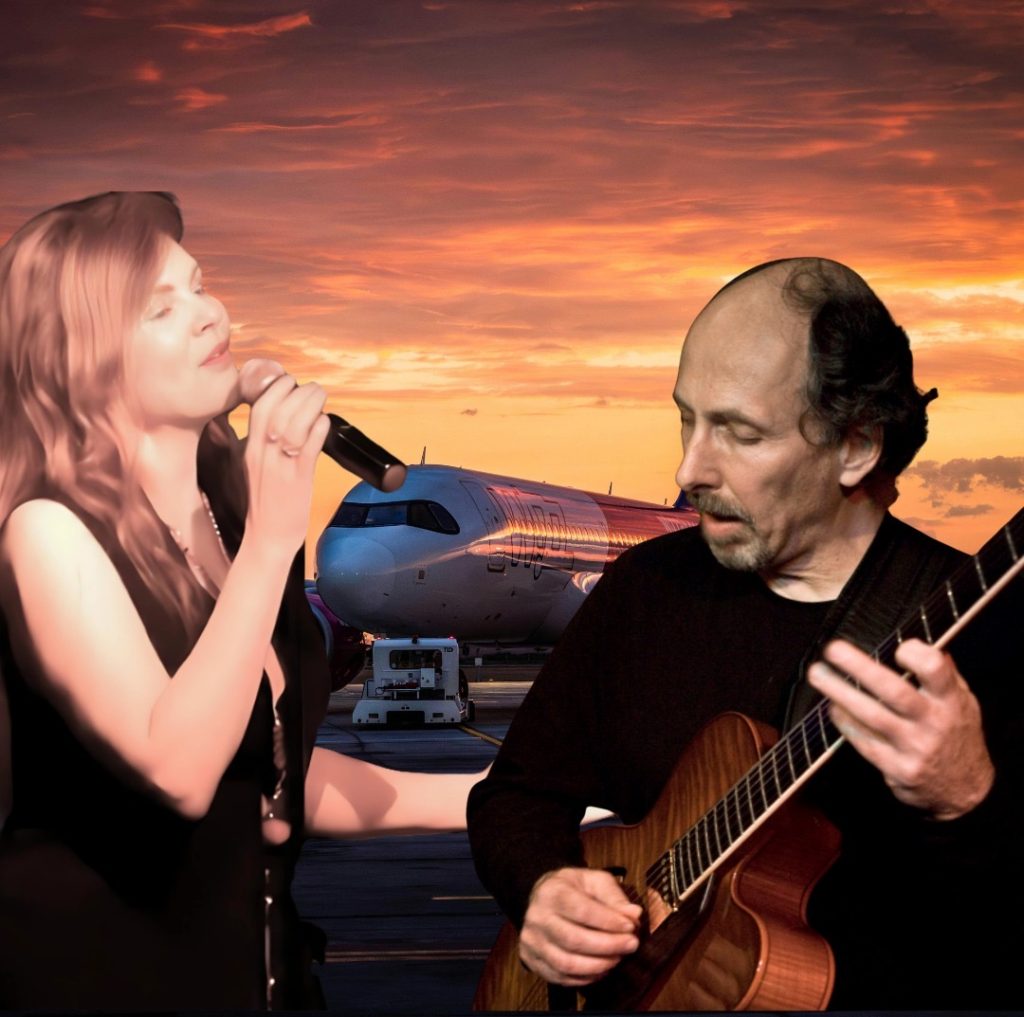
At the heart of the record is the collaboration between Lansberg and guitarist Brad Rabuchin, whose musical history brings a deep sense of weight and intuition to the project. Rabuchin, who spent five years touring as Ray Charles’s final sideman and has worked with artists such as Bonnie Raitt, Stevie Wonder, Willie Nelson, Tom Jones, Pat Martino, Steve Turre, and David “Fathead” Newman, approaches each song with quiet authority. His playing never overwhelms; instead, it creates shifting harmonic landscapes that respond directly to Lansberg’s phrasing. This creates a conversational dynamic where guitar and voice function less as separate roles and more as equal participants in a continuous musical dialogue.
Aeroplane Album Track Reviews:
Aeroplane:
“Aeroplane,” the title track of Connie Lansberg’s album, establishes its emotional and sonic identity through intimate voice-and-guitar minimalism, where gently fingerpicked acoustic patterns create an airy, drifting motion that mirrors the sense of flight suggested by the title. The open chord voicings lend the piece a suspended, cinematic quality, with the guitar functioning less as rhythm and more as atmospheric storytelling built on warmth and resonance. Lansberg’s vocal delivery is soft, breath-laden, and carefully controlled, with phrasing that often lingers at the ends of lines to create emotional suspension rather than resolution. Instead of dramatic peaks, she leans into subtle tonal inflections that feel natural, conversational, and deeply human. The production preserves an unfiltered intimacy, capturing finger movement, room ambience, and the natural decay of notes, which enhances the feeling of closeness between performer and listener. Harmonically rooted in gentle folk-jazz sensibilities, the track unfolds gradually, balancing longing and freedom while transforming minimalism into a quietly immersive emotional space.
Broken Doll:
“Broken Doll” stands as the emotional centerpiece of “Aeroplane,” unfolding through a stripped-back voice-and-guitar arrangement that prioritises atmosphere, space, and emotional honesty over any studio embellishment. The acoustic guitar is delicately fingerpicked, leaving intentional gaps between notes where silence becomes part of the composition itself, heightening the emotional weight of each lyric as it lands. Its harmonic structure is cyclical and understated, avoiding dramatic shifts in favour of a looping progression that mirrors emotional vulnerability and stagnation. Connie Lansberg’s vocal performance is strikingly fragile, shaped by breath texture, restrained vibrato, and conversational phrasing rather than technical power, with occasional vocal cracks that enhance authenticity rather than detract from it. Her delivery sits between singing and storytelling, creating a confessional tone that deepens the song’s intimacy. The warm, closely recorded guitar tone captures subtle physical details of performance, reinforcing its unprocessed realism. Rather than building toward resolution, the track remains emotionally suspended, sustaining tension throughout.

Heart Of Stone:
“Heart Of Stone” carries one of the strongest emotional contrasts on “Aeroplane,” balancing tenderness with emotional distance through a minimalist voice-and-guitar arrangement that still feels quietly tense. The guitar is more rhythmically grounded than elsewhere on the album, using firmer strumming patterns that introduce subtle forward motion beneath the calm surface, while minor chord coloration and gently unresolved harmonic shifts deepen its darker emotional tone. Connie Lansberg’s vocal performance is marked by controlled restraint, never oversinging yet consistently carrying emotional weight, with her lower register adding gravity and occasional lighter upper tones revealing vulnerability beneath the hardened imagery of the title. Her phrasing is conversational and natural, avoiding rigid melodic symmetry in favour of speech-like flow that heightens intimacy and realism. The close, minimalist production captures every nuance, from breath to string resonance, keeping the sound warm and immediate. Ultimately, the track proves that emotional intensity can emerge through restraint rather than volume.

Starlight and Gold:
“Starlight and Gold” stands as one of the most luminous moments on “Aeroplane,” offering a brighter emotional palette while remaining grounded in the album’s intimate voice-and-guitar framework. The acoustic guitar introduces a gentle melodic sparkle, with open, harmonically uplifting chord voicings that create a sense of warmth and quiet expansion. Its fluid, dreamlike progression allows the track to float effortlessly, balancing emotional depth with a soft sense of optimism without ever losing its minimalist identity. Connie Lansberg’s vocal delivery is especially tender here, shaped by light, melodic phrasing and subtle tonal shifts that allow emotion to unfold naturally without theatricality. Her voice conveys calm reflection and emotional maturity, turning restraint into expressive strength. The recording remains deliberately unpolished, preserving breath, finger noise, and slight imperfections that enhance the sense of presence and authenticity. Harmonically, the song evolves gently without dramatic turns, reinforcing its floating quality. Ultimately, “Starlight and Gold” feels like a quiet emotional exhale, radiating warmth through simplicity.
Lansberg’s vocal presence remains the emotional centre of “Aeroplane,” marked by clarity, control, and an understated expressive depth. Her delivery avoids unnecessary ornamentation, allowing lyrical intent and melodic shape to guide each performance. The genre-fluid nature of her songwriting is especially evident here, as the songs move freely between jazz tradition, contemporary songwriting, and subtle pop sensibilities. The inclusion of a surprising pop cover is particularly striking, not because it contrasts with the originals, but because it is reimagined through the same minimal lens, revealing new emotional angles through silence, pacing, and restraint.
Aeroplane Is An Intimate Voice-And-Guitar Collection Where Connie Lansberg Transforms Restraint, Space, And Instinct Into Deeply Human, Emotionally Immersive Storytelling
~ Faithfulness (Dulaxi Team)
Connie Lansberg is one of Australia’s most streamed jazz vocalists, with over 12 million streams and an audience spanning Australia, the United States, Japan, Spain, Canada, and Brazil. Based in Melbourne, her work has been praised by PBS Jazz Radio for its musical openness and emotional sincerity. Rather than confining herself to strict genre boundaries, she consistently collaborates with jazz musicians who prioritise instinct and listening as much as technical skill. “Aeroplane” embodies that philosophy in its purest form, presenting music that feels unforced, immediate, and deeply human. In this setting, Lansberg’s artistry is defined less by embellishment and more by presence, closing the album like a quiet, suspended moment that lingers well after the final note fades.
For more information about Connie Lansberg, click on the icons below.