
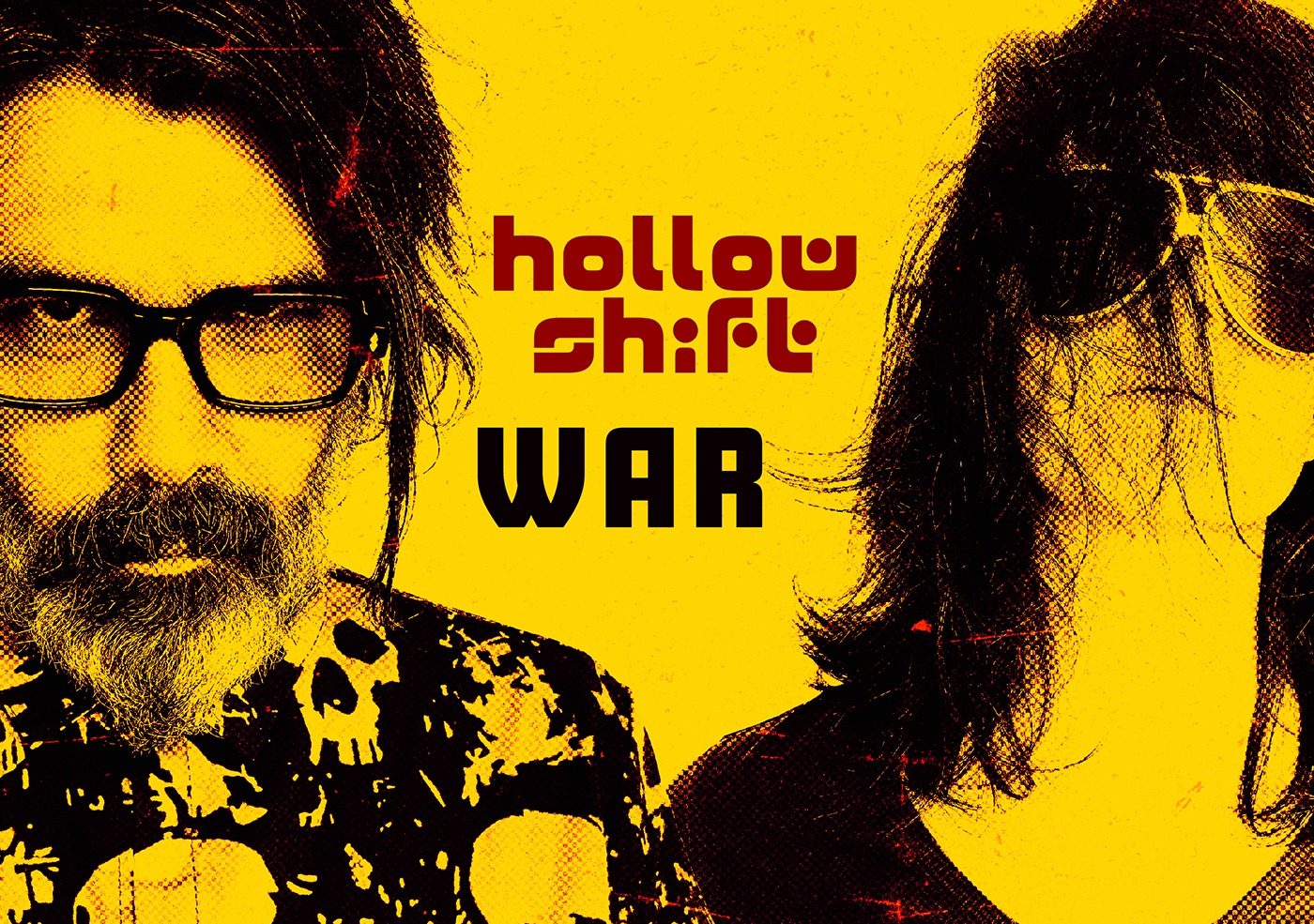
Hello everyone, it’s your host Oliver from DULAXI, and today I’m delighted to be joined by Jessica Bell, vocalist and songwriter of Athens-based darkwave duo Hollow Shift. Originally from Australia and now creating from Athens, Greece, Jessica joins us to discuss Hollow Shift’s three-track release, WAR, which arrived on June 19th, 2026, blending darkwave, synthwave, post-punk, and electronic influences into a deeply atmospheric exploration of conflict, resilience, identity, and survival.
Before we begin our conversation with Jessica Bell, here’s what you need to know about today’s featured project.
ABOUT HOLLOW SHIFT
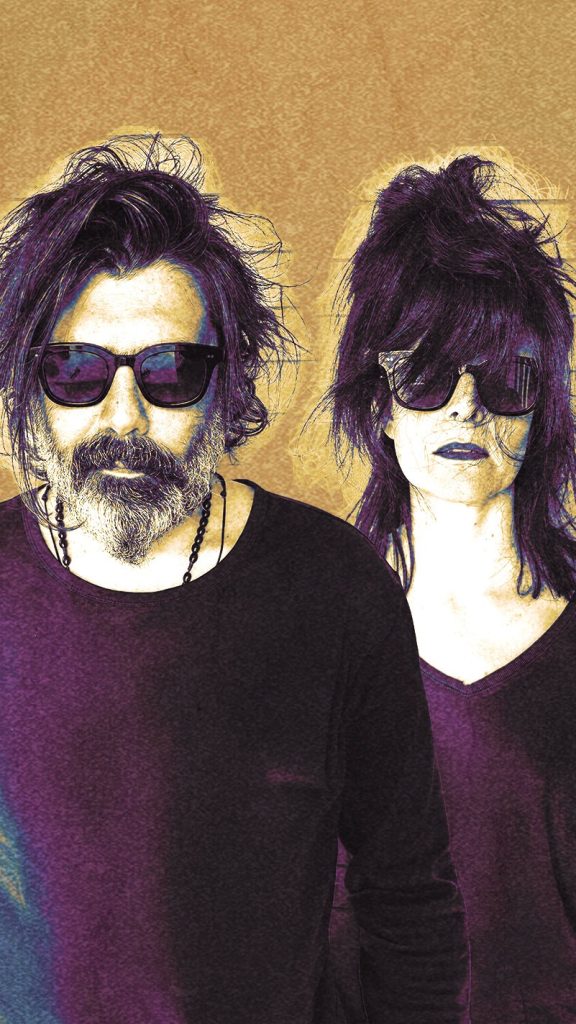
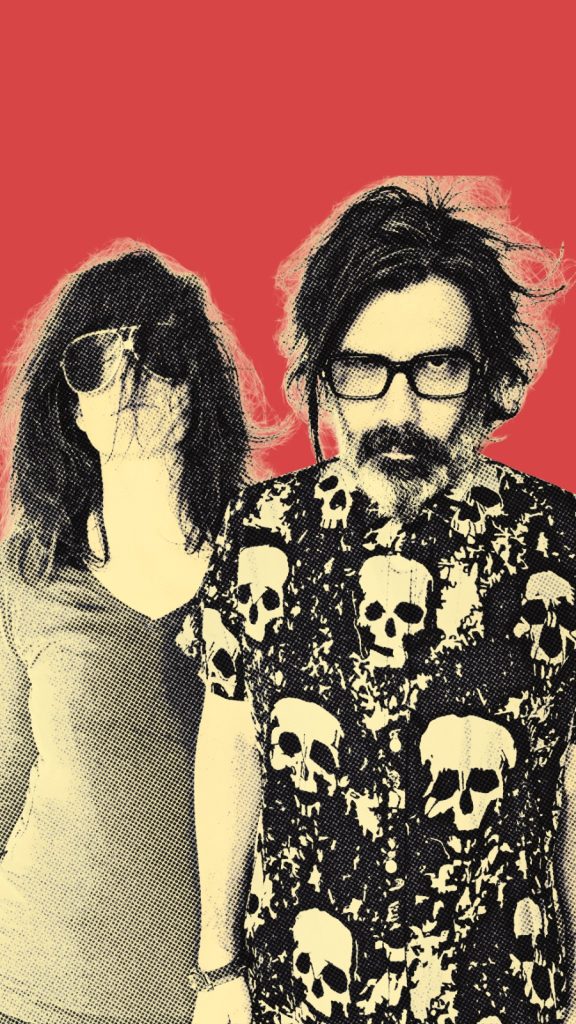
Hollow Shift is the creative collaboration between vocalist and songwriter Jessica Bell and producer, composer, and multi-instrumentalist Alexander Zamparas, an Athens-based duo whose music exists at the intersection of darkwave atmosphere, post-punk tension, synth-driven textures, and emotionally immersive electronic production.
The foundations of Hollow Shift were built through years of individual artistic exploration. Jessica Bell’s journey has moved through multiple creative disciplines, from songwriting and poetry to fiction writing, publishing, and visual design, experiences that have shaped her deeply observant approach to storytelling. Her lyrical style focuses less on direct explanations and more on capturing emotional landscapes, creating space for listeners to connect their own experiences with the music.
Alexander Zamparas brings an extensive background within Athens’ evolving alternative and electronic music scenes. Known for his work as a producer, composer, and multi-instrumentalist, including his involvement with projects such as Keep Shelly in Athens, Expert Medicine, and Fever Kids, Alexander contributes a production style built around atmosphere, texture, and carefully crafted sonic environments.
The two artists first began collaborating through their shared creative journey, eventually forming Hollow Shift in 2025 as a space where their different instincts could meet. Rather than attempting to recreate their previous musical identities, the project allowed them to explore a darker and more rhythm-focused direction where emotional storytelling and movement could exist together.
Following the releases of Hades and Without Darkness Souls Won’t Move, Hollow Shift continued developing this artistic vision with WAR, a three-track release that examines conflict in its many forms. The project moves beyond the traditional understanding of warfare, exploring internal struggles, social division, fear, transformation, and the resilience required to continue moving forward.
Across WAR, Hollow Shift combines haunting melodies, cinematic arrangements, driving rhythms, layered synthesizers, textured guitars, and emotionally charged vocals to create a sound that feels both expansive and intimate. The release reflects the duo’s interest in exploring difficult subjects without losing the possibility of hope, using darkness not as an endpoint but as a place where change and understanding can emerge.
Recorded through the duo’s collaborative process, WAR represents a continuation of Hollow Shift’s evolving identity. The release brings together Jessica’s emotionally expressive songwriting and Alexander’s immersive production, creating a body of work where electronic experimentation, human vulnerability, and philosophical reflection exist side by side.
With their music receiving attention across independent darkwave, post-punk, and alternative electronic circles, Hollow Shift continues to define a unique space within modern electronic music. Through each release, the duo explores new ways of balancing introspection with rhythm, creating songs that invite both emotional reflection and physical movement.
Having this brief introduction to today’s featured project, I’m sure both new listeners and longtime fans are excited to hear directly from Jessica. So, without further ado, let’s begin today’s interview.
INTERVIEW SESSION
Oliver:
Before Hollow Shift, who were you as an artist and as a person, Jessica, growing up between Australia and Athens, and how did those early experiences, alongside Alexander’s musical journey through projects like Keep Shelly in Athens, Expert Medicine, and Fever Kids, shape the creative connection that would eventually bring you together?
Jessica Bell:
We actually came from very different worlds, which I think is one of the reasons Hollow Shift works.
Growing up between Australia and Greece gave me this strange sense of never fully belonging to one place. Every few years my surroundings would change, the people around me would change, and I’d have to find my feet again. Looking back, I think that taught me to observe before speaking. I’ve always been drawn to the emotional undercurrents of situations—to what isn’t being said as much as what is. That eventually became the way I write lyrics. I’m rarely interested in telling a story from beginning to end. I’d rather capture the feeling someone is left with after the story is over.
I’ve also always moved between different creative disciplines. I’ve written novels and poetry, designed book covers, run a publishing house, and written songs. To me, they’re all part of the same instinct: trying to understand people. Music just happens to express things that words alone sometimes can’t.
Alexander’s journey was very different. He’s spent years immersed in bands, production and electronic music, working with projects like Keep Shelly in Athens, Expert Medicine and Fever Kids. He has this incredible ability to build atmosphere without overcomplicating it. He understands when a song needs another layer, but more importantly, when it doesn’t. I think that’s a rarer skill.
When we started writing together, it never felt like we were trying to merge two musical résumés. It was more that we recognised something in each other’s instincts. I tend to begin with emotion and imagery; Alexander often begins with rhythm, texture or a sound that sparks a feeling. Somewhere in the middle those approaches meet, and neither of us quite knows where the song is going until it starts revealing itself.
I don’t think either of us wanted Hollow Shift to sound like a continuation of what we’d done before. We weren’t trying to recreate the past or prove anything. It was more like giving ourselves permission to make the music we’d genuinely want to listen to—music that could make you dance, but also stay with you long after the track had finished.
Oliver:
When you began shaping Hollow Shift in 2025, what did the name and identity of the project allow you to express that did not fully belong inside your earlier creative lives, and how did that darker, rhythm-driven direction change the way you understood yourselves as a duo?
Jessica Bell:
One of the first things we realised was that we weren’t interested in creating a project around an image or a concept. We wanted to create a space where we could follow our instincts without asking whether a song fit into a particular box. In that sense, Hollow Shift felt less like inventing a new identity and more like uncovering one that had been waiting for us.
The name resonated with us because it suggests change. A shift is movement, but “hollow” isn’t something we see as purely negative. Sometimes you have to empty something out before something new can grow. We liked that tension. It reflects a lot of what we write about—grief, resilience, transformation, conflict—not as fixed states, but as things we’re constantly moving through.
For me personally, Hollow Shift also gave me permission to write more intuitively. In the past I often felt the need to explain or resolve an emotion. With this project, I’ve become much more comfortable leaving questions unanswered. Life rarely gives us neat conclusions, so why should every song? Sometimes it’s enough to capture the emotional truth of a moment without telling the listener what they’re supposed to take from it.
The rhythm-driven direction changed us as writers as well. We’d both made music that explored atmosphere before, but this was the first time we consciously asked ourselves, “Could someone dance to this?” That wasn’t about making club music—it was about recognising that movement can be incredibly cathartic. There’s something powerful about confronting difficult emotions while your body keeps moving forward. We loved that idea.
It also changed the way we worked together. Because rhythm became such an important part of the writing process, we’d often find ourselves building a song from the groove upwards instead of starting with a complete lyric or melody. I’d respond differently to the music Alexander was creating, and he’d react differently to the spaces I left in the vocal. It became much more conversational.
I think that’s probably the biggest change Hollow Shift brought us. We stopped trying to lead the songs and started listening to them. More often than not, they ended up somewhere neither of us expected, and those were usually the moments that felt the most honest.
Oliver:
Hollow Shift feels like a deliberate move into a more rhythm-driven and shadowed world, with darkwave, synthwave, post-punk, and electronic elements all living inside the same frame. When Alexander first imagined that direction, what artistic gap did you both feel needed to be filled that your previous projects had only hinted at?
Jessica Bell:
I think we’d both reached a point where we were less interested in genre and more interested in how music makes you feel. We love darkwave, post-punk, synth-pop, electronic music—there are so many artists we’ve admired over the years—but we never sat down and said, “Let’s make a darkwave record.” We were chasing a feeling rather than a style.
Alex was probably the first to recognise the gap. We’d both been making music for years, but he kept coming back to the idea that so much electronic music was either emotionally detached or completely focused on the dancefloor. At the same time, a lot of more introspective music wasn’t particularly rhythmic. We kept asking ourselves, “Why can’t it be both?”
I’ve always loved songs that stay with you emotionally, but I’ve also realised how powerful movement can be. Dancing isn’t always about celebration. Sometimes it’s release. Sometimes it’s survival. Sometimes it’s the only way of carrying an emotion that feels too heavy to put into words. We wanted to make music that acknowledged both of those experiences at the same time.
Another thing we wanted to move away from was the idea that darkness has to be oppressive. We’ve both lived through difficult periods in our lives, as everyone has, but we’ve never been interested in glorifying despair. Even our darkest songs are searching for something beyond the darkness. Not necessarily hope in the obvious sense, but perspective. A way through.
I also think we gave ourselves permission to be less concerned with where a song “belongs.” If a post-punk guitar sat naturally beside cinematic synths, we kept it. If a pop melody made the song stronger, we weren’t afraid of that either. Those influences weren’t competing with each other—they were simply different tools for telling the same emotional story.
In the end, Hollow Shift became the place where all of those instincts could exist together without us feeling the need to justify them. It wasn’t about filling a gap in the music scene. It was about filling a gap we’d both felt in ourselves as artists.
Oliver:
WAR arrives as a three-track single, or mini EP, and its title carries a lot of weight. What does the word WAR mean to you beyond the obvious conflict it suggests, and why did this feel like the right frame for this release at this point in Hollow Shift’s story?
Jessica Bell:
When people hear the word “war,” they understandably think of armies, borders and politics. Those realities are impossible to ignore, especially at the moment, and they certainly influenced the emotional climate we were writing in. But the title isn’t intended to point to one conflict or one place. It’s about something much broader—and unfortunately, much more universal.
War begins long before the first explosion. It starts with fear, division, dehumanisation, silence, the inability to listen to one another. You can see those patterns play out between nations, but you also see them inside families, friendships, relationships, workplaces, and within ourselves. That’s what fascinated us. The mechanisms are often surprisingly similar.
As a songwriter, I’m much more interested in asking questions than providing answers. I didn’t want to write songs that told people what to think about the world. I wanted to explore what conflict feels like from the inside. What does it do to us emotionally? How does it change the way we see each other? What survives after the dust settles?
I think that’s why WAR felt like the right title. It’s blunt. It doesn’t hide behind metaphor. But the songs themselves are much less literal. They’re about survival, resilience, grief, identity, endurance, and the small decisions we make every day that either widen the distance between people or begin to close it again.
It also felt like an important step in Hollow Shift’s journey. Our earlier releases explored transformation on a more personal level, but WAR widens the lens. It acknowledges that none of us exist in isolation. The world inevitably finds its way into our inner lives, just as our inner lives shape the world around us.
I don’t think these songs offer solutions—and I don’t believe music has to. Sometimes its role is simply to help people feel seen. If someone listens to WAR and recognises their own private battle in one song, or reflects differently on the conflicts unfolding around them in another, then we’ve created the space we hoped to create.
Oliver:
This release explores conflict in several forms at once, including inner battles, division in the world, survival, uncertainty, and the human cost of separation. How did you approach writing about those different layers without flattening them into one message, and where did you want the listener to feel the most emotional pressure?
Jessica Bell:
One of the things we were most conscious of was not reducing conflict to a slogan. Life is rarely that simple. People can be victims and perpetrators in different moments. They can feel compassion and anger at the same time. They can desperately want peace while still carrying resentment. We wanted to leave room for those contradictions because that’s where people actually live.
I’ve never been interested in writing songs that tell listeners what to think. If a lyric becomes too specific, it can unintentionally close the door on someone else’s experience. I’d much rather someone hear a line and think, “That’s exactly how my divorce felt,” while someone else hears the same line and thinks about a war, a family breakdown, or a battle with their own mental health. None of those interpretations are wrong.
That’s also why I tend to write in images rather than explanations. Images stay with us. They invite us to participate. If I explain everything, the listener becomes an observer. If I leave space, they become part of the story.
Where I wanted the emotional pressure to sit wasn’t actually in the moments of obvious conflict. It was in the moments where you’re forced to choose how you’ll respond to it.
Most of us don’t wake up intending to become harder, more cynical or more divided. It happens gradually. You get hurt. You stop trusting. You build walls because they seem safer than being vulnerable again. I think that’s one of the quiet tragedies of conflict—it changes us long before we notice it’s happening.
I hope listeners feel that tension running through the release. Not the pressure of violence itself, but the pressure of remaining human in the middle of it. Of asking yourself whether you’ll let fear define you, or whether you’ll keep choosing empathy even when it’s difficult.
I don’t know that any of us gets that balance right all the time. We certainly don’t. But I think it’s one of the most important questions we can keep asking ourselves, and music is a beautiful place to ask it because there doesn’t have to be a definitive answer.
Oliver:
Jessica, your voice often carries an emotionally charged, cinematic quality, and that matters especially in a project built around tension and endurance. When you step into these songs, how do you decide what should be sung with clarity, what should be left hanging in the air, and how the lyric should guide the emotional story rather than simply describe it?
Jessica Bell:
I’ve always believed that what you leave unsaid can be just as powerful as what you say outright. Some of my favourite songs don’t explain themselves. They leave little spaces for the listener to step into and complete the picture with their own experiences. That’s something I consciously think about when I’m writing and recording.
As a writer, I usually begin with an emotion rather than a story. I don’t sit down thinking, “Today I’m going to write about this event.” It’s more like trying to capture an atmosphere or an emotional truth that I can’t quite put my finger on. The lyrics come from chasing that feeling until something suddenly clicks.
When I’m recording vocals, I don’t think about singing beautifully so much as singing honestly. Sometimes the technically “perfect” take isn’t the one we keep because it doesn’t carry the right emotional weight. A slight crack in the voice, a breath that comes a little earlier than expected, or a phrase that’s almost whispered can communicate something that perfect technique never could.
I also think silence is part of the vocal performance. The moments where a phrase hangs unresolved, where a word trails away, or where the music takes over for a while are just as important as the lyrics themselves. Those are often the moments where the listener gets to reflect instead of simply receiving information.
I’m not trying to describe an emotion as much as recreate the experience of living through it. There’s a big difference. If someone finishes one of our songs knowing exactly what I was writing about, then maybe I’ve been too literal. But if they finish it feeling something they can’t quite explain, then I think the song has done what it was supposed to do.
Oliver:
Jessica, your voice often carries an emotionally charged, cinematic quality, and that becomes especially important in a project built around tension, endurance, and transformation. When you step into these songs, how do you decide what should be sung with clarity, what should remain unresolved, and how the lyrics should guide the emotional story rather than simply describe it?
Jessica Bell:
I’ve always believed that what you leave unsaid can be just as powerful as what you say outright. Some of my favourite songs don’t explain themselves. They leave little spaces for the listener to step into and complete the picture with their own experiences. That’s something I consciously think about when I’m writing and recording.
As a writer, I usually begin with an emotion rather than a story. I don’t sit down thinking, “Today I’m going to write about this event.” It’s more like trying to capture an atmosphere or an emotional truth that I can’t quite put my finger on. The lyrics come from chasing that feeling until something suddenly clicks.
When I’m recording vocals, I don’t think about singing beautifully so much as singing honestly. Sometimes the technically “perfect” take isn’t the one we keep because it doesn’t carry the right emotional weight. A slight crack in the voice, a breath that comes a little earlier than expected, or a phrase that’s almost whispered can communicate something that perfect technique never could.
I also think silence is part of the vocal performance. The moments where a phrase hangs unresolved, where a word trails away, or where the music takes over for a while are just as important as the lyrics themselves. Those are often the moments where the listener gets to reflect instead of simply receiving information.
I’m not trying to describe an emotion as much as recreate the experience of living through it. There’s a big difference. If someone finishes one of our songs knowing exactly what I was writing about, then maybe I’ve been too literal. But if they finish it feeling something they can’t quite explain, then I think the song has done what it was supposed to do.
Oliver:
Alexander’s work is known for brooding synths, textured production, and driving rhythms, and that combination gives Hollow Shift its pulse. When you and Alexander are building a track together, how do you balance atmosphere against movement so the songs feel immersive while still maintaining the forward momentum that makes this music physically alive?
Jessica Bell:
We don’t really separate atmosphere and rhythm because, to us, they’re part of the same conversation. If the groove isn’t carrying any emotion, it doesn’t matter how beautiful the sounds are. And if the atmosphere isn’t supporting the rhythm, the track can lose its energy. We’re always looking for that point where both are working together.
Quite often, everything begins with a rhythm or a bassline. Once that’s there, we start experimenting with textures to see what emotional world naturally grows around it. We don’t really have a fixed blueprint. Every track tells us something different if we’re willing to listen.
Restraint is incredibly important. There are endless possibilities when you’re producing electronically, and it’s tempting to keep adding layers simply because you can. But we’ve found that songs usually become stronger when every sound has a purpose. If something isn’t adding to the emotion or the movement, it probably doesn’t need to be there.
Our process is also very collaborative. The production and the vocals are constantly influencing each other. Sometimes the music creates space for the vocal to carry the emotion, and sometimes the vocal becomes another texture within the soundscape. That’s a balance we’ve gradually discovered by working together, and it’s become one of the defining characteristics of Hollow Shift.
We also love the surprises that happen during the writing process. It’s quite common for one of us to begin with an idea, only for the other to hear something completely different in it. Those moments are usually worth following because they mean the song is evolving rather than us trying to control it.
We feel that you can experience Hollow Shift songs in different ways. You might put them on while driving at night, lose yourself in them with headphones, or suddenly realise you’re dancing without even thinking about it. If a track can create an atmosphere while still making your body want to move, then we feel like we’ve found the balance we’re always chasing.
Oliver:
WAR is presented as a three-track single, or mini EP, which gives the release a concentrated shape rather than a long album format. How did you decide what each track needed to carry so the project could feel complete, focused, and emotionally connected within such a tight frame?
Jessica Bell:
I’ve always liked the idea that a release should leave you wanting more rather than asking you to work too hard. There’s something satisfying about three songs that feel intentional—that each has a reason to exist and each reveals a different side of the same conversation.
We never sat down and said, “This song will represent this emotion.” It happened much more organically than that. As we wrote, we realised each track was approaching conflict from a different angle. One leans into confrontation, another into perseverance, another into what comes after. Together they began to feel like three chapters rather than three separate songs.
I also think a shorter release asks more of every track. On a full-length album you can afford a few quieter moments or songs that simply create atmosphere. With three tracks, every one has to carry emotional weight. There isn’t anywhere to hide. If something didn’t feel essential, it didn’t belong.
That said, I didn’t want WAR to feel conceptually heavy. I still wanted people to enjoy listening to it. Sometimes there’s an assumption that if music explores difficult subjects it has to feel emotionally exhausting, but I don’t believe that’s true. Rhythm creates its own kind of release. Melody creates moments to breathe. Those elements allow listeners to engage with challenging ideas without feeling overwhelmed by them.
I suppose that’s one of the reasons we chose this format. The songs are connected, but they don’t tell people how to interpret them. You can listen to the release from beginning to end and hopefully feel like you’ve travelled somewhere emotionally, or you can connect with one track because it happens to meet you where you are in your own life.
Oliver:
Hades stretches into a more mythic, six-minute space, while Without Darkness Souls Won’t Move leans into a memorable chorus and a more danceable structure. What did those two songs teach you about how far Hollow Shift can travel between cinematic immersion and accessibility without losing the identity of the project?
Jessica Bell:
Those two songs were really reassuring for us because they confirmed something we’d been hoping was true—that Hollow Shift isn’t defined by a particular structure or running time. It’s defined by a feeling.
Hades almost asks for patience. It unfolds gradually, taking its time to build tension, and we never felt the need to make it shorter just because six-minute songs aren’t considered commercially safe anymore. If the journey needs six minutes, then it needs six minutes.
Without Darkness Souls Won’t Move came from a different instinct. It has a more immediate chorus and a stronger rhythmic pull, but we never saw that as compromising who we are. I actually think there’s something quite beautiful about writing a melody that people can remember while still giving them something meaningful to sit with afterwards. Those two things don’t have to be at odds.
One thing I’ve become more conscious of is that accessibility isn’t the same as simplicity. A song can be inviting on the surface and still reveal more of itself every time you hear it. Some of my favourite records have done exactly that. They welcome you in with a melody, but years later you’re still discovering details you somehow missed.
I also think we’ve stopped worrying about what we’re “supposed” to sound like. That’s a trap a lot of artists fall into. You release something people respond to, and suddenly there’s pressure to keep repeating it. I’d rather each song become what it naturally wants to become than start writing to preserve an idea of what Hollow Shift should be. I hope people never quite know what the next Hollow Shift release is going to sound like, but I also hope they immediately recognise that it’s us.
Oliver:
Your songs often seem to hold two emotional truths at once: darkness and a kind of forward-looking hope. That balance can be difficult to achieve in the studio, so how do you decide when a lyric, synth layer, or rhythm should lean into heaviness, and when it should leave a door open for resilience or release?
Jessica Bell:
I don’t think either of us has ever been interested in darkness for its own sake. Life can be incredibly painful, but it’s rarely one-dimensional. Even in the worst moments, there’s usually a conversation that makes you laugh, a stranger who shows you kindness, or a tiny glimpse of something that reminds you to keep going. That’s the version of life I’m interested in writing about—the complexity of it.
Usually if a song becomes overwhelmingly dark, we instinctively look for a moment of light—not necessarily happiness, but possibility.
That doesn’t always come through the lyrics. Sometimes it’s a shift in harmony, a rhythm that suddenly feels more alive, or a melody that gently lifts the emotional weight without pretending everything is okay. I think those moments often have a greater impact because they’re understated. They’re not saying, “Everything will be fine.” They’re saying, “Keep going.”
As a lyricist, I’ve realised that hope doesn’t have to sound optimistic. Sometimes hope is simply refusing to become the thing that hurt you, or choosing compassion when anger would be easier. Sometimes it’s surviving another day. Those quieter forms of resilience feel much more truthful to me than neat, uplifting conclusions.
I think that’s also why I love writing with Alexander. We never actually have conversations about making something “darker” or “lighter.” We respond to what the song is asking for. If the emotion feels too heavy, one of us will naturally introduce something that creates space. If it starts feeling too comfortable, we’ll often do the opposite and bring some tension back in. We don’t even talk about it, it just happens.
Oliver:
When you bring a lyrical or melodic idea into the room and Alexander begins shaping the production around it, how do you approach those moments when the song asks one of you to step back, change direction, or trust an instinct that was not part of the original idea?
Jessica Bell:
Trust has become one of the biggest strengths of this partnership. We’ve both learned that the song has to win. If an idea we loved isn’t serving the finished piece anymore, we let it go. There are plenty of moments where a song ends up somewhere neither of us expected, and those are usually the most exciting ones. Sometimes we’ve even gone as far as scratching a song altogether… then months later one of us has an idea, and we revive it, and it becomes something we hadn’t even imagined.
I think that only works because neither of us is precious about being “right.” There isn’t a sense of keeping score over whose idea made it onto the record. Once we begin working on a song, it stops belonging to one person. It becomes something we’re discovering together.
There have been times when I’ve arrived with lyrics that I thought were finished, only to realise once Alexander started building the track that they no longer belonged in that world. Sometimes the music changes the meaning of the words, and suddenly I find myself rewriting from a completely different emotional perspective. It can be frustrating in the moment because you think you’ve solved the puzzle, but it’s almost always worth it.
The same thing happens in reverse. Alexander might have a production idea he’s really excited about, but if it draws attention away from the heart of the song, he’s incredibly good at letting it go. I think that’s one of his greatest strengths as a producer. He’s never adding things simply because they’re clever. Everything has to serve the emotional core of the track.
I also think we’ve become comfortable with silence. If one of us isn’t convinced about an idea, we don’t force it. We might leave the song alone for a few days, come back to it, and suddenly the answer seems obvious. That little bit of distance can be incredibly valuable.
Ultimately, neither of us is trying to impress the other. We both know each others’ strengths and weaknesses and have nothing to prove. Separately we are completely different musical artists, but together it’s like we create a third person. Those moments where one of us hears something the other hadn’t imagined are usually the moments that make a song feel alive. They’re also the moments that remind us why Hollow Shift works as a collaboration rather than as two people simply contributing different parts.
Oliver:
Since launching Hollow Shift, your music has found attention across independent darkwave, post-punk, and alternative electronic circles, which can be both encouraging and clarifying for a new project. How has that response influenced your confidence, your creative choices, and the sense of responsibility you feel as you continue defining this sound publicly?
Jessica Bell:
It’s been incredibly encouraging, not just because people are listening, but because the people connecting with the music genuinely understand us. When someone who has spent years immersed in darkwave or post-punk tells you they connected with a song, it means a lot. It tells us we’re speaking a language that resonates beyond ourselves.
At the same time, we’ve been careful not to let that shape the creative process too much. It’s very easy, especially as an independent artist, to start analysing streaming numbers, playlists or which songs perform best and think, “Maybe we should do more of that.” I think that’s a dangerous road to go down because you end up chasing your last release instead of creating your next one. With every release, we do talk about that, and wonder what we need to do to increase our followers, but I don’t think there is ever any easy answer. Usually the things that statistically should work, don’t, and things that do perform really well, are the least expected.
If anything, the response has given us confidence to trust our instincts more. Some of the songs we weren’t sure people would connect with have ended up receiving incredibly thoughtful responses, and that’s been a reminder that listeners are often more adventurous than the industry gives them credit for.
I don’t really feel a responsibility to fit neatly into a scene or to represent a particular sound. I feel a responsibility to keep being honest. If we start making music because we think it’s what people expect from Hollow Shift, then we’ve probably lost the reason we started the project in the first place.
What has been really special is seeing listeners interpret the songs in ways we’d never anticipated. I think once music is released, it no longer belongs entirely to the artist. It becomes part of other people’s lives, and that’s a privilege.
Oliver:
2026 has already revealed a great deal about Hollow Shift’s identity, from your first releases to WAR, and that kind of evolution can reveal unexpected strengths and challenges. What has this year taught you about your creative process, and what have been the most difficult or meaningful adjustments as a duo?
Jessica Bell:
It’s funny because when you’re living through it, it doesn’t feel rapid at all. It just feels like you’re constantly learning. Every release has taught us something different—not just about the music, but about ourselves and how we work together.
One of the biggest lessons has been learning to trust our instincts. Early on, it’s easy to second-guess everything. Is this too dark? Too melodic? Too long? Too electronic? Too pop? At some point we realised those questions weren’t actually helping us make better music. The more we focused on making something that felt honest rather than something that ticked boxes, the stronger the songs became.
We’ve also become much better at recognising each other’s strengths. There are moments where I’ll instinctively know what a lyric needs, and moments where Alexander hears something in the production that I simply can’t. Instead of trying to do everything ourselves, we’ve learned to trust each other’s perspective. I think that’s made the collaboration much more relaxed.
The practical side has been a learning curve too. As independent artists, you’re not just writing and recording music. You’re organising releases, creating visuals, reaching out to media, pitching to playlists, talking to radio, building relationships… there’s a huge amount happening behind the scenes that people never see. It can be exhausting, but it’s also given us an enormous appreciation for every person who chooses to support independent music.
Perhaps the biggest adjustment has been accepting that growth doesn’t happen in a straight line. Some songs connect immediately. Others take time. Some opportunities appear out of nowhere, while others you’ve worked incredibly hard for never materialise. So we’re asking ourselves a much simpler question with each track: “Do we love it?” If the answer is no, we don’t release it.
Oliver:
Athens feels central to the atmosphere of Hollow Shift, not just as your location but as part of the emotional landscape surrounding the music. How does living and creating in Athens shape the textures, tension, and late-night pulse within your songs, and what does this city give your work that another place might not?
Jessica Bell:
Athens has a way of getting under your skin. It’s a city of contradictions, and I think that’s one of the reasons it feels so inspiring creatively. You can walk past ancient ruins, then turn a corner and find yourself surrounded by concrete apartment blocks covered in graffiti. It’s chaotic and beautiful, resilient and worn down, all at the same time. Those contrasts inevitably seep into the music.
For me, Athens has never felt polished, and I mean that as a compliment. There’s a rawness here that feels very honest. Life happens out in the open. People argue, laugh, eat, dance and grieve publicly. There’s a sense that emotions aren’t hidden away, and I think that openness has influenced the way I write.
Some of my favourite moments are late at night, when the city quietens just enough for you to notice the details. A motorbike echoing down an empty street. Music drifting from an apartment balcony. The glow of kiosks that never seem to close. There’s something incredibly cinematic about Athens after dark. It feels like the city is constantly telling stories, even when nobody is speaking.
What Athens has given us more than anything is perspective. It’s a city that’s been through economic hardship, political upheaval and constant change, yet it still finds reasons to gather, create and celebrate. There’s a resilience here that isn’t loud or performative, it’s just part of everyday life.
Oliver:
The combination of female vocals, 80s-inspired influences, synth-pop instincts, and more experimental electronic edges gives WAR a wide emotional range. How did you decide where to place the more melodic or immediate moments so they could coexist naturally with the harsher, more cinematic parts of the release?
Jessica Bell:
We don’t ever make a conscious decision to write “the catchy part” or “the experimental part.” Those things tend to reveal themselves as the song develops. We follow what feels emotionally true, and if that happens to be a memorable chorus, then great. If it wants to wander somewhere darker and less predictable, we’re equally happy to let it.
I’ve always loved contrast in music. Some of my favourite songs pull you in with something familiar and then quietly take you somewhere you weren’t expecting. I think that’s much more rewarding than staying in one emotional register from beginning to end.
For me, melody is incredibly important because it’s often the doorway into a song. You might be drawn in by a vocal line or a chorus, but once you’re there you begin noticing the textures underneath, the lyrics, the little production details that weren’t obvious at first. I like the idea that a song can reveal itself gradually rather than giving you everything in the first listen.
Also, I don’t think accessibility and experimentation are opposites. A strong melody doesn’t make a song less interesting, just as unusual production doesn’t automatically make it more meaningful. The challenge is making sure every choice serves the same emotional purpose rather than existing simply because it’s clever.
I think that’s something Alexander and I naturally keep each other accountable for. If a section starts feeling too comfortable, we’ll often ask whether it needs a little more tension. If it becomes too dense or abstract, we’ll look for a melody or a rhythmic moment that gives the listener something to hold onto. It’s less about balancing genres and more about balancing emotions.
Oliver:
When listeners move through WAR, what do you hope they carry with them after the final note, emotionally, physically, and perhaps even philosophically? How do you imagine this release meeting people who are living through their own private or collective conflicts right now?
Jessica Bell:
I hope they leave feeling a little less alone.
I don’t mean that in a sentimental way. I just think music has this extraordinary ability to remind us that whatever we’re feeling—fear, grief, anger, uncertainty—someone else has felt it too. It doesn’t solve anything, but it can make the weight feel a little easier to carry.
One thing that’s become increasingly important to me is resisting the idea that darkness and hope are opposites. I don’t think they are. Some of the strongest, kindest people I know are people who’ve been through incredibly difficult experiences. They haven’t avoided darkness—they’ve learned how to keep moving through it. That’s something I wanted WAR to acknowledge.
I also hope people feel something physically. We spend so much of our lives inside our own heads, analysing everything. Sometimes putting on a piece of music and letting your body respond before your mind catches up can be incredibly healing. There’s a reason people have gathered around music, rhythm and dance for thousands of years. Movement reminds us that we’re alive, even when life feels overwhelming.
Philosophically, if the record leaves people with anything, I hope it’s curiosity rather than certainty. The world feels increasingly divided, and we’re constantly encouraged to see things in black and white, to choose a side, make a judgement, have an instant opinion. But most of life happens in the grey areas. Most people are more complicated than the labels we give them.
WAR isn’t asking listeners to agree with us. It’s asking them to stay curious. To sit with discomfort for a while instead of rushing to resolve it.
If someone is going through a difficult period in their own life, I hope these songs don’t tell them everything will be okay. None of us can promise that. What I hope they say instead is, “Keep going. You’re not the only one trying to find your way through this.”
Sometimes that’s enough. Sometimes that’s exactly what we need to hear.
Oliver:
There is a strong sense that Hollow Shift is still early in its journey, but already has a distinct identity. Looking beyond WAR, how do you hope this project continues expanding sonically and emotionally, and what kind of legacy would you want Hollow Shift to build as the work continues unfolding?
Jessica Bell:
I think one of the nicest things someone could say about Hollow Shift is, “I never quite know what they’re going to do next.” Not because we’re trying to reinvent ourselves with every release, but because I never want us to become predictable. If we start repeating ourselves simply because something worked before, I think we’ll lose the curiosity that made us start this project in the first place.
We’re both naturally curious people, and I hope that always comes through in the music. There are still so many directions we’d like to explore. Different tempos, different textures, different ways of telling stories. Maybe the songs will become more expansive, maybe they’ll become more stripped back. I honestly don’t know yet, and I like not knowing.
Emotionally, I hope we keep asking bigger questions. The world is changing so quickly, and so are we. If Hollow Shift is still making exactly the same music five years from now, then we’ve probably stopped paying attention.
As for legacy, that’s a difficult question because we’re still so close to the beginning. I don’t spend much time thinking about whether people will remember us in twenty years. I’m much more interested in making something that feels meaningful today.
If I had to hope for one thing, it would simply be that our music became part of people’s lives. That someone puts one of our songs on during a long drive at night because it helps them think. That someone else dances to it in a club without realising how much they needed to let go for a few minutes. Or that a lyric finds someone at exactly the right moment and makes them feel understood.
To me, that’s a far more meaningful legacy than numbers or accolades. Music becomes part of people’s memories. It becomes attached to moments in their lives they’ll never forget. If Hollow Shift can quietly become part of that for even a small group of people, I think we’d feel incredibly fortunate.
Oliver:
For someone discovering Hollow Shift through WAR, what do you most want them to understand about the heart of this project right now, beyond the genre labels, visual darkness, and electronic influences that may first draw them in?
Jessica Bell:
Genres are useful because they help people discover new music, but they can also create expectations before you’ve even heard a note. If someone comes to Hollow Shift expecting “just another darkwave band,” I hope they leave having found something more human than that.
One thing that’s become really important to us is writing music that doesn’t underestimate the listener. We don’t want to explain every lyric or tell people exactly what a song means. We trust them to bring their own experiences into it. In fact, I think that’s one of the most beautiful things about music. A song stops belonging entirely to the people who wrote it the moment someone else hears it.
I also hope people realise that despite the darkness in the imagery, Hollow Shift isn’t a pessimistic project. It’s actually quite the opposite. It’s about what survives. It’s about resilience, transformation and finding a way to keep moving, even when life becomes messy or uncertain. We don’t write from a place of hopelessness—we write from the belief that difficult experiences can change us without defining us.
If someone finishes listening to WAR and immediately wants to hear the rest of our catalogue, that’s wonderful. But more than anything, I hope they feel something genuine. Whether that’s recognition, curiosity, comfort, or simply the feeling that they’ve spent twenty minutes somewhere they didn’t expect to go.
“Hollow Shift transforms the weight of conflict into a space where vulnerability, movement, and reflection exist together, proving that the most powerful musical journeys often emerge from the places where darkness and resilience meet.”
~ Oliver (DULAXI Team)
MY EDITORIAL PERSPECTIVE
WAR presents Hollow Shift as a project deeply committed to emotional exploration, where atmosphere and storytelling work together to create a listening experience that extends beyond genre boundaries. The duo’s ability to combine driving electronic rhythms, immersive production, and introspective songwriting allows the release to feel both cinematic and deeply personal. Through Jessica Bell’s expressive vocal approach and Alexander Zamparas’ detailed production, Hollow Shift creates music that encourages reflection while still embracing movement. WAR is a thoughtful exploration of conflict, endurance, and transformation, revealing a duo with a clear artistic identity and a compelling future ahead.
~ Oliver (DULAXI Team)
CLOSING
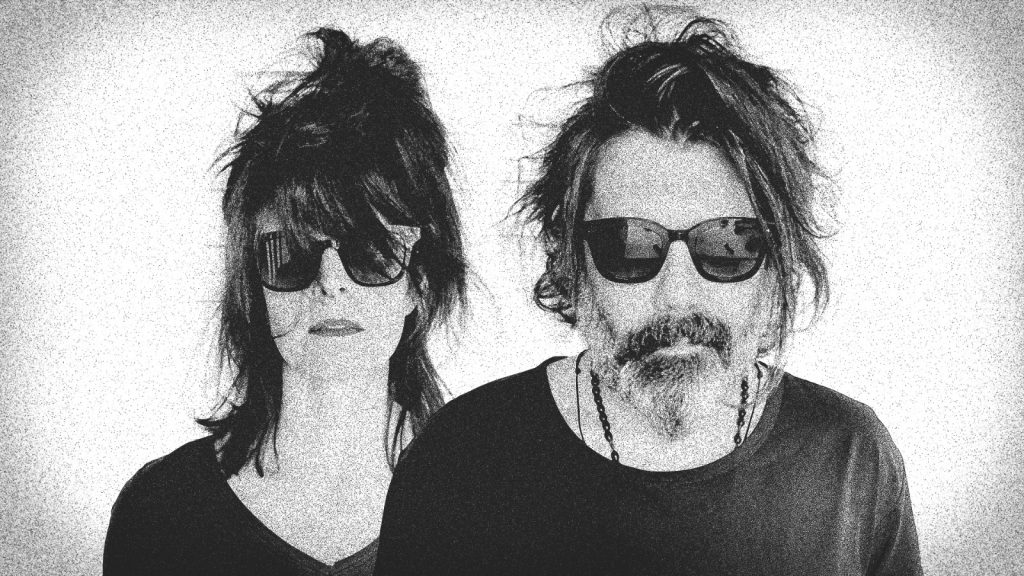
Jessica Bell, thank you for taking the time to share the story behind Hollow Shift, your creative journey with Alexander Zamparas, and the deeper ideas that shaped WAR. This conversation offered a fascinating look into the emotions, decisions, and artistic instincts behind a project that continues to evolve with every release.
For listeners discovering Hollow Shift for the first time, WAR provides an opportunity to experience music that blends atmosphere, movement, and emotional honesty while exploring themes that remain deeply connected to the human experience. We encourage everyone to spend time with the release, explore the duo’s previous work, and continue following their journey as Hollow Shift continues to grow.
Thank you to everyone who spent time with this DULAXI interview. We appreciate your continued support of independent artists and the stories behind the music. Stay connected with DULAXI for more conversations, discoveries, and interviews from artists around the world.