

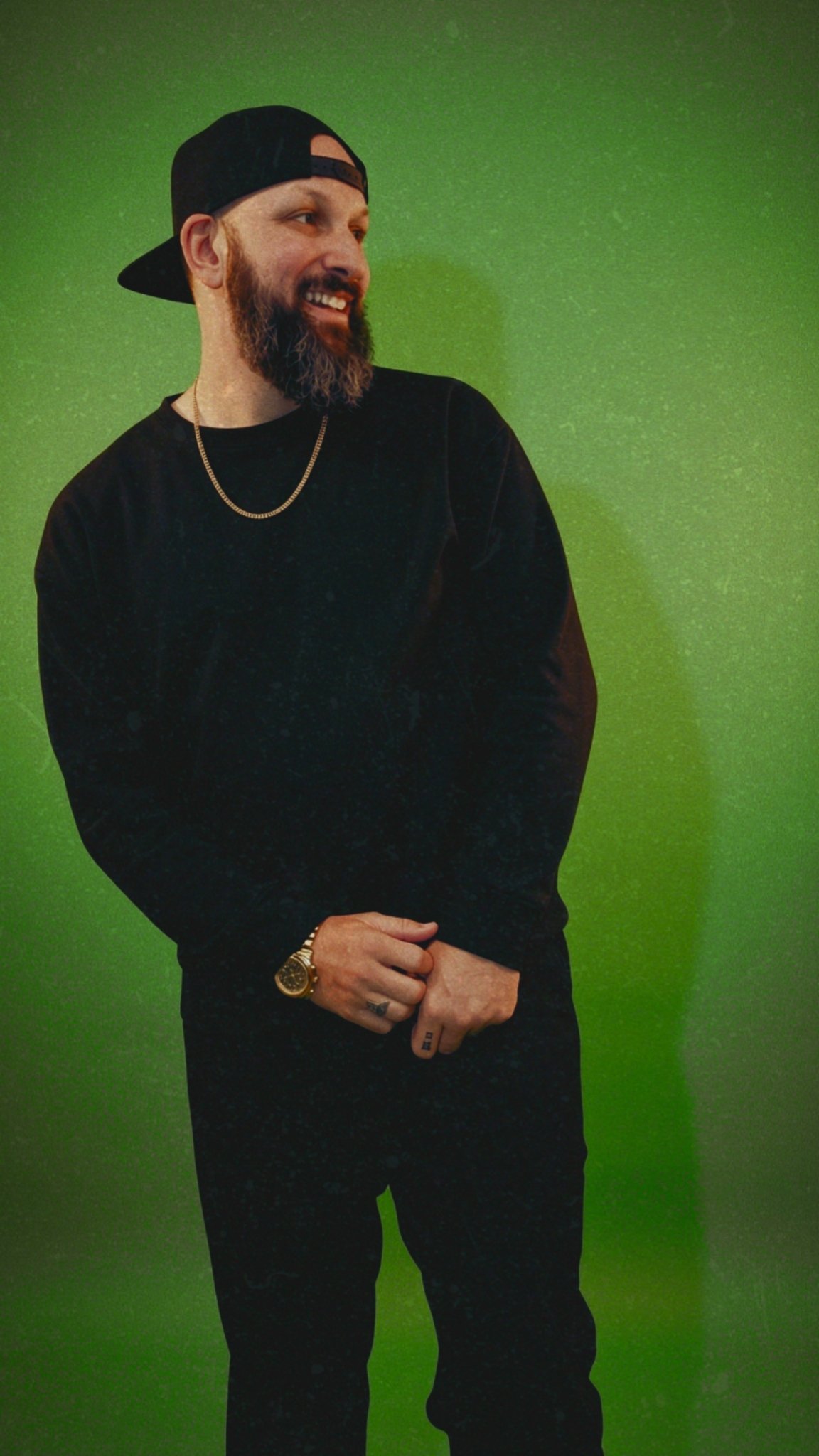
Hello everyone, it is your host Oliver from DULAXI, and today I am delighted to be joined by Canadian composer and producer Jayme McDonald, the creative force behind Chatterless, to discuss his latest single, “CONVERSATIONS WITH FRIENDS.” Released on September 15, 2026, the track is a bright, feel-good house production that captures the pleasure of reconnecting with friends and allowing an ordinary afternoon to develop into a memorable night. Blending warm synthesizers, chopped vocal fragments, and a steady dance rhythm, the single offers a sunnier perspective from an artist whose work has moved through lofi, synthwave, tech house, and dark electronica.
Before we begin our conversation with Jayme McDonald, here is what you need to know about today’s featured project.
About Chatterless
Chatterless is the musical project of Canadian composer and producer Jayme McDonald, whose career has developed across several areas of the entertainment industry. Over more than 23 years, he has created music for film, television, video games, comedy, and hip hop, building experience in settings that require music to respond to different stories, moods, and audiences. His credits include scoring the video game “SIGNAL OPS,” which sold more than 20,000 units, contributing music to the multiple award-winning feature documentary “DOSED,” and securing placements in the television series “TIES THAT BIND,” internationally released as “Detective McLean.” He has also produced comedy specials for Kwasi Thomas and Steve McGowan and hosted and produced 175 episodes of the podcast “INTERGALACTIC INTERVIEWS.”
His hip hop production credits include work with Merkules, ThisIsMakaInc, formerly known as Maka, D.O. Gibson, CHINO XL, and KXNG CROOKED, formerly known as Crooked I. These experiences form part of a wider creative history that has allowed McDonald to approach music from different perspectives, whether responding to a visual narrative, working with another artist’s vision, or developing a composition entirely on his own.
Chatterless began releasing music in 2018 with “Snowbank,” followed by projects that explored different electronic styles. The 2021 album “Nobody From Nowhere With Nothing” later returned to Canada’s iTunes Electronic Albums chart during the release period surrounding “DECUMANUS,” a darker industrial single released in 2026. That return brought renewed attention to an earlier part of his catalogue and illustrated how listeners could move between different sides of the Chatterless project.
“CONVERSATIONS WITH FRIENDS,” released through Less Chatter Music Group on September 15, 2026, approaches electronic music from a distinctly warmer direction. Built around bright synths, chopped vocal fragments, and a steady four-on-the-floor groove, the single takes inspiration from the social experiences that can make everyday life feel meaningful. Its concept also has a personal foundation. During a self-imposed sabbatical, McDonald spent time reconnecting with family and working on himself, while stepping away from many of his usual social encounters. That period helped him recognise how much he missed the company of friends and the sense of connection that comes from spending time with people who matter.
His approach to creating music also reflects the freedom he has developed through years of working across different formats. Rather than restricting Chatterless to a single electronic genre, McDonald treats each release as an opportunity to test his abilities and explore a different creative direction. That philosophy has shaped the contrast between “DECUMANUS” and “CONVERSATIONS WITH FRIENDS,” although the two tracks were created at different points rather than as a deliberate sequence from darkness to light. Audience participation has also become part of his release decisions, with listeners voting through Patreon and social media on music they would like to hear released.
There is already more to explore from Chatterless. The Halloween album “BLOODBANK,” previously available as a Patreon exclusive, has now been released publicly and is available to listen to on YouTube. We have embedded it at the end of this interview so readers can experience it for themselves. Looking ahead, McDonald is planning a breakbeat and big beat album for January 2027, built around “BACK OF THE LIMO (LOOK AT THE DEVIL).” He is also set to compose the score for a feature-length horror film expected in the third quarter of 2027, while preparing to perform his original music live as a DJ in 2027. These plans point towards an exciting period of creative exploration across electronic music, live performance, and film scoring.
Having explored the background of Chatterless and the personal experiences behind “CONVERSATIONS WITH FRIENDS,” it is time to hear directly from Jayme McDonald about the ideas, decisions, and experiences that continue to shape his work. Without further ado, let’s begin today’s interview.

INTERVIEW SESSION
Oliver:
You have spent more than two decades creating music for other people’s stories, from film and television to games, documentaries and comedy. Looking back, what were some of the moments in that journey that most changed the way you understand music and your own place within it?
Jayme McDonald:
I think probably the most fundamental change in the direction of my career was when I did the mixtape called Project Mayhem. It was a Fight Club rescoring. When I did it, I had no previous scoring experience. It was for an artist I was working with, and the idea was that we were just going to rework the cinematic ideas, like the dialogue of Fight Club. But I found a bunch of scenes that were not scored yet, so I went ahead and rescored them. Midway through the process I started to realize, hey, I really like this — and hey, I actually might be kind of good at it. Once that was released and it was successful — we did soap releases to promote it — I ended up pursuing video games after that, because I still didn’t feel like I was good enough to do film yet. But the reality is, that was a pivotal moment in my career. At that point I had already been producing for about five, six, seven years.
Oliver:
Before Chatterless became a space where you could explore your own ideas, you were often writing within someone else’s world and serving a particular scene or story. What first made you want to step more fully into your own artistic identity and create music without having to follow another person’s narrative?
Jayme McDonald:
I think a major part of what made me focus suddenly on my own work versus producing other people’s visions was that I was actually trying to release unreleased beats that I had that were not selected by artists, or I had not shopped to anyone, and I just couldn’t really figure out a way to put it together. So I had a beat tape. I did kind of everything backwards in my career — I got all my first placements, major and indie, before I ever did a beat tape. So, you know, that was pretty interesting. That’s not usually the way that goes. There’s a lot of producers starting out right now that think they have to do a number of things online and all these shoppings and blah blah blah — that’s not the way I did it. I’m kind of old school in the way that I started. I mean, I was quite young when I started producing, I was 17. So by the time it was 2019 — 2018 I think was the first Chatterless release, when I did Snowbank — I mean, there weren’t even any beats on there, that was just a Christmas album. But the fact is, Wake Up Aurora came out in the January or the February following that, if I recall correctly. And the fact is, I decided right away that when I put my logo of MD — as I produce for other artists under the name MD of the Boomsday Alliance — I realized that my logo just looked weird every time I put it on the artwork I was playing with. So I had to come up with a new name. And I always thought, like, wow, I won’t stop talking most of the time, as you can tell by the length of this answer. So I realized every report card I’ve ever had growing up said “Jayme would do well to focus on his work and not talk so much,” and I realized I should probably chatter less — and that’s where that came from. So yeah, the focus really came from a point of me wanting to actually explore more with other artists and realizing that the best thing I could do is explore the artists within myself.
Oliver:
Your career has moved through film scoring, hip hop production, podcasting and several electronic styles, while Chatterless itself has travelled through lofi, synthwave, tech house and dark electronica. What does that freedom to move between very different musical worlds allow you to express that staying within one sound never could?
Jayme McDonald:
The majority of what I’m doing when I’m switching genres isn’t necessarily for anyone else. Honestly, it’s just purely a challenge for myself. I’m really just trying to see, can I do it? Sometimes I get really locked into a style like lo-fi or synthwave, and the information that I’m usually processing when I’m doing that is more emotional — what is the best way I can get the emotion out that I’m actually thinking and feeling? And as I’ve mentioned in other promotional releases and things like that, when I’m making music, oftentimes I’m making the way I want to feel rather than how I actually feel. So some of the happiest stuff I’ve ever written has not exactly been in the happiest times of my life. So I think when it comes to exploring different styles for me, it’s more about the challenge of it — like, can I do it, will people respond to it, do they understand that when they’re listening to me, they’re not just listening to, say, an electronic release in a tech house style. You’re really listening to Chatterless’s tech house. You’re listening to a Chatterless synthwave. You’re listening to Chatterless chill hop, etc. That’s more of what it’s about. It allows me to explore any range of emotion and anything I can think of. And I’m proud to say that I’ve been able to connect with audiences in every single attempt so far.
Oliver:
You describe your approach as wanting to “create the soundtrack of your life” and make “all kinds” of music. How has that philosophy developed through the different chapters of your career, and what does creative freedom mean to you now compared with when you first started making music?
Jayme McDonald:
I think when I first started making music, I was extremely involved in a lot of dark emotional spaces. Anger, especially. I was actually having a lot of — I would say probably negative influences, not only just in my life, but also internally. And my major issue is that when I was making music, a lot of it was reflecting that type of energy. So as the music has changed and I’m no longer making music so primarily for other people, a bigger issue is that I’m actually now making the soundtrack of my life, as you mentioned — but not just my life, everyone’s life. And some people seem to really enjoy the movie I’m making.
Oliver:
“CONVERSATIONS WITH FRIENDS” captures those afternoon moments that gradually become long nights, with a bright house feel built around warm synths, chopped vocal fragments and a steady four-on-the-floor groove. What was happening in your life or imagination when the idea for this particular atmosphere first began to take shape?
Jayme McDonald:
I mean, this song actually is a perfect example of what I was describing earlier when I said that I make music for how I want to feel rather than how I feel. This song was actually written during a period of sabbatical — self imposed — where I had been reconnecting with family and working on myself quite a bit. And I’d actually kind of removed myself from social encounters almost entirely for the better part of the last year. So suddenly it dawned on me that I was really missing the fellowship of connection. My friends, the men and women in my life that are just fantastic to be around — I had cut myself off from them, not intentionally, but in a way that was not allowing for us to connect again. And then it just lined up with a number of moments recently where I was able to reconnect and do those things. So yeah, I think I’ve had a number of moments where that really lines up perfectly, but this one in particular really dialed into the element that it became Conversations With Friends.
Oliver:
There is an interesting contrast between this warm, sunny release and the darker industrial direction of “DECUMANUS.” What made you want to move from that heavier world into something more relaxed, euphoric and openly feel-good with “CONVERSATIONS WITH FRIENDS”?
Jayme McDonald:
It wasn’t so much a conscious choice, so to speak. It wasn’t like I made DECUMANUS and then I made Conversations With Friends. It was actually completely the opposite. I had made Conversations With Friends much earlier in the year, I think — somewhere around January or so. And then with respect to DECUMANUS, I made DECUMANUS in the spring, later than that time. So it actually came out that DECUMANUS was part of a fan vote I did through Patreon and social media in general. And while the other songs performed well in the vote, the reality is that DECUMANUS won that by a larger margin. So I was responding more to the audience and what they wanted to listen to. And now, the vast majority of the people listening — my existing audience, as it grows — people are learning that I do tend to make genres that are based on the challenge of what I want to do, rather than just being locked into, like, “oh, he’s an electronic artist,” or “oh, he makes hip hop beats,” etc. It’s not like that for me. It’s more like, “oh, I listen to Chatterless.” That’s the feedback I get from people.
Oliver:
Your work in visual media has taught you how music can enhance a moment or deliberately step back and allow the scene to breathe. When you approached “CONVERSATIONS WITH FRIENDS” as a song rather than a score, how did you decide when the music should lead the listener and when it should simply give them room to feel the moment?
Jayme McDonald:
I don’t necessarily make music like that — or any particular art like that. I don’t necessarily sit down and think, would this make a better score or would this make a better song? For me, oftentimes the song is completely done in my head, and I’m just simply working it out, oftentimes in one session. I do try to do the bulk of the work, if not the majority of it — up to like an 80, 90 percentile range — all in one session, that way it’s completely organic to what I was feeling in that moment and there’s no crossover, etc. One of the benefits of working solo is that I get the opportunity to do that. So within this, I would say there wasn’t necessarily a moment where I thought, like, this might make a better score. It’s more like, if anything, based on your question — sometimes mid-song or mid-score I’ll think, oh, you know what, this might be a good soundtrack versus a score.
Oliver:
The chopped vocal fragments become part of the texture rather than functioning like a conventional vocal performance. What attracted you to that approach, and how did you use those fragments to add a sense of human presence without taking away from the instrumental character of the track?
Jayme McDonald:
Vocals were actually the last component to be added to that song. When I was actually completing the mix — I was already done the majority of the mix — and then realized that there was, like you mentioned, a bit of a, I don’t know, organic human presence that was just missing. Like, how could it be Conversations With Friends, a title I already had? How could it be that and not have a human or a friend involved, essentially, right? So I definitely decided to peruse the items that I had and worked with the samples I was working with, and I found one. And the woman is saying — there’s a longer construct of a sentence when I was using it, but essentially I chopped it into saying “all right, go.” And for me, that almost felt like a sense of permission that I was giving myself to be on the sabbatical I mentioned in the previous answer. Like, “all right, go” — like my friends would understand, they would know that I wasn’t going to be there because I was pursuing my own self improvement, which is pretty much the ethos of Chatterless in general.
Oliver:
You have worked across very different forms of production, including hip hop with artists such as Merkules, ThisIsMakaInc, D.O. Gibson, CHINO XL and KXNG CROOKED. How has working with vocal-driven artists and lyric focused music influenced the way you now approach rhythm, space and composition in electronic music?
Jayme McDonald:
I think for one, the artists that you mentioned here are specifically hip hop artists in general. With rappers, there’s — you know, even the most versatile rappers, someone like, say, Maka, like ThisIsMakaInc — someone like Maka is an incredibly versatile writer. I mean, he’s an award-winning writer. There’s an amazing reason why he does what he does. And when we worked together on the project Rude Man, that project’s still considered ahead of its time. I mean, it came out in 2013, and it did really well in the festival circuit, and there was a lot of really good feedback from it. But since then, the stuff we were making ended up becoming very much, in large parts, part of the hip-hop scene around the world. So we’re standing on the shoulders of giants, of course, and we’re not responsible for anything more than what we did. But I do want to say, something like that is a good example of why working with someone that can push you to do more and push the envelope — that’s a really big part of it. For another example, someone like KXNG CROOKED or Merkules, like CHINO XL — those are amazing credits I have, and I’m really, really proud of the work I’ve done with them. Especially with Chino’s passing recently, I have to say it’s really important for me to be able to say I’ve worked with some incredible legends in the game. But a lot of these credits, those were features, and I didn’t necessarily get the hands-on approach that I would have preferred with working with them. But that being said, I learned a lot from it, because just knowing that they were going to be featuring on the songs made sure that I was going to be able to increase my abilities, so I could step it up — because I knew their audiences were going to check out their material, which would become our material, and there was a challenge within that that I really wanted to meet.
Oliver:
Your scoring work on “DOSED” and “SIGNAL OPS,” along with your television and commercial placements, has required you to understand how music interacts with very different audiences and situations. What have those experiences taught you about communicating emotion without relying on lyrics?
Jayme McDonald:
Sometimes I think that the way that I interact with music is like trying to find a balance that is really hard to explain. So almost more of a metaphor might work better here. I think when you breathe in and you breathe out, the moment you inhale, the moment you exhale, there’s a brief moment where you’re doing neither. And that is the moment where you want to be scoring. Because you don’t want to take away from what the scene is representing visually — you want to enhance it. And sometimes the best way to enhance it is by not doing anything at all. So knowing when to be quiet and when to be loud, so to speak — to make it very basic — is a critical element that I’ve been trying to refine since I’ve gotten into this line of work.
Oliver:
You have also produced comedy specials and hosted 175 episodes of “INTERGALACTIC INTERVIEWS,” which places you in a very different relationship with storytelling and human expression. How has spending so much time listening to other people’s stories affected the way you create and the subjects or emotions you instinctively respond to?
Jayme McDonald:
Probably the way I interpret my own social battery is probably the number one way that’s affected me day to day. I used to be this unlimited, can-go forever social butterfly magnet, and I would just never have an issue whatsoever with anything. And then one day I realized that listening intently in a creative manner and asking questions in a thoughtful way — trying to archive an era within an entertainment scene, like I was doing with Intergalactic Interviews — a big part of that was draining my ability to be social in my personal life. And I don’t mean that in a way that I was not having a good time — it was quite the opposite. I was having a blast doing it, it was so much fun. But really what it was, it was draining my battery. The thing about Intergalactic Interviews is that you would record one night, then edit the next night, then promote the following night, and then that leaves you four days to get the next guest in order, promote the current episode, and then do it all again. So I was essentially burning two to three days a week, every week, with seven days of work still to do. So when you jam seven days of work into four days for four or five years — however long the run was for Intergalactic Interviews — you tend to redline your engine. So that’s what’s affected the way I created. For a long time, you’ll notice that Chatterless started when Intergalactic Interviews ended. And that’s not a coincidence at all.
Oliver:
Your 2021 album “Nobody From Nowhere With Nothing” recently returned to the Canadian iTunes Electronic Albums chart during the release period around “DECUMANUS.” What did that moment mean to you after several years of continually experimenting with Chatterless, and did it change how you view the audience that has grown around the project?
Jayme McDonald:
That moment meant a lot for me because even though Nobody From Nowhere With Nothing was critically successful when it was released, the charting aspect was missing domestically. It did chart briefly in an international sense, but the domestic charting was the first time, I believe, any project I’d ever worked on had charted that way. So I was very proud of that. And I was also proud that it was because of the attention that DECUMANUS was receiving. So the bleed-off of people saying, “oh, I like DECUMANUS” — and, I guess I’m inventing this part, I have no idea, but I would imagine people would listen to DECUMANUS and then think, “who is this guy, what’s he done,” and then click the other stuff. And I think at the time, the most popular stuff on my social media probably would have been from Nobody From Nowhere With Nothing — and that would have been probably “Stay With Me,” that song. And if people really like that, if they listen to it enough, yeah, it would probably chart. Of course, charting was like a cup of coffee, essentially — don’t blink or you’ll miss it. But at the same time, it was a very proud moment for me as a professional.
Oliver:
Your Patreon audience recently voted “BACK OF THE LIMO (LOOK AT THE DEVIL)” alongside “CONVERSATIONS WITH FRIENDS” as a favourite, giving you a direct indication of what your listeners are connecting with. How does that kind of audience involvement influence your creative decisions while still allowing you to protect the freedom and unpredictability that seem central to Chatterless?
Jayme McDonald:
In reference to Back Of The Limo, that song and Conversations With Friends were actually tied in the poll that came out. So I chose to go with Conversations With Friends as a tiebreaker because it was a bit more of a summer, late-summer vibe — so the idea that it fit more, maybe, with audiences that might appreciate it at the time, even though it was a tie. I think that sticks. And also I have to say, with Back Of The Limo, the energy of that song — it’s essentially a love letter to The Prodigy, one of my favourite groups of all time. And I did a whole project, big beat, breakbeat style — Fatboy Slim, essentially, that type of The Chemical Brothers, The Crystal Method, that type of work. I’ve really, really dug into that, because that is what’s been driving me lately. When we talk about challenges in previous questions of different genres, that’s been my most recent challenge this year, and I think that’s something I’ve really locked into. So having that slated for January honours the people that voted and tied with the Patreon poll for the Conversations With Friends winner. But essentially what this does is that gives me the entirety of January 2027 onward to support that release, Back Of The Limo — and then also whatever comes next from it.
Oliver:
Looking at the evolution from “Snowbank” in 2018 through projects such as “This Fun Might Kill Us,” “I Don’t Give A Fuck,” “DECUMANUS” and now “CONVERSATIONS WITH FRIENDS,” what do you hear in your earlier work that reminds you of where you came from, and what do you hear now that tells you how much you have changed?
Jayme McDonald:
That’s an interesting question because I don’t necessarily consider stuff I did at the beginning of Chatterless as my early work, because my career has been over a couple of decades. So I think when I think of my early work, I actually think of my vocal performances as a rapper under the name MD. I had a lot of work under that. So when I think about that stuff — I alluded earlier, in a previous question, about being in a darker place mentality-wise in terms of anger, and maybe not having a proper way of lashing out in a healthy way. So some of that bled into the music itself. So when I hear that, and then I hear it now — the artist who made that stuff in the beginning of my career certainly wouldn’t be capable of making songs like “Kindness,” or “Butterflies For A Day,” or “Wake Up Aurora,” any of these — like, yeah, “Long Shadows On The Sand.” Those songs all come from a place that that person, at the beginning of my career, probably would have turned their nose up at, and would have thought they were too soft or happy or things like that. So the evolution isn’t necessarily that I’ve gotten happier. I think it’s that I’ve become more understanding and more mature about what emotions can be, and what they mean to other people, and how I reflect my own feelings of what I want to feel into the music I create.
Oliver:
The next stage of Chatterless is already moving through very different territory, from the Halloween album “BLOODBANK” to a break/big beat album in January and eventually a feature-length horror score in 2027. What excites you most about these challenges, and how do you want each project to reveal another side of what Chatterless can become?
Jayme McDonald:
It’s funny because they actually all have essentially the same crossover goals. There might be extreme stretch goals within them that I think everyone, especially artistic and creative people, could identify with — in terms of reach, and wanting them to affect as many people as possible in a positive way. I think that’s obviously always a goal. But for me, the goal has changed over the last few years. It’s not necessarily about that anymore. Like I mentioned, that’s a stretch goal. The reality is that I’ve shifted my perspective to it being a success the moment I make it, rather than release it. The sheer fact that I’ve created something is a success to me — versus the fact that I’ve released it, or what anyone else feels about it. That’s all gravy. That’s all the best stuff afterwards. That doesn’t make me feel any different about the project itself. For example, BLOODBANK — no one told me to make a Halloween seasonal album. And the spinoff of the name of Snowbank into BLOODBANK just kind of came to me as I was creating it. But I created that whole album in the span of about five days while house sitting for my brother. And there was a crazy thunderstorm that night, and I just felt like a mad scientist, to be honest with you. I took video of it, just thinking, wow, what a strange experience to make an album. But as I started making it more and more, I understood as I was doing it that this was going to be something very different, very special for me — and that if it was done right, it could be a seasonal favourite that people could put on every Halloween and hopefully celebrate their spooky season. And when I say there’s crossover goals within that, what I mean is that from BLOODBANK into the next release — which will be Conversations With Friends, after Snowbank season — what will happen is you’re going to be able to see how much high energy I can put into an album, what I want to do, how I want to translate that to the dance floor as I move more into DJing these original songs live, which is also a major goal for me in 2027. And that is going to also play into how much I want this horror film I’m tagged to — how I want it to be successful. I want the audiences to feel it. When DECUMANUS was released, I mentioned that the road that the name of the song comes from was designed to move people, and I thought, well, so is this song. Well, in this sense, I hope that the score I make for this horror film moves people in their seats and gets them excited about what’s going to happen next for me into the next film I score, hopefully.

Oliver:
You have said that you want listeners to stop trying to guess what a Chatterless record will sound like and instead allow each release to take them somewhere for a few moments. When someone finishes listening to “CONVERSATIONS WITH FRIENDS,” what do you hope they carry with them from that moment, whether it is a memory, a feeling, or simply the desire to press play again?
Jayme McDonald:
I want listeners to know that their lives have meaning. And that everything they do is a movie, and that there is a cinematic aspect to everything they’re doing — and the music I make can absolutely be the score that underlines it. And I’d be very proud and happy to be involved in the soundtrack of their lives.
“Chatterless approaches music as an open-ended story, where every release offers a different perspective on life. With ‘CONVERSATIONS WITH FRIENDS,’ Jayme McDonald reminds us that the moments we share with others can become some of the most meaningful scenes in our personal stories.”
~ Oliver (DULAXI Team)
Editorial Perspective
What stands out about “CONVERSATIONS WITH FRIENDS” is the personal experience behind its relaxed house production. Jayme McDonald’s account of stepping away from social life and rediscovering the importance of friendship gives the single a clear emotional foundation. His willingness to move between electronic styles also reveals an artist who values creative exploration over predictable results. Throughout our conversation, his reflections on personal growth, collaboration, and the freedom to create without external expectations offer a deeper understanding of the thinking behind Chatterless. The single ultimately connects its dance-oriented sound with an everyday experience many listeners can recognise.
~ Oliver (DULAXI Team)
Closing
A sincere thank you to Jayme McDonald for joining us at DULAXI and sharing the experiences, creative decisions, and personal reflections behind Chatterless. From his early work in hip hop and his extensive experience in visual media to his continuing exploration of electronic music, our conversation has offered a closer look at an artist who approaches each new project as an opportunity to discover something different.
Listeners are encouraged to experience “CONVERSATIONS WITH FRIENDS” and discover the warmth and easygoing rhythm at the heart of the single. Its story also serves as a reminder of the value of reconnecting with friends and making room for the moments that bring people together.
With “BLOODBANK,” a breakbeat and big beat album, live DJ performances, and a feature-length horror film score among his forthcoming plans, Chatterless has several new creative directions to explore. We look forward to seeing how these projects develop and what further dimensions of his musical identity they reveal.
Thank you for spending time with DULAXI. I am Oliver, and we look forward to bringing you more conversations with artists whose music, experiences, and creative ideas deserve to be heard. Until our next interview, keep discovering new music and supporting the artists who make it.