

Hello everyone, it’s your host Oliver from DULAXI, and today I’m delighted to be joined by Aurealis, the solo independent artist behind a cinematic synth-pop and electronic-pop project rooted in emotion, storytelling and immersive visual presentation. Based in the Southeastern United States, Aurealis has built a distinctive studio-based identity around original songwriting, layered vocals, atmospheric synthesizers and carefully developed electronic production.
Today, we are exploring Aurealis’ latest single, “Exquisite,” released on September 25, 2026. The song enters a fascinating emotional space, examining what happens when an unexpected attraction takes hold despite the knowledge that it cannot, and should not, become anything more. Rather than presenting attraction as something that must be pursued, “Exquisite” focuses on the thoughts, imagination, awkwardness and restraint that can exist around a feeling that was never consciously chosen.
Before we begin our conversation with Aurealis, here’s what you need to know about today’s featured project.
About Aurealis
Behind the Aurealis mask is a solo independent songwriter whose relationship with music began long before the project took its current electronic and cinematic form. Music has always been a significant part of Aurealis’ life, with songwriting becoming a natural way to transform thoughts, observations and emotions into something tangible. That emotional foundation remains central to the project today.
Aurealis’ music is shaped by a strong interest in the small but meaningful experiences that make people human. Love, longing, loss, resilience, self-doubt and complicated emotional situations all find space within the project, with songwriting often beginning from a feeling, observation or moment that continues to occupy the mind. The music moves between energetic electronic-pop territory and more introspective emotional spaces, while layered vocals, strong melodies and atmospheric production form part of what Aurealis describes as the project’s “Aurealis DNA.”
The studio-based approach is equally important. Rather than centering the project around live performance, Aurealis focuses on recorded music, allowing each song to be developed carefully within a controlled creative environment. This approach also gives the music room to expand into visual storytelling, with each release accompanied by a distinctive visual world designed to deepen the emotional narrative rather than simply accompany the song.
That approach comes into particularly clear focus with “Exquisite.” The single explores a very human contradiction: being committed to the life you have while unexpectedly experiencing an intense attraction toward someone who exists outside those commitments. The narrator notices the attraction, loses his composure, imagines conversations and allows his thoughts to wander, but remains conscious of the boundary separating feeling from action.
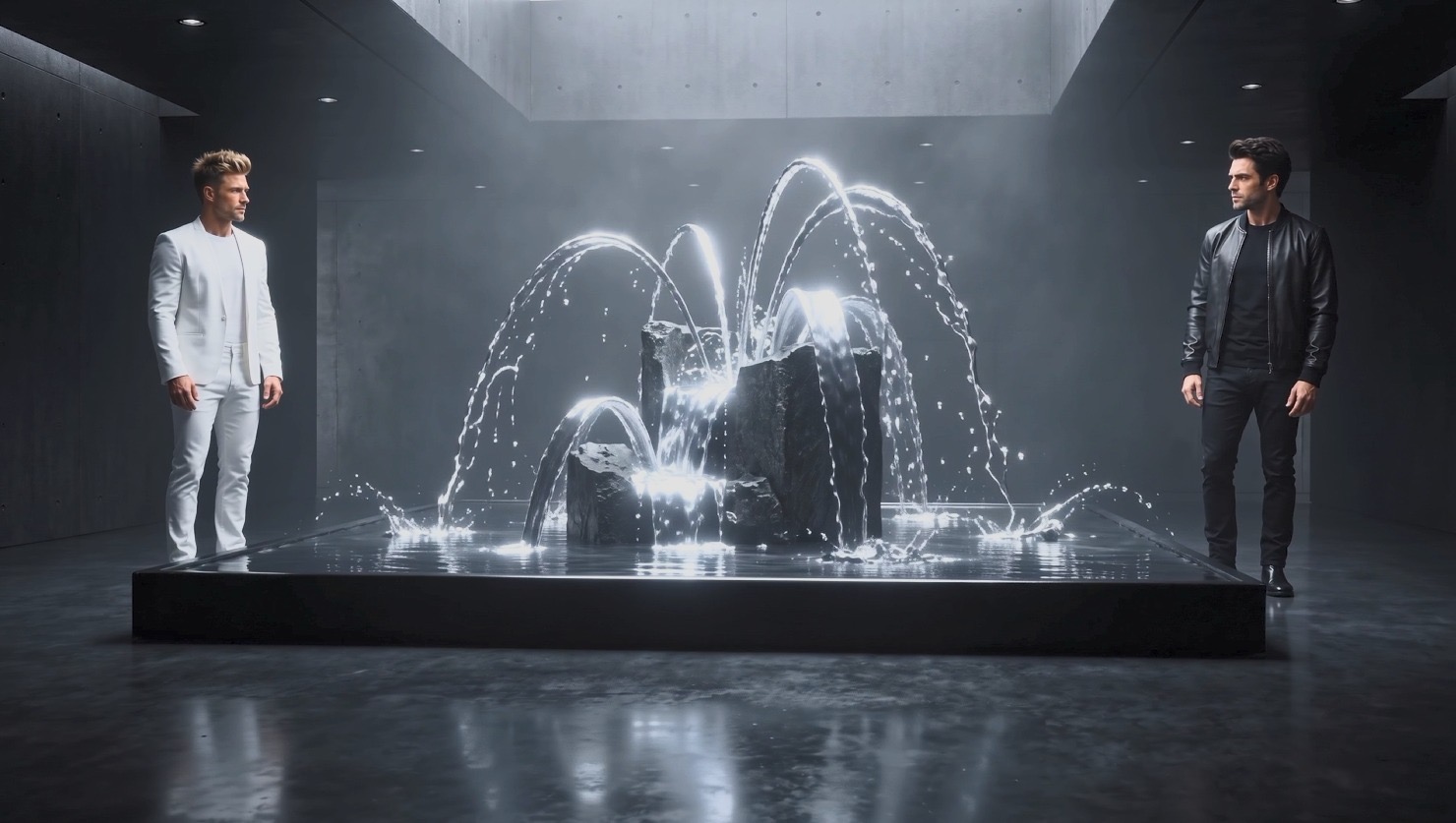
That same conflict continues into the visual world created for the release. The black, white and silver aesthetic places the two central figures inside an environment of mirrors, reflections, futuristic architecture, illuminated spaces and carefully constructed physical boundaries. One figure is presented in black and the other in white, creating a visual distinction between their circumstances and reinforcing the separation that remains at the heart of the story.
“Exquisite” therefore represents an important expression of what Aurealis is building creatively: music that combines melodic pop songwriting, electronic production, emotional storytelling and visual imagination while maintaining a recognizable identity beneath every experiment. Looking ahead, Aurealis intends to continue exploring emotions that people experience but do not always discuss openly, while pushing the electronic and visual sides of the project into new territory.
Having this brief introduction to today’s featured project, I’m sure both new listeners and longtime followers are ready to hear directly from Aurealis. So, without further ado, let’s begin today’s interview.

INTERVIEW SESSION
Oliver:
Before we get into “Exquisite,” tell us a little about the person and artist behind Aurealis. What initially led you toward creating music, and what experiences or influences have played the biggest role in shaping the artist you are today?
Aurealis:
Hi Oliver! First of all, I want to thank you for inviting me to this interview. I’m grateful to be here!
Music has always been a part of my life. Growing up, it was an escape for me. I first learned to write songs on the guitar, although I was never a particularly good guitar player. I also played piano and took singing lessons. But my real passion always seemed to be in creating music, writing lyrics and melodies, and breathing life into something that previously existed only in my mind.
I’m a very emotional person, and that naturally gets poured into the songs I write. How a song makes you feel is really the essence of music to me.
Oliver:
Aurealis is presented as a solo independent, studio-based project built around songwriting, layered vocals, electronic production and visual storytelling. How did this identity come together, and what made this particular approach to making and presenting music feel right for you?
Aurealis:
I’ve always been a pretty shy person. Put me in front of a large group of people and I can suddenly forget everything I know! I’m an introvert, basically, and it took me a long time to decide to share my music at all.
Taking a studio-based approach was the best fit for me because it allows me to create in my own element and focus on presenting exactly what I envision. I’ve always loved classic pop music with layered vocals and melodies that stick with you, and I tend to naturally write music that fits somewhere within that world. Over time, the electronic and visual sides simply grew around that foundation.
Oliver:
Your music explores subjects such as love, longing, loss, resilience and self-doubt, often focusing on the quieter moments where emotions can become complicated. Where does that interest in human emotion and storytelling come from, and how has it influenced the way you write?
Aurealis:
I think one word pretty much sums it up for me: emotion.
As I mentioned earlier, I’m a very emotional person, and when I write, I feel like I’m sometimes channeling those emotions and working through things in my subconscious. My songs are often based on those little human moments that we all experience. Sometimes they are manifestations of something I’m working through myself, and sometimes they are musings based on things I’ve observed in other people.
People are magnificent, beautiful, and sometimes messy. Those little day-to-day moments can be incredibly interesting to explore through music.
Oliver:
Across your work so far, how would you describe the creative evolution of Aurealis? Are there particular experiences, releases or creative discoveries that have changed the way you approach songwriting and production?
Aurealis:
This is a great question! I’ve been writing songs for years, and sometimes when I go back and listen to older material, I’m genuinely happy with what I accomplished. But my tastes have definitely shifted over time.
These days, I lean much more toward a modern, sleek, futuristic sound while still keeping those classic elements I love, layered vocals, strong melodies, and lyrics that actually mean something. I jokingly call that the “Aurealis DNA.”
That DNA tends to be there regardless of when I wrote a song, but sometimes I’ll listen to something I thought was finished and think, “I wish I had gone in this direction,” or “What if I tried this instead?” So I’m not afraid to go back to the drawing board and see if I can push an older song toward where my musical tastes are today.
Oliver:
“Exquisite” explores the experience of being unexpectedly overwhelmed by an attraction that you know you cannot, and should not, pursue. What first drew you to explore this particular conflict between involuntary attraction and conscious restraint?
Aurealis:
Another great question! Exquisite was one of those songs where, after I wrote it, I wondered whether people would really “get” what I was trying to say.
Cursed was like that as well. It was born out of a very real, very dark period in my life, but I wasn’t sure people would understand that at its core, Cursed was really a conversation I was having with myself during that difficult time. But people did pick up on that, and I think many listeners related to it.
With Exquisite, I wanted to explore that space between desire and restraint. I was concerned that people might interpret it as a song glorifying infidelity, when it is actually the opposite. It examines what happens when intense attraction arrives unexpectedly even though you are already committed to someone else.
The feeling itself may not be something you chose, but what you do with it is. Do you act on it, or do you show restraint and remain committed? For me, I wanted to show that desire and restraint can coexist. You may think about something, but thinking about it and acting on it are two very different things.
Oliver:
The narrator catches himself staring, looking away, losing his composure and imagining a conversation that never actually happens. How did you approach writing those private thoughts so they could feel personal and believable without over-explaining what the character is experiencing?
Aurealis:
Honestly, it just came naturally. Once I got into the mindset of, “Okay, this is what I’m feeling for this song, and this is what I want to say,” everything clicked into place.
I basically inserted myself into the situation and wrote what felt natural to me. Emotion plays the biggest role when I’m writing, so once I’m in that frame of mind, the lyrics tend to flow.
I didn’t really have some grand plan for how to explain what the character was experiencing. I just wrote what felt honest and real. I think sometimes if you try too hard to explain an emotion, you can actually lose some of the emotion in the process.
Oliver:
The line “You’re absolutely exquisite” becomes the emotional release of the song, while the repeated “mind, mind, mind” hook captures the fixation happening internally. How did those two elements come together during the songwriting process, and what made them central to the song?
Aurealis:
I wanted this to feel like more than a simple crush. Exquisite is about being completely overwhelmed by someone.
You don’t hear someone describe another person as “exquisite” very often, and when you do, it suggests that person has made a stronger than usual impact. “You’re absolutely exquisite” is almost like the exhale of the song. At that moment, the narrator finally says exactly what he is feeling.
The “mind, mind, mind” hook is important because I wanted it to be very clear that the conversation and scenario in the song are imaginary. They are happening entirely inside the narrator’s mind. In a way, it also becomes his reminder to himself: this stays inside my head, and it goes no further.
Oliver:
One of the defining ideas in “Exquisite” is that attraction can exist without becoming permission to cross a boundary. What did you want the song to communicate about the difference between experiencing a feeling and choosing what to do with it?
Aurealis:
Exactly that. You can experience a feeling and still choose not to act on it.
Being committed to someone doesn’t suddenly mean you are incapable of noticing or being attracted to another person. But if those feelings do arrive, what you choose to do with them is still a choice.
I think Exquisite is really about acknowledging that we are human while also acknowledging that commitment means something.
Oliver:
The song combines glossy, cinematic synth-pop with layered vocals and euphoric electronic production. What were you aiming for sonically when you began building “Exquisite,” and how did you want the production to interact with the tension within the lyrics?
Aurealis:
I was hoping to create a kind of push-and-pull effect.
The verses are quieter, more reflective and restrained. Then when we reach the chorus, everything opens up. It becomes a release because the narrator is finally saying what he wants to say, even though he is still only saying it inside his mind.
I wanted the verses to represent the reasoning part of him, the part reminding himself of his boundaries. They are essentially the restraint section of the song. The chorus is where all of that emotion gets to burst out for a moment. It is the exuberant exhale of the song.

Oliver:
As a studio-based artist, how involved are you in shaping the instrumental arrangement, vocal layers and overall production of your releases, and what part of that process is most important to you when turning an idea into a finished song?
Aurealis:
I’m extremely involved because I’m the one making the creative decisions throughout the process.
Vocal layers are especially important to me because they are part of that “Aurealis DNA” and a big part of my overall sound. That doesn’t mean every song is going to have enormous stacks of vocals, but there is definitely a lane I naturally gravitate toward.
I love experimenting with different sounds and production approaches, and I never want to stop growing creatively. But whatever direction I explore, I still want the finished song to sound like “me” underneath it all. For me, that sense of identity is probably the most important part.
Oliver:
The official video takes the internal conflict of “Exquisite” and turns it into a visual world of mirrors, futuristic architecture, geometric lighting, reflections and silver-toned spaces. What was the original creative idea behind translating the song into this particular visual environment?
Aurealis:
It just seemed to fit.
Since the song takes place largely inside the narrator’s mind, I felt the video needed to exist there as well. And because the narrator views this attraction as something “exquisite,” almost larger than life, the visual world needed to reflect that.
The black, silver, and chrome motif opened the door to these gorgeous, heightened environments that matched the feeling of the song. Mirrors and reflections became a natural extension of that idea.
If you watch closely, there are also several moments where the two characters are literally positioned on opposite sides of a line or boundary. That was intentional. The line is there because it represents the line our narrator is unwilling to cross.
Oliver:
The two central figures are presented in stark contrast, with one dressed entirely in black and the other in white. What do those contrasting visual identities represent within the story you wanted the video to tell?
Aurealis:
They are essentially in opposite places in their lives.
Mr. Dark is already committed. He is married, he has obligations, and there are boundaries attached to that. Mr. Light represents the object of this unexpected attraction and exists outside those commitments.
The contrast between black and white made that separation visually immediate. Even when they occupy the same space, you can tell they belong on opposite sides of something.
Oliver:
Throughout the video, the two figures repeatedly circle one another, cross paths through mirrored spaces and face each other without immediately resolving the tension between them. How did you use their physical movement, positioning and the surrounding environment to express the attraction and restraint at the centre of the song?
Aurealis:
I wanted them to feel constantly drawn toward one another without ever quite being allowed to arrive at the obvious destination.
So much of their movement involves circling, approaching, passing each other, or standing very close while still maintaining some kind of separation. That creates a visual version of what is happening inside the narrator. The attraction keeps pulling him forward, while another part of him keeps stopping him.
The environments help reinforce that. Lines, corridors, reflections and physical distance become little visual barriers. Even when the two characters seem close, there is usually something reminding you that a boundary still exists.
Oliver:
Mirrors and reflections appear repeatedly throughout the video, which connects closely with a song that is largely about an internal conversation. What role did reflection, repetition and the visual relationship between the two figures play in expressing what is happening inside the narrator’s mind?
Aurealis:
The mirrors were probably one of the most natural visual choices for this song because the entire story is so internal.
The narrator is constantly examining his own reaction, questioning himself, imagining possibilities and then reminding himself where the boundary is. A mirror lets you externalize some of that without having to explain it.
I also liked the idea that reflections can make something feel real even when it isn’t. You can see an image right in front of you, but you cannot actually step into it. That felt very appropriate for Exquisite. This imagined relationship feels vivid and emotionally real to the narrator, but it remains something that exists only inside his mind.
Oliver:
The futuristic corridors, illuminated ceilings, geometric lighting and shimmering spaces give the video a heightened, dreamlike quality. Why was it important for you to place such a personal and recognisable emotional conflict inside a world that feels so visually removed from everyday life?
Aurealis:
Because that is what intense attraction can feel like!
Something can happen in a completely ordinary setting, but inside your head it suddenly feels enormous. Your mind turns it into something much more dramatic than what may actually be happening around you.
I wanted the video to live inside that heightened version of reality. The futuristic spaces, light, chrome and reflections are not meant to represent an ordinary physical place. They represent how the narrator is experiencing the situation internally.
For him, this person has temporarily knocked the normal world slightly off its axis, so the visual world does the same thing.
Oliver:
There is a brief moment near the end where the two figures finally make physical contact before separating again. What did you want that moment to communicate about desire, imagination and the restraint that runs through the song?
Aurealis:
That moment is basically the fantasy reaching its furthest point.
For most of the video, the two characters are moving around each other and coming close without really crossing that boundary. Near the end, the narrator allows the fantasy to go a little further. For one brief moment, there is contact.
But it still doesn’t become a real romantic encounter. The moment passes, and the separation returns. I wanted it to feel like the narrator letting himself imagine the “what if” for just a second before reality, and his own sense of restraint, takes over again.
Oliver:
Your releases combine music with distinctive visual worlds rather than treating the video simply as a separate promotional piece. What does visual storytelling allow you to communicate about your songs that the music alone may not always express?
Aurealis:
For me, the video is another part of the storytelling.
When I write a song, I tend to see things in my head anyway. There are moods, colors, places, characters and little moments attached to the music. A video gives me a chance to bring some of that internal world out where somebody else can actually see it.
It can also reveal things that might only be hinted at in the lyrics. With Exquisite, for example, the song tells you that this conflict is happening internally, but the video lets me turn attraction and restraint into actual spaces, movement, distance, mirrors and boundaries.
I love that because it gives someone another way into the song without replacing whatever meaning they may already have found for themselves.
Oliver:
Now that “Exquisite” and its visual world are out in the world, what do you hope listeners take from the relationship between what they hear in the song and what they see in the official video?
Aurealis:
I hope the video helps people understand the song a little more deeply, especially the idea that this is not really a story about pursuing someone. It is a story about what happens internally when you feel something powerful and choose not to pursue it.
The song gives you the narrator’s thoughts, and the video lets you step inside those thoughts for a few minutes.
But I also hope people simply enjoy the world we created. I wanted it to be beautiful, slightly surreal, romantic, tense, and maybe even a little overwhelming, because that is exactly how the narrator is experiencing the person he finds so exquisite.
Oliver:
Looking beyond “Exquisite,” what does this release represent within the wider creative direction of Aurealis, and what kinds of stories, emotions or creative territory would you like to explore in the next chapter of the project?
Aurealis:
I think Exquisite represents where I’m heading very well. It combines a strong melodic pop song with electronic production, layered vocals, emotional storytelling and a visual world that is very intentionally connected to the music.
Going forward, I want to keep pushing all of those things further. I’m interested in songs that explore emotions people recognize but may not always talk about, whether that is attraction, grief, insecurity, hope, obsession, resilience, love, or something completely different.
Musically, I want to keep experimenting too. I love sleek electronic production, but I also enjoy introducing unexpected sounds and textures when they serve the song. I never want to become so predictable that you know exactly what the next song will sound like before you hear it.
What I do want is for there to always be something underneath it that makes you say, “Yes, that sounds like Aurealis.”
“Exquisite” turns an intensely private moment into a world where every glance, reflection and boundary carries emotional weight, showing how powerful a feeling can become without ever needing to be acted upon.
~ Oliver (DULAXI Team)
EDITORIAL PERSPECTIVE
There is something compelling about the way Aurealis builds “Exquisite” around a conflict that remains largely internal. The sleek electronic arrangement gives the song room to expand emotionally, while the layered vocals and recurring hooks reinforce the narrator’s restless thought process. The visual concept takes that same idea further, transforming internal hesitation into physical distance, reflections and boundaries. Together, the music and imagery create a cohesive creative world where emotion is allowed to feel enormous without losing its sense of restraint.
~ Oliver (DULAXI Team)
CLOSING
Our conversation with Aurealis offers an insightful look into the ideas behind “Exquisite” and the wider creative identity taking shape around the project. From its exploration of involuntary attraction and conscious restraint to its carefully constructed electronic production and visual storytelling, the release demonstrates how a personal emotional experience can become something much larger through music and imagery.
Aurealis, thank you for taking the time to speak with DULAXI and for sharing such thoughtful insight into your songwriting, production process, visual ideas and the meaning behind “Exquisite.” It has been a pleasure exploring the story behind the song and the creative world surrounding it.
For everyone discovering Aurealis for the first time, “Exquisite” is a release worth experiencing both through the music and its visual counterpart. Listen closely, step into the world created around the song, and allow yourself to explore the thoughts and emotions at its centre.
And to our readers, thank you for spending time with DULAXI and for continuing to support the conversations we have with artists creating music from their own experiences, ideas and imaginations. We look forward to bringing you more conversations and stories from the world of music.