
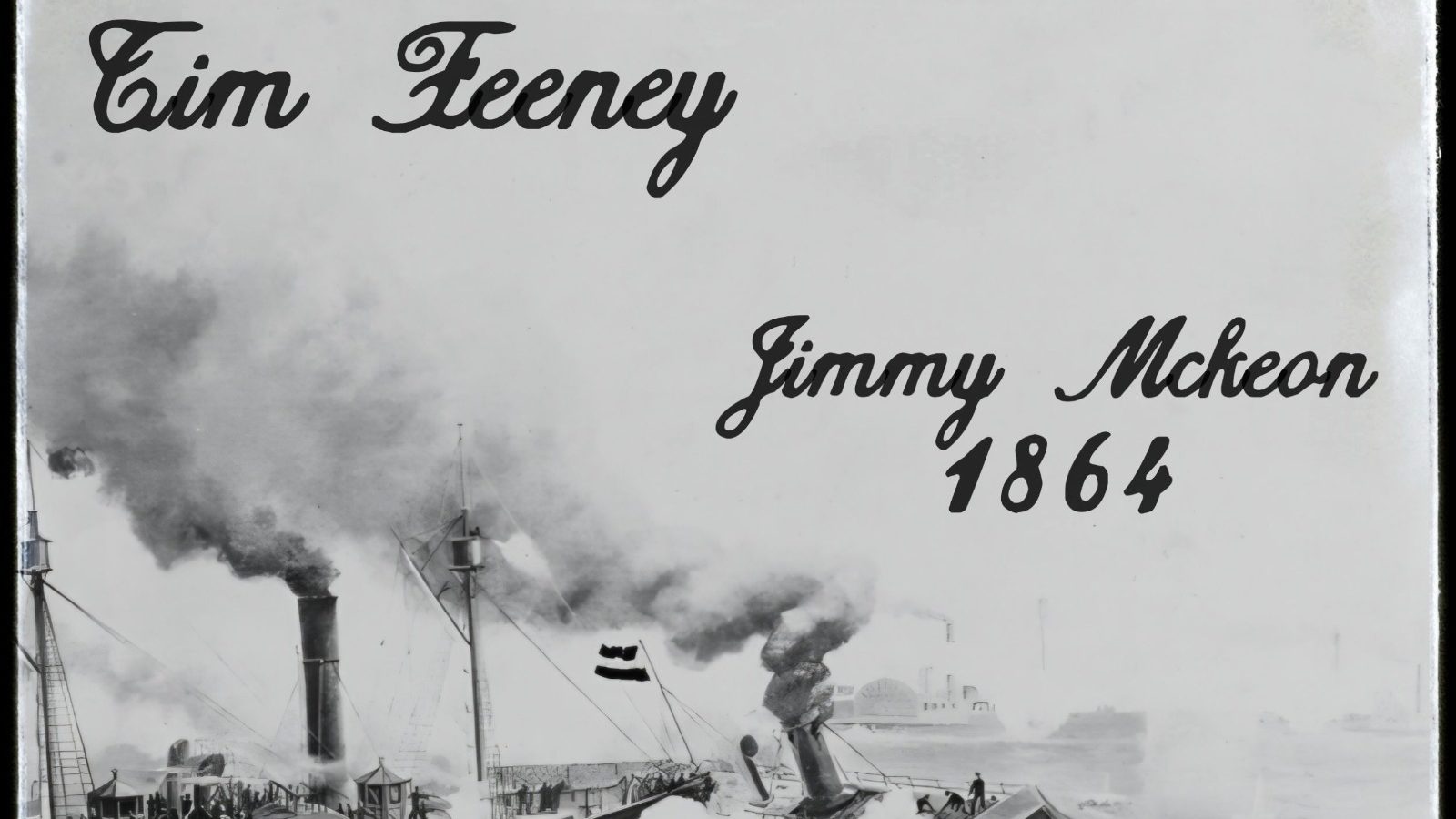
Tim Feeney’s “Jimmy McKeon, 1864” stands as a deeply immersive historical folk ballad that transforms documented ancestry into a vivid acoustic narrative. Rather than treating history as distant subject matter, the song reconstructs it as lived experience, tracing the journey of James A. McKeon across continents and generations. From the aftermath of the Irish Famine to the crowded, turbulent streets of New York, the track immediately establishes itself as both a personal family record and a broader commentary on survival, migration, and endurance. The storytelling approach gives the song a documentary-like weight while maintaining the emotional intimacy of traditional folk expression.
At its core, the composition is anchored in the historical displacement caused by the Irish Famine of the mid-19th century, a period that forced countless families into uncertain transatlantic journeys. The song captures the fragile hope and devastating risk of those migrations aboard coffin ships, where survival was never guaranteed. This sense of precarious beginning sets the emotional foundation for McKeon’s later life in America, particularly his arrival in the densely populated and often harsh environment of Five Points in New York City. These early narrative stages are presented with careful detail, allowing the listener to feel the accumulation of hardship and resilience that defines the protagonist’s life arc.
Musically, the track embraces a stripped-back acoustic arrangement that prioritizes storytelling clarity over ornamental production. The instrumentation is deliberately restrained, built around steady guitar textures that echo the rhythmic flow of oral storytelling traditions. This minimalist framework creates space for the narrative to unfold naturally, while subtle harmonic shifts add emotional shading without disrupting the song’s reflective tone. The pacing is measured and intentional, giving each lyrical moment time to resonate fully, as if each verse is a page from a carefully preserved historical manuscript being read aloud.
The vocal performance at the center of the song is marked by sincerity and emotional precision. Tim Feeney delivers the narrative with a controlled, conversational cadence that mirrors spoken memory rather than theatrical performance. This approach allows the story to remain grounded and accessible, drawing listeners into the emotional texture of McKeon’s journey without overwhelming embellishment. Subtle variations in tone convey shifts between vulnerability, resolve, and reflection, ensuring that the emotional landscape remains dynamic while preserving the song’s overall sense of restraint and authenticity.
As the narrative progresses, the song moves toward McKeon’s later life, including his service as a teenage lookout during the dramatic 1864 naval conflict involving the Confederate ironclad CSS Albemarle. This moment introduces a heightened sense of historical tension, expanding the scope of the song from personal migration story to wartime survival narrative. The arc eventually resolves in his post-war life in Peekskill, New York, where he finds stability working at a local foundry casting stoves. This concluding section of the story grounds the historical journey in labor and community, emphasizing endurance as its central theme.
Jimmy McKeon, 1864 Is A Meticulously Researched Historical Folk Ballad That Transforms Ancestral Survival, Migration, And Resilience Into A Cinematic, Emotionally Grounded Acoustic Narrative
~ Faithfulness (Dulaxi Team)
This final sense of resolution naturally extends into the artistic identity behind the work itself. Tim Feeney, a Peekskill-based Americana songwriter and founding member of the Hudson Valley indie outfit Phineas and the Lonely Leaves, approaches folk music as a vessel for working-class history and inherited memory. Drawing inspiration from the literate emotional storytelling of The Weakerthans, the raw acoustic honesty of Bright Eyes, and the Celtic-infused rebellion of The Pogues, he crafts songs that preserve overlooked narratives with clarity and purpose. With “Jimmy McKeon, 1864,” Feeney not only reconstructs his great-great-grandfather’s journey but also reinforces his own role as a modern folk chronicler, ensuring that the voices of the past remain present, resonant, and alive within contemporary Americana storytelling.
For more information about Tim Feeney, click on the icons below.