
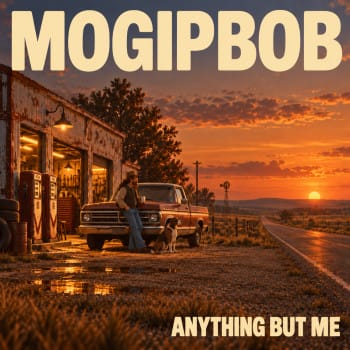
Hello everyone, it’s your host Oliver from DULAXI, and today I’m pleased to be joined by Mogipbob, a Canadian songwriter based in Hythe, Alberta, whose music draws from country, folk, soul, blues, rock, funk and Americana. With his third album, Anything but Me, released on October 20, 2026, Mogipbob continues to explore an approach to songwriting that places storytelling, creative freedom and individuality at its centre. Across 16 original songs, the album moves between humour, unusual characters, nostalgia and more personal reflections, allowing each composition to follow its own musical direction.
Before we begin our conversation with Mogipbob, here’s what you need to know about today’s featured project.
About Mogipbob
Mogipbob has developed a songwriting style that draws inspiration from everyday observations, memories, imaginative ideas and the unusual situations that can emerge from seemingly ordinary experiences. His music carries a warm, 1970s-inspired character, incorporating folk, country, soul, light funk and rock influences, while his storytelling often focuses on working people, imperfect circumstances, dry humour and the thoughts that shape how we understand ourselves. Rather than confining his work to one genre, he allows each song to find the musical atmosphere that best suits its subject.
Anything but Me marks a further step in that creative approach. The 16-track album brings together amusing and unconventional ideas, including vampires, bell bottoms, mythical creatures and peculiar modern-day situations, alongside compositions that reflect on aging, memory, identity, change and the importance of everyday experiences. Songs such as “Hell’s Bell Bottoms,” “The Fleas of Hercules,” “Umpire Vampire” and “Modern Person, Ancient Solutions” explore the album’s more imaginative side, while “Some Things Never Change,” “The Old Me Was the Young Me” and “It’s the Little Things That Matter Most” turn toward more reflective subjects.
At the heart of Mogipbob’s work is a songwriting process that begins with human-written concepts, lyrics, structures and creative direction. AI serves as a production tool to help realise the arrangements and performances, but the creative decisions, revisions, musical direction and final selections remain under his control. Through experimentation with different instruments, arrangements, vocal approaches and musical styles, he works to find the version that best captures the original idea.
With Anything but Me, Mogipbob embraces the freedom to move between the amusing and the thoughtful without feeling the need to fit neatly into a particular musical category. His interest in storytelling, wordplay, familiar musical textures and unexpected ideas gives the album a varied character, while its underlying themes of perspective, individuality and the experiences that shape everyday life provide a thread connecting its different compositions.
Having this brief introduction to today’s featured project, I’m sure both new listeners and longtime fans are ready to hear directly from Mogipbob. So, without further ado, let’s begin today’s interview.

INTERVIEW SESSION
Oliver:
Having previously explored Unemotional Rollercoaster, we’re now looking at your third album, Anything but Me. There seems to be an interesting development in the way you approach your songwriting, particularly in your willingness to move between different musical styles and storytelling ideas. Looking back at your recent body of work, what changes in your creative thinking or artistic confidence do you feel are most evident in this album?
Mogipbob:
I feel that I’ve continued to improve as a songwriter, particularly in how I approach different subjects and musical arrangements. One thing I’ve learned is not to restrict myself to a particular genre.
I generally begin with the lyrics, and once the song starts taking shape, the words seem to tell me what kind of music they want accompanying them. Sometimes it’s folk or country, other times it’s soul, funk or rock.
That freedom has become an important part of my creative process. I’m not particularly concerned about whether one song sounds completely different from the next. I’d rather give each composition the musical character that feels right for it.
Oliver:
One thing that stands out about Anything but Me is its willingness to embrace unusual ideas. You have songs involving vampires, bell bottoms, ancient solutions and questionable deliveries, alongside compositions dealing with memory, identity and everyday life. What usually makes an idea worth developing into a complete song for you? Do these unusual concepts begin with something you observe, a personal experience, a humorous thought, or simply an idea that captures your imagination?
Mogipbob:
Sometimes it’s something I’ve observed, while other times it’s simply a bit of wordplay that gets my imagination going. I’ve always enjoyed combining expressions that don’t ordinarily belong together. “Hell’s Bell Bottoms,” for example, came from joining “hell’s bells” and “bell bottoms.”
Once an idea catches my attention, I start imagining the little world it might inhabit. Who lives in that world? What happens there? What sort of situations could arise?
I enjoy taking something that initially sounds ridiculous and developing it into a story with its own characters and internal logic.
If the idea keeps entertaining me and suggests somewhere interesting to go, there’s probably a song waiting to be written.
Oliver:
The title Anything but Me is particularly interesting because it invites questions about identity, self-perception and the way people sometimes distance themselves from their own experiences. What does the title represent to you, and how does it connect with the wider message you wanted the album to communicate?
Mogipbob:
We live in a world where there’s often pressure to behave a certain way, hold particular opinions or become the person somebody else expects us to be.
To me, “Anything but Me” is about recognizing those expectations and deciding that you’re going to remain yourself anyway.
It’s a declaration of individuality. You don’t necessarily have to agree with everybody, follow every trend or change who you are simply to satisfy someone else’s expectations.
When I finished writing the song, its message resonated with me enough that I immediately knew it should close the album. It also seemed like the natural title for the entire project.
Oliver:
Your songwriting moves between humour and sincerity without allowing either side to overpower the other. A song can introduce an amusing character or an almost absurd situation, yet there is often something recognisable about the human behaviour underneath it. How deliberately do you use humour to explore serious subjects, and do you sometimes find that people are more receptive to difficult truths when they are presented through comedy?
Mogipbob:
I don’t think the world can ever have enough laughter. I enjoy imagining unusual situations and then seeing just how far I can take them.
For example, with “Umpire Vampire,” the starting point was essentially, “Imagine if a baseball umpire happened to be a vampire. What would his world look like?”
But I also believe the world can never have enough sincerity and consideration for others.
Sometimes an idea that begins as a comedy develops into something more meaningful as I’m writing it. I don’t necessarily plan that transition. I simply follow the story.
I sometimes wonder what the world would look like if we all laughed a little more and treated one another with a little more consideration.
Oliver:
I find your decision to let each song determine its own musical direction particularly interesting. Rather than building the entire album around one sound, you move between country, folk, blues, soul, funk and rock. When you begin writing a song, how do you recognise which musical style will serve its story best? Is the sound already present in your imagination when the lyrics take shape, or does it become clearer as the composition develops?
Mogipbob:
It’s difficult to explain because it’s more of an instinct than a formal decision.
As I develop the lyrics, I begin to get a feeling for how the song should sound. The words, the characters and the overall mood suggest a particular musical direction.
For some songs, I can imagine acoustic guitars and a relaxed rhythm. Others seem to demand a prominent bass line, keyboards, brass or a more energetic arrangement.
The musical direction isn’t always completely clear at the beginning. Sometimes it develops as the lyrics come together, and sometimes I discover that my first musical approach isn’t quite right.
I keep exploring until the arrangement feels like it belongs to the story.
Oliver:
Songs such as “Hell’s Bell Bottoms,” “The Fleas of Hercules” and “Umpire Vampire” suggest a strong interest in creating characters and situations that listeners might not encounter in conventional songwriting. What attracts you to this kind of imaginative storytelling, and how much thought goes into making these characters feel believable within the world of each song?
Mogipbob:
One of the things I enjoy most about songwriting is coming up with subjects that may never have been written about before. There are countless songs about familiar subjects, and while there’s nothing wrong with that, I find it particularly rewarding to create something a little different.
When an unusual idea comes along, I like to imagine the world it would exist in. For example, if a baseball umpire were actually a vampire, what would his life look like? What sorts of problems might he encounter? How would he manage the demands of both occupations?
The same applies to songs like “The Fleas of Hercules” and “Hell’s Bell Bottoms.” Once I’ve established the premise, I try to explore the possibilities within that particular world.
I think even the most ridiculous character becomes believable when there’s some consistency to their circumstances and behaviour. The listener doesn’t necessarily have to believe such a character could exist in real life. They just need to enjoy visiting that world for a few minutes.
Oliver:
On the more reflective side, songs such as “Some Things Never Change,” “The Old Me Was the Young Me” and “It’s the Little Things That Matter Most” approach subjects that are much closer to everyday human experience. These themes touch on time, memory, personal change and the value of ordinary moments. Do you find that writing these songs requires a different emotional approach from your more humorous compositions, and which of these subjects has been most meaningful to you personally during this stage of your life?
Mogipbob:
My more reflective songs often draw on memories, particularly those that have earned a permanent address in my soul’s residency.
Some experiences stay with you long after the circumstances surrounding them have changed. They might involve people you’ve known, places you’ve been, or seemingly insignificant moments that become more meaningful as the years pass.
As I’ve gotten older, I’ve developed a greater appreciation for those little things. Time has a way of changing your perspective. Something you barely noticed years ago can suddenly become a fond memory.
I don’t necessarily approach these songs differently from my humorous compositions. In both cases, I’m trying to capture a particular feeling or experience. The main difference is where that feeling comes from.
With a humorous song, I might start by imagining an unusual situation. With a reflective song, I’m more likely to begin with something I’ve experienced or remembered.
Songs like “The Old Me Was the Young Me” and “It’s the Little Things That Matter Most” reflect that growing appreciation for time, memory and the ordinary moments that make up a life.
Oliver:
Something particularly distinctive about your creative approach is the relationship between human songwriting and AI-assisted production. You’ve explained that the concepts, lyrics, structure and creative direction remain human-written and human-directed, while AI helps realise the arrangements and performances. How do you maintain your artistic identity throughout this process, and what specific creative decisions do you believe must always remain under your control?
Mogipbob:
For me, the songwriting and creative direction are the foundations of everything I do. I develop the ideas, write the lyrics and determine the musical character I want each song to have.
I’m particular about how a song breathes. The pacing matters, as do the instruments being used and when they appear. Sometimes I want a particular instrument to carry a section, while another might only make a brief appearance at a certain moment.
I also pay close attention to vocal delivery, harmonies, instrumental breaks and the way the arrangement develops from beginning to end.
AI provides the means to realize these ideas, but it doesn’t eliminate the need to make creative decisions. In fact, it often presents me with more possibilities than I originally imagined.
I might generate numerous versions of a song before finding one that captures what I’m hearing in my head.
Ultimately, I’m the one deciding what the song is about, how it should feel and whether the finished recording represents what I intended to create.
Oliver:
With AI playing a production role, the process of choosing between different musical arrangements, instrumental combinations and generated performances becomes an important part of the creative work. Could you take us through how you develop a song from its original lyrical idea to its final version? In particular, how do you evaluate different renders, decide when an arrangement is right, and recognise when further revisions are no longer improving the composition?
Mogipbob:
The process generally begins with an idea, which might come from wordplay, a personal experience, an observation or something that simply strikes me as an interesting subject.
From there, I develop the lyrics, paying attention to the story, structure, rhythm and how the words flow together. I want the song to have a reason for existing beyond simply putting words to music.
Once I’m satisfied with the songwriting, I begin developing the musical arrangement. By that stage, I usually have a fairly good idea of the style, instrumentation, tempo and vocal character I’m looking for.
Then comes the experimentation.
I use AI to generate different interpretations, and it’s quite common for several versions to have elements I like. One might have a particularly strong chorus, another might have better instrumental arrangements, and a third might capture the vocal delivery more convincingly.
The challenge is finding the version where those elements work together.
I listen for the overall feel, the pacing, the strength of the hook and whether the arrangement complements the lyrics. I also pay attention to unwanted artifacts, awkward pronunciations and other imperfections that can distract from the listening experience.
Sometimes a render is very close, but one little detail prevents it from becoming the finished version. Other times, an unexpected musical choice turns out to be exactly what the song needed.
Knowing when to stop is another challenge. There comes a point where another revision isn’t necessarily an improvement. It might simply be different.
Ultimately, I want the finished recording to capture the feeling I had when I first imagined the song. When everything comes together and I find myself wanting to hear it again, that’s usually a pretty good indication that I’m getting somewhere.
Oliver:
Your music draws on a warm, 1970s-inspired palette, including acoustic guitars, keyboards, horns, strings and layered harmonies. These elements give your work a nostalgic character while allowing you to explore contemporary ideas. What is it about this particular musical era and its production qualities that continues to appeal to you, and how do you keep those influences from becoming a simple exercise in nostalgia?
Mogipbob:
Those are the sounds I grew up with, and they’ve stayed with me ever since. I still occasionally refer to music from the 1990s as “that new stuff,” so that probably tells you something about where my musical tastes are rooted!
I’ve always appreciated the character of recordings from the 1960s through the 1980s. The melodies, arrangements and instrumentation had a warmth and personality that I continue to enjoy.
I’m particularly fond of instruments such as Hammond organ, Rhodes piano, acoustic and electric guitars, brass, strings and prominent bass lines. I also enjoy the layered vocal harmonies that were so common in recordings from those decades.
But I’m not necessarily trying to recreate a particular song or artist from the past.
The lyrical ideas are my own, and many of the subjects are quite different from what you’d ordinarily expect to hear in those musical styles.
I enjoy taking a familiar musical atmosphere and introducing an unfamiliar story into it. The sound might remind somebody of an earlier era, but the song itself is something new.
For me, that combination is part of the fun.
Oliver:
Working across 16 original songs creates considerable creative demands, particularly when each composition is allowed to follow its own musical direction. Were there any songs on Anything but Me that proved especially difficult to complete, whether because of their lyrical structure, the arrangement you wanted, or the challenge of getting the musical performance to match your original vision? What did those experiences teach you about your own creative process?
Mogipbob:
Every one of the sixteen songs presented its own challenges. It’s rare that a song comes together exactly as I imagined it on the first attempt. Some require considerably more experimentation than others, particularly when I’m trying to achieve a specific arrangement, vocal delivery or overall atmosphere.
One of the challenges is finding the right combination of elements. A song might have a wonderful melody but lack the rhythmic feel I intended. Another version might have excellent instrumentation but fail to deliver the chorus with enough impact.
I’m particularly interested in creating a memorable hook, something that stays with the listener after the song has finished. But the hook is only part of the equation. The pacing, instrumental choices and emotional character all need to complement one another.
The biggest lesson has been patience. Sometimes the difference between a promising render and one that truly works is surprisingly small, but finding that difference can take considerable effort.
I’ve learned that it’s worth continuing to experiment until the recording captures the feeling I originally wanted to convey. At the same time, I’ve also learned that another revision doesn’t automatically mean a better result.
Oliver:
As your third album, Anything but Me also gives you an opportunity to look at your development across multiple projects. Without simply comparing the number of songs or the musical styles, what do you believe you understand about songwriting today that you might have approached differently when working on your earlier albums? Has there been a particular creative lesson that has changed the way you now evaluate your own work?
Mogipbob:
I don’t approach songwriting as a competition with other artists, or even with my earlier recordings. I’m simply enjoying the opportunity to create music and become a little better at it along the way.
With every song I write, I develop a greater understanding of structure, pacing and how different musical elements contribute to the finished composition. I’ve become more conscious of how a verse leads into a chorus, how much breathing room a song needs, and whether a particular section is contributing something worthwhile.
I sometimes think of the creative process as playing in an enormous audio sandbox. There’s practically unlimited room to experiment, try unusual combinations and discover something unexpected.
That freedom is one of the things I enjoy most about songwriting.
I don’t necessarily measure progress by whether a new song is more commercially appealing than an earlier one. I’m more interested in whether I’ve developed the idea as effectively as I can.
If I can look back at something I’ve written and recognize that I’ve learned a little more about my craft, I consider that progress.
Oliver:
Your campaign places particular importance on radio airplay, especially through independent, college, community, roots, Americana, soul, folk and country stations. You have also spoken about the special feeling of hearing one of your own songs unexpectedly on the radio. What would meaningful radio support look like for you at this stage of your career, and are there particular songs from Anything but Me that you believe could connect especially well with those different audiences?
Mogipbob:
For me, the most rewarding aspect of sharing my music is discovering that complete strangers are connecting with something I’ve written.
I’ve received comments from listeners identifying their favourite songs, and what’s particularly interesting is that different people often choose completely different tracks. That tells me the songs are finding their own audiences.
Radio airplay is especially appealing because there’s something wonderful about the possibility of somebody discovering a song unexpectedly. Perhaps they’re driving to work, doing something around the house or simply listening to their favourite station when a Mogipbob song comes on.
Given the musical variety on Anything but Me, I think different songs could appeal to different radio formats.
“Set-Back Out Back” would be a natural candidate for Americana or roots programming, while “Walking Bass” might appeal to listeners who enjoy more traditional jazz-influenced arrangements. Songs such as “Hell’s Bell Bottoms” and “The Fleas of Hercules” could offer something a little more playful.
But meaningful radio support wouldn’t necessarily mean reaching millions of listeners. I’d be delighted knowing that a song had found its way to people who genuinely enjoyed it.
Sometimes somebody needs a reflective song to keep them company. Other times, a silly song might provide exactly the little lift they needed.
If my music can do either of those things, that’s pretty rewarding.
Oliver:
Your music draws from several traditions, which means it may appeal to listeners who approach it from very different musical backgrounds. Someone who enjoys country storytelling might connect with one song, while another listener might discover you through the soul, funk or blues influences. How do you think about reaching these different audiences without having to narrow your artistic identity to fit one particular genre or market?
Mogipbob:
That’s actually one of the greatest advantages of not restricting myself to a particular genre.
People don’t necessarily feel the same way every day. Some days we’re upbeat and full of energy, while other days we’re reflective, nostalgic or perhaps feeling a little blue.
Our musical preferences can change with those moods, too.
I enjoy being able to write a relaxed folk song one day, something funky the next, and perhaps a humorous country tune after that.
I’m not particularly concerned about whether all those songs would normally appear together on a conventional genre-specific album. The variety is part of what makes the creative process interesting to me.
I hope listeners approach my albums with that same openness.
Someone might discover Mogipbob through a country song and then find that they also enjoy one of the soul or funk arrangements. Or perhaps the opposite happens.
I’d rather give listeners an opportunity to discover something unexpected than limit the music to fit one particular category.
Oliver:
Music creation can sometimes be a solitary process, but bringing a project to life may involve other creative contributions, technical decisions and outside perspectives. Were there any collaborators, creative partners or other individuals who played a meaningful role in bringing Anything but Me together? If so, how did their contributions influence the finished album, and how do you approach collaboration while maintaining a clear sense of your own creative direction?
Mogipbob:
The song ideas, concepts, lyrics and core melodies on Anything but Me originated with me, myself and I. 🙂
I enjoy the independence of being able to follow an idea wherever it leads, without having to accommodate a particular band’s sound or another songwriter’s preferences.
That doesn’t mean every part of the finished recordings is performed traditionally by me. As I’ve mentioned, I use AI tools to generate the instrumental arrangements and vocal performances. The technology provides the performances, while I establish the creative direction and evaluate the results.
I determine what each song should be about, how the lyrics develop, the overall structure, the instrumentation I’m seeking and the atmosphere I want the recording to capture.
There are plenty of adjustments along the way, and sometimes the process introduces musical possibilities I hadn’t initially considered.
But the songwriting decisions and final selection remain mine.
I think of it as having the freedom to explore a musical idea without being limited by the number of instruments I can personally play or the musicians I happen to have available.
And for somebody who enjoys moving between genres as much as I do, that creative independence is particularly valuable.
Oliver:
Beyond the music itself, independent artists must also make decisions about how their work reaches people and how they build a lasting connection with listeners. What has your experience been like sharing your music with audiences so far, and have any particular listener reactions, messages or unexpected interpretations of your songs made you look at one of your compositions differently?
Mogipbob:
One of the most rewarding things about releasing music is discovering that complete strangers are enjoying something I’ve created. It’s an interesting feeling knowing that a song which began as a little idea in my head has found its way into somebody else’s life.
I’ve had people tell me which songs they particularly enjoy, and what I find fascinating is that their favourites aren’t always the same. A song that really connects with one listener might be completely different from the one that resonates with somebody else.
That variety of reactions is encouraging because it reminds me that each song can find its own audience.
At the same time, the philosophy behind “Anything but Me” is important to how I approach songwriting. I don’t want to create songs simply because someone else expects me to write in a particular style or follow a certain formula.
I’d rather write the music I genuinely want to create, share it with the world, and allow listeners to discover whatever meaning or enjoyment they find in it.
Oliver:
With Anything but Me now representing another important chapter in your catalogue, I’m interested in what comes next. Has working on this album opened up new musical directions or storytelling possibilities that you would like to explore in your next project? Are there ideas, genres or creative approaches that you have deliberately held back for another release?
Mogipbob:
I’ve actually written a few new songs since “Anything but Me” was released, and I feel like I’ve managed to level up my songwriting another notch.
One of the things I enjoy about writing regularly is that each new song seems to teach me something. I might discover a different way of structuring a chorus, develop an unusual lyrical idea, or find a musical arrangement that takes a composition somewhere I hadn’t originally expected.
I’m not deliberately saving particular genres or ideas for another album. When something catches my imagination, I generally want to explore it rather than put it aside.
I love the freedom in not knowing what the next song will sound like. It might be funny, reflective, funky, soulful or something completely different.
As long as the ideas keep coming and I’m enjoying the process, I intend to keep writing. And if the songs continue to develop the way I hope they will, there may well be another Mogipbob album in the future.
Oliver:
Finally, if Anything but Me introduces a listener to your music for the first time, what would you hope they take away from the experience? And looking beyond this particular album, what would you like the next stage of your musical career to represent, both creatively and in terms of the audience you hope to reach?
Mogipbob:
The biggest thing I’d encourage a first-time listener to do is approach the album with an open mind.
If you’re listening to a Mogipbob album, you’re probably going to encounter several different musical styles. You might normally listen to heavy metal, for example, but find yourself unexpectedly enjoying a country-flavoured song like “Impartial Marshal.”
I don’t expect everybody to enjoy every song, and I certainly don’t expect everyone to have the same favourite. I’d rather give listeners a variety of stories and musical experiences and allow them to discover what appeals to them.
Some songs might make you laugh, others might remind you of something from your own life, and perhaps one will give you a moment to reflect.
As for the next chapter, I’d simply like to continue growing as a songwriter and sharing what I create.
If the audience grows along the way, that would be wonderful. But I don’t want the pursuit of a larger audience to take away the freedom and enjoyment I get from writing music in the first place.
A Closer Look at the Songs
Oliver:
“Set-Back Out Back” is an interesting way to open the album because it takes something as ordinary as an old working truck and gives it a much bigger story. What I particularly like about the idea is how the truck’s age, imperfections and battle scars gradually become reasons to appreciate it rather than dismiss it. There is also a lovely shift in the story as the rookie’s initial uncertainty develops into trust and admiration. Was there a particular experience or observation that inspired this character and his relationship with the truck, and did you intend the song to carry a wider message about how we sometimes overlook the value of things simply because they are no longer new?
Mogipbob:
The underlying message of “Set-Back Out Back” is really about comfort, familiarity and dependability.
It’s reassuring when an old piece of equipment that has proven itself over the years. It might not have the latest technology or all the options of something newer, but you know what to expect from it.
In the song, even the boss has a certain fondness for the old rig. It has earned its place through years of reliable service, and the rookie gradually comes to appreciate that.
I can relate to that personally. I recently purchased an older Ford truck that doesn’t have a great many options. It even has crank windows!
But it’s dependable, doesn’t ask for much, and does what I need it to do.
Every so often, while I’m driving along, I’ll find myself saying, “What a good ol’ truck!”
I suppose that’s the feeling I wanted to capture in the song.
Something doesn’t necessarily lose its value simply because it’s getting older. Sometimes its age and imperfections are part of what makes it worth appreciating.
Oliver:
“Walking Bass” caught my attention because its title works on two levels. There is the musical meaning of the walking bassline, but underneath that is a thoughtful idea about people who provide stability and support without necessarily receiving recognition. I also enjoyed the decision to give this song a softer, more spacious jazz-pop arrangement, which feels quite different from some of the guitar-driven tracks elsewhere on the album. What inspired you to connect a musical concept with this particular human message, and is there a person or experience that helped shape your understanding of the importance of those who quietly support others?
Mogipbob:
First of all, I was hoping nobody would expect “Walking Bass” to be about a fish that had somehow learned to walk!
However, knowing my songwriting habits, I suppose that wouldn’t be entirely unreasonable. 🙂
What appeals to me about a walking bassline is its steady, dependable presence. It keeps moving, provides a foundation for the other instruments, and contributes enormously to the overall character of the music without necessarily demanding attention.
I admire that same quality in people and things.
There are individuals who quietly provide stability, encouragement and support without expecting recognition for everything they do. They’re simply there when they’re needed, and their importance sometimes becomes more apparent when they’re absent.
I liked the idea of connecting that human quality with something musical.
The walking bass became a way of representing steadiness and dependability, while also giving me an opportunity to explore a different musical atmosphere.
Sometimes the most important contribution isn’t the loudest or most noticeable one. It’s the one that keeps everything moving.
Oliver:
There is something wonderfully familiar about the situation in “As Is Where Is.” The excitement of finding what appears to be a bargain at an auction, only to discover that the reality comes with a few expensive surprises, is a story many people can recognise in one form or another. I particularly like how the repeated auction phrase gradually takes on a meaning beyond the sale itself, becoming a reminder that our decisions have consequences. When developing this song, were you more interested in telling an entertaining story about an unfortunate purchase, or did you see an opportunity to explore the way optimism sometimes gets ahead of good judgement?
Mogipbob:
“As Is Where Is” actually is from a real-life experience. I once attended an auction and waved to a friend, only to discover that the auctioneer had interpreted my friendly gesture as a bid. Before I knew it, I’d purchased a 1976 BMW!
So I have some personal experience with the unexpected consequences of an auction.
There’s another connection to my everyday life. In my regular job, I administer surplus asset sales for the City through online auctions, where the phrase “as is, where is” is an important part of the terms and conditions.
It’s a familiar expression to anyone involved in buying or selling used equipment, but I liked the idea of turning it into a song.
On the surface, it’s an entertaining story about an unfortunate purchase. Underneath, there’s something familiar about the way enthusiasm can occasionally get ahead of good judgment.
I think most of us have made a decision that seemed perfectly reasonable at the time, only to discover a few surprises afterward.
And in my case, apparently all it took was waving hello to somebody. Incidentally, it was the same friend from “Solid as Metal.”
Oliver:
“Solid as Metal” has a clever way of turning a mechanical problem into a reflection on human responsibility. The recurring suggestion that the machinery is perfectly sound, while the real problem lies somewhere between the seat and the treadle, gives the song its humour, but there is a deeper point about how easily people blame their circumstances or equipment instead of examining their own actions. What made you choose an auto-shop setting to communicate that idea, and did you have a particular type of human behaviour in mind when you developed the song’s central punchline?
Mogipbob:
“Solid as Metal” came from another real-life experience, although this time the inspiration was an expression my best friend, who’s a mechanic, used to say.
When someone complained about a problem with a machine, he’d sometimes respond, “It’s the linkage between the seat and the treadle.”
That would usually produce a moment of confusion while the person tried to figure out which mechanical component he was talking about. Eventually, they’d realize he was referring to the operator!
I always thought that that expression was funny because it sounds so technical while delivering a wonderfully simple punchline. It’s also funny as I once worked as a parts technician.
The song originally started as a comedy built around that idea. But as I developed the lyrics, it gradually became something more reflective.
Sometimes we’re quick to blame the equipment, our circumstances or something beyond our control when the real problem might be closer to home.
I hadn’t necessarily set out to write a song about personal responsibility, but that’s where the story eventually led.
It’s one of those occasions when a humorous idea revealed a more serious message along the way.
Oliver:
“First Degree, Second Decree” takes an unusual approach to emotional storytelling by bringing legal language into a subject involving passion, separation and loss. The contrast between a first-degree fever and the cold finality suggested by a second decree gives the writing an interesting tension, almost as though two very different worlds are being used to describe the same emotional experience. How did you arrive at this combination of language and feeling, and what did you want listeners to understand about the emotional experience sitting beneath the song’s unusual title and wordplay?
Mogipbob:
This song began with two words that sound similar but have very different meanings: “degree” and “decree.”
I always like that kind of wordplay, particularly when it suggests an unexpected connection between two otherwise unrelated ideas.
Once I had the title “First Degree, Second Decree,” I started imagining the world the song might exist in.
The contrast between those words gave me an opportunity to explore powerful emotions through an unusual combination of language. There was something interesting about connecting the intensity of a relationship with the cold formality of its ending.
As I developed the story, the song took on a much more serious emotional character than the original wordplay might suggest.
That’s something I particularly enjoy about songwriting. A title can begin as a clever little linguistic exercise and eventually become the foundation of something quite moving.
I was very pleased with how this one developed. What started with two similar-sounding words ended up becoming one of the more powerful songs on the album. When the finished song gave me goosebumps, I knew I had something special.
Oliver:
“Modern Person, Ancient Solutions” presents a particularly entertaining clash between two different ways of living. Images such as hourglasses, pigeon messages, bone combs and lutes appearing alongside Wi-Fi and modern conveniences create some wonderfully unexpected situations. Beyond the humour, though, there is an interesting question about how much of our behaviour is genuinely modern and how much of it is simply old habits dressed up in new surroundings. Were you exploring the absurdity of technological progress through this character, or is there a more personal observation about modern society that you wanted to bring into the song?
Mogipbob:
The inspiration for “Modern Person, Ancient Solutions” actually came from something my mother once said about a fellow who was very much stuck in the past.
She told me, “He fell off the conveyor belt of evolution.”
I’ve never forgotten that expression. It’s such a wonderfully colourful way of describing somebody who seems to have missed several developments along the way!
I started imagining what the world of a person like that might look like. What if somebody were living in modern society but insisted on approaching everyday situations with methods that belonged to a completely different century?
That opened the door to all sorts of ridiculous possibilities.
Two of my favourite lyrical ideas involve paying for Wi-Fi by telegraph and using a pigeon to send a text message “tapped manual send”. Those combinations still make me laugh.
It was a fun song to write because the idea allowed me to take familiar modern conveniences and give them absurdly outdated solutions.
I don’t think the message necessarily has to be that modern technology is bad or that older methods are better. Sometimes the humour is simply in watching two completely incompatible worlds collide.
And I like to think my mother would appreciate what became of her expression!
Oliver:
I’d like to return to “The Old Me Was the Young Me” because its central idea carries a different kind of weight from many of the album’s more playful stories. The suggestion that the person we once were is still connected to the person we have become makes the song an interesting reflection on aging, memory and self-understanding. The image of youthful decisions, such as driving without a map, also creates a contrast with the wisdom that comes through experience. When you put this song together, were you looking back at your own life and the changes you’ve experienced, or were you thinking more broadly about how people gradually learn to understand their younger selves? Has your relationship with the past changed as you’ve continued writing and releasing music?
Mogipbob:
I love the paradox the song title provides.
The person I am today is the same person who was once considerably younger, yet so much has changed along the way. It’s an interesting thought when you consider how much our circumstances, abilities and perspectives evolve over time.
There are things I could do when I was younger that I certainly wouldn’t attempt quite so enthusiastically today.
I remember being able to drive for two days straight or stay awake all night and somehow still function afterward. These days, I suspect I’d be paying for those adventures for considerably longer!
But aging isn’t simply about losing the ability to do certain things. It’s also about gaining experience and developing a different appreciation for the life you’ve lived.
I enjoy thinking about how the younger version of myself might view the person I’ve become, and how I now understand things that probably never crossed my mind back then.
The title reminds me that although we change throughout our lives, we never completely leave our younger selves behind.
They’re still part of who we are, even if they had considerably more energy!
“Anything but Me” turns the absurdity and nostalgia of everyday life into a deeply human collection of character-driven storytelling, where the biggest truths sit in the smallest moments.
~ Oliver (DULAXI Team)
EDITORIAL PERSPECTIVE
What makes Anything but Me particularly interesting is the freedom with which Mogipbob approaches songwriting. The album does not depend on a single musical identity, instead allowing its stories to move between playful imagination, familiar musical textures and more thoughtful observations. His creative process also raises interesting questions about authorship and the role of technology in music production, particularly when human direction remains central. Ultimately, the record reflects a songwriter willing to experiment, explore unusual ideas and approach everyday life from different perspectives without losing sight of the stories he wants to tell.
~ Oliver (DULAXI Team)
CLOSING
Our sincere thanks to Mogipbob for taking the time to share the stories, ideas and creative experiences behind Anything but Me with us. This conversation offered a closer look at the imagination, thoughtful songwriting decisions and creative independence that shape his music, from the humorous characters that populate his songs to the more reflective moments that explore memory, identity and everyday life.
We encourage readers to spend some time with Anything but Me and discover the different stories and musical directions woven throughout its 16 tracks. Whether it is the unusual humour, the familiar musical influences or the quieter reflections that resonate most, there is plenty to explore across this collection.
Thank you for joining us here at DULAXI and for taking the time to read today’s interview. We look forward to bringing you more conversations with musicians, songwriters and creative voices from around the world. Until next time, keep discovering new music and supporting independent artists.