
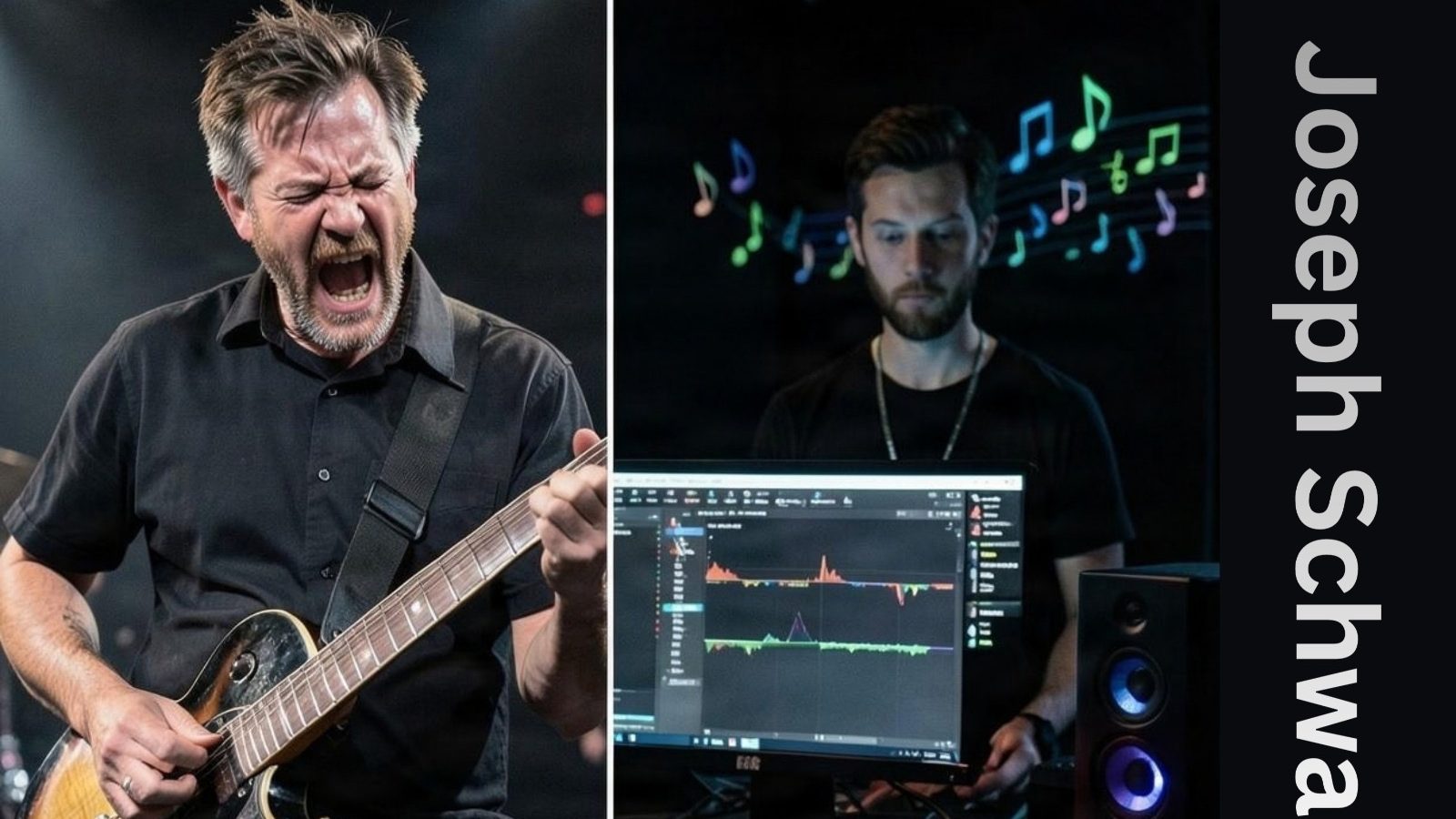
Hello everyone, it’s your host Oliver from DULAXI, and today I’m delighted to be joined by Joseph Schwartz, a Chicago-based independent songwriter and artist whose work explores the intersection of music, technology, storytelling and creative experimentation. Hailing from the United States, Schwartz’s musical approach moves across folk, Americana, country, alternative rock, pop, punk-pop and synth-pop, embracing genre experimentation and AI-assisted production as part of his creative process.
Released on 16 October 2026, John Henry v Tech Bro (all versions) is an Original EP that revisits the legendary story of John Henry, the railroad worker who challenged a steam drill, through the lens of contemporary musicians navigating the growing influence of artificial intelligence. Inspired in part by a visit to the National Museum of African American Music, Schwartz reimagines the historical narrative as a modern reflection on creative identity, technological evolution and the changing relationship between artists and their tools.
The project presents two versions of the modernized title track, alongside synth-pop and punk-pop reinterpretations of the traditional John Henry song. Through contrasting vocal perspectives, musical arrangements and production styles, Schwartz explores how familiar stories can evolve while retaining their central meaning. His creative process involves extensive experimentation, with approximately 1,000 generations per completed track, followed by human selection, lyrical adaptation, stem editing, mixing, EQ adjustments and mastering. Rather than presenting technology as an independent creative force, the project highlights the role of human judgment in shaping musical ideas into finished works.
Schwartz has continued to develop his distinctive creative identity through releases such as Superhuman, Ready for Doom, Seven Deadly Sins and Maybe I Belong, exploring different genres, narratives and production approaches along the way. With John Henry v Tech Bro (all versions), he turns a familiar piece of folklore into a contemporary discussion about creative freedom, technological progress and the possibilities of artistic adaptation. Before we begin our conversation with Joseph Schwartz, here’s what you need to know about today’s featured project.
Having this brief introduction to today’s featured project, I’m sure both new listeners and longtime fans are interested in hearing directly from Joseph about the ideas, experiments and perspectives behind this release. So, without further ado, let’s begin today’s interview.

INTERVIEW SESSION
Oliver:
Your description of this EP suggests that it is about much more than experimenting with new production technology. It also raises questions about music history, creative identity, and how artists respond to change. What personal experiences or observations first led you to become interested in exploring these subjects through your music?
Joseph Schwartz:
Anyone who has shared an interest in AI music, or even AI in general, has experienced a significant amount of hate speech and, frankly, ignorant, repetitive memes and talking points. That isn’t to say that the current state of AI and its sociopolitical impacts are not fraught, but that is a much larger subject.
When I started exploring AI music, it was really just an experiment to see how much it could elevate the ability of a non-musician to produce music that is “viable” (whatever that would mean). I quickly realized that the tools could be so much more powerful for a knowledgeable musician. I also noticed a strange lack of curiosity among musicians, so I kept exploring and thinking, “What new possibilities does this create?” and “How did changes like this manifest in the past?” with the obvious parallel being the Luddites.
At the same time, even within the communities that accept AI music, lines were being drawn around how AI was used to create lyrics. So, when I decided to cover “John Henry,” it was about asking, “Can I do something interesting where I am not creating lyrics at all?” That song was perfect subject matter and had been covered many times. However, when I listened to those covers, I never got a sense that it was updated musically to evolve into modern genres. Meanwhile, I was fascinated by how lyrics could be placed in wildly different genres and still work. That is something I had already experimented with on a number of songs on my earlier albums. So, I thought it would be fun and “meta” to use AI to reimagine “John Henry” sonically, before ultimately deciding to modernize the lyrics as well.
Oliver:
You have described yourself through ideas such as “Post-Human Arena Rock” and “Neural-Symphonic Pop.” These are distinctive ways of approaching your artistic identity. How did these descriptions develop, and what do they allow you to express that you feel more conventional genre labels cannot fully capture?
Joseph Schwartz:
Honestly, so many people want to put a warning label on AI music (like it will harm you to listen) that I just wanted terms making it clear that it was a synthetic performance. I didn’t go in the direction that will.i.am recommended in embracing “slop” in the genre name. My goal with my music is to break constraints, so I find conventional genre labels frustrating. They make it harder to break boundaries and nearly impossible to get amplification from the algorithm, because if you don’t put yourself in a box, it will ignore you.
Oliver:
The story of John Henry has traditionally represented the struggle between human strength and industrial machinery. You have brought that historical conflict into the modern debate surrounding musicians and artificial intelligence. What made John Henry the right figure through which to examine the changing relationship between human creativity and technology?
Joseph Schwartz:
When I started seeing the comments of anti-AI musicians on social media, it struck me that many of them wanted to cast themselves as a John Henry-like hero resisting the new “steam drill” of AI.
I think John Henry represents one approach: battling to stop the evolution of industry in an attempt to keep one’s dignity and protect opportunities. While those are important concerns, when you reflect on the past and how technology grows, you realize that isn’t the only path. Technology is, to some degree, inevitable and unstoppable, and people don’t inherently lose their dignity or opportunity as it advances. It simply requires human creativity to adapt to the tools and keep pushing boundaries. No one looks back today and says, “I’m glad we’re still hammering steel manually instead of using heavy machinery.”
Oliver:
Your visit to the National Museum of African American Music helped inspire the project’s connection to musical history and folklore. What stood out to you during that visit, and how did reflecting on the history of African American music influence the way you approached this modern retelling of John Henry?
Joseph Schwartz:
The museum itself was fascinating and enlightening in a number of ways. It was really the exposure to traditional music that sparked the idea that classic lyrics, when placed in modern sonic environments, could evolve and stay relevant in new ways. That sent me searching for an appropriate song to try that with, and when I landed on “John Henry,” it felt like the exact right fit for what I wanted to explore.
Oliver:
One of the central ideas behind the EP is that John Henry won his battle but only defeated version 1.0. You use that comparison to suggest that resisting technological progress may not be the same as protecting the future of music. How do you personally distinguish between preserving the human foundations of music and remaining open to the possibilities of new technology?
Joseph Schwartz:
Art has always been about working within constraints to express a vision, and every new tool helps break those constraints. Right now, music creators face three major limits: money, time, and technical skill. An artist can often imagine something bigger than they can build, but are blocked because they lack the budget to hire session players, the time to coordinate schedules and non-creative logistics, or the mastery of every instrument they hear in their head.
AI should be used to overcome blockers to manifesting creative vision. To me, the distinction is simple: if you have a great guitarist and drummer, you don’t use AI to replace them; you use it to empower them to realize the full scope of their vision and push past the limits that would otherwise hold their creativity back.
Oliver:
The EP presents two versions of the title track, one told through a male perspective and another through a female storyteller. What led you to explore the same central story through these two vocal perspectives, and how does each version change the way the listener experiences its message?
Joseph Schwartz:
I have always been intrigued by creating the same song across multiple styles. When I originally released my updated sonic versions of “John Henry,” I paired it with two directions: punk-pop (male) and synth-pop (female). I carried that same pairing over to the updated lyrics for symmetry, and because, realistically, I loved both.
Oliver:
You also revisit the traditional John Henry song through synth-pop and punk-pop arrangements. These styles bring very different musical attitudes to the same historical material. What did you want each arrangement to communicate, and how did you decide which musical direction would best serve each interpretation?
Joseph Schwartz:
I tried many, many styles when starting that project, and I felt punk-pop was a natural fit that supported the rebellious nature of the story. The female synth-pop version was a happy surprise when I heard the first pass of it, and I quickly decided that its energy and contrast made it a sonic direction I wanted to pursue.
Oliver:
Your approach to the project brings together folk storytelling, rock energy, dance-pop rhythms, and country structures. When working across such different musical traditions, how do you maintain a recognisable artistic identity while allowing each genre to bring something distinct to the story?
Joseph Schwartz:
It isn’t a conscious element of my process. I just try to be honest and create songs with messages I want to deliver. I release tracks when they feel right to me and I crave listening to them over and over. That is the only thing that determines my identity. If a listener ever spends enough time with my catalog to recognize the underlying threads in my storytelling and sonic decision-making, that would be amazing to me.
Oliver:
The lyrics reimagine a familiar historical conflict as a modern struggle involving musicians, technology, and creative independence. How did you approach writing a story that could speak to listeners who may have very different opinions about AI, while still giving them something meaningful to consider?
Joseph Schwartz:
Like many of my song rants, I simply told the story I wanted to tell. I’m not sure how it lands with people holding different perspectives. I did have one listener say, “Awww… I thought it would have a happy ending.” I just tried to honestly represent what I am seeing and feeling right now.
Oliver:
You have described your creative process as involving hundreds of lyric and soundscape variations. The press release also explains that each completed track can involve roughly 1,000 generations before human editing and refinement. What does this process look like in practice, and how do you recognise when an idea has finally reached the point where it expresses what you originally intended?
Joseph Schwartz:
I have experimented with many different workflows. For “John Henry v Tech Bro,” I started with the traditional song and began transforming each verse to fit the modern story I wanted to tell, bouncing some thematic ideas around early on. Once I had a lyrical starting point, I generated a bunch of initial sonic directions. When I found one I liked, I began refining each verse and regenerating until the delivery felt right.
From there, I listened repeatedly, and every lyric line that stood out as less than ideal, I went back and fixed. To make the production more interesting, I layered in elements of slap house and dance-pop, adjusted the vocals, and continued building sonic variations. Then, to tighten the narrative arc, I cut three verses and restructured the lyrics. By this point, I was managing two distinct sonic directions (male and female versions) and running through many more rounds of listening and refinement, both lyrically and sonically. Once I had my final versions, I brought them into Audacity for mixing and mastering, which is a craft I am very much still learning. I still have some of the longer working drafts up on SoundCloud if anyone wants to hear how the track evolved.
Oliver:
You make an important distinction between generating musical material and shaping it into a finished artistic work. Your process includes lyrical adaptation, stem editing, mixing, EQ adjustments, and mastering within a DAW. Which parts of that human-led process are most important in giving the final recordings their identity, and where do you feel your own judgement makes the greatest difference?
Joseph Schwartz:
For my songs, I almost always start from the premise that the music exists to support the lyrics. Starting with a strong concept and a foundational lyrical story is critical. From there, choosing a sonic direction and iterating back and forth between the arrangement, lyrical phrasing, melody, and prosody is the core of the work. That is where most of my time and iterations go. Mixing and mastering isn’t an area where I have the advanced skills to completely transform the overall sound, but it is essential for cleaning up distracting AI artifacts and making subtle adjustments to ensure the vocals are clear and forward.
Oliver:
Working with AI-assisted production can introduce an unusual creative challenge: having access to many possible directions without losing sight of the original idea. During the making of this EP, were there particular moments when the technology produced something unexpected that changed your creative direction, and how did you decide whether to embrace or reject those results?
Joseph Schwartz:
That happens often, and it’s part of the fun. I usually begin with a loose direction and frequently get something surprising that either locks in the vibe or sparks a completely new idea. It feels like having 100 musicians at my disposal who can propose ideas without any ego when I immediately say, “No, try again.” I typically start with a broad genre direction, then add instrumental details or layer in different genres. Once the sonic direction solidifies, I give much more specific directives around mood, emotion, pauses, and effects.
Oliver:
Your wider catalogue includes projects such as Superhuman, Ready for Doom, Seven Deadly Sins, and Maybe I Belong. Across these releases, you appear to use different musical forms to explore human experiences and ideas. How has your approach to songwriting and production developed through these projects, and where does John Henry v Tech Bro (all versions) represent a new stage in that evolution?
Joseph Schwartz:
In some ways, each release is just a new experiment. “Seven Deadly Sins” came very early in my journey; I wanted every track to expose the danger of a “sin” from the perspective of someone who embodied it and didn’t think they were wrong, intentionally using a variety of styles and very short tracks. “Ready for Doom” was my first track using Suno where I started with my own voice to establish the melody. “Superhuman” leaned further into AI while telling the story of how I got started (using music creation as a distraction from the news) and thinking, “If I have access to world-class virtual musicians, I should go as over-the-top as I can” across multiple genres.
“Maybe I Belong” was an experiment in that same spirit, taking a Rachmaninoff piece and transforming it into modern guitar rock with lyrics imagining what Rachmaninoff might write today. That album pulled together remixes of previously released songs to tell the overarching story of an artist’s life.
“John Henry v Tech Bro” is a new set of experiments, but using learnings that I have gotten along the way. I think each time I create a new song, I am building on process learnings, but I try to make it something new.
Oliver:
Ready for Doom was described as a “choose-your-own-adventure of righteous anger,” while Superhuman was recognised as an intriguing musical laboratory. Both descriptions suggest a willingness to experiment with form and ideas. How do you balance the desire to challenge listeners intellectually with the need to create music that remains emotionally engaging and enjoyable to hear?
Joseph Schwartz:
I only release songs that I genuinely like and want to hear over and over. The fun part is finding a sweet spot in a genre I don’t typically gravitate toward and ending up with a result I love. When I released “The Oath,” it was a very different sound for me: industrial EDM, somewhat Rammstein-esque. People responded well to it, so I wanted to explore that lane further. Some feedback noted that it sounded very cold and machine-like, which was intentional for that subject matter.
So, for my next step, I wanted to make something less overtly political and more “traditional” on the surface, while exploring alt-R&B, which is a style I don’t usually listen to. I ended up layering alt-R&B vocals over an industrial EDM track and writing about “getting back together,” a classic relationship trope, even though for me it was really about the country coming back together. That became “Let’s Get Back.” Similarly, on “Superhuman,” I pushed boundaries by blending country and folk-rock in unexpected ways.
Oliver:
You have spoken about the danger of treating AI as a replacement for musicians rather than as a tool that can expand what they are able to create. From your perspective, what do you think the music industry most needs to understand about the difference between using technology to generate material and using it as part of a wider creative process?
Joseph Schwartz:
First, people spend time and money on art that speaks to them through artists they feel connected to. No AI output will replace human performance. People don’t just buy songs; they buy experiences: sound, story, fashion, live performance, and identity.
Second, no art is inherently “good” or “bad.” The real challenge is finding the audience that resonates with it; whoever doesn’t like it doesn’t matter. From an economic standpoint, it comes down to how efficiently you can reach that audience, i.e. whether it costs more in promotion to find listeners than streaming revenue will ever return. And once you find them, it is about how you build loyalty so they support you through live tickets, merch, and deeper engagement.
Third, trying to constrain art by rigid definitions is antithetical to creativity. The focus should be on expanding what is possible. Fourth, we need better curation, both organic and algorithmic, to actually connect listeners with the music they want. Finally, we should use the right tools for the right purpose. Functional music, e.g. music for relaxing or studying, can integrate with wearables like Apple Watches and Oura rings to respond to biometric feedback and create personalized audio optimized for the individual. Not every use of sound has to be “art”.
Oliver:
The project is intended to encourage discussion among music writers, critics, historians, musicians, and listeners on different sides of the AI debate. What kind of response or conversation would make you feel that the EP has achieved what you set out to accomplish, particularly among people who may initially disagree with your perspective?
Joseph Schwartz:
Maybe I’m a bit modest in my expectations. The fact that you showed interest, asked insightful questions, and gave me a platform to express myself is already wonderful. I’m not sure I can change minds or even convert skeptics into listeners. Right now, I just want to create, say my piece, and share it. Frankly, the broader conversation around AI feels super toxic. If even a single person visited my website and sent a message saying, “This is interesting,” that would be amazing to me. I appreciate every listen I get. My interest in learning about music promotion was really about seeing what strangers think of my songs objectively. In pure business terms, I can’t claim commercial success. But in the context of my original goal of simply sharing my music, I feel incredibly fortunate to have had thousands of people listen to my songs multiple times across more than 80 countries. When I release political commentary and see even small listening traction in places like Ukraine, that alone is enough to make me want to keep going.
Oliver:
Your work draws on established musical traditions while exploring production methods that are still developing. Looking ahead, how do you see your own sound and creative philosophy changing as these technologies evolve, and are there particular musical ideas or styles you would like to explore next?
Joseph Schwartz:
I recently went on a safari in Africa and heard a local folk tale that I felt compelled to turn into a song. I decided it should be an Afro-pop track, and I love how it turned out. I have a whole list of other ideas from that trip to explore as well.
I also have a song called “Sonic Storm” coming out on my next album, which was an experiment in weaving many genres into a single track. I made a video for it and love how it came together, even though I know it isn’t algorithmically friendly; nobody could possibly pin it to a single genre since it flows from psychedelic rock to singer-songwriter, yacht rock, and EDM/dubstep. Ultimately, I just let whatever experiences and thoughts spark my curiosity guide the next project.
Oliver:
Finally, when listeners encounter John Henry v Tech Bro (all versions), they may come away thinking about the future of AI, the value of human creativity, or the history of music itself. Beyond the debate surrounding technology, what lasting thought or feeling would you most like people to carry with them after experiencing the EP?
Joseph Schwartz:
We should stay open-minded about the possibilities of new tools and new mediums and channel our emotions into pushing art forward, rather than letting fear or anger lead to self-destructive behavior.
“Perhaps the most interesting question raised by John Henry v Tech Bro is not whether technology will change music, but whether artists are willing to rethink what creativity can become without losing sight of the human intention behind it.”
~ Oliver (DULAXI Team)
EDITORIAL PERSPECTIVE
Joseph Schwartz approaches the conversation around AI music through storytelling, experimentation and a willingness to challenge established creative boundaries. Across the EP, familiar folk material and contemporary arrangements become a way of examining how musical ideas can evolve without losing their narrative foundations. What particularly stands out is the attention given to refining generated material, making creative decisions and shaping different interpretations of the same story. Rather than limiting the discussion to technological novelty, Schwartz encourages listeners to consider the possibilities, responsibilities and creative choices that accompany new tools.
~ Oliver (DULAXI Team)
CLOSING
Our sincere thanks to Joseph Schwartz for joining us at DULAXI and sharing the ideas, experiences and creative decisions behind John Henry v Tech Bro (all versions). This conversation has offered a closer look at his approach to songwriting, experimentation, technology and the importance of remaining curious as music continues to evolve.
We encourage readers to experience the EP themselves and explore the wider catalogue to discover the different musical directions Schwartz continues to pursue. His openness to experimentation and storytelling makes his work an interesting contribution to the ongoing conversation surrounding contemporary music creation.
Thank you for spending your time with DULAXI and for joining Oliver in today’s conversation. We look forward to bringing you more interviews with artists, songwriters and creative voices from around the world. Until next time, keep discovering new music and supporting independent artists.