
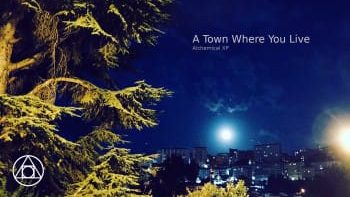
Hello everyone, it’s your host Oliver from DULAXI, and today I’m delighted to be joined by Alchemical XP, an Italian electronic music artist from Potenza whose work explores the relationship between music, atmosphere, memory and emotion. Working across downtempo, psychill, ambient, synthpop and experimental electronic music, Alchemical XP creates instrumental compositions that draw inspiration from cinema, Japanese anime, visual storytelling and the bittersweet beauty of everyday experiences. Today, we’re discussing the twelve-track album A Town Where You Live, released on 2 May 2026, and the creative ideas behind a project that places emotional expression at the centre of electronic music.
Before we begin our conversation with Alchemical XP, here’s what you need to know about today’s featured project.
About Alchemical XP
Alchemical XP is an Italian electronic music project rooted in melodic expression, atmospheric production and a strong connection to visual storytelling. Moving between downtempo, psychill, ambient-leaning electronica, synthpop and experimental electronic music, the project embraces a sound that can be intimate, expansive, nostalgic or futuristic. Rather than following rigid genre boundaries, Alchemical XP approaches music as a personal form of expression, exploring moods and sensations that often extend beyond what words can communicate.
Released on 2 May 2026, A Town Where You Live is a twelve-track instrumental album built around evocative synth melodies, restrained grooves and gradually evolving electronic textures. The album moves through different emotional environments, bringing together melancholy, nostalgia, dreams and the quieter experiences of everyday life. Compositions such as “Rumbling Hearts,” “A Town Where You Live,” “Scent of Sunflowers” and “Angel’s Egg” offer different perspectives on the project’s musical direction, allowing melody and atmosphere to create individual impressions while maintaining a shared emotional identity.
Japanese anime, cinema and visual storytelling have played an important role in shaping Alchemical XP’s creative outlook. Rather than attempting to recreate particular scenes or narratives, the project draws inspiration from the feelings and impressions that stories leave behind. Familiar images such as rainy afternoons, distant coastlines, airplanes disappearing into the evening sky and snow falling at night become emotional starting points for musical ideas. This approach allows the compositions to move between personal memories, imagined experiences and dreamlike environments, leaving listeners free to discover their own meanings within the music.
The album also reflects a creative philosophy built around making music that feels personally meaningful rather than following commercial expectations or musical trends. Its arrangements balance atmospheric layers with rhythmic movement, allowing introspective moments to coexist with more energetic compositions. Through A Town Where You Live, Alchemical XP continues to explore the relationship between sound, emotion and imagination, while also developing a closer connection between music and visual culture. With future plans involving cinematic and animated imagery, the project remains open to new creative possibilities while maintaining its commitment to personal expression.
Having this brief introduction to today’s featured project, I’m sure both new listeners and longtime fans are excited to hear directly from Alchemical XP. So, without further ado, let’s begin today’s interview.
INTERVIEW SESSION
Oliver:
Welcome back to Dulaxi, Alchemical XP. Your music has a distinctive relationship with atmosphere, emotion, and memory. As your creative work continues to develop, how would you describe the artistic ideas that have become increasingly important to you, and has your understanding of what you want your music to communicate changed over time?
Alchemical XP:
I think the most important thing has always been the emotional side of music. I’ve been developing Alchemical XP for many years, and over time I’ve become less concerned with fitting into a particular genre and more interested in creating something that feels genuine to me.
Atmosphere, memory and emotion have always been at the heart of my music. What has changed is probably my confidence in expressing those things without feeling the need to explain everything. I like the idea that a piece of music can suggest a story without actually telling one.
Oliver:
You describe music as a way of expressing feelings that words cannot reach. I find that particularly interesting because instrumental music often leaves listeners to interpret emotions without being guided by lyrics. When you create a piece of music, how do you balance expressing your own feelings with leaving enough space for listeners to discover their own meaning?
Alchemical XP:
That’s actually one of the things I love most about instrumental music. I can put something very personal into a composition, but the listener doesn’t necessarily have to experience it the same way I do.
A melody might remind me of a particular moment, while someone else might associate it with a completely different memory. I don’t think one interpretation has to be more correct than another. Once the music is out there, it becomes part of other people’s lives too.
Oliver:
A Town Where You Live is built around nostalgia, memory, and the emotional weight of everyday moments. What was happening in your life or creative thinking when the idea for this album began to take shape, and was there a particular feeling you wanted to capture throughout the project?
Alchemical XP:
There wasn’t anything particularly extraordinary happening in my life when I started working on this album. I was simply living, like everyone else, experiencing happiness and sadness, beautiful moments and difficult ones, everyday problems, and desires both fulfilled and unfulfilled.
Sometimes I just feel that there’s something inside me that needs to come out, and music is the way I let it out.
I often lose myself in nostalgia and dreams, especially dreams that I know will never come true because they’re simply impossible. It’s a strange feeling, being nostalgic for something that has never happened and never will. And yet, when I put those feelings into music, somehow those impossible moments begin to exist.
Maybe that’s what this album really is: a collection of things I’ve lived, things I’ve dreamed of, and things that will never happen, but that become real in their own way through music.
Oliver:
The album title suggests a connection to places, personal memories, and perhaps even people who remain part of our lives through the memories we carry. What does the idea of a town where someone lives represent to you, and how did you translate that concept into an instrumental album?
Alchemical XP:
The title has a very personal meaning to me. It represents an emotion, a particular mood that exists somewhere inside me.
Sometimes that feeling begins with an anime, as it did in this case. A story leaves something behind, an emotion that stays with me. But eventually that feeling separates itself from the original story and becomes something entirely my own. It takes me back to the cities where I’ve lived or travelled, places where I’ve left a little part of myself and taken something away in return.
But the truth is that this particular town doesn’t really exist, except inside me. It’s a place where I’m the only one who lives.
There’s something special about the album cover too. It’s actually a photograph of Potenza, a small city in southern Italy where I live. I took it with my phone one evening, just outside my home, when something about that familiar view reflected a particular feeling I was experiencing.
But when I look at that photograph now, I don’t really see the city where I live anymore. I see that extraordinary imaginary city inside me, the one where only I live.
Oliver:
Your relationship with Japanese anime and cinema appears to play an important role in your creative identity. What is it about Japanese visual storytelling that connects with you emotionally, and are there particular storytelling techniques, moods, or visual experiences that you find yourself translating into your music?
Alchemical XP:
What I love about Japanese storytelling is the way it can give extraordinary emotional weight to apparently ordinary moments.
I’m particularly drawn to stories about imperfect people, complicated relationships, missed opportunities and the passage of time. Sometimes a character looking out of a window, a silent goodbye or an empty street can say more than a long conversation.
I think that sensitivity is very close to what I try to express through music. It’s not necessarily about recreating an anime scene, but about capturing the kind of feeling that stays with you after watching it.
Oliver:
There is something interesting about how a film or anime can leave a lasting emotional impression long after its story has ended. Have you ever found yourself returning to a particular scene, character, or fictional world because of the feelings it created, and how might those memories influence the way you approach composition?
Alchemical XP:
Absolutely. And not just one particular scene or character. I think everything I’ve watched, played, read and experienced becomes part of me in some way.
There are works like Maison Ikkoku, Cowboy Bebop and Serial Experiments Lain, or films like Lost in Translation. And then there are video games like NieR:Automata. They’re all very different from one another, but each of them has left something inside me.
What fascinates me is that these different experiences somehow come together, forming a sort of emotional kaleidoscope. And I suppose that kaleidoscope is simply who I am.
When I make music, I don’t necessarily think consciously about any of these works. Their emotions have already become part of me, so they naturally find their way into what I create.
Oliver:
The album contains twelve instrumental tracks, each described as creating its own small world. How did you approach giving each composition an individual identity while ensuring that the entire album still feels connected to one central idea?
Alchemical XP:
I don’t usually plan an album around a central concept. I make music when I feel the need to make it, and each piece finds its own direction. When enough tracks have come together, I can begin to hear how they belong alongside one another.
For me, the connection doesn’t have to be a particular sound or arrangement. It’s more like a shared emotional atmosphere, something that runs through the pieces because they all come from the same person and the same inner world.
Sometimes a track finds a home I never expected. Alongside my solo project Alchemical XP, I’ve been part of Serial Experiments for many years. Serial Experiments is a duo, so it’s a different musical project, although both are part of my creative life. Side Story, for example, was originally left off Harmony, an album by Serial Experiments, but later found its place on A Town Where You Live, where it became one of the most appreciated tracks.
Oliver:
Tracks such as “Rumbling Hearts,” “A Town Where You Live,” “Scent of Sunflowers,” and “Angel’s Egg” have titles that immediately suggest different images and emotional experiences. When naming your compositions, do you begin with a particular visual or emotional idea and build the music around it, or does the finished music inspire the title afterwards?
Alchemical XP:
The music always comes first. I don’t usually sit down thinking, “I’m going to write a track about this particular anime, place or feeling.”
I start making music because I feel something inside me that wants to come out. Then, while I’m composing or sometimes only after the track is finished, I listen to it and suddenly realise what it reminds me of, or where that particular emotion came from.
It’s almost as if the music knows what it’s about before I do. So yes, there’s always something behind a composition, but quite often I only understand what that something is after the music has already started to exist. And that’s usually when the title comes to me.
Oliver:
Your creative philosophy includes images such as a rainy afternoon viewed through a wet window, an airplane disappearing into the evening sky, the sea at the end of summer, and snow falling at night. These are ordinary moments, but they carry a strong emotional quality. Why are you drawn to these quieter experiences, and what makes them such powerful sources of musical inspiration?
Alchemical XP:
I’ve always been fascinated by those moments when something completely ordinary suddenly creates a feeling that’s difficult to explain.
A rainy afternoon, the sea at the end of summer, an airplane disappearing into the evening sky. Nothing particularly extraordinary is happening, yet sometimes those images stay with me.
I think music begins somewhere in that space between what we see and what we feel. Sometimes the feeling disappears almost immediately, but something of it remains. And for me, that something can become music.
Oliver:
Your sound moves between downtempo, psychill, ambient, and cinematic electronic music, while retaining a melodic focus and a steady rhythmic pulse. How do you decide when a composition needs to remain spacious and atmospheric and when it needs a stronger groove to give the listener something more physical to connect with?
Alchemical XP:
I’ve never really considered atmosphere and rhythm to be opposites. My main instrument is the bass guitar, so I have a deep, almost instinctive connection with rhythm. For me, groove isn’t just something that gives a track energy; it’s one of the ways I feel the music.
A groove can take me from something reflective to something hypnotic or energetic, without ever losing its connection with the mood. Sometimes a very subtle pulse is enough, while other times I feel the need for a more prominent rhythm. I don’t follow a rule: I follow what the music makes me feel.
Even when the groove becomes more physical, it still belongs to the emotional world of the piece. That’s simply how I experience my music.
Oliver:
One of the defining qualities of your music is the balance between nostalgia and futuristic electronic production. How do you approach combining sounds that can feel connected to the past with production techniques that suggest something unfamiliar or even futuristic?
Alchemical XP:
I find that nostalgia and futuristic electronic music can work very naturally together.
Electronic sounds can suggest something unfamiliar, distant or futuristic, while a melody can bring us back to a feeling we recognise immediately. I like that contrast. You can imagine yourself in a futuristic city surrounded by neon lights and still experience something deeply human, like loneliness, longing or affection.
Perhaps that’s also one of the reasons I’ve always been attracted to cyberpunk imagery.
Oliver:
Your music appears to place considerable importance on melody rather than relying entirely on complex arrangements or heavy production. When developing a composition, what tells you that a melody has the emotional strength to carry a track, and how do you know when adding more elements would improve it or take something away?
Alchemical XP:
For me, a melody has to create a feeling. It doesn’t necessarily have to be complicated or technically impressive. Sometimes a few notes can communicate much more than an elaborate arrangement.
I deeply love Ryuichi Sakamoto, whom I’ve always thought of as a ‘master of simplicity’. Of course, I wouldn’t even remotely dream of comparing myself to him! But his music is a beautiful example of how much emotion can be contained in something apparently simple.
Merry Christmas Mr. Lawrence means an enormous amount to me. I can’t really explain why, but it has left a profound mark on me, just like Tangerine Dream’s Love on a Real Train. Those pieces have become part of who I am; they’re music I carry with me.
Perhaps that’s why I think it’s important to leave enough space for a melody to breathe. Adding more layers doesn’t automatically make a composition stronger. What matters is not losing the emotion that made it worth creating in the first place.
Oliver:
With an instrumental album, the production and arrangement carry much of the storytelling responsibility. What does your composition process typically look like, from the first musical idea to the finished recording, and which part of that process demands the most attention from you?
Alchemical XP:
I’m afraid I don’t have a very organised answer to this question, because there really isn’t a fixed process!
Sometimes I pick up my bass and something starts coming out. Other times I sit at the keyboard and find myself playing something that gradually becomes a composition.
It might start with a beat, with me tapping my foot while a melody begins forming in my head. Or perhaps one of my musician friends is casually playing something on the guitar, and suddenly I hear something in it that sparks a completely different musical idea.
And sometimes I’m just standing on my balcony, smoking a cigarette, looking at the same view I’ve seen thousands of times, which somehow never looks exactly the same to me. Maybe even the sound of the boiler decides to contribute something to the composition! (laughs)
There’s no formula, and I can’t really say that one particular stage always demands the most attention. It changes from one track to another. Music comes from somewhere inside me, and when I feel it coming, I try to follow it.
Oliver:
Across a twelve-track project, maintaining a consistent emotional atmosphere without making every composition sound alike can be challenging. Were there any particular difficulties in creating A Town Where You Live, whether in developing its arrangements, deciding on its direction, or choosing which pieces belonged on the final album?
Alchemical XP:
My albums are probably the one part of my work that involves the least planning. I simply make music. When a track is finished, I put it in a folder, and when there are enough tracks, an album comes together.
As for difficulties, if I finish a piece and don’t like it, I leave it out. I have folders full of discarded tracks. But that doesn’t mean they’re gone forever. Perhaps years later I’ll listen to one and suddenly like it, or maybe it will become the starting point for something completely different. Who knows?
Side Story, which I mentioned earlier, is a perfect example. It didn’t make it onto Harmony, an album by Serial Experiments, the long-running duo I’m part of alongside Alchemical XP. But it eventually found a home on A Town Where You Live, where it became one of the most appreciated tracks.
The only thing I’ve recently decided to change is the release strategy. Instead of collecting finished tracks until there’s enough material for an album, I’d like to start releasing them as singles as soon as they’re ready. And to be completely frank, that’s because I’ve realised Spotify’s algorithm seems to favour that approach. It’s a practical decision, not a change in how I make music.
Oliver:
You have described your approach as creating music you genuinely want to hear before leaving the door open for other people to connect with it. How important is that personal satisfaction to your creative decisions, especially when working in a music environment where artists are often encouraged to follow trends or consider what might perform well commercially?
Alchemical XP:
I think it’s essential to make music that I genuinely want to listen to.
Of course, it’s wonderful when other people appreciate what you create. Knowing that someone connects with your music is incredibly rewarding. But I wouldn’t want to choose my artistic direction simply because a particular genre or sound is fashionable.
Music has always been something personal to me, and I think losing that connection would also mean losing an important part of Alchemical XP.
Oliver:
Your work brings together music and visual culture in a way that could appeal to listeners who enjoy soundtracks, animation, cinema, and electronic music. Have you noticed particular reactions from listeners who connect with those influences, and what kind of emotional response would make you feel that someone has truly understood this album?
Alchemical XP:
Yes, and some of those experiences have genuinely moved me.
I remember receiving a message from someone in Russia who told me that my music had accompanied him through a very difficult period of his life and helped him get through it.
Another time, someone from Japan wrote to me. And honestly, just knowing that someone in Japan was listening to my music was already incredible to me! She told me that she worked in a hospital where children were being treated, and that she often played my music because she found it calming and relaxing for them. She actually thanked me for it. I found that almost unbelievable.
Here I was, making music primarily for myself, expressing feelings that I often associate with nostalgia and even sadness, and somewhere on the other side of the world people were experiencing something completely different through it.
There have been other messages, but these two have stayed with me. I don’t need listeners to feel exactly what I felt when I wrote the music. I think that’s one of the most wonderful things about it: something born from your own emotions can become something entirely different, and equally meaningful, in someone else’s life.
Oliver:
Looking at your development as Alchemical XP, are there aspects of your production or artistic identity that you feel you have become more confident exploring through this album? In what ways has A Town Where You Live expanded what you believe is possible within your sound?
Alchemical XP:
I don’t usually like to think of my music as a series of stages in an artistic evolution. For me, listening to my older compositions is more like opening a photo album. They take me back to what I was feeling and dreaming about at the time, and to what was happening in my life, both the beautiful things and the painful ones.
But when I listen back, I can’t deny that I hear changes, both in the music itself and in the choices I make as a musician and producer, including the technical ones.
A Town Where You Live is the first Alchemical XP album I’ve mastered entirely myself. Mastering is a technical job, and honestly it’s not the part of making music I enjoy most. But because it’s my own music, I found I actually preferred the result to some of my previous albums, which had been mastered by professionals.
It’s not perfect, but I’m quite proud of it. There’s something satisfying about hearing the final result and knowing I took care of that part myself, too.
Oliver:
Finally, as you look towards your next creative chapter, are there other musical or visual ideas you would like to explore, perhaps through a closer connection with animation, film, or other forms of storytelling? What would you like the future of Alchemical XP to look and sound like, and what can listeners look forward to after A Town Where You Live?
Alchemical XP:
There are definitely things I’d love to explore, especially the relationship between music and visual storytelling.
I’ve always been fascinated by cinema and animation, and I’ve spent years connecting my music with images that meant something to me. Now, with the development of AI tools, I’m beginning to have the possibility of creating images and videos that come directly from my own imagination. That’s incredibly exciting, because I can start bringing to life visual worlds that previously existed only in my head.
One of my upcoming projects is Love on the Real Train, my reinterpretation of Tangerine Dream’s music, accompanied by a video that brings together my love for cinema and Japanese animation.
I’d like to keep exploring these possibilities, creating an even closer relationship between what I hear and what I imagine. As for the musical future of Alchemical XP, I don’t really have a grand plan. I can only say this: as long as I’m alive, and as long as I feel that something inside me needs to come out, I’ll keep finding a way to let it out. And most likely, that way will be music.
“Through A Town Where You Live, Alchemical XP turns the nostalgia of places, forgotten moments and imagined experiences into a twelve-track electronic collection. What makes the album particularly interesting is how its melodies and cinematic textures create the feeling of revisiting somewhere that may exist only in memory, yet somehow feels familiar.”
~ Oliver (DULAXI Team)
EDITORIAL PERSPECTIVE
A Town Where You Live presents electronic music as a personal language, one that finds meaning in ordinary moments, distant memories and experiences that are sometimes difficult to articulate. Its melodic focus, restrained rhythmic approach and cinematic sensibility create room for imagination without imposing a single interpretation. What particularly stands out in Alchemical XP’s creative philosophy is the willingness to follow an instinct rather than a formula, whether in composition, arrangement or production. This conversation reveals an artist whose relationship with music remains deeply personal while welcoming the unexpected ways listeners may connect with it.
~ Oliver (DULAXI Team)
CLOSING
It has been a pleasure speaking with Alchemical XP and learning more about the personal experiences, artistic influences and creative ideas behind A Town Where You Live. This conversation offered a thoughtful look into how music can transform everyday moments, imagined experiences and lingering emotions into something that listeners can interpret in their own ways.
If you haven’t yet experienced A Town Where You Live, we encourage you to spend some time with the album and discover the different atmospheres and melodies that unfold across its twelve instrumental compositions. You can also follow Alchemical XP’s journey as the project continues exploring new connections between electronic music, cinema and visual storytelling.
Thank you, Alchemical XP, for sharing your experiences and insights with us, and thank you to everyone who has spent time with DULAXI. We look forward to bringing you more conversations with artists from around the world, exploring their music, creativity and the stories behind their work.