
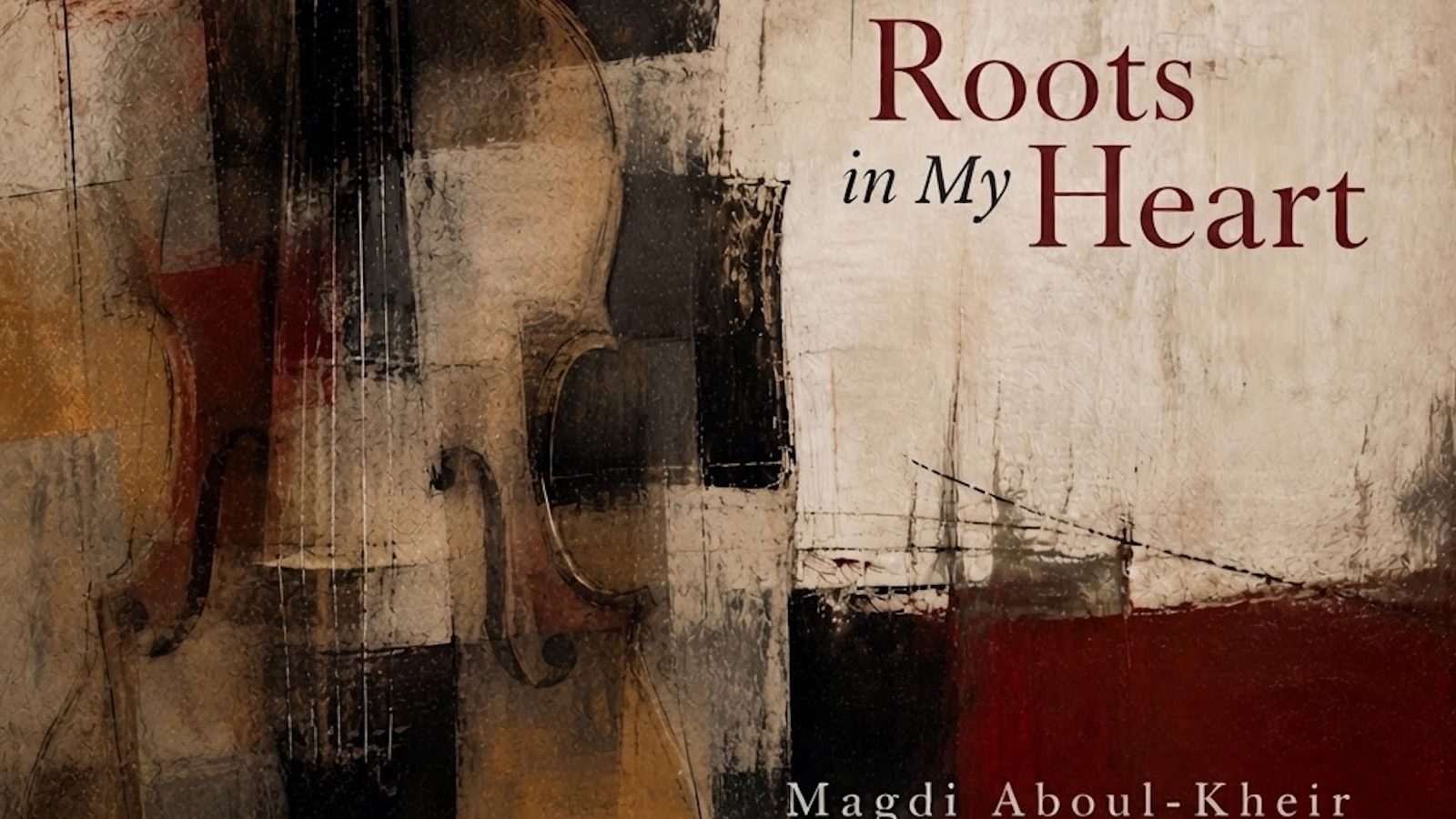
Hello everyone, it’s your host Oliver from DULAXI, and today I’m delighted to be joined by Germany-based composer Magdi Aboul-Kheir, whose musical work explores an impressive range of instrumental styles, from chamber and orchestral compositions to ambient, jazz-influenced, and electronic music. Based in Ulm, Germany, Magdi brings his appreciation for melody and emotional expression to his latest original album, Roots in My Heart, released on November 6, 2026. Rooted in the expressive possibilities of contemporary chamber music, the album brings strings, woodwinds, and piano together to explore love, memories, nature, and the many experiences that shape our lives.
Before we begin our conversation with Magdi Aboul-Kheir, here’s what you need to know about today’s featured project.
About Magdi Aboul-Kheir
Magdi Aboul-Kheir is a Germany-based composer and trained pianist whose musical interests extend across several genres and creative traditions. His catalogue encompasses minimal music, chamber and orchestral compositions, pop and jazz-influenced instrumentals, ambient soundscapes, and vintage electronic music. Rather than restricting himself to one particular style, he approaches composition with an openness to different musical possibilities, guided by emotional expression, craftsmanship, and a lasting appreciation for memorable melodies. His musical philosophy reflects the belief that different genres can provide equally meaningful ways of communicating personal experiences.
Throughout his previous releases, Magdi has demonstrated an interest in exploring contrasting musical environments. Albums such as Into the Retroverse and Replicant Dreams highlight his playful relationship with retro-inspired synthesizers, while Nubes Sonorae (Ambient Cloudscapes) and Slow Heat explore atmospheric and electroacoustic approaches to instrumental composition. His more recent works, including The Garden of Make Believe, One Last Dance, and The Piano Has Been Dreaming, further demonstrate his appreciation for romantic orchestral writing and intimate piano compositions.
With Roots in My Heart, Magdi turns his attention to the expressive possibilities of chamber music, bringing strings, woodwinds, and piano into a musical conversation across ten compositions. The album explores a range of human experiences, including dreams, encounters with nature, farewells, the joy of living, and, most importantly, love. Its musical character moves between light-hearted moments, passionate expressions, playful passages, and deeper reflections, creating a collection shaped by intimacy and emotional variety. The title itself reflects the idea that important people, meaningful encounters, and deeply felt experiences leave lasting impressions on who we become.
A central part of the album’s identity is Magdi’s appreciation for transparent arrangements and expressive melodies. His approach to chamber music allows individual instrumental voices to complement one another while retaining their own character, creating space for the listener to appreciate the musical conversation as it unfolds. Across the collection, he brings together comforting harmonies and romantic expressions with moments of melancholy, tenderness, and joy. With further orchestral, piano, and ambient projects already forming part of his creative direction, Roots in My Heart represents another chapter in an ongoing exploration of musical expression.
Having this brief introduction to today’s featured project, I’m sure both new listeners and longtime followers of Magdi Aboul-Kheir are excited to hear directly from him about the ideas, experiences, and creative decisions behind his music. So, without further ado, let’s begin today’s interview.

INTERVIEW SESSION
Oliver:
Having followed your musical work across different projects, from the retro-electronic ideas of Into the Retroverse and Replicant Dreams to the intimate piano compositions of One Last Dance, it’s interesting to see how many different musical worlds you continue to explore. At this stage of your career, how do you understand your identity as a composer, and what personal values or creative principles remain consistent regardless of the genre you’re working in?
Magdi Aboul-Kheir:
I think identity is made up of many different facets: when and where we are born, how we are socialized, the people we meet, what we learn, what we believe, what we do for a living, and whom we love. All these facets – biological, social, and cultural – shape who we are.
In much the same way, I think my identity as a composer is made up of everything I have listened to, everything that has influenced me musically, the music I love as a music fan, and what I try to express through my own work – in the way I write melodies, the way I arrange, and the harmony and rhythm I am drawn to.
As for the values or principles that remain consistent, for me it is about making music that is authentic, personal, open, and emotional.
Oliver:
You’ve described yourself as someone who believes strongly in melody, with musical interests stretching from baroque and late romanticism to pop, jazz, and vintage synthesizers. Was there a particular experience or period in your life that strengthened your belief in melody as the most important connection between a composition and its listener? How has that belief influenced the way you approach your work today?
Magdi Aboul-Kheir:
I think my entire life as a music lover has shaped the way I think about melody. I love distinctive, elegant, expressive melodies – from Johann Sebastian Bach and Antonín Dvořák to Henry Mancini and Ennio Morricone, and from ABBA to Tom Waits.
To me, melody is what ultimately remains, whether you are listening to a symphony, a film score, or a song. That is why I always try to find melodies that express the essence of an idea – melodies that feel as if they had always been there, waiting to be discovered.
Oliver:
Your work moves comfortably between traditional instrumental composition and more contemporary electronic approaches. These styles can sometimes attract very different audiences, yet you seem interested in exploring all of them without restricting yourself to one musical identity. How do you maintain that freedom while ensuring that your compositions still carry a recognisable sense of your personality?
Magdi Aboul-Kheir:
As I mentioned before, I think it is precisely this diversity that shapes my identity, while there are still certain characteristics that connect everything. I love having the freedom to explore different genres and musical worlds, and yet I believe that, at its core, my music is connected and expresses my personality.
For me, there is no contradiction between musical diversity and having a recognisable identity. The different genres are simply different ways of expressing the same person.
Oliver:
With Roots in My Heart, you return to the intimacy of chamber music, bringing strings, woodwinds, and piano together. There is something particularly human about these instruments, especially when they are allowed to communicate without words. What drew you back to this musical setting for your latest album, and what did it allow you to express that perhaps your electronic and ambient projects could not?
Magdi Aboul-Kheir:
Chamber music is a conversation. I love its transparency – the fact that the listener can follow each individual voice at any moment. There is a quality of immediacy and intimacy to chamber music that makes it particularly special to me.
Oliver:
The title Roots in My Heart suggests a connection between identity, memory, belonging, and the experiences that remain with us throughout life. When you settled on this title, what personal meaning did it carry for you? Were you thinking about particular relationships, places, memories, or emotions that have become an important part of who you are?
Magdi Aboul-Kheir:
I like the image of important people, special encounters and moments, and deeply felt emotions putting down roots in our hearts. For example, there are people who have passed away, but who remain a part of us.
Some of the pieces on the album certainly have very specific starting points – images, encounters, experiences – but then they become music. And music is always abstract, and hopefully universal.
Oliver:
One of the interesting aspects of Roots in My Heart is the range of human experiences it explores across ten compositions, including encounters with nature, dreams, farewells, the joy of life, and love. Rather than presenting one continuous story, the album appears to offer different emotional perspectives. How did you approach bringing these individual pieces together, and what made them feel like parts of the same musical statement?
Magdi Aboul-Kheir:
I think the album holds together through the character of the music itself. Most of the pieces are romantic, transparent chamber music, deliberately kept fairly simple. But there is also a personal way of seeing and feeling things that runs through all of them, and that naturally finds its way into the music.
I wanted the album to feel like a varied musical journey through different emotional worlds – sometimes faster, sometimes more gentle and reflective, sometimes lighter, sometimes more intense, sometimes in a major key, sometimes in a minor key. But throughout, I wanted the music to remain direct and emotional.
Oliver:
Love occupies an important place in the emotional world of this album, but it is not necessarily presented as one simple feeling. Love can be comforting, painful, passionate, playful, or deeply reflective depending on the experience behind it. When composing these pieces, how did you explore the different sides of love, and did any particular personal experience influence the way you approached this theme?
Magdi Aboul-Kheir:
I think this probably reflects the way I see life in general: love makes life richer – even, or perhaps especially, when it hurts sometimes.
That’s why love, in all its different shades, is present in many of these pieces, even when they are about very different feelings. For me, love can be joyful, painful, tender, passionate, or full of longing. It’s such a fundamental part of life that it naturally finds its way into my music.
Oliver:
Instrumental music presents an interesting challenge because listeners are not given lyrics to explain what they should feel or understand. Instead, they interpret the melodies, harmonies, and movements through their own experiences. When composing Roots in My Heart, how much room did you intentionally leave for listeners to create their own emotional interpretations, rather than guiding them towards one specific meaning?
Magdi Aboul-Kheir:
Of course, some of the pieces give you a hint through their titles about what inspired them. But as I said before, music is always abstract, and I want every listener to feel completely free to experience and interpret my music in their own way.
I don’t think my music is really illustrative. That’s why I have to smile when someone says they can hear the flowers in Sunflower Sundown stretching towards the evening sun one last time before lowering their little heads. 🙂 But of course, nobody has to hear it that way. And besides, I’ve always felt that the creator is never the best interpreter of their own work.
Oliver:
Your background as a trained pianist is an important part of your musical identity, and the piano has featured prominently in projects such as The Piano Has Been Dreaming and One Last Dance. However, Roots in My Heart expands the musical conversation through strings and woodwinds. How has your relationship with the piano influenced your understanding of other instruments, and what do you look for when deciding which instruments should carry the emotional weight of a composition?
Magdi Aboul-Kheir:
What I love about the piano is that it can be both a solo instrument and an accompanying instrument. So you can approach music from two very different perspectives.
At the same time, I try not to let my thinking as a pianist shape my composing too much. I’d rather understand each instrument on its own terms and let it do what it does best.
As for choosing the instruments for a piece, that usually comes quite naturally from the basic idea of the music. The instrumentation grows out of what the piece needs. You could say: form follows function. 🙂
Oliver:
Your compositions often balance comforting harmonies with more passionate or melancholic expressions. Achieving that balance can be difficult because a piece can easily become too sentimental or lose its emotional direction. When developing the arrangements for Roots in My Heart, how did you manage the relationship between harmony, instrumentation, and emotional intensity to give each composition its own character?
Magdi Aboul-Kheir:
That’s a difficult one to answer. In the end, I mostly just trust my intuition and my own sense of what feels right.
When you’re in the middle of the creative process, it’s actually quite hard to judge things like that, because you’re simply too close to the music. That’s why I often leave a piece alone for a while once I think it’s finished, and then come back to it later and listen with fresh ears. Sometimes a little distance is all you need to hear whether something really works.
Oliver:
You’ve explored several distinct creative environments, including the atmospheric approach of Nubes Sonorae (Ambient Cloudscapes), the intimacy of Slow Heat, and the orchestral romanticism of The Garden of Make Believe. Looking across these projects, what have you learned about your own creative process? Have any of these releases changed the way you think about composition, arrangement, or the emotional possibilities of instrumental music?
Magdi Aboul-Kheir:
I hope I learn something from every album and every project, and that I keep developing as a composer. After all, writing music is a craft, and there’s always something new to learn.
I think what I’m still working on is becoming more confident in trying things out, leaving things out, and getting to the heart of an idea. Sometimes it’s about knowing what to leave out rather than what to add.
Oliver:
When composing instrumental music, there is often a point where technical decisions must give way to instinct. A particular melody might work perfectly from a compositional perspective but still lack the feeling you want to communicate. Can you take us through your creative process when developing a piece, from the first musical idea to the final arrangement, and explain how you recognise when a composition has reached the emotional point you originally imagined?
Magdi Aboul-Kheir:
There’s no single creative process that I follow. Quite often, I start with a melody or just a fragment of one, but it might just as well be a riff, an accompaniment pattern, or a chord progression. But sometimes, I already have a pretty clear and complete picture in my mind from the very beginning, and all I have to do is bring it to life.
Sometimes an idea is so strong and inspiring that the music almost seems to write itself. It just starts flowing, and you get carried along by it. That’s a wonderful feeling, although a little mysterious, too. At other times, I might only have a tiny idea to begin with, and then I really have to work at it, building the piece step by step, almost like a craftsman. After all, composing is basically about putting things together.
And how do I know when a piece is finished? Well, sometimes I’m convinced everything is just right, only to realise later that it isn’t. And sometimes I’m not sure at all, but when I come back to it a few days later, I find that everything has fallen into place.
I also have to say that some pieces develop a life of their own. They move away from the original idea and turn into something I would never have imagined at the beginning. I think you have to be open to that and learn to go with it, because some really special things can come out of it.
Of course, I want my music to be as good as possible, but I also think perfectionism can be a trap. It can stop you from moving forward.
Oliver:
You’ve built a catalogue that moves between chamber music, orchestral compositions, minimal piano works, ambient recordings, and retro-inspired electronic music. Maintaining such a broad creative output requires considerable discipline, particularly when each style demands a different approach. What have been some of the biggest challenges of sustaining this level of creative activity, and how do you keep yourself motivated to begin something new after completing a major project?
Magdi Aboul-Kheir:
On the one hand, I try not to force things. On the other, I do make an effort to write music regularly. Having different genres to explore actually helps a lot, especially because the creative process can be quite different from one style to another.
Some albums have come together in a very concentrated period, almost in one go. Others take much longer. I sometimes jump back and forth between different genres and projects, collecting ideas and material for several albums along the way.
Just to give you an example: Slow Heat was written more or less within three weeks, whereas the pieces for Roots in My Heart came together over the course of more than a year. So, quite often, I have several projects in the making at the same time.
Oliver:
Your recent releases demonstrate a composer who is comfortable moving between intimate musical expressions and larger orchestral ideas. Has your understanding of what makes a successful composition changed over the years? In particular, do you now approach your music with a different sense of confidence, restraint, or emotional honesty compared with your earlier work?
Magdi Aboul-Kheir:
I think I’m always trying to get to the point more directly with my music. As a listener, I love complex music, too, of course, but I really admire people who can say a lot with very little, without ever sounding simplistic. That’s something I’m definitely trying to achieve in my own work.
I also want to be emotionally honest and open in my music, even if that means making myself a little vulnerable. I think that’s an important part of what makes music feel genuine.
Oliver:
One of the strengths of instrumental composition is its ability to reach people who speak different languages and come from very different cultural backgrounds. As a Germany-based composer working across musical traditions and styles, what kind of connection do you hope to establish with listeners internationally? Have any audience reactions or personal messages about your music surprised you or changed how you view the relationship between your compositions and the people who listen to them?
Magdi Aboul-Kheir:
One of the things I love most about instrumental music is that it can reach people anywhere in the world, regardless of their language or cultural background. I really experienced that for myself when I started releasing my own music. It was wonderful to discover that my music could find listeners all over the world.
I initially released my tracks on SoundCloud, and I was quite surprised to find that most of my early listeners were in South Korea, Egypt, and Latin America. The fact that I was based in Germany simply didn’t matter. That really opened my eyes.
The old saying that music brings people together is actually true, and I think that’s a wonderful thing, especially in times like these.
Every now and then, people write to me and tell me that my music has touched them emotionally or stirred something inside them. That’s probably the most rewarding thing of all.
Oliver:
Your catalogue also raises an interesting question about artistic collaboration. When working with other musicians, performers, or creative professionals, there is always a balance between protecting the original musical vision and allowing another person’s interpretation to bring something unexpected into the work. How important has collaboration been in your development as a composer, and what qualities do you value most in people who contribute to your creative projects?
Magdi Aboul-Kheir:
Making music together can be something truly magical. When it works, the result is more than the sum of its parts. But that requires really listening to one another and finding a way to bring together what each person has to offer.
As for creative influences, I particularly love getting inspiration from other art forms – anything from a profound line in a book to a painting or a photograph.
Oliver:
With Roots in My Heart now adding another dimension to your catalogue, alongside your orchestral, ambient, piano, and electronic releases, do you feel that you are gradually building towards a larger artistic vision? Looking at the body of work you’ve created so far, what would you say has been your most meaningful achievement as a composer, and which aspects of your musical identity are you still working to develop?
Magdi Aboul-Kheir:
I see it as an ongoing journey, and I like the idea of being surprised by where it might take me next. One thing I really appreciate is when people recognise a piece as mine, even though I work in such different genres. Perhaps having your own musical voice, despite being shaped by so many different influences, is one of the nicest things a composer can hope for.
At the same time, I’m still curious to explore new territory and expand my musical palette. There are so many things I haven’t tried yet, and I’d like to keep that sense of discovery alive.
Oliver:
Looking ahead, there are several creative directions you could continue exploring, from the intimate chamber arrangements of Roots in My Heart to the atmospheric and electronic approaches found in your previous projects. Are there particular musical ideas, collaborations, instruments, or compositional styles you are especially interested in pursuing next? And when people look back on your body of work in the future, what do you hope they will understand about the person and the musical philosophy behind it?
Magdi Aboul-Kheir:
At the moment, I’m working on some powerful orchestral pieces with an action-movie feel, as well as some quiet, intimate piano pieces. I’m also developing an ambient album about the relationship between humanity and the Earth, combining electronic and orchestral elements.
As for how people might look back on my music in the future – I’d rather not think about that just yet. 🙂 If people can recognise something of me as a person in my music, that’s quite enough for me.
“With Roots in My Heart, Magdi Aboul-Kheir turns the chamber ensemble into a meeting place for the people, memories, and emotions that shape a lifetime. Its ten compositions remind us that some of our deepest connections do not need words to remain with us; sometimes, a melody is enough to bring them back.”
~ Oliver (DULAXI Team)
EDITORIAL PERSPECTIVE
What makes Roots in My Heart particularly interesting is the way Magdi approaches chamber music as an exchange between individual instrumental voices rather than simply a collection of arrangements. The strings, woodwinds, and piano give the compositions room to develop their own emotional identities, while his commitment to melody keeps the album accessible. Our conversation also revealed an artist who values restraint, creative freedom, and emotional honesty, qualities that extend beyond this particular release.
~ Oliver (DULAXI Team)
CLOSING
Our conversation with Magdi Aboul-Kheir has offered a wonderful opportunity to understand the creative philosophy behind Roots in My Heart and the experiences that continue to shape his musical identity. From his appreciation for expressive melodies and the intimacy of chamber music to his willingness to explore different genres, Magdi’s responses reveal a composer who remains curious about the possibilities of instrumental expression while staying connected to the personal emotions at the heart of his work.
A special thank you to Magdi for taking the time to share his thoughts, creative experiences, and future ambitions with us. His reflections on music, love, memory, and the importance of remaining open to new creative possibilities provide an interesting perspective on the ideas behind this latest release.
For readers who have not yet experienced Roots in My Heart, the album offers an opportunity to explore ten compositions shaped by intimacy, romantic expression, and the many emotions that connect us as human beings. We also encourage you to continue following Magdi’s musical journey as he explores new orchestral, piano, and ambient directions.
Thank you for spending your time with DULAXI. We hope you enjoyed this conversation as much as we did. Stay connected with us for more exclusive interviews, musical discoveries, and conversations with artists from different parts of the world.
Until next time, this is Oliver from DULAXI.