
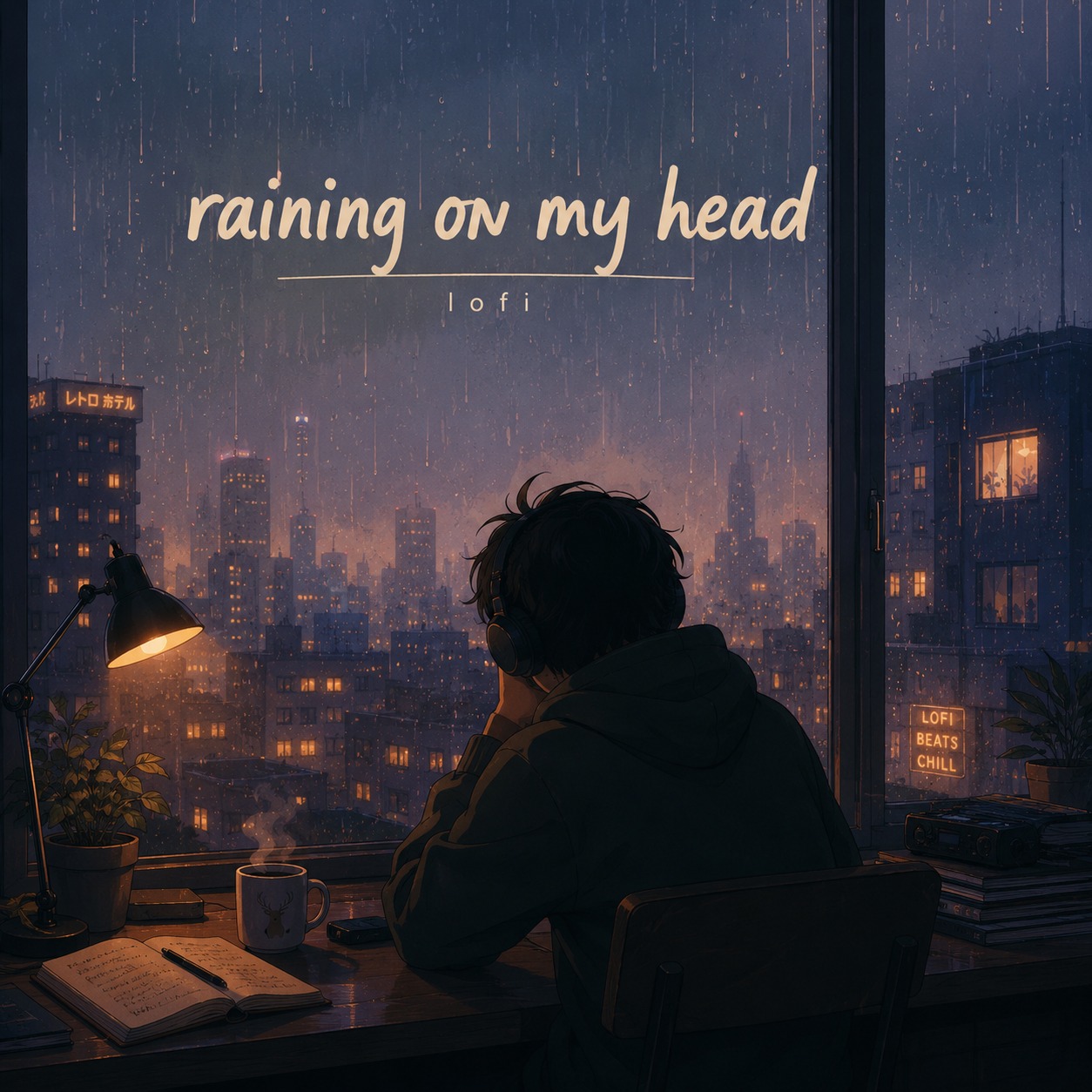
Hello everyone, it’s your host Oliver from DULAXI, and today I’m delighted to be joined by Cervi, a French lo-fi music creator based in Lille, France. Working across lo-fi hip-hop, easy listening, instrumental, contemporary and cinematic sounds, Cervi creates music centred on atmosphere, emotion and the small moments that can easily pass unnoticed. Today, we’re speaking about Cervi’s original single, “Raining on My Head,” released on 01 Jul 26, as well as the wider creative world behind the upcoming Water Cycle project.
Before we begin our conversation with Cervi, here’s what you need to know about today’s featured project.
About Cervi and “Raining on My Head”
Cervi’s music begins with observation. Rather than treating instrumental music simply as a collection of melodies and rhythms, the French creator uses each composition to capture a particular atmosphere, whether that means autumn rain against a window, the warmth of late afternoon, a quiet café, or the feeling of watching a long road disappear into the distance. The intention is not to tell listeners exactly what to feel, but to create an environment where their own thoughts and imagination can have room to develop.
That approach is especially clear in “Raining on My Head,” a mellow lo-fi composition released on 01 Jul 26. The track forms part of Water Cycle, a larger lo-fi album exploring the beauty of water in its different forms. For Cervi, rain provides more than a natural sound to place within a composition. It creates a particular emotional setting, one where the outside world seems to become quieter and ordinary surroundings take on a more reflective quality.
The concept behind “Raining on My Head” is built around the contrast between the cool, wet world outside and the warmth of an indoor space. Cervi imagined someone sitting somewhere comfortable while rain falls outside, perhaps near a window with a cup of coffee or tea, watching the world slow down for a few minutes. This image became the foundation for a piece intended to feel comforting rather than sad.
The wider Water Cycle concept gives “Raining on My Head” an important place within a larger musical journey. Cervi describes the track as the beginning of that journey, with later compositions exploring snow, mountain rivers, the ocean and other forms of water. Each setting is intended to carry its own emotional landscape while remaining connected through the broader themes of water, cinematic atmosphere and reflection.
Cervi’s approach to music also reflects a wider creative philosophy. The project is designed to accompany reading, studying, working, creativity, travelling, reflection or simply taking a few moments to slow down. Instead of demanding the listener’s full attention, the music can exist alongside everyday life and become part of a personal routine.
Having this brief introduction to today’s featured project, I’m sure both new listeners and longtime fans are excited to hear directly from Cervi. So, without further ado, let’s begin today’s interview.
INTERVIEW SESSION
Oliver:
You describe yourself as a French lo-fi music creator whose tracks capture fleeting moments such as autumn rain against a window, a warm late-afternoon glow, a quiet café, or a long road ahead. What first drew you to creating music around these small, reflective moments, and how has this approach shaped the artist you are becoming?
Cervi:
I have always been attracted to the atmosphere of small, ordinary moments. A rainy afternoon, the light at the end of the day, a quiet place where you can simply think… These moments may seem insignificant, but they can create very strong emotions.
When I started creating music, I realised that I wanted to capture those feelings rather than tell a conventional story. This approach has shaped Cervi into a project that is more about atmosphere, emotion and imagination than about following a particular genre. I want each track to feel like a small window into a moment.
Oliver:
There is something very intentional about music that does not demand attention but instead quietly accompanies whatever the listener is already doing. What does creating music for reading, studying, working, creativity, or simply slowing down mean to you personally?
Cervi:
For me, music can be a companion rather than the main focus. I love the idea that someone can listen to a Cervi track while reading, working, studying or simply looking out of a window, and that the music can quietly become part of that moment.
Personally, I also need those moments of slowing down. Life can be very busy and sometimes we forget to simply breathe and observe what is around us. If my music can create a small space for that, then it has already achieved something meaningful.
Oliver:
Your music sits between lo-fi hip-hop, easy listening, instrumental, contemporary, and cinematic influences. How do you decide which musical elements belong in a Cervi composition, and what qualities are most important to you when shaping its overall character?
Cervi:
I don’t really start by thinking about genre. I usually start with an image, a feeling or a place. From there, I look for the sounds that can best express it.
I like combining warm piano melodies, gentle beats, organic instruments, atmospheric textures and sometimes field recordings or environmental sounds. The most important qualities for me are warmth, emotion and a sense of space. I also want the music to remain accessible and comfortable to listen to, without becoming too predictable.
Oliver:
Rain appears not only in the title of “Raining on My Head,” but also in the wider concept behind the “Water Cycle” album. What does rain represent to you creatively, and why did water become the central idea through which you wanted to explore these different moments?
Cervi:
Rain has a very particular emotional power. It can make the world feel quieter and more intimate. The same street, café or room can suddenly feel completely different when it starts raining.
Water also gave me a beautiful way to explore many different emotions. It can be gentle, peaceful, powerful, mysterious or even a little melancholic. The water cycle connects all these forms — rain, snow, rivers, oceans, clouds — so it became a natural framework for creating a musical journey through different atmospheres.
Oliver:
“Raining on My Head” is built around warm textures, gentle melodies, and the sound of rainfall. When you first imagined this track, what did you want the listener to feel or picture before you even began developing the composition?
Cervi:
I imagined someone sitting somewhere warm while rain was falling outside. Perhaps near a window, with a cup of coffee or tea, watching the world become slower for a few minutes.
I wanted the track to feel comforting rather than sad. The rain is outside, but you are inside, in a safe and peaceful space. That contrast between the cool, wet world outside and the warmth inside was the starting point for the track.
Oliver:
Rain can change the feeling of an ordinary environment, making a window, room, café, or street suddenly feel more reflective. Was there a particular scene, memory, or visual feeling that influenced the atmosphere you wanted to capture in “Raining on My Head”?
Cervi:
It wasn’t really one specific memory, but rather a familiar feeling. I love those rainy days when you can hear the drops against the window and everything outside seems slightly blurred.
There is something almost cinematic about watching rain through glass. It creates a little distance from the outside world and gives you permission to slow down. That was the visual feeling I wanted to translate into music.
Oliver:
The rainfall itself becomes part of the musical experience rather than simply sitting in the background. How did you approach balancing the natural sound of rain with the melodic and lo-fi elements so that they complement one another?
Cervi:
The rain needed to feel like part of the environment of the track, almost like another instrument, but without competing with the music.
I therefore kept the melodic elements relatively gentle and left enough space for the rainfall to breathe. I wanted the listener to sometimes notice the rain consciously and sometimes simply feel it as part of the atmosphere. Finding that balance was an important part of the production.
Oliver:
Your description of the track focuses strongly on concentration and relaxation. When you are producing a piece intended to help someone focus, how do you think about melody, repetition, pacing, and the amount of musical detail you introduce?
Cervi:
I think subtlety is very important. If a track is meant to accompany concentration, the melody should be memorable without constantly asking the listener to follow it.
I tend to favour gentle repetition, a steady rhythm and gradual evolution rather than dramatic changes. At the same time, I like introducing small details — a texture, an instrument, a subtle variation — so that the track remains alive when you listen to it for several minutes.
Oliver:
Lo-fi music can be deceptively simple because every texture and small production choice can affect how comfortable or distracting a track feels. What are some of the production decisions you made on “Raining on My Head” that helped you achieve the calm quality you were looking for?
Cervi:
I tried to keep the arrangement relatively uncluttered and give the different elements their own space. The rhythm is gentle, the melodies are simple, and the rainfall helps fill the background without becoming overwhelming.
I also paid a lot of attention to the textures and dynamics. For me, a calm track doesn’t necessarily mean a track with very few sounds; it means that the sounds interact gently and leave room for the listener.
Oliver:
You describe each composition as capturing a fleeting moment rather than simply being another instrumental track. How important is storytelling to you when there are no vocals or lyrics to directly explain what a piece is about?
Cervi:
Storytelling is actually very important to me. Without lyrics, the story becomes more open and personal. I don’t have to tell the listener exactly what to feel or imagine.
Instead, I try to provide a setting — a place, a time of day, a weather condition or a particular emotion. Then the listener can create their own story around it. I like that ambiguity because the same piece can mean something completely different to two people.
Oliver:
“Raining on My Head” is part of a larger album concept, which means the track has a place within a wider exploration of water in different forms. How did you approach giving this particular composition its own identity while still making it feel connected to the world of “Water Cycle”?
Cervi:
I wanted each track on Water Cycle to represent a different stage or form of water, but also a different emotional landscape.
“Raining on My Head” is the beginning of that journey, so it needed to feel intimate and welcoming. Later tracks explore snow, mountain rivers, the ocean and other environments, so the sounds and emotions become progressively different. The connection comes from the idea of water and from the cinematic, reflective atmosphere that runs through the album.
Oliver:
Your work is designed to fit naturally into everyday moments, from reading and working to simply taking time to breathe. Have you received any reactions from listeners that made you realise your music had become part of someone’s routine or personal space?
Cervi:
Yes, and those reactions are particularly meaningful to me. When someone tells me that a track helped them study, relax after a long day, read, or simply create a peaceful atmosphere around them, I feel that the music has found its purpose.
For an independent artist, those personal connections are incredibly rewarding. A stream is a number, but knowing that a piece of music accompanied someone during a real moment of their life feels much more tangible to me.
Oliver:
Creating music that encourages people to slow down feels especially meaningful in a world where so much music competes for immediate attention. What have you learned about yourself through making music that prioritises calmness, patience, and subtle detail?
Cervi:
I’ve learned to be more patient myself. Creating this kind of music has made me realise that something doesn’t always need to be spectacular or immediately impressive to have an emotional impact.
I’ve also become more attentive to small details in everyday life — sounds, light, weather, colours, and the atmosphere of places. In a way, creating Cervi has changed the way I observe the world.
Oliver:
As a French independent artist, how has your own environment and cultural surroundings influenced the way you hear everyday sounds, notice small moments, and translate those observations into instrumental music?
Cervi:
Living in northern France, I am surrounded by a lot of changing weather and very different atmospheres throughout the year. Rain, grey skies, soft winter light and the transition between seasons are very familiar parts of everyday life.
At the same time, I think my musical influences are quite international. Lo-fi itself is a very global culture, and I enjoy discovering sounds and musical traditions from different places. Cervi is therefore rooted in my own environment but also shaped by a curiosity about the wider world.
Oliver:
Looking at your development as a creator, what has changed most in the way you compose and produce music since you first began creating lo-fi pieces, and what are you still discovering about your own artistic identity?
Cervi:
At the beginning, I was mainly experimenting and learning how to create a sound that I personally liked. Over time, I have become much more conscious of the relationship between the musical arrangement, the visual world and the story behind each track.
I’m still discovering my identity, though. I don’t want Cervi to become locked into a formula. I want to keep experimenting with organic instruments, cinematic elements, field recordings and different rhythms while maintaining the calm and emotional character of the project.
Oliver:
The idea behind your music is that if a composition can bring a few moments of peace to a busy day, it has fulfilled its purpose. What does that definition of success mean to you compared with more traditional measures of an artist’s progress?
Cervi:
Of course, streams, listeners and playlists are important, especially for an independent artist trying to build an audience. But they don’t tell the whole story.
For me, success is also about creating something that has a life beyond the studio. If someone discovers a track and decides to listen to it every morning, uses it while studying, or associates it with a peaceful moment in their life, that’s a very meaningful form of success.
Oliver:
As listeners spend time with “Raining on My Head,” what would you most like them to take from the track, whether they are studying, reading, working, travelling, or simply sitting somewhere and listening to the rain?
Cervi:
I would simply like them to feel a little more peaceful than they did before pressing play.
If the track helps someone concentrate, relax, daydream, or just take a few minutes away from the noise of everyday life, then I’m happy. I don’t want to impose a particular interpretation on the listener. I would rather give them a space where their own thoughts and imagination can wander.
Oliver:
With “Water Cycle” exploring the beauty of water in all its forms, are there other natural sounds, environments, or everyday moments you are interested in translating into future compositions?
Cervi:
Absolutely. I’m very interested in forests, ancient trees, mountains, mist, deserts and remote landscapes. I’m particularly fascinated by remarkable trees and plants around the world and the stories they carry.
I would like to explore these subjects through music in the future, combining natural sounds with cinematic and lo-fi elements. I’m also interested in everyday scenes — travelling, walking through a city at night, discovering a quiet place, or simply watching the landscape change through a train window.
Oliver:
Finally, as Cervi continues to develop this world of calm, reflective instrumental music, what are you hoping to explore next, and what kind of place would you like your music to have in people’s everyday lives over the coming years?
Cervi:
I want to continue developing Cervi as a kind of musical travel journal — a collection of places, landscapes, emotions and fleeting moments.
I’m currently interested in exploring the relationship between nature, memory and sound, while continuing to experiment with more organic and cinematic elements. In the long term, I would love Cervi to become the kind of music people naturally return to when they want to read, create, travel, work, reflect or simply slow down.
If my music can quietly become part of those moments in people’s lives, that would be the greatest achievement for Cervi.
“Cervi’s music does not try to interrupt the listener’s day. Instead, it creates a quiet space within it, turning ordinary moments of rain, reflection and stillness into places where imagination can breathe.”
~ Oliver (DULAXI Team)
EDITORIAL PERSPECTIVE
“Raining on My Head” is most compelling in the way its musical identity is connected to a clear visual world. The rainfall, gentle melodies and restrained arrangement work together to create the feeling of observing a rainy scene from somewhere warm and comfortable. Cervi’s wider philosophy also gives the composition greater context, particularly the idea of creating instrumental music that can exist naturally alongside reading, work, creativity and reflection. The interview reveals an artist who is interested not only in sound, but in the memories and environments that sound can quietly preserve.
~ Oliver (DULAXI Team)
CLOSING
Our conversation with Cervi offers a thoughtful look into the creative ideas behind “Raining on My Head” and the wider Water Cycle project. From the emotional character of rainfall to the role of instrumental storytelling, Cervi’s answers reveal a creative process built around observation, patience and the desire to give listeners room to experience music in their own way.
A sincere thank you to Cervi for taking the time to speak with DULAXI and for sharing the ideas, intentions and experiences behind the music. We encourage readers to spend some time with “Raining on My Head” and discover the atmosphere for themselves, whether during a quiet evening, a study session, a creative moment, a journey, or simply a few minutes away from the noise of everyday life.
Thank you for spending time with DULAXI and joining us for another conversation with an independent artist. We look forward to bringing you more interviews and stories from the people creating music around the world.