

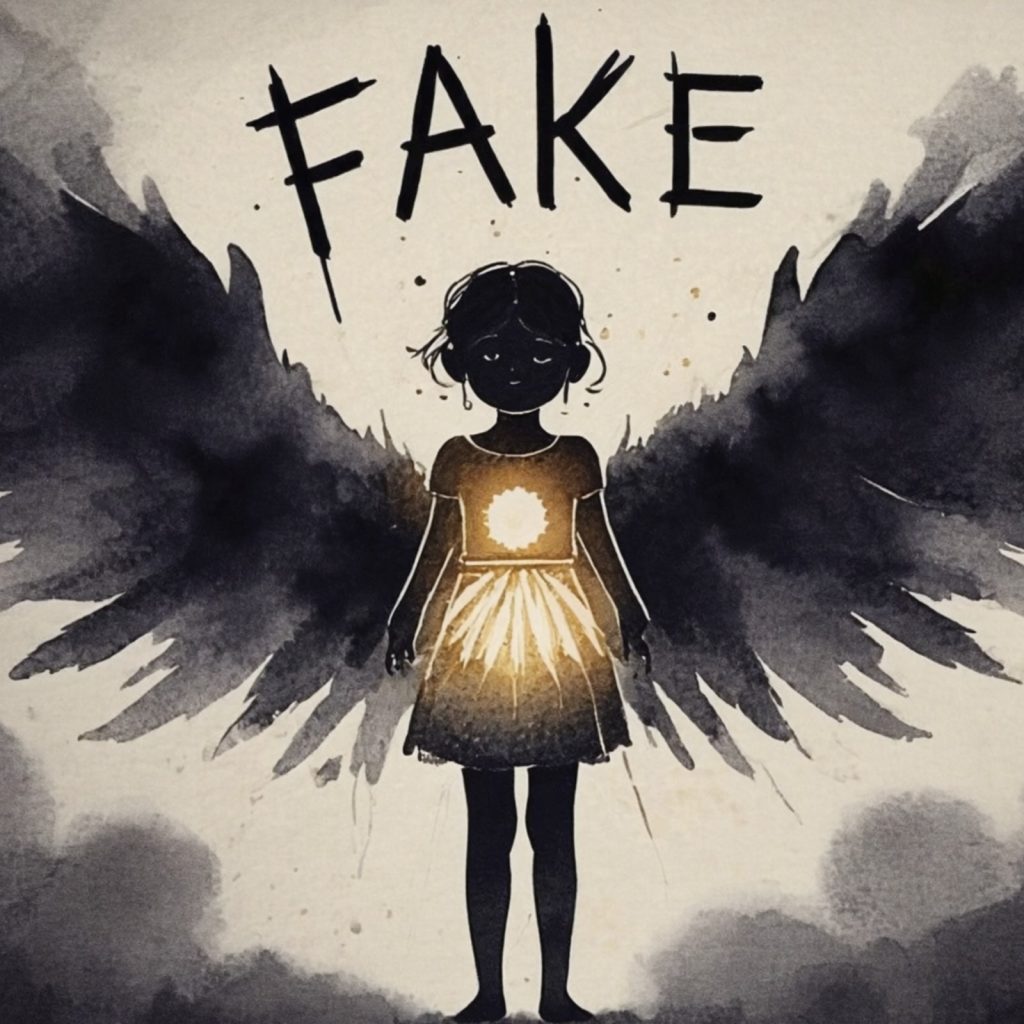
Released on 28th August 2026, Garbage Garden’s “Fake” builds its identity around a disturbing but ultimately empowering question: what makes a voice real? The song begins from a place of profound isolation, expressed through imagery of being “mouthless and alone,” where existence feels manufactured rather than lived. That sense of artificiality becomes central to the writing, particularly through references to construction, synthetic existence and an altar-like presence that implies a life shaped by something outside personal control. The vocals give these ideas their emotional weight, moving through an atmospheric intensity that makes the loneliness feel physical before erupting into harsher metalcore expression. The recurring accusation of being “fake” is therefore more than an insult; it becomes a challenge to authenticity itself. Garbage Garden turns that accusation around, refusing to accept that an unconventional method of creation automatically makes the resulting emotion meaningless.
What gives “Fake” its strongest emotional movement is the transformation of pain into ownership. The image of a “cold blade to my throat” is deliberately severe, presenting the emergence of a personal voice through violence, pressure and suffering rather than comfort. The vocals reinforce that struggle by shifting between restrained tension and aggressive death vocals, making the performance feel increasingly liberated as the song progresses. Rather than allowing the idea of artificiality to determine the meaning of the music, Garbage Garden pushes toward the declaration, “But it’s my voice, but it’s my destiny.” That line provides the song with its central act of defiance: circumstances may be complicated, technology may be involved, and outside voices may question the process, but personal expression still carries ownership. The closing image of the scar continuing to sing turns damage into evidence of survival, giving the song a clear message about finding identity after years of silence.
Garbage Garden makes that argument through an intentionally unstable collision of metalcore, post-hardcore and digital production. Low-tuned distorted guitars provide the physical force, while aggressive bass and punishing drums establish a dense foundation beneath the vocals. Electronic textures then interfere with that heaviness through industrial synths, glitch effects, digital stutters and noise, creating a colder atmosphere that feels deliberately artificial. The contrast is important because “Fake” does not simply discuss technological displacement; its production makes that conflict audible. Tightly controlled passages carry a mechanical precision before heavier sections break open with greater physical aggression. Dance-inflected rhythms and hyperpop-influenced touches further complicate the arrangement, preventing the song from settling into a conventional metalcore structure. Instead, Garbage Garden creates a push and pull between sterile digital control and abrasive rock energy, giving the track an uneasy momentum that constantly threatens to rupture.
That tension ultimately makes “Fake” more than a heavy song built around technological anxiety. Its greatest strength comes from connecting AI-made music with a much older human struggle: the desire to express something that has remained trapped inside. The production may sound futuristic, but the emotional foundation is painfully direct. The haunting vocal passages establish vulnerability, while the harsher delivery turns that vulnerability into confrontation, allowing the performance itself to embody the movement from voicelessness toward agency. The electronic sounds never completely overpower the guitars, just as the question of artificial creation never completely overwhelms the personal meaning behind the music. By combining industrial coldness with chaotic heaviness, Garbage Garden creates a sound that feels both claustrophobic and liberating. “Fake” ultimately argues that the means through which expression emerges do not erase the significance of having something to express.
“Fake” Confronts Artificiality And Isolation, Transforming Pain, Technological Doubt, And Silence Into A Defiant Claim That Authentic Expression Belongs To Whoever Finds Their Voice.
~ Daniel (Dulaxi Team)
Garbage Garden is a Kobe-based artist project led by Yulmi, whose creative practice extends across writing, concept design, visual direction, sonic curation, and music. The project moves between alternative rock, electronic textures, cinematic pop, and experimental sound design, creating an expansive artistic world centred on existence, connection, memory, survival, and self-reclamation. Damaged memories, lost childhoods, anxious nights, invisible care, and fragile human relationships become raw material for exploring light within emotional debris without romanticizing suffering. This wider creative philosophy gives “Fake” greater significance, placing its confrontation with authenticity within Garbage Garden’s fascination with imperfect connections and digital ghosts. “Fake” ultimately leaves its strongest impression by turning technological uncertainty into an argument for personal expression. For anyone drawn to metalcore that challenges convention rather than simply delivering heaviness, this is a track worth experiencing in full, especially for the moment its digital unease collides with its explosive, defiant release.