
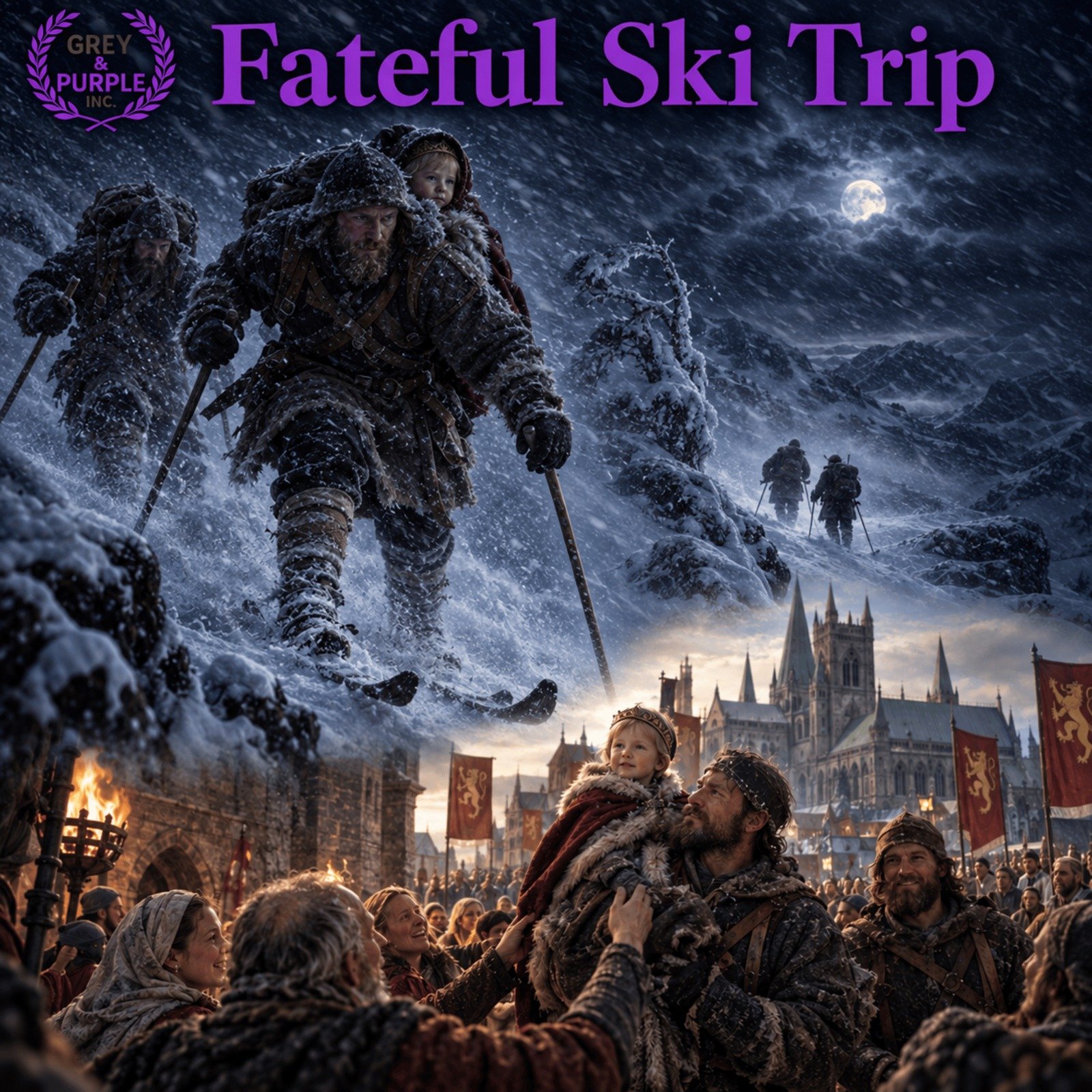
Hello everyone, it is your host Oliver from DULAXI, and today I am delighted to be joined by Grey & Purple Songbook, a musical storytelling project from Oslo, Norway, working across folk, singer-songwriter, jazz, orchestral and epic musical styles. We are discussing their original single, Fateful Ski Trip, released on 13 September 2026, which revisits a dramatic moment in Norwegian history when two Birkebeiner skiers risked their lives to carry a young royal heir through a fierce winter storm. Through a creative approach that places storytelling at the centre of music, Grey & Purple Songbook brings historical events and human experiences to listeners in a way that speaks to both the heart and the mind. Before we begin our conversation with Grey & Purple Songbook, here is what you need to know about today’s featured project.
About Grey & Purple Songbook
Grey & Purple Songbook is a musical storytelling project from Oslo, Norway, operating under the Grey & Purple Inc. label. Established in the autumn of 2025, the project grew from the creative interests of two brothers who developed a love of books, stories and writing during childhood. Their mother was a librarian, and growing up surrounded by books helped shape their appreciation for narratives and the ideas that stories can communicate. After spending years writing texts about different subjects and themes, the brothers eventually decided to bring their work to life through music, combining their passion for writing with their shared love of musical expression.
At the heart of Grey & Purple Songbook is a creative process that begins with a story, theme or message rather than a predetermined musical style. The team first develops the text before deciding which genres, beats and instruments best support its meaning. This approach allows each composition to take shape according to the subject it explores, creating room for different musical influences while keeping the narrative at the forefront. Their work moves between storytelling, music and the communication of ideas, with the intention of reaching listeners intellectually and emotionally. Rather than limiting themselves to one genre or subject, they explore a range of historical, political, philosophical and personal themes.
Released on 13 September 2026, Fateful Ski Trip draws inspiration from Norway’s civil war during the late twelfth and early thirteenth centuries, when the Birkebeiners and the Baglers fought over political authority and the relationship between the monarchy and the church. The song focuses on the winter of 1205 to 1206, when two skilled Birkebeiner skiers carried the two-year-old son of King Håkon Sverresson across dangerous mountain terrain to protect him from the rival Bagler faction. Travelling through a fierce snowstorm, they brought the child safely to Trondheim. He later became King Håkon IV Håkonsson, whose 46-year reign played a significant role in bringing Norway’s prolonged civil conflict to an end. For Grey & Purple Songbook, this episode offered an opportunity to explore courage, loyalty, survival and the consequences of a single decisive act within a much larger historical struggle.
Musically, Fateful Ski Trip brings together folk influences, orchestral elements, jazz touches and a strong rhythmic foundation to reflect the historical setting and the tension of the journey. Its opening features flute and guitar, gradually establishing the atmosphere before the composition develops further through its instrumental arrangement and backing vocals. The creative team carefully considers how each musical choice supports the narrative, adjusting the relationship between lyrics and sound until the composition communicates the intended feeling. Beyond this release, Grey & Purple Songbook remains interested in stories that encourage reflection, including folktales, sagas, political questions, philosophy and the complexities of human nature. With conceptual albums already in the pipeline, the project continues to explore how music can make meaningful stories accessible while leaving listeners with questions worth considering.
Having this introduction to Grey & Purple Songbook and the historical story behind Fateful Ski Trip, it is time to hear directly from the creative team about their beginnings, their approach to musical storytelling and the ideas that continue to shape their work. So, without further ado, let us begin today’s interview.
INTERVIEW SESSION
Oliver:
Grey & Purple Songbook operates at the intersection of music, history and storytelling, with each composition beginning from a particular theme, story or message. How did this creative vision first develop, and what inspired the establishment of the project?
Grey & Purple Songbook:
The creative team at Grey & Purple Inc. consists of two brothers who grew up with books, stories, and libraries as a natural part of their childhood—thanks, in part, to their mother, who was a librarian. As a result, we are both accustomed to and deeply fond of stories and narratives, and over time, we also developed a passion for writing. For many years, both of us have written texts covering various themes and messages—pieces that, for a long time, simply remained tucked away in a drawer. Eventually, the idea took shape to bring these texts to life in some form. Since we both also love music, it felt entirely natural to choose music as our medium for storytelling and communication. And so, in the autumn of 2025, Grey & Purple Inc. and the Grey & Purple Songbook came into being. In short, that is the story of how this project began.
Oliver:
Your creative process places the story before the music, with the lyrics developed before selecting the genre, beats and instrumentation. What led you to adopt this approach, and how does it influence the way you think about music as a storytelling medium?
Grey & Purple Songbook:
As mentioned earlier, given our respective backgrounds, writing is the most natural form of expression for both members of the creative team. Consequently, text and storytelling became the obvious starting point for our creative process. However, since we both recognized that the “mode” of delivery is just as crucial as the text itself in conveying a message—and because we both love music—it felt natural to incorporate music as an effective vehicle for the messages within our texts.
Oliver:
Your work explores historical events and ideas through musical narratives rather than following conventional songwriting approaches. What attracts you to using music as a way of preserving, interpreting and communicating stories from the past?
Grey & Purple Songbook:
Music is an excellent tool for communication because it is rooted in moods and emotions—in other words, the heart—unlike texts, which largely address the mind. This aligns perfectly with our ambition to appeal to both the heart and the mind in our texts and communications.
Oliver:
“Fateful Ski Trip” takes listeners back to Norway’s civil war during the late twelfth and early thirteenth centuries. What first brought this particular historical episode to your attention, and what convinced you that it deserved to become a musical story?
Grey & Purple Songbook:
The civil war between the two political factions—the Birkebeiners and the Baglers—marks, in many ways, the origin of a political divide in Norway that has shaped society ever since: the divide between those who have much and those who have little. It was, therefore, a pivotal aspect of early Norwegian history, well-suited as a basis for both a text and a song. The specific episode involving the rescue of the young royal son was so dramatic, so consequential, and so historically significant that it became a natural choice to focus on this particular event from the civil war for the text and song.
Oliver:
The composition centres on the extraordinary journey of two Birkebeiner skiers carrying the young Håkon Håkonsson across dangerous mountain terrain during the winter of 1205–1206. What aspects of this rescue story affected you most when researching and developing the narrative?
Grey & Purple Songbook:
What made the greatest impression during the research process was, without a doubt, the fact that the life of a small, two-year-old boy hung in the balance during a brutal confrontation between the two political factions—and, in retrospect, how crucial this boy’s survival proved to be for the course of development in Norway.
Oliver:
The Birkebeiners and Baglers represented opposing political and social interests, with their conflict involving questions of royal authority and the influence of the church. How important was it for you to communicate the wider historical and political circumstances rather than focusing exclusively on the dramatic rescue?
Grey & Purple Songbook:
Fundamentally, what I—or rather, we—sought to convey was the dramatic story of the royal son’s rescue, as well as its historical significance. Yet, as previously mentioned, the divide between the haves and the have-nots has historically played a significant political role, with repercussions that have persisted long after. Consequently, this particular story took on an added dimension, given that the influence of the common people—those of modest means—on the nation’s governance hinged entirely on whether they would succeed in saving the young royal son.
Oliver:
The Birkebeiners were associated with commoners, rebels and people from less privileged backgrounds, while the Baglers received considerable support from the church and aristocracy. Did these contrasting identities influence the way you approached the story, particularly its themes of loyalty, power and survival?
Grey & Purple Songbook:
Perhaps not so much in terms of our specific approach to the subject matter and the actual story, but I would say that the gravity of the situation—regarding the Birkebeiners’ prospects for maintaining influence over the governance of Norway—hinged entirely on whether they could first locate the young boy, and subsequently succeed in bringing him safely to Trondheim, their base of operations. Given this high-stakes context, this specific historical rescue mission was defined by profound courage and loyalty to the late king; it was also driven by the two skiers’ determination to survive—and to ensure the survival of the king’s son—as they navigated the immense obstacles that stood in their way.
Oliver:
One of the most striking details is the journey through a fierce snowstorm, with the child carried on the backs of the two strongest skiers. How did you translate the danger, isolation and determination of that moment into the emotional language of the composition?
Grey & Purple Songbook:
Perhaps the most difficult aspect of using music as a medium for communication is finding the right genre, beat, and instrumentation for specific parts of the text or story—ensuring it appeals as much to the heart as it does to the mind. In practice, this is a highly demanding process, as you rarely get it exactly right on the first attempt. You may have an idea of the general structure of the composition, but you will almost always need to make adjustments before the music truly resonates with the text and the story.
Oliver:
The child at the centre of this journey eventually became King Håkon IV Håkonsson, whose reign helped bring Norway’s long period of civil conflict to an end. How did knowing the historical outcome influence the way you wanted the story to unfold musically?
Grey & Purple Songbook:
The historical outcome—that the king’s son was ultimately saved and became King of Norway—was likely most significant for the final part of the composition, the conclusion.
Oliver:
Your submission describes the project as moving in the twilight of storytelling, music and conveying a message. What does that creative philosophy mean to you, and how do you balance the responsibility of communicating historical information with the freedom of artistic interpretation?
Grey & Purple Songbook:
When we write about and retell historical episodes through music, we place great importance on accuracy. However, this does not mean that we refrain from offering our own interpretations or adding color to the lyrics to bring out a potential message. We do not always have a deliberate message in mind when retelling history; simply conveying what we consider to be significant historical episodes can be reason enough for us to write a piece. Yet, as we explore and develop a theme, a message often emerges—and in such cases, this naturally influences both the lyrics being written and the way the material is ultimately presented musically.
Oliver:
When developing a historical composition, how do you decide which details belong in the lyrics and which aspects should be communicated through the music itself? Is there a point where adding more historical information might interfere with the emotional flow of the story?
Grey & Purple Songbook:
Yes, definitely. An overly detailed text can stifle the emotions and feelings that are an essential part of the overall communication. The text should include the themes and messages we deem important to convey, but without becoming so detailed that the flow—ideally supported by the composition—comes to a complete halt. Once again, for us, it is always important during the creative process to keep in mind that the final result should appeal to both the heart and the mind.
Oliver:
Grey & Purple Songbook explores different musical genres depending on the subject and message of each release. When working on “Fateful Ski Trip,” what musical qualities did you feel were necessary to reflect the historical setting, the harsh winter journey and the eventual arrival in safety?
Grey & Purple Songbook:
Yes, there were several elements we felt needed to be in place to form the musical framework for the song. Since the story is set in the 13th century, it required a folk-inspired quality; at the same time, the subject matter occasionally takes on a grand scale, calling for a degree of orchestration. We also wanted the piece to be catchy, which made the inclusion of jazz elements a natural choice. The opening sequence, featuring flute and guitar, serves to gradually build the drama. A strong rhythmic element was also essential to drive the composition forward, reflecting both the drama and the gravity of the situation. The backing vocals evoke the mountain landscape and a sense of the sacred or regal, while also effectively supporting the narrative through the lyrics.
Oliver:
Your project aims to educate and entertain through music, making historical narratives accessible to listeners who may not already know the events being described. Who do you primarily imagine listening to your music, and what do you hope they discover beyond the musical experience?
Grey & Purple Songbook:
I feel it’s difficult to say for certain who our music appeals to. We assume, however, that it likely resonates with listeners who have an interest in lyrics—exploring themes such as human nature, society, and history—as well as the art of storytelling. It’s hard to be definitive about this, but if we have managed to get our listeners to reflect on the themes and messages conveyed in the lyrics—and if the music has played a part in that—then, quite humbly, we are very pleased.
Oliver:
Norway has a rich cultural and historical identity, and “Fateful Ski Trip” draws attention to an important chapter in that history. Do you see Grey & Purple Songbook as having a particular role in introducing Norwegian history and heritage to audiences beyond Norway?
Grey & Purple Songbook:
We haven’t necessarily set out with the conscious intention of playing a role in conveying Norwegian culture and history; however, it is undeniable that our upbringing has shaped us. Consequently, it feels entirely natural for us to explore themes and convey messages in our lyrics that are clearly influenced by where we grew up. In that sense, we do end up sharing aspects of Norwegian culture and history. At the same time, we are very deliberate about writing about themes, narratives, and messages that are universal and fundamentally human—for instance, in songs like “Tales of Scheherazade” (the saga of the Persian queen Scheherazade), “Radio Host” (the role and responsibility of the media in society), “Wasp on My Nose” (anxiety), and “This is My Crescendo” (nervousness and performance anxiety experienced by a concert pianist).
Oliver:
Since the project is driven by a creative team rather than a conventional individual artist identity, how do the contributors at Grey & Purple Songbook and Grey & Purple Inc. collaborate when selecting stories, developing lyrics and deciding on their musical presentation?
Grey & Purple Songbook:
The creative team at G&P Inc. operates with very little hierarchy, favoring a distribution of tasks that emerges naturally following a collaborative brainstorming and ideation process. We assign the various stages of the production chain—including writing, composition, cover art creation, mastering, production, and publishing—to the individual best suited to convey the chosen theme or message. This approach allows every member of the creative team to leave their personal mark on the text and music from start to finish. It results in a more streamlined production process and offers greater satisfaction to the person writing the lyrics, as they are able to influence the entire production right through to the final stage.
Oliver:
Looking at your wider catalogue, are there particular historical periods, cultural traditions or human experiences that you find especially compelling to explore through music? What kinds of stories are you currently most interested in bringing to listeners?
Grey & Purple Songbook:
The creative team at G&P Inc. is, in principle, very open to writing about almost any subject matter or message. We prefer not to adopt a preachy tone; rather, we aim to encourage reflection on the chosen themes and messages. That said, it is no secret that we have a particular fondness for topical, broad political themes, philosophy, various facets of human nature—such as behaviors, thoughts, and attitudes—as well as folktales and sagas from around the world, often with a unique, distinctive twist. It is this general inclination, rather than any specific historical era or theme, that tends to shape our work at any given time. Even so, we do have a couple of conceptual albums in the pipeline.
Oliver:
What has been the most challenging aspect of transforming a documented historical event into a composition that still feels emotionally engaging and musically accessible? Has working on “Fateful Ski Trip” changed the way you approach future storytelling projects?
Grey & Purple Songbook:
A general challenge when using text and music as a medium for communication is that, while you may have an idea of the composition’s framework, you must constantly make adjustments to ensure the text and music “harmonize”—that the music supports the themes and message of the text. This process can be both time-consuming and resource-intensive. It becomes especially critical to find the “right” music for the text when the work is based on a specific story, fairy tale, or saga, as the themes and message are, to a large extent, already established. In contrast, when working with more open-ended texts—where the themes and message are more uniquely your own—you have greater freedom in how you approach the composition.
Oliver:
Finally, when listeners finish “Fateful Ski Trip,” what would you most like them to take away from the experience? Is your greatest hope that they remember the historical event, connect with the courage of the people involved, or become curious enough to explore the story further?
Grey & Purple Songbook:
I suppose I would choose both. But the most important thing would probably be if we have managed to spark a curiosity that leads people to want to know more about the event.
In conclusion, I would just like to express my thanks for the opportunity to share our thoughts and ideas, and to present the project Grey & Purple Songbook.
“Fateful Ski Trip” demonstrates how a moment of extraordinary courage can become more than a historical account when music gives its story a human voice. Grey & Purple Songbook approaches the past with a clear purpose, inviting listeners to discover not only what happened, but also why the choices made centuries ago continue to matter.
~ Oliver (DULAXI Team)
EDITORIAL PERSPECTIVE
What stands out about Grey & Purple Songbook is the decision to let the story determine the music rather than forcing the narrative into a fixed style. In Fateful Ski Trip, folk influences, orchestral touches, jazz elements and a developing rhythmic arrangement help communicate the danger and eventual hope surrounding the rescue. Our conversation also revealed the thought behind this process, particularly the team’s effort to preserve historical accuracy without losing emotional expression. The result reflects their wider ambition to create music that encourages curiosity, connects listeners with unfamiliar stories and leaves room for personal reflection.
~ Oliver (DULAXI Team)
CLOSING
A sincere thank you to Grey & Purple Songbook for joining DULAXI and sharing the story behind Fateful Ski Trip. This conversation has offered a closer look at the creative thinking behind the project, from the brothers’ early love of storytelling to their careful approach to matching music with historical narratives. Their reflections also highlight how an event from centuries ago can continue to raise questions about courage, loyalty, political power and the decisions that shape the future.
We encourage readers to listen to Fateful Ski Trip and discover the historical episode that inspired it. Whether the music first catches your attention or the story draws you in, there is an opportunity to learn something new about Norway’s past while considering the wider human experiences at the heart of the song. You can also explore Grey & Purple Songbook’s other work to discover how the project approaches subjects ranging from history and folklore to society and human nature.
Thank you for spending time with DULAXI and reading this interview. I am Oliver, and it has been a pleasure bringing you this conversation with Grey & Purple Songbook. Stay with us for more interviews exploring the people, ideas and creative decisions behind the music.