
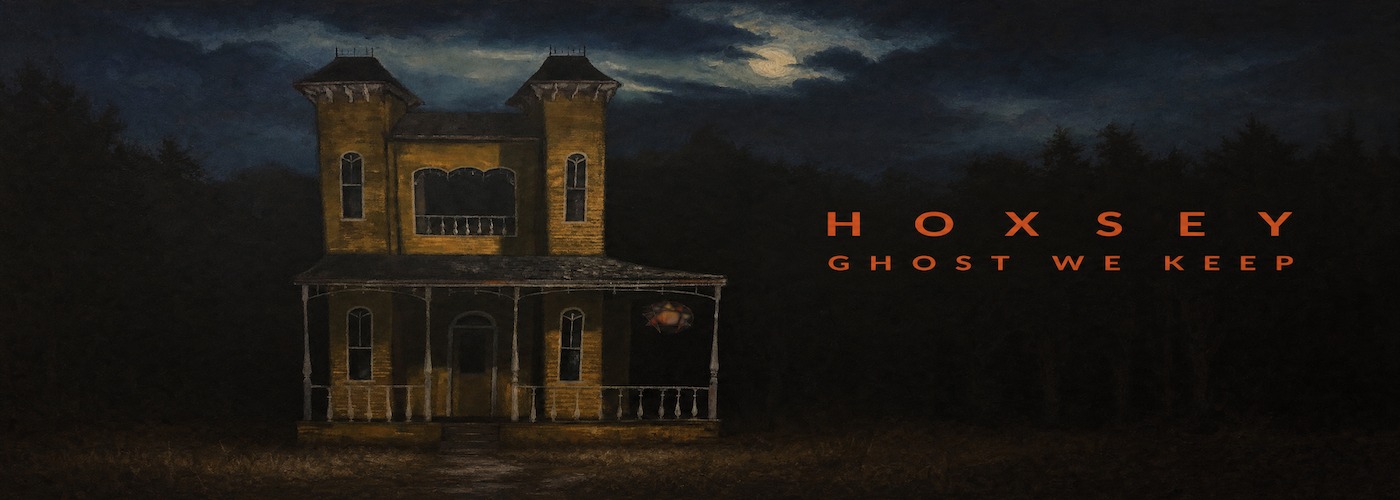
Hoxsey’s “Ghost We Keep,” released August 25, 2026, sounds like exactly what its creator has called it: the kind of Halloween record built to outlast the season it’s built around. The Austin-based artist’s latest full-length imagines a traveling circus that never quite left town. Across eleven tracks, dirt roads, tent shows, and half-remembered names become a way into questions about memory, mortality, and the people we don’t fully let go of. The songs don’t treat the season as a costume; instead, Hoxsey uses genre itself as a stage, letting alternative rock, gothic textures, punk urgency, and orchestral scale trade off from song to song, so atmosphere ends up doing as much narrative work as the lyrics themselves.
That range comes from an artist with a genuinely restless catalog behind her. Hoxsey moves between acoustic, electronic, punk, and orchestral rock as a matter of course, and “Ghost We Keep” is a joint work with collaborator Peppermilk, built around the idea of a world a listener can wander through instead of one that explains itself. Several tracks feature vocalist Taliba Fields, whose presence deepens the theatrical, almost narrated quality running through the record’s darker corners. Four of the album’s eleven songs are examined here: “Skeleton Key,” “The Road,” “Charm Cider,” and “A Ride With the Four Horse Men in 1888.”
Skeleton Key:
“Ghost We Keep” opens with “Skeleton Key” gradually assembling itself out of strings and electronic texture before Hoxsey’s vocal enters, full-bodied, raspy, and dark in tone. The delivery is dramatic and almost choral, nothing close to a straightforward opening statement. The lyric leans on storytelling more than direct message, using imagery of mortality and the supernatural to establish the album’s world without spelling it out, and the vocal performance holds that tension until the bridge, where it opens into the song’s clearest emotional peak. It’s an unusual choice for a record opener: patient, not immediate. The payoff is that by the time the arrangement fully arrives, the listener has already been pulled inside the carnival, not simply told about it.
That arrangement, once it lands, is dense by design. Brass, strings, and orchestral elements stack against punchy bass and complex, driving percussion, giving the track a richly layered, theatrical scale instead of a conventional verse-chorus build. The instrumentation is used less to carry melody than to build emotion and shape the storytelling directly, with a booming, announcer-like presence running underneath the vocal that makes the song feel staged, not simply performed. What “Skeleton Key” leaves behind isn’t resolution so much as curiosity: the sense of a door opening, not closing. That makes it a natural entry point for a record built on wandering, not explaining.
The Road:
Where “Skeleton Key” announces Hoxsey’s theatrical world, “The Road” turns away from it almost immediately. Bass and synth lead the arrangement in before the vocal arrives, and the song settles into something more interior. Its lyric follows solitude, self-discovery, and the discomfort of choosing a path instead of being handed one. The vocal is powerful and distinctive, delivered with dramatic, passionate expressiveness, and it reaches its emotional peak early, at the pre-chorus, giving the whole song a sense of urgency that most tracks save for the final stretch.
The instrumentation matches that urgency without abandoning the album’s scale: heavy, driving guitar and punchy, groovy bass sit under dynamic, energetic percussion, with synth work used to add tension and atmosphere instead of easing the mood. It’s an energetic arrangement throughout, built more for forward motion than the theatrical stillness of the opener. Thematically, it’s the most hopeful of these four songs: healing, resilience, and self-worth sit alongside identity and change, tracing an arc that runs from calm into intensity, not from darkness into dread. It’s the sound of a record shifting from spectacle to something closer to the person walking through it.
Charm Cider:
“Charm Cider” moves the album out to sea, opening on bass, synth, and ambient texture before the vocal enters with a captivating, raw distinctiveness that stays controlled even as the song’s mood grows uneasy. Where “The Road” is driven by momentum, this track is driven by atmosphere. It’s industrial and intimate in the same breath, with folk-inflected guitar running underneath a flowing, liquid arrangement that supports a surreal maritime narrative. The vocal performance is dramatic without being aggressive, building steadily toward the chorus as its clearest emotional high point.
Lyrically, it’s the most morally tangled of the four songs. Betrayal, temptation, and transformation move through a story about identity and self-discovery, occasionally tipping into outright violence, and the song leaves reflection and melancholy behind instead of resolution. Warm, punchy bass and tight, energetic percussion give the track a groove that never fully settles, while the keys add texture and tension, not comfort, keeping the arrangement unsettled in a way that mirrors its narrative. It’s the album’s clearest example of Hoxsey using genre-blending (folk, industrial, electronic) not as a stylistic flex but as a way of keeping a listener off-balance on purpose.
A Ride With the Four Horse Men in 1888:
The album’s most cinematic moment closes out the four songs examined here, building slowly out of synths and electronic texture before erupting into a dense wall of orchestral rock. This is where Hoxsey’s palette goes maximalist. Acoustic and electric guitar, full drums and percussion, strings, brass, synth, and orchestral elements all layer into a richly textured, dynamic arrangement built specifically for apocalyptic imagery: horsemen, skulls, famine, plague, graves, witches, and fate. The vocal is captivating, powerful, dark, and deep in tone, delivered with an aggressive, dramatic storytelling quality that peaks twice, across the bridge and again in the final chorus, as if the song needs two separate crescendos to hold everything it’s carrying.
Thematically, it’s the widest-reaching of the four tracks, moving through separation, grief, and mortality on the way toward something closer to a spiritual reckoning, with an emotional arc that runs from darkness toward hope and from personal struggle toward growth. Taliba Fields’ presence throughout deepens that theatrical scale, giving the track the character of a shared performance, not a solo statement. What’s left once it ends is reflection laced with nostalgia, a fitting way to close this stretch of the album and the clearest proof here that Hoxsey can turn gothic storytelling into something closer to a fully staged production than a song.
Ghost We Keep Turns a Traveling Carnival Into a Map of Grief, Without Ever Losing Its Sense of Spectacle.
~ Daniel (DULAXI Team).
Across “Skeleton Key,” “The Road,” “Charm Cider,” and “A Ride With the Four Horse Men in 1888,” the throughline holds even as the arrangements shift dramatically underneath it: Hoxsey treats memory and loss as something theatrical, something to be staged and walked through, not simply described. The specifics change from song to song: a carnival gatekeeper announced through choral drama, a solitary walk carried by driving rock, a morally tangled sea story wrapped in folk and industrial texture, an apocalyptic duet built for orchestral scale. The underlying idea holds across all four: a ghost story can still function as a rock record, and a rock record can still function as a way of processing what won’t stay buried. It’s an ambitious start to an eleven-track world, built by an artist with the range and the collaborators to make good on Halloween-record ambitions that could otherwise sound overstated.