
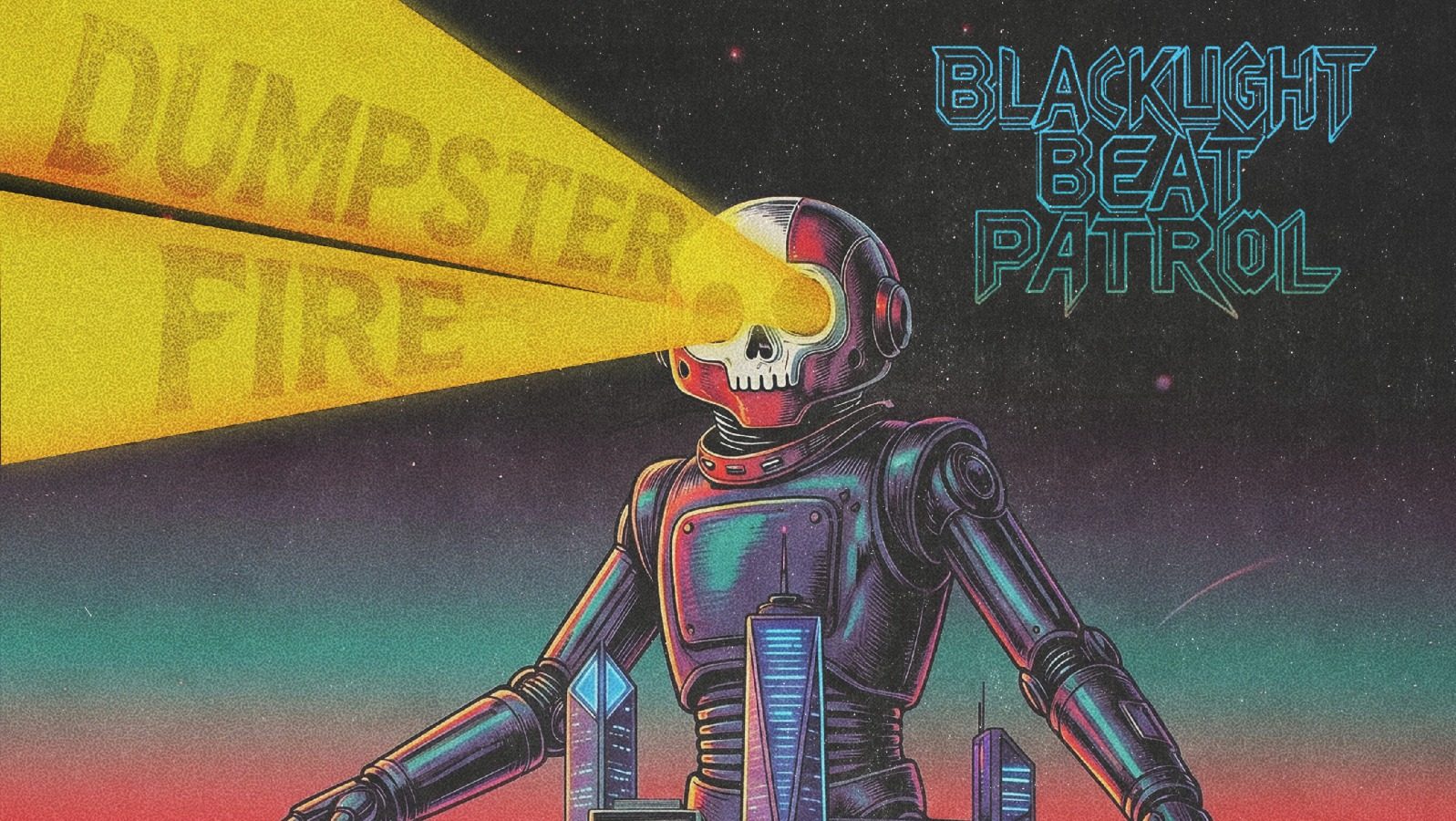
“Dumpster Fire” functions as more than a sonic experiment; it presents itself as a thematic articulation of controlled collapse within modern digital and industrial sound culture. Released on April 30th, 2026, as the lead single from Blacklight Beat Patrol’s upcoming album It Gets “Better”, and first appearing on Bandcamp and SoundCloud, the track carries the conceptual weight of transition between eras. It extends the trajectory set by Phizzle Phinkle Pop (2025), but shifts the focus from playful fragmentation toward a harsher philosophy of instability. The message essence is rooted in accepting disorder as a structural principle rather than a breakdown state. The sound design, built on mechanical percussion and distorted tonal fragments, becomes a metaphor for systems that continue to function while visibly decaying. Nothing resolves cleanly here; everything is kept in motion as a statement of persistence inside collapse.
The thematic core of “Dumpster Fire” is expressed through its industrial-IDM language, where sonic friction operates as narrative identity rather than background texture. The distorted bass swells and digital decay are not decorative elements but representational forces, symbolizing environments where clarity is constantly eroded by overload. The oscillation between fragmented melodic flashes and abrasive noise bursts constructs a message of unstable perception, where meaning cannot stabilize long enough to settle. Instead of offering emotional resolution, the track frames disorientation as a valid state of modern experience. The mechanical, clockwork-like percussion reinforces this idea, suggesting systems that continue operating even when coherence has been stripped away. In this sense, the track becomes a study of endurance under pressure, where sound mirrors structural tension in digital existence.
Rhythmically, the message deepens through its rejection of traditional groove logic in favor of evolving pulse mechanics. The stuttering, reversed, and micro-varied percussive elements reflect a thematic refusal of predictability, reinforcing the idea that structure can exist without repetition or comfort. Each rhythmic interruption feels like a recalibration of time perception itself, turning the listening experience into a shifting framework rather than a steady progression. This instability communicates a central idea: that contemporary systems, musical, technological, or social, rarely move in clean cycles but instead in fractured, reactive patterns. The drum programming becomes a coded representation of this reality, where continuity is manufactured through disruption rather than flow.
Ultimately, the essence of “Dumpster Fire” rests in its transformation of chaos into deliberate architecture. Its production design, defined by compression pressure, abrupt layering, and controlled sonic erosion, frames collapse as an organized condition rather than failure. The track communicates a worldview where instability is not an endpoint but a functioning state of design. Even its most abrasive moments are structurally intentional, reinforcing the idea that disorder can be composed, shaped, and sustained. Within this framework, Blacklight Beat Patrol constructs a sonic thesis: that modern electronic music can embody fragmentation without seeking repair. The result is a soundscape where collapse is not feared, but engineered into form and allowed to persist as identity.
Dumpster Fire Operates As A Controlled Collapse Where Distortion Becomes Structure, Instability Becomes Rhythm, And Decay Is Sustained As A Deliberate System Of Motion Without Resolution Or Escape.
~ Daniel (Dulaxi Team)
Blacklight Beat Patrol is an experimental electronic project led by producer and multi-instrumentalist Scott R. Corneau, launched in 2021 and based in Rhode Island, functioning as a laboratory for controlled chaos where structure is consistently destabilized rather than preserved. Across works like Startup Sounds (2022), Whispers from the Void (2024), Meet the Blacklight Beat Patrol (2024), and Phizzle Phinkle Pop (2025, mastered by Wise Audio Lab), the project evolves through glitch-heavy IDM, fractured rhythm design, and emotionally charged digital textures that prioritize friction over accessibility. Built in a home studio environment, its sound explores contrasts between melody and collapse, digital decay and resonance, drawing influence from Aphex Twin, Boards of Canada, Flying Lotus, and Tycho. In relation to “Dumpster Fire,” this artistic identity fully converges into a refined statement of controlled instability, making the track an essential entry point for listeners drawn to immersive electronic worlds where chaos is engineered, not accidental, and every sound feels like it is deliberately breaking apart while still moving forward.
For more information about Blacklight Beat Patrol, click on the icons below.