
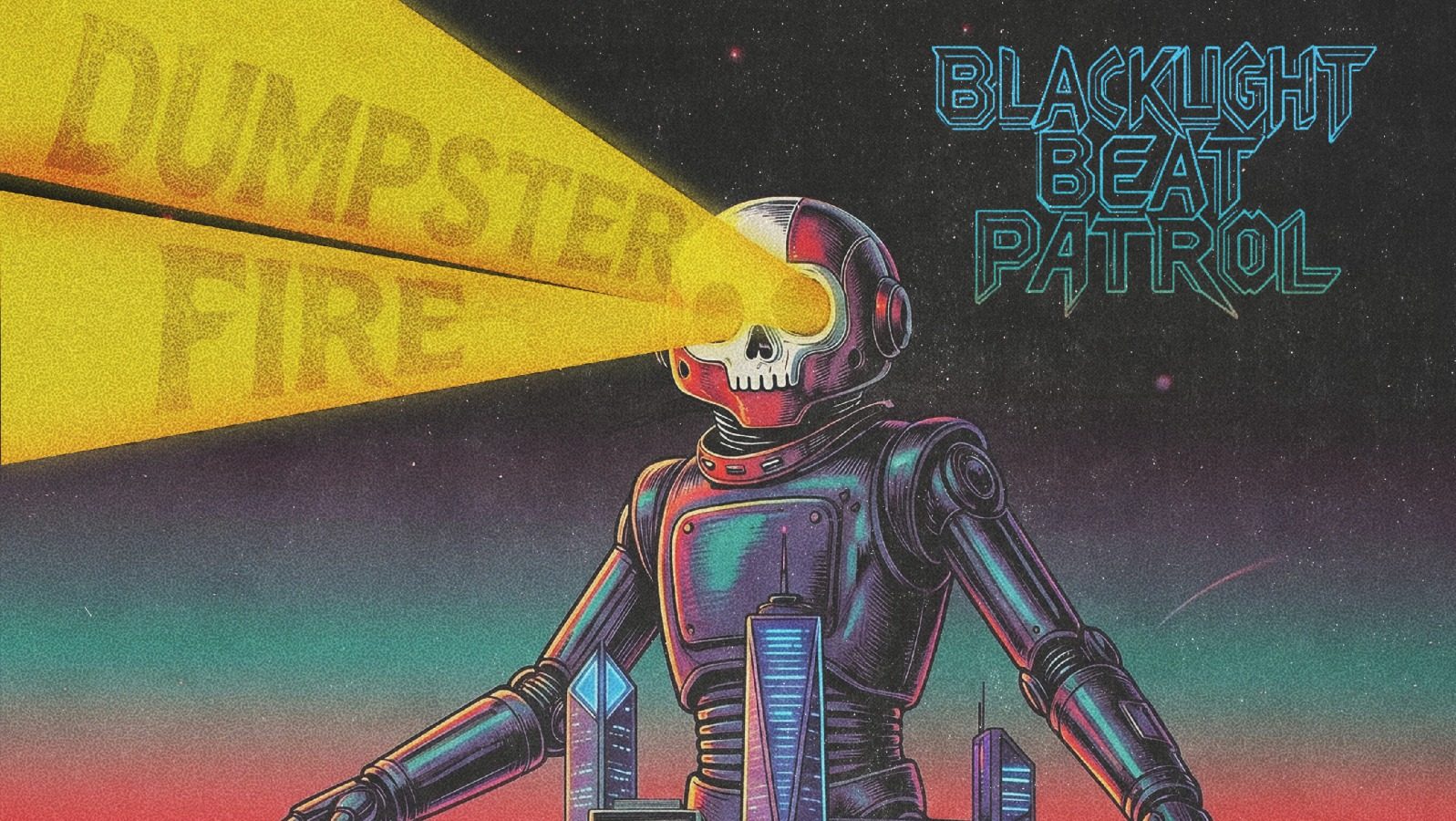
Hello everyone it’s your host Daniel from Dulaxi, and today I have with me the exceptional project, Blacklight Beat Patrol from East Providence, United States. And Blacklight Beat Patrol is here to discuss their recent cataclysmic single “Dumpster Fire” which was released on April 30th, 2026. So, welcome, Backlight Beat Patrol!. But before we begin our interview, to our audience; here is what you need to know about this artist.
Blacklight Beat Patrol is an experimental electronic project led by producer and multi-instrumentalist Scott R. Corneau, launched in 2021 in Rhode Island and currently based between Central Falls and East Providence. Built as a “laboratory for controlled chaos,” the project embraces an outsider perspective that rejects conventional structure in favor of instinct-driven, unpredictable composition. Its sound fuses experimental electronic, IDM, glitch, and leftfield influences, defined by complex rhythmic systems, digital artifacts, and a signature “weird tone” that prioritizes technical friction and emotional texture over accessibility. Working from a home studio, Corneau constructs immersive sonic environments where tracks unfold without fixed structure, blending melody and collapse, digital decay and emotional resonance, and cinematic depth with abrasive rhythmic design. Across releases including “Startup Sounds” (2022), “Whispers from the Void” (2024), “Meet the Blacklight Beat Patrol” (2024), and the 2025 album “Phizzle Phinkle Pop” (mastered by Wise Audio Lab), the project has steadily refined its approach to fractured rhythm and sensory distortion, drawing comparisons to Aphex Twin, Boards of Canada, Flying Lotus, Tycho, Autechre, Lorn, and The Chemical Brothers while establishing a distinct presence in the electronic underground. The 2026 single “Dumpster Fire,” released April 30 as the lead into the upcoming album It Gets “Better,” intensifies this identity through mechanical, clockwork-like percussion, distorted bass swells, and digital decay, functioning as a calculated study in sonic friction that reinforces the project’s commitment to organized chaos, active listening, and the artistic value of the off-center and unstable within modern electronic music.
Having this brief Introduction about Blacklight Beat Patrol, I’m sure new and current fans must be excited about our Interview today.
INTERVIEW SESSION
Daniel: Blacklight Beat Patrol has built a reputation around “controlled chaos” and embracing the outsider perspective. At what point did you fully realize that this unconventional sonic identity was not something to hide, but actually the core strength of the project?
Blacklight Beat Patrol: I’ve always gravitated toward “outsiders” in music, movies, and literature because they were unapologetically themselves. They represent a freedom of sorts. The “weird” sounds, off-time elements, and chaos in my music aren’t really deliberate choices, they just happen naturally during the process. While that sometimes makes me question my own skill set, I’ve come to realize this isn’t something to hide or suppress. It wasn’t one specific moment, it was a gradual evolution. This “controlled chaos” is the most honest version of how I hear music, and that’s where the project’s strength comes from.
Daniel: Your catalog constantly balances melody, distortion, emotional texture, and digital decay in a way that feels immersive yet unpredictable. How would you describe the philosophy behind the world Blacklight Beat Patrol creates sonically?
Blacklight Beat Patrol: If I had to describe the world my music lives in, it’s almost a hallucination. The philosophy isn’t really to make it unpredictable on purpose, it’s to allow the chaos to happen and trust that listeners will step inside the song’s world mentally and participate in it. The off-time and unconventional elements feel right to me because they make sense within that world. The best way I can describe what Blacklight Beat Patrol is building is hallucinogenic meditation music through chaos.
Daniel: From Startup Sounds to Phizzle Phinkle Pop and now “Dumpster Fire,” the project has evolved rapidly in just a few years. Looking back, what do you think has changed the most about your artistic mindset since launching the project in 2021?
Blacklight Beat Patrol: When I started, I was getting used to new tools and a totally new workflow. I’d dabbled with electronic music way back, but I had always worked with groups of people in different kinds of bands, nu metal, groove metal, alt rock. So launching Blacklight Beat Patrol was really about growing on my own, without anyone else’s input. Learning the tools, building out my electronic setup, figuring out how I write when nobody else is in the room. The biggest mindset shift has been finally accepting that the stuff I come up with is just “me”.
Daniel: “Dumpster Fire” feels abrasive, mechanical, and strangely hypnotic all at once. What emotional or psychological atmosphere were you trying to pull listeners into with this single?
Blacklight Beat Patrol: I wrote the song after a really frustrating day spent catching up on the news. I kept hearing politicians say things I found appalling, gaslighting, name-calling, just a pure distortion of reality. The song captures that exact whiplash: one moment you’re enjoying your life, and the next you’re reading or hearing something so off that you’re sitting there thinking, “Am I the crazy one, or has everyone lost touch with reality?” That’s the atmosphere I wanted to pull listeners into, that disorienting moment when reality stops behaving the way you thought it did.
Daniel: The phrase “calculated study in sonic friction” perfectly captures the track’s identity. What does “friction” represent to you creatively and emotionally within the context of this song?
Blacklight Beat Patrol: Creatively, friction is about pairing elements that shouldn’t go together and trusting that the collision creates a spark. Sometimes it’s technical, rhythms or textures that fight each other on paper but ignite once they’re in the same room. Emotionally, it’s about feeding conflicting moods into the same song so the listener feels both pulls at once. With “Dumpster Fire” specifically, the friction is the point. It’s the sound of the disconnect I was feeling, that uncomfortable space between something being wrong and being told it’s normal.
Daniel: There is a recurring sense of tension throughout “Dumpster Fire,” especially through the distorted bass swells and clockwork-like percussion. Was the track designed to reflect chaos in modern life, or is the meaning more personal and internal?
Blacklight Beat Patrol: It’s both. I was dealing with some personal struggles and trying to accept a new “normal”, all while watching the world devolve into a reality TV show running through some of the worst-case scenarios you could imagine. The track is what comes out of those two things colliding.
Daniel: You described the project as “accepting your musical identity” and embracing life on the fringe. How deeply does that statement connect to the message behind “Dumpster Fire” and the upcoming album It Gets “Better”?
Blacklight Beat Patrol: It connects directly. Accepting that I sit on the fringe means I stopped trying to match somebody else’s definition of music. Music is art, by definition, and uniqueness, even the absurd, is what makes art art. If we all painted with one color, in one style, it isn’t art anymore. It’s homogeneous, no soul. Too much of everyday life is already about fitting in. “Dumpster Fire” and It Gets “Better” are both built on that. The quotes around “Better” are doing work. They’re a challenge: better according to who? Who is it better for? Whose version are we supposed to buy into? “Dumpster Fire” is what it sounds like when you’re standing outside that conversation, watching everyone else nod along, complacent.
Daniel: Even without traditional songwriting structures, “Dumpster Fire” communicates a strong emotional narrative. Were there any specific moments, textures, or sonic passages in the track that you personally feel best capture the heart of the song?
Blacklight Beat Patrol: The first thirty seconds or so. There’s this bright, beautiful trombone over lush pads, you’re in your own world, minding your business, just enjoying things. If you listen close, you can already hear an inkling of chaos chirping in the background. Then the drums come in and unsettle that peace, and pretty quickly they outright disrupt it. That opening is basically the whole song in miniature, peace, then warning, then chaos taking over.
Daniel: Your music often rejects fixed structures and predictable arrangements. When creating a track like “Dumpster Fire,” do you begin with rhythm, atmosphere, distortion, or pure experimentation?
Blacklight Beat Patrol: Pure experimentation. I usually start with a synth, if I like the progression, I’ll mess with the tones from there. If I get stuck, I set the idea aside, keep it, and pull up other works in progress. Sometimes working on a different unfinished track is what feeds an older idea I couldn’t push further on its own. That rotation is kind of how I work without a traditional roadmap, nothing gets forced, and ideas finish themselves when they’re ready.
Daniel: The percussion on this record feels almost industrial and machine-like, while the bass carries a heavy emotional weight underneath. How did you approach building that balance between technical precision and emotional impact?
Blacklight Beat Patrol: Honestly, there’s no fancy technical answer here. I build bass around drums because that’s where my bass training comes in, I started as a bassist, and I have a real soft spot for the instrument. To me, the bass is always going to carry the emotional weight no matter what. So that side isn’t really planned, it just works out that way. The mechanical drum sound is more deliberate, though. It’s a nod to old electronic music, early Filter albums, Ministry, and it’s how I add grit.
Daniel: Blacklight Beat Patrol operates from a home studio environment, yet the sound design feels massive and cinematic. What role does experimentation with production tools and sound manipulation play in shaping your final compositions?
Blacklight Beat Patrol: I live in Ableton, with Reason as a plugin for effects and drums. I also tinker in FL Studio and Bitwig, working in unfamiliar DAWs feeds ideas because I use skill or tool ignorance as a tool. Not knowing exactly how something works often pushes me somewhere I wouldn’t have gone otherwise. I chase sounds that feel huge, a real sense of spread between the instruments. Go-to gear is Arturia and Baby Audio, plus my Arturia MicroFreak, sometimes mangled, sometimes left as is. Experimentation and unfamiliarity are effectively the process.
Daniel: You mentioned feeling like you were “standing on the outside looking in” before fully embracing this project. How much did that feeling of isolation influence the identity and direction of Blacklight Beat Patrol?
Blacklight Beat Patrol: That feeling has been with me since I can remember, always a little off to the side, always one step removed. Blacklight Beat Patrol is where I stopped fighting it. But isolation specifically, no producer, no bandmate, no one telling me to fix the weird parts, is what actually shaped the direction. For better or worse, I suppose that’s up for debate.
Daniel: Experimental electronic music is rarely driven by mainstream expectations. Has creating music outside traditional industry standards given you more creative freedom, or has it also come with certain challenges?
Blacklight Beat Patrol: Definitely creative freedom. But with that freedom comes the challenge of staying fresh, not letting every song or album end up sounding the same. With the independence of working alone, I don’t have a sounding board to tell me when I’m repeating myself.
Daniel: Many listeners compare your work to artists like Aphex Twin and Boards of Canada, yet your music still maintains its own personality. How do you balance inspiration from pioneers while protecting your originality?
Blacklight Beat Patrol: Truthfully, neither band served as a direct inspiration. I’ll listen to the masters now and then to learn, but I didn’t grow up with them, so that direct influence isn’t there. What I respected most was the freedom they took; hearing what they did gave me permission to do what I wanted. The actual sonic DNA of Blacklight Beat Patrol comes from a different place, early industrial, hip-hop, IDM, EDM, and even noisecore outfits like Minch.
Daniel: Across your releases, there seems to be an ongoing conversation between disorder and beauty, collapse and calm. Do you think your music has become more emotionally revealing as the project has evolved?
Blacklight Beat Patrol: I think so. I don’t plan it that way consistently, but as time goes on, I’ve gotten more capable of shaping what I’m feeling at the time. Deliberate or not.
Daniel: With every release, Blacklight Beat Patrol appears to push further into risk-taking and sonic unpredictability. Have you reached a point where discomfort and experimentation are now essential parts of your creative process?
Blacklight Beat Patrol: Definitely not essential. It comes down more to me becoming comfortable releasing music that may land flat on its face, challenging myself, the listener, and sometimes my own discomfort, treating it more like artwork and not necessarily a product to quickly consume and be done with.
Daniel: Because your music demands “active listening,” the audience experience feels very intentional. What has surprised you the most about the way listeners have connected with Blacklight Beat Patrol so far?
Blacklight Beat Patrol: The surprise is not the way listeners have connected, it’s where. I see a lot of engagement from places like the UK, France, Brazil, and the Netherlands. Those international audiences have been more accepting of my music than I expected.
Daniel: Fans often describe your work as immersive, cerebral, and emotionally textured despite its abrasive elements. What do you hope listeners ultimately take away after experiencing a track like “Dumpster Fire”?
Blacklight Beat Patrol: I want listeners to take away whatever they want from it. The songs are instrumentals, and I’ve always appreciated that as a listener, instrumental music lets you create your own story. But if I had to insert a takeaway, it would be this: don’t fall into the normalization of chaos, and hate. Right now it feels that it should expected and treated as acceptable.
Daniel: “Dumpster Fire” serves as the introduction to It Gets “Better”. Without revealing too much, what can listeners expect from the full album both sonically and emotionally?
Blacklight Beat Patrol: Sonically, it leans a bit angrier than Dumpster Fire, with a touch of melancholy underneath. The album has become an audio therapy session for me, more of a cathartic vibe than anything. I’m still working on a few songs, so it should prove interesting.
Daniel: Looking ahead, what are your long-term goals for Blacklight Beat Patrol, and are there any future releases, collaborations, or creative directions fans should be excited about?
Blacklight Beat Patrol: Long-term, I want to keep pushing Blacklight Beat Patrol in whatever honest direction the work takes me. The big thing on the immediate horizon is the full It Gets “Better” album later this year. Collaborations are tricky for me, I tend to overthink approaching people, and the vocalists I’ve worked with in the past struggled to find melodies in my tracks. That said, I’m contemplating a side project, possibly with an old bandmate. Nothing’s locked in yet.
Having Had A Close Listen To This Cataclysmic Piece of Art, Here’s My Thought.
Listening to “Dumpster Fire” by Blacklight Beat Patrol feels like being placed inside a tightly engineered system that is constantly breaking down while still holding itself together. The track builds its identity through mechanical, clockwork-like percussion that drives forward with relentless precision, while distorted bass swells push against the mix like unstable foundations under pressure. I find the sound design deliberately abrasive yet fully controlled, with synth layers shifting between fragmented melodic traces and bursts of digital noise that never settle into anything familiar. Instead of offering clarity or resolution, the composition thrives on instability, making every moment feel like it is on the edge of collapse but never fully falling apart. The industrial-leaning textures create a dense, pressurized atmosphere where every frequency feels compressed into a shared space of tension and friction. Rhythmically, it avoids repetition entirely, relying on stutters, reversals, and micro-variations that constantly reshape timing and prevent any sense of predictable groove. The bass behaves almost like a decaying structure, breaking and reforming as if the foundation of the track is eroding in real time. Even the production choices, heavy compression, saturation, and abrupt layering, intensify this feeling of controlled instability, where silence and negative space briefly expose structure before everything collapses back into density. What stays with me most is how the track transforms chaos into something deliberately structured, making disorder feel intentional rather than accidental, and turning constant disruption into its own form of coherence.
~ Daniel (Dulaxi Team).
Finally to our audience, I urge to listen to “Dumpster Fire”, add it to your playlist and be inspired by it and on behalf of Dulaxi I like to appreciate you all by saying thank you everyone, See you on our next interview.
For more information about Blacklight Beat Patrol, click on the icons below.