

Hello everyone, it’s your host Faithfulness, and today I have with me KAT KIKTA from London, England. KAT KIKTA is here to share more insight into her evolving artistic journey while diving into her latest original single, “Dreamer,” released on 15th May 2026. Serving as the final single before her highly anticipated debut album Moldavite arrives in June, “Dreamer” introduces listeners to a deeply atmospheric and emotionally layered world shaped by memory, subconscious thought, and spiritual reflection. In Kat’s words and artistic direction, the single explores themes of farewells, separation, acceptance, and the lingering emotions left behind when closure is never fully reached. Blending lo-fi pop textures with soft hip-hop pulses and cinematic ambience, “Dreamer” feels both intimate and haunting, inviting audiences into a space where dreams and reality quietly overlap. With a striking music video also set for release and film festival consideration, this new chapter raises intriguing questions about healing, unresolved emotions, and the echoes people carry within themselves. Let’s find out more.
Welcome, KAT KIKTA. Before we begin our interview, here is what you need to know about this remarkable artist. KAT KIKTA is a multi-dimensional artist, singer, and songwriter whose creativity stretches across music, film, and sound art. Through the use of sound healing instruments, organically found and electronic beats, field recordings, and layered vocals, she crafts avant-pop experiences filled with cinematic and ambient intentions. Her artistic vision reaches far beyond conventional songwriting, creating immersive worlds that merge emotional vulnerability with visual storytelling. Known for her dedication as an on-screen performer, Kat’s music videos have become essential extensions of her creative identity, combining poetic imagery with experimental performance. Many of the instruments she incorporates are traditionally connected to healing, meditation, and spiritual mysticism, reflecting her open desire to create music that rekindles the spirit while offering emotional restoration to listeners.
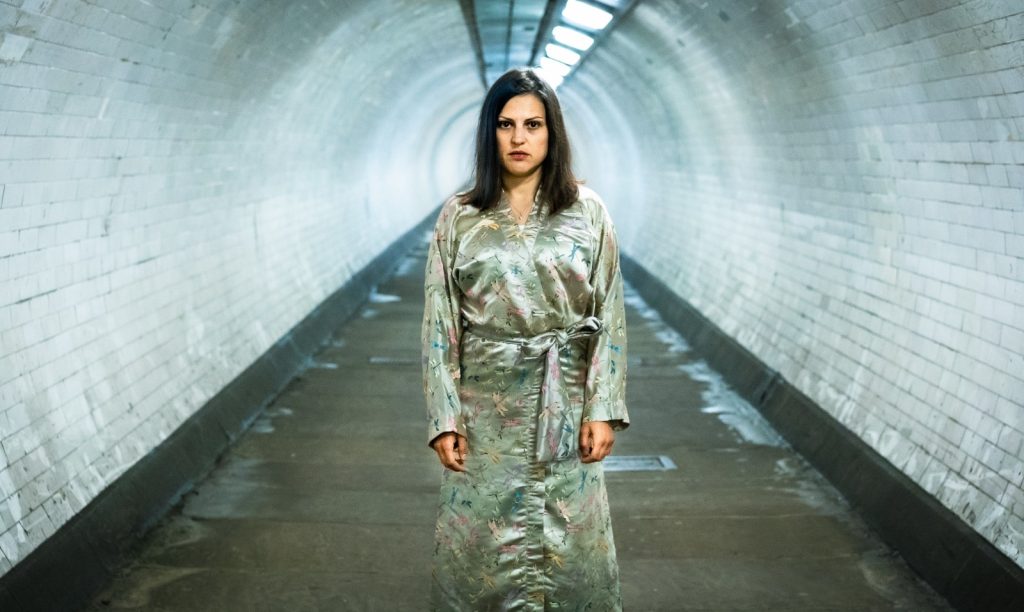
KAT KIKTA’s “Dreamer” unfolds like a whispered conversation between consciousness and memory. Built around a strong narrative, the song follows a dreamer troubled by a persistent presence, awakening to confront unresolved emotions and the ghostly weight of unfinished goodbyes. Rather than presenting heartbreak in dramatic fashion, Kat approaches separation with softness, introspection, and haunting beauty. The single stands as one of her most refined artistic offerings to date, giving audiences a tantalising glimpse into the evolving soundscape of Moldavite while solidifying her place as a fearless experimental voice within contemporary avant-pop.
Having this brief Introduction, I’m sure new and current fans must be excited about our Interview today.
INTERVIEW
Faithfulness: From your roots in Slovakia to arriving in London as a teenager with just £40, how has bridging these two completely different worlds shaped the multi-dimensional artist you are today?
Kat Kikta: My background is defined by massive contrasts. Growing up in Poprad, right under the majestic High Tatras mountains in Slovakia, gave me a deep reverence for silence, vast open spaces, and nature’s raw, spiritual presence. But landing in London as a teenager with literally £40 in my pocket was a trial by fire. I had to quickly learn to navigate a beautifully chaotic collision of concrete, survival, and underground subcultures. My artistry lives right in the middle of those two worlds—it’s the stillness of the mountains meeting the grit and rhythm of the London streets. It taught me that art doesn’t have boundaries; it’s about capturing the friction between where you come from and where you are going.
Faithfulness: Your work spans music, film, and sound art. At what point did you realize you didn’t want to be confined to just one creative discipline?
Kat Kikta: It really goes back to how I grew up and how I was trained. My BA in Performing Arts was a massive turning point—it taught me to be fiercely adaptable, curious, and explorational. It showed me that creativity doesn’t have boundaries. When I later decided to go back to university to study Creative Musicianship, I didn’t approach music from a rigid, traditional perspective; I came to it with a ‘performer’s mindset’ – I have worked on films and devised physical theatre performances and have done sound for some of them – so I think I perceive music differently. My Slovakian upbringing and my journey across disciplines taught me that I don’t have to be one thing living in one dimension. However, wanting to explore various art forms isn’t a conscious choice to step out of my lane— it’s just the realization that I need a full, multi-dimensional toolkit to properly translate the worlds inside my head.
Faithfulness: Many of your sounds are drawn from healing instruments and field recordings. What first drew you toward that spiritual and organic sonic world?
Kat Kikta: It actually started as a direct reaction to my background in performing arts. For a long time, I was singing musical theatre, but I eventually hit a wall where I felt a disconnect. Those songs are beautiful, but they come with very rigid expectations—there is a specific, established way they are “supposed” to be sung. After a while, repeating and covering music that had already been interpreted so many times started to feel less like authentic expression and more like a performance of a performance. I was craving something with a raw, unfiltered soul and presence.
To find that, I took a complete pivot and enrolled in a Sonic Arts course with Paul Chivers—who, beautifully enough, remains my sound engineer to this day.
That course completely blew my world open. Paul encouraged me to stop just listening to music and start listening to the world. It expanded my awareness of the environments around me, opening my ears and my heart to everyday textures. Paul reminded me that the seed was already inside me. I showed up to Paul’s classes with my own field recordings that I had collected purely out of instinct; something in my nature had always compelled me to tune into the hidden frequencies of my everyday world. Paul’s incredible role wasn’t to teach me how to hear, but to act as a mirror for my intuition. He highlighted the wonderful, unique aspects of the sounds I brought him, celebrated them, and fundamentally reinforced my belief in my own ears.
That validation completely expanded my awareness. Moving toward field recordings and healing instruments wasn’t just a stylistic choice; it was the moment I finally fell in love with making my own music, because I was capturing a truth that couldn’t be rehearsed or regurgitated.
Faithfulness: You’ve described yourself as an experimental performer with a strong visual identity. How do you personally define your artistic identity in one sentence?
Kat Kikta: I am a sonic painter and a world-builder capturing the spaces between reality, dreams, otherworldly visions and cinema.
Faithfulness: Before “Dreamer,” your work has already built a very cinematic and ambient signature. What do you feel has stayed constant in your artistry as everything around it has evolved?
Kat Kikta: My obsession with atmosphere, balanced with a fierce determination to remain human, authentic, and vulnerable. Genres, software, and production tools will always shift and evolve, but my desire to map the raw human journeys we experience on this planet remains absolute. For me, tech is just a vehicle; the passenger is always emotion. I still want my music to feel like a living, physical space you can walk into, step around in, and get temporarily lost inside.
Faithfulness: “Dreamer” feels like a journey through the subconscious. What emotional or mental space were you in when this track first began forming?
Kat Kikta: I was in that heavy, twilight state where you’re fighting to move forward, but the past keeps finding its way back to you in your sleep. One night, I woke up in the absolute stillness of the early hours and wrote the lyrics directly in response to a dream I’d just had. The song became an internal, almost tangible conversation with someone I had walked away from.
By that point, I knew with complete clarity that I had made the right decision by choosing myself, but it was still a deeply painful path to walk, and closure takes time. Writing “Dreamer” was my way of processing that grief and finalizing the resolution. The track was born out of a raw need to finally look those subconscious ghosts in the eye so I could truly move forward.
Faithfulness: The song blends lo-fi pop with a subtle hip-hop pulse. How did you approach balancing structure with atmosphere in the production?
Kat Kikta: The hip-hop pulse acts like a heartbeat—it’s the grounding force that keeps the track from completely drifting away into the ether. I wanted the lo-fi pop structure to give the listener a familiar hand to hold, while the ambient layers and field recordings swirl around them, creating that disorienting, dream-like weightlessness.
Faithfulness: The narrative feels like an encounter with a persistent, almost ghost-like presence. How did that concept shape the writing process?
Kat Kikta: It completely stripped away any pressure of traditional songwriting and turned the process into pure transcription. I wasn’t sitting down to engineer a standard verse-chorus pop track; I was simply documenting an ongoing conversation in my mind. It didn’t feel like I was composing a piece of music—it felt like I was exhaling my own story, word for word, exactly as it was happening inside me.
Faithfulness: There’s a strong theme of farewell, separation, and closure in “Dreamer.” Was there a personal moment that influenced that emotional direction?
Kat Kikta: Absolutely. It stemmed from a profound period of shedding old skins—leaving behind relationships, spaces, and older versions of myself that no longer aligned with the person I was becoming. Real closure is rarely neat, polite, or wrapped in a perfect bow; it’s heavy, messy, and complicated. “Dreamer” was the exact sonic space where I allowed myself to let go of the things I couldn’t fix.
Faithfulness: You’ve mentioned the idea of “unclosed loops” haunting the subconscious. How did you translate that abstract idea into sound and vocal layering?
Kat Kikta: Sonically, an unclosed loop is a sound that echoes but never quite resolves. To translate that weight into the production, I relied heavily on cyclical vocal layering. I built harmonies that constantly overlap, used delay lines that catch the tail end of a phrase and feed it back into the mix, and wove in ambient textures that repeat subtly in the background. It creates an auditory illusion where the listener is caught in a beautiful haze—never quite sure where a thought begins or where a memory ends.
Faithfulness: Your use of space and texture in music often feels very visual. If “Dreamer” were a physical place or scene, what would it look like?
Kat Kikta: “Dreamer” was intensely visual for me from the very start. The imagery was so vivid that we actually traveled to the exact locations I saw in my mind to bring them to life. Instead of just describing the setting, I wanted to physically capture it. If you want to step directly into that world and see exactly what it looks like, you can watch the official music video right here: youtu.be/T_ZpASA…AInHY.
Faithfulness: This release also serves as the final single before your debut album “Moldavite.” How does “Dreamer” act as a bridge into that next chapter?
Kat Kikta: Moldavite is a project deeply rooted in transformation, impact, and intense spiritual alchemy. It’s my debut album, and it holds my entire evolution—I essentially learned my craft while writing, recording, and producing these songs. “Dreamer” acts as the bridge because it captures the exact moment of letting go. It’s the final, heavy sigh before you step completely through the portal. Interestingly, it also marks a sonic shift: while “Dreamer” leans into that heavy, ambient haze, the rest of the album moves into a lighter, happier, and more upbeat space, blending my experimental roots with a more defined pop sensibility.
Faithfulness: The upcoming music video adds another layer to the story. How important is visual storytelling to fully understanding “Dreamer”?
Kat Kikta: To me, the audio and the visual are completely inseparable. The music gives the story its soul, but the visual elements give it a physical body. While you can absolutely feel the emotion of the song on its own, the music video grounds those abstract, subconscious loops into a tangible, striking reality. It completes the story and brings the entire vision full circle.
Faithfulness: When listeners finish “Dreamer,” what feeling or thought do you hope stays with them the longest?
Kat Kikta: A sense of exhale, followed closely by a wave of empowerment. I hope they feel a gentle, cathartic release—like they’ve just woken up from a heavy dream, looked at their own lives and lingering ghosts, and realized they finally have permission to let them go. I want them to realize they have the power to follow their own inner guidance and walk away from whatever no longer serves them.
Faithfulness: As you move toward the release of your debut album “Moldavite,” what truth about yourself as an artist feels the most clear right now?
Kat Kikta: That I can no longer compromise on my intuition, and that I am capable of far more than I ever gave myself credit for. Creating this album taught me to fully trust my own multi-dimensional blueprint. I don’t need to fit into a neat, predictable box; my truth lies entirely in the spaces between mediums.
A few years ago, writing, recording, producing, and independently releasing an entire album—while simultaneously creative directing the music videos—felt like an impossible peak to climb. Yet, I’ve done it. I did it independently, with NO funding, purely through relentless hard work, learning from my brilliant mentors, and collaborating with my filmmaker friend Tom Cheshire, who has an incredible gift for bringing my exact visual thoughts to the screen. This journey has taught me that the power is entirely in my hands, even when the world tries to make it seem otherwise. If I decide to build a world, I can do it.
CHECK OUT THE RELEASE OF ‘Dreamer’
HAVING LISTENED TO ‘Dreamer’, HERE ARE MY HONEST THOUGHTS
“Dreamer” finds Kat Kikta crafting an atmosphere that feels suspended between memory and emotional release. Built around lo fi pop textures and soft hip hop rhythms, the track unfolds with remarkable restraint, allowing its ambient production and minimalist instrumentation to shape the emotional core. Every detail feels intentional, from the blurred sonic layers to the subtle pulse moving beneath the arrangement. Kikta’s vocal performance is delicate and deeply immersive, carrying a conversational intimacy that strengthens the song’s reflective tone without becoming overly dramatic. The production expands gradually throughout, evolving from sparse and weightless into something fuller while preserving its dreamlike calm. What makes “Dreamer” especially compelling is its cinematic sense of space, revealing Kikta’s ability to transform vulnerability into an atmospheric and emotionally absorbing listening experience ahead of Moldavite.
~ Faithfulness (Dulaxi Team)
Finally to our audience, I urge to listen to “Dreamer“, add it to your playlist and be Inspired by it and on behalf of Dulaxi I like to appreciate you all by saying thank you everyone, See you on our next interview.
For more information about Kat Kikta, click on the icons below.