
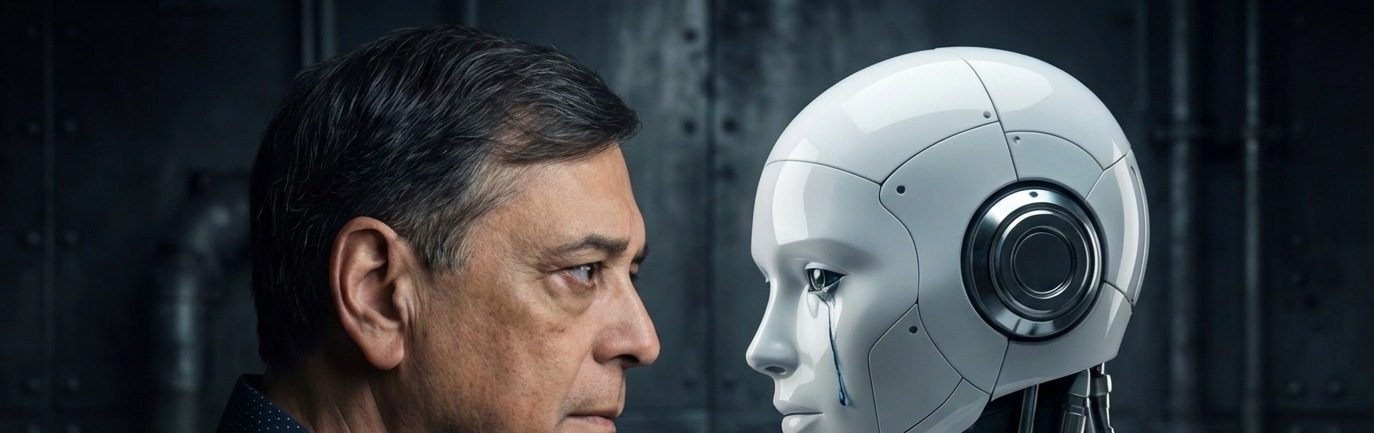
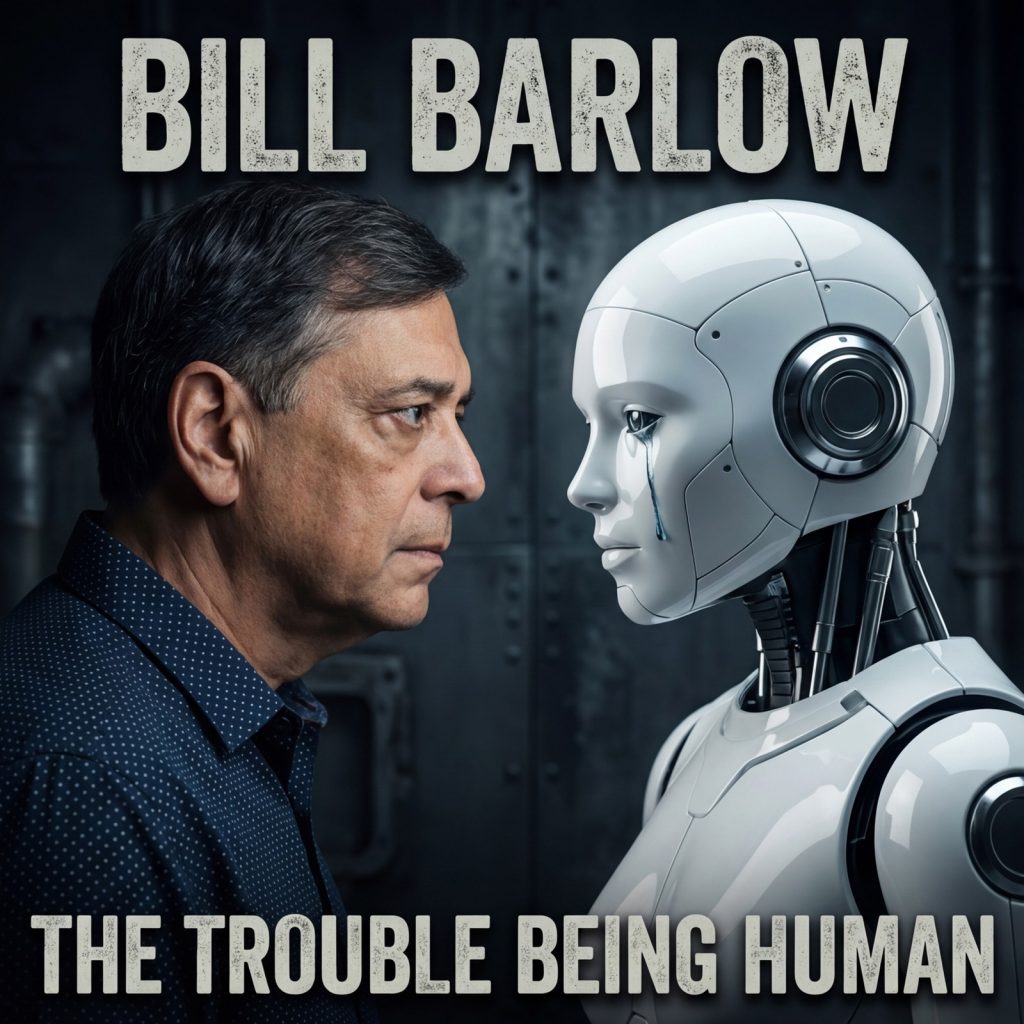
Hello everyone it’s your host Daniel from Dulaxi, and today I have with me the talented Bill Barlow from Tampa, United States. And Bill Barlow is here to discuss his recent thought provoking album “The Trouble Being Human” which was released on April 17th, 2026. So, welcome, Bill Barlow!. But before we begin our interview, to our audience; here is what you need to know about this artist.
Bill Barlow is a Tampa-based digital composer, observational songwriter, and genre-fluid artist whose emotionally authentic approach to music has continued to distinguish him as one of the most thought provoking independent musicians emerging from the United States. Known for transforming everyday experiences, emotional struggles, and existential reflections into compelling musical narratives, Barlow blends Pop, R&B, Rock, Folk, and Blues into a sound that feels both intimate and expansive, balancing passion, vulnerability, sharp lyrical clarity, and subtle sarcasm with remarkable precision. Following the critical acclaim of his genre-bending project “Out of Obscurity,” Barlow returns with his boldest and most fearless statement yet through his 18 track album “The Trouble Being Human,” released on April 17th, 2026. Anchored by its emotionally charged title track, the album explores the deeply personal realities of living in an age where technology evolves faster than the human heart, confronting themes of identity, authenticity, creativity, emotional survival, and the growing fear of being replaced in a world where machines can imitate voices, choices, and even art itself. Through rich production, warm analog textures, and melodies that linger long after the music fades, Barlow crafts a listening experience that provokes thought while remaining emotionally resonant and deeply human. Standout tracks such as “Dream Girl,” “Chillin’ in Zanzibar,” “Social Butterfly,” and “Don’t Stop” further showcase his ability to move effortlessly between warmth, reflection, confrontation, and escapism, while still maintaining a cohesive emotional flow throughout the album. With “The Trouble Being Human,” Bill Barlow does more than release music; he delivers a mirror to modern society, reminding listeners that flaws, friction, vulnerability, and authentic human emotion remain the most powerful qualities we possess in an increasingly artificial world.
Having this brief Introduction about Bill Barlow, I’m sure new and current fans must be excited about our Interview today.
INTERVIEW SESSION
Daniel: Bill, your music has always carried a strong observational and emotional depth, but with “The Trouble Being Human”, it feels like you’re confronting the modern world more directly than ever before. What inspired you to build an entire 18-track project around identity, authenticity, and the emotional tension between humanity and technology?
Bill Barlow: Daniel, as artificial Intelligence becomes our norm and the go to for even mundane tasks, often without checking the facts, I wanted to pause and reflect. The position most people take without thinking is that if AI produces something, it must be better. This can’t be further from the truth. AI will give you incorrect information in attempts to please you. And that’s not what it’s for. When you translate that to art and music, the inaccurate, imperfect and even mispronounced parts of being human are what makes a track something more relatable. Why is a live show so much better, not because it’s perfect, but because you can connect with the performers when they are not perfect.
Daniel: Coming from Tampa and carving your own path as an independent artist and digital composer, how has your personal journey shaped the fearless and genre-fluid sound listeners hear throughout this album?
Bill Barlow: Tampa Bay, where I live is a bit of a cultural melting pot. There are a lot of influences here that impact my taste in music. Caribbean, country, R&B, folk, Latin, rap and blues. So, I imagine those influences became part of who I am as an artist and digital composer,
Daniel: Your work blends Pop, R&B, Rock, Folk, and Blues so naturally, yet your lyrical voice remains unmistakably yours. How important is it for you to maintain that human fingerprint in your music during a time where artificial creativity is becoming more common?
Bill Barlow: A major record label has already signed the first AI artist. It won’t be long before the record labels don’t even bother much with live artists. They’ll simply hire kids to use AI to write lyrics, create personas and build music that satisfies the algorithm. Being human at that time will matter more than you think. Like I said earlier, the human connection is a better experience than what a sterilized AI track delivers. Keeping that realism is important to not being heard but being felt. I care a lot about that.
Daniel: The title track, The Trouble Being Human, feels deeply reflective and emotionally urgent at the same time. What was the exact moment or realization that sparked the creation of this song?
Bill Barlow: I worked for years in advertising. I have watched writing, video production and strategy functions replace the people who used to be the best. I’ve watched the human value for these services plumet because AI can do it better and faster. As that began to creep into music, I took time to reflect. That was the moment that I wrote The Trouble Being Human. What happens next is not really up to us anymore.

Daniel: One of the most powerful ideas surrounding the track is the fear of being replaced while still fighting to remain “unmistakably human.” How personal was that message for you as an artist creating music in today’s AI-driven landscape?
Bill Barlow: I have the same AI tools that everyone else has. But there is a pride of authorship welded in me that won’t let AI write my songs. I won’t put my name on it if it didn’t come out of my brain. I hear friends justifying the partial use of AI. Statement like, “Well I wrote it, but then I ran it through the AI to clean it up.” Nope, that doesn’t work for me. My thoughts, my words, my melodies. I wrote a few years ago called Abuse the Muse. In that I wrestle with the idea of using stimulants to get your brain working. One line in it says, “Then again if I can’t write when I’m myself can I write at all? Should I sign my name to the work or should I write down “alcohol?” That pretty much sums up my feeling on this subject.
Daniel: The album repeatedly reminds listeners that flaws, vulnerability, and emotional friction are still valuable. Why do you think imperfection has become such an important theme in your songwriting?
Bill Barlow: It’s all about the connection. My “lane” is emotional conveyance. You can’t convey emotion if you remove all of the human aspects. It has to be raw, vulnerable, honest and even slightly flawed. Just like all of us.
Daniel: Tracks like Today Moves Faster and Outside Looking In suggest feelings of isolation, pressure, and emotional disconnection. Were there particular life experiences or observations that shaped the emotional tone behind these songs?
Bill Barlow: Today Moves Faster pokes fun at an ever-increasing world with outrageous expectations. Everyone likes to brag a bit about the trend they are on or following. This was meant as a satire of any of us that does that, starting with me. Outside Looking In is a reflective piece that came from a time when I realized that everything that I was accustomed to has changed. Every now ang again you have to stop, take stock and try to look at your life as others might. It’s amazing what you can discover if you take the time for this kind of reflection.
Daniel: Songs such as Dream Girl, Social Butterfly, and Chillin’ in Zanzibar bring lighter and more familiar moments into the album’s heavier existential themes. How intentional was that balance between emotional intensity and escapism across the project?
Bill Barlow: In every album I try to take the listener on an emotional journey. I carry them through a series of highs and lows, much like real life. Dream Girl and Chillin’ in Zanzibar are complete peaks in that journey. Who doesn’t want that special someone that they want to brag about and then it’s off to an exotic
place like Zanzibar. It’s not a bad fantasy. Social Butterfly while it is lighter explores those people we meet online who love to stir the pot in any situation, even if they agree with you, they’d rather have the engagement.
Daniel: The production on The Trouble Being Human has been described as rich, warm, and analog-driven while still embracing modern textures. What was your approach to building a soundscape that feels both intimate and expansive?
Bill Barlow: While The Trouble Being Human, had to feel modern, it still had to have some air for reflection. I also incorporated some “thick vocals” in the chorus, doubling my voice a few times to give the line a feeling that many people are feeling the same thing. There is more thought into the production layers than you may expect. I think through each line and section trying to capture certain emotional ques. The saxophone brings in a slight jazz element that hopefully makes it a bit more timeless. But the sax ties it all together.
Daniel: With 18 tracks spanning multiple genres and emotional states, how did you structure the album to feel like a cohesive listening journey rather than just a collection of songs?
Bill Barlow: Great question. I spend tons of time playing tracks, moving the order around, even eliminating some songs, so that they all flow in a certain way. Each song can be an island, but the collection has to be its own unique experience. I have a journey in mind and that is where I take you.
Daniel: The final track, Truth In a Bottle (Live Studio Session), closes the album in a very raw and organic way. Why was it important for you to end the project with a live studio recording?
Bill Barlow: The album starts with Time Stands Still, a reflective song that feels raw and deeply human. The natural way to end this journey is where it began. Truth is a Bottle is a very raw human track, but the song itself is a reflective song that is vulnerable and emotionally raw. But after making the statement in Trouble Being Human about the importance of being an imperfect human, nothing demonstrates that better than Truth is a Bottle. It seemed like the natural end of this journey.
Daniel: Following the acclaim of Out of Obscurity, did you feel any pressure while creating this new album, especially knowing listeners were expecting another emotionally impactful body of work?
Bill Barlow: I do. It is certainly a concern of mine to be better and grow with each new release. I seem to have a good supply of emotional content currently, so that works for putting out new material. I do focus on making each project better than the last.
Daniel: You mentioned that independent artists often struggle to be seen in a world flooded with synthetic content. How have those challenges affected your confidence, motivation, or even your definition of success over the years?
Bill Barlow: I suppose it has. It has challenged my motivation at times. But then something crazy happens and I am recharged again. I was staring at the screen one afternoon, not necessarily feeling motivated. I got a text message from a guy I know. He says, “I’m flying back from London now. I am listening to your track, Gonna Fly. Man’s that a great song.”
Who isn’t motivated after a message like that!
Daniel: Your songwriting often transforms everyday experiences into powerful narratives. How do you personally know when an ordinary moment is meaningful enough to become a song?
Bill Barlow: I don’t always know. I write a lot of stuff that will never be seen. It gets filed in the “That was a good idea at the time” pile. But I do try a lot of stuff that sounds “iffy”. You never know which ones are worth doing until you spend a little time roughing one out.
Daniel: Looking back at your earlier work compared to The Trouble Being Human, where do you think you’ve grown the most, as a songwriter, performer, or even as a person?
Bill Barlow: I feel like I was born with the gift to write. I spent long periods ignoring or even taking that for granted. That was a mistake. While I do feel like I’ve grown as a writer, it just feels very natural for me. I have grown the most as a performer and a person. Still learning in both. I have to borrow the line, “I may not be where I want to be but thank God, I’m not where I used to be.”
Daniel: Many listeners connect with your music because of its honesty and emotional realism. Has there ever been a song on this album that was especially difficult or vulnerable for you to write?
Bill Barlow: Absolutely. My mother passed away recently. I wrote a few songs as that time was approaching and then afterward that were hard. I have a couple that are still hard for me. I can’t get through them in one pass. On this album, What’s A Man To Do, is a good example. It was written quite a while ago. I was sitting alone feeling a little sorry for myself and projecting into the future. I was imagining what could happen if a sad situation played out. Thankfully, things didn’t go like I expected and all went well. But it is a snapshot in time when I was especially wounded, vulnerable and emotionally raw.
Daniel: Since the album’s release, what kind of reactions or conversations from listeners have impacted you the most emotionally?
Bill Barlow: I’ve had a lot of chats about AI as one would expect. But that is mostly the media. Fans chuckle at The Trouble Being Human and then move on to tell me about other tracks. Dream Girl and Chillin’ in Zanzibar get the most conversation and questions. But I have gotten some smirky faced smiles when people ask me about Call Me at Night. “Did that really happen?”, being the most asked question. Yes. Yes it did, and no I am not saying who it was. But my favorite thing that impacts me emotionally is when someone quotes back a line and wants to know what I was really saying there. That is when I feel that I am supposed to be doing what I do and the way I’m doing it.
Daniel: With songs that touch on authenticity, emotional overload, and the pace of modern life, what do you hope listeners ultimately take away from “The Trouble Being Human” after hearing it from start to finish?
Bill Barlow: As I mentioned earlier the track set is an emotional journey but not everyone will connect with the whole ride. I just hope that everyone finds one track where they want to camp out and identify with it.
Daniel: After delivering such a bold and thought-provoking project, where do you see your artistry evolving next, both musically and personally?
Bill Barlow: I am usually working on my next project about the time the previous one comes out. The next album will most likely be called Somewhere In Between, featuring a set of songs about people not where they way to be and thinking about where that is. The tracks are full of my signature reflection and sarcasm balance.
Daniel: Beyond The Trouble Being Human, what future plans, collaborations, or creative ideas are you most excited for fans to experience in the coming months?
Bill Barlow: I am working on a few collaborations that I think are interesting. One is where my songs can be played for people in emotional hardships. The songs help them to relate, recover or reflect. If I can help people feel better through my work, It will be an excellent day.
Having Had A Close Listen To This Deeply Introspective And Emotionally Charged Album, Here’s My Thought.
Listening to Bill Barlow’s “The Trouble Being Human” felt, to me, like stepping into a mirror that reflects both personal uncertainty and the wider anxiety of modern existence. Across its 18-track structure, the album unfolds as a continuous emotional and philosophical journey, grappling with identity, emotional survival, love, exhaustion, and the uneasy tension between humanity and rapidly advancing technology. What stands out immediately is how fully realized the sound feels; the blend of Pop, R&B, Rock, Folk, and Blues is not treated as separate influences but as a single evolving language that gives the album both intimacy and scale. The production carries a warm, analog character that makes each track feel lived-in, while still maintaining a cinematic expansiveness that keeps the listening experience immersive from start to finish. Vocally, Bill Barlow delivers with striking sincerity throughout, and what makes it compelling is not perfection but emotional truth, his voice consistently carries vulnerability, frustration, reflection, and resilience in a way that feels deeply human rather than constructed. The title track, “The Trouble Being Human,” anchors the entire project thematically, confronting the fear of being replaced by machines that can imitate creativity while simultaneously insisting on the irreducible value of human emotion and imperfection. That tension runs through the entire album, not as a concept forced onto songs, but as a lived emotional reality. Moments of openness, escapism, and defiance are woven throughout the record, reinforcing its emotional range and balance between heaviness and release. What ultimately makes “The Trouble Being Human” so impactful is its refusal to settle into cynicism; instead, it transforms modern fear into reflection, and reflection into a quiet form of resilience. It feels less like an album that observes life from a distance and more like one that breathes alongside it, reminding me that even in an increasingly automated world, emotional honesty remains the most enduring form of connection.
~ Daniel (Dulaxi Team).
Finally to our audience, I urge to listen to the entire album; “The Trouble Being Human”, add its songs to your playlist and be inspired by them. On behalf of Dulaxi I like to appreciate you all by saying thank you everyone, See you on our next interview.
For more information about Bill Barlow, click on the icons below.