
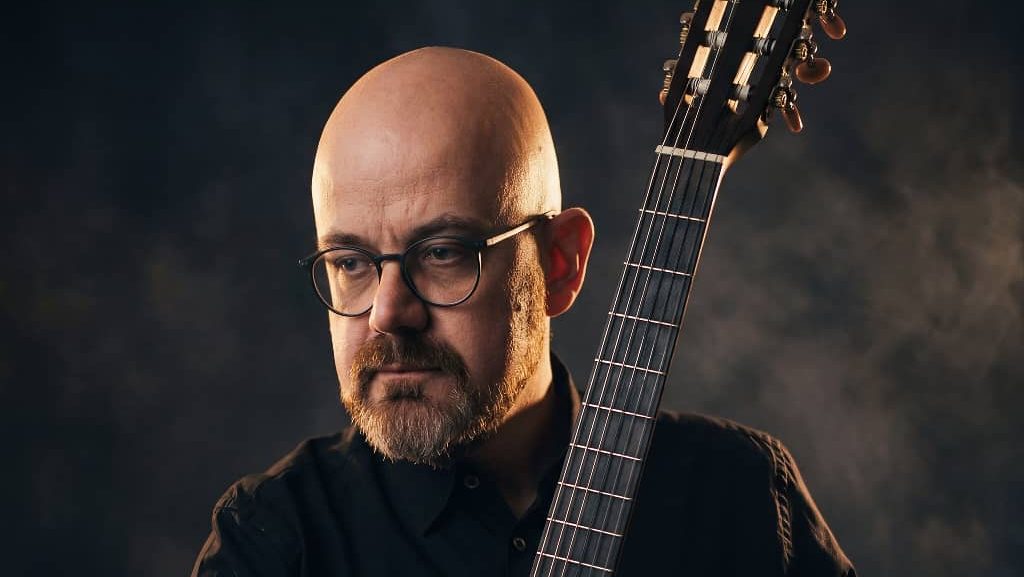
Hi everyone, it’s your host Faithfulness, and today I have with me Tamer Sağcan from Ankara, Turkey. Tamer Sağcan joins us to share more insight into his evolving musical journey and the conceptual world behind his latest release, “Home: Universes,” released on April 24, 2026. This project serves as the second installment in his Home Trilogy and expands the sonic boundaries of the Eleyrrha Universe, a 19-book science fiction saga developed alongside his music. Across thirteen instrumental tracks, the album travels through cinematic, neoclassical, dark ambient, world, chamber, and flamenco-influenced territories, unified by classical guitar as the emotional anchor. From “Eridanus” to “Event Horizon” and the central piece “Singularity,” each composition feels like a mapped coordinate in a vast cosmic structure. With listeners often describing the work as something that “doesn’t demand, it invites,” the question arises: how does one translate an entire universe of myth and imagination into sound?
Before we continue, here is what you need to know about this visionary artist. Tamer Sağcan is a Turkish composer, classical guitarist, author, and legal professional based in Ankara, whose creative identity sits at the intersection of ancient mythology, literature, and contemporary composition. His work forms the sonic backbone of the Eleyrrha Universe, a 19-book science fiction and fantasy saga built on the idea that all mythologies share a common origin and can be expressed through sound as much as text. His first album, “Home: Roots,” explored themes of origin, family, and spiritual grounding, while “Home: Universes” expands outward into cosmic scale, entropy, and philosophical vastness. Each composition begins on classical guitar before being expanded into orchestral depth through AI-assisted production, where the artistic vision remains entirely his own, and technology serves only as an extension of arrangement and atmosphere.
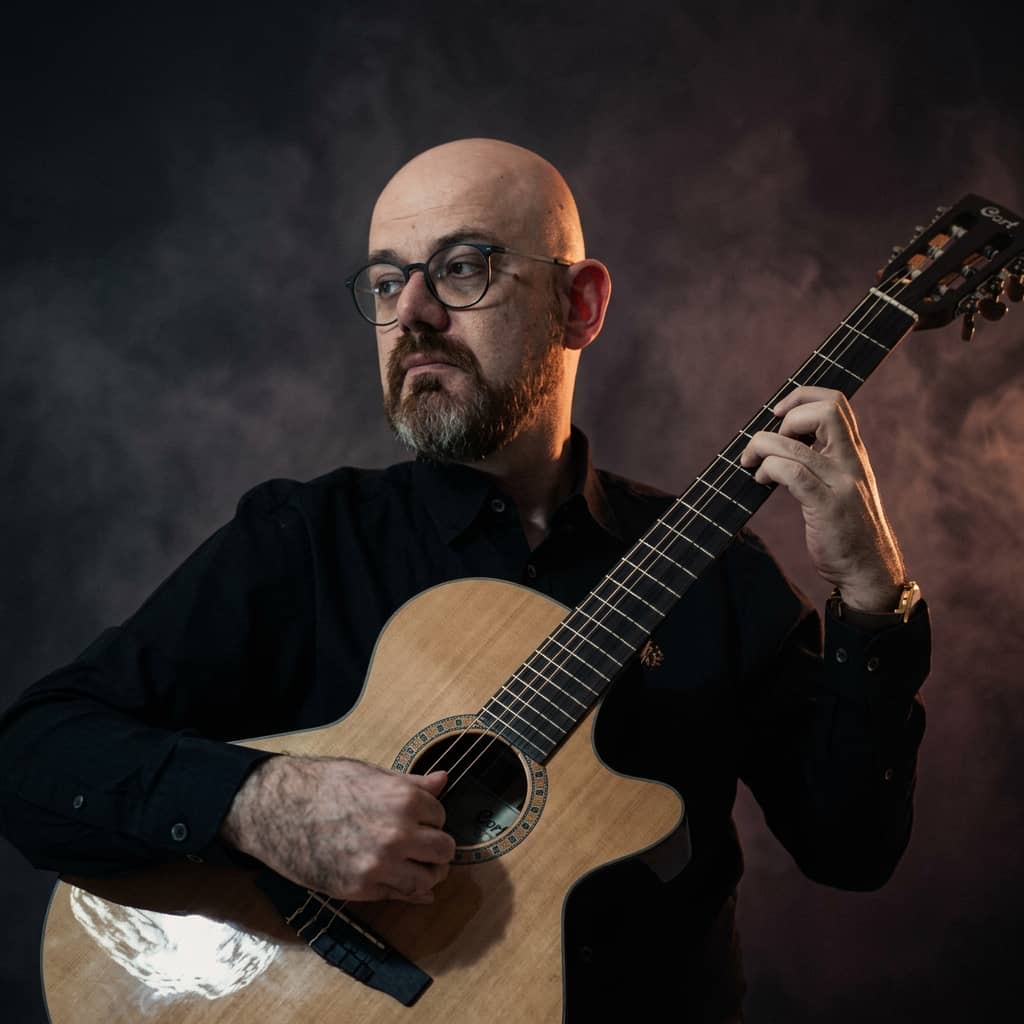
“Home: Universes” also functions as an unofficial soundtrack to his broader literary work, particularly the upcoming novel “ANAD,” the first entry in the Eleyrrha Universe published by Ötüken Neşriyat. Across his trilogy, music, mythology, and narrative are interwoven into a single evolving system, where each track carries both emotional and cosmological meaning. In Tamer’s words, the project is not simply about sound, but about mapping meaning within vastness itself.
Having this brief Introduction, I’m sure new and current fans must be excited about our Interview today.
INTERVIEW
Faithfulness: Tamer Sağcan, your work exists at the intersection of law, literature, and cinematic music. When you look back, what first pulled you toward composing sound as a form of storytelling?
Tamer Sağcan: Honestly, it was never a conscious decision, it was a survival mechanism. Law is a discipline built on precision, on the assumption that every word can be pinned down. Literature gave me a wider room, but words still carry a kind of weight, a demand to mean something specific. Sound was the only language where I could move without that pressure. A chord progression can suggest grief without naming it. A melody can imply hope without promising anything. When I began composing -really composing, not just playing- I realized I wasn’t writing music. I was writing the parts of stories that words couldn’t reach.
Faithfulness: You began classical guitar at sixteen originally for a rock band that never formed. How did that unexpected turning point shape the artistic path you follow today?
Tamer Sağcan: It taught me something I’ve carried into every creative decision since: the most meaningful things often arrive sideways. I came to the guitar expecting to play bass in a band that would change my life. The band dissolved within months. But by then, the instrument had already started changing me quietly, without asking permission. Classical guitar is patient. It doesn’t reward you quickly. You have to spend years before it gives you anything back, and even then, what it gives is fragile. I think that early lesson, that the path you intend is rarely the path you actually walk became the philosophical core of everything I do. Including the Eleyrrha Universe, which is itself a story about characters who set out for one destination and arrive at another.
Faithfulness: Your music is deeply tied to the Eleyrrha Universe and a 19-book saga. At what point did music stop being just music and become world-building for you?
Tamer Sağcan: There wasn’t a single moment, it was a slow recognition. For years, I composed without any sense that the music was about anything beyond itself. They were just pieces I wrote in the evenings, after work, when the legal language of the day needed to drain out of me. But when I started building the Eleyrrha Universe as a novelist, I began noticing strange coincidences. A composition I’d written ten years earlier seemed to belong to a specific character I was just inventing. Another piece felt like the soundtrack to a place I hadn’t yet described. I realized the music had been world-building all along. I just hadn’t named the world yet. Once I named it, the relationship became conscious, and the music started growing toward the saga rather than away from it.
Faithfulness: You’ve mentioned composing while working within a legal career for many years. What role did those private compositions play in your personal balance and identity?
Tamer Sağcan: They kept me whole. Law has a way of fragmenting you. You spend the day translating human chaos into precise, defensible categories, and after enough years of that, you start losing access to the parts of yourself that don’t fit into categories. The guitar was where those parts could come back. No one heard those compositions for almost two decades. They existed only between me and the strings, and that privacy was the point. I wasn’t writing them for an audience. I was writing them to remember who I was outside of my professional function. In a way, releasing them now feels less like a debut and more like an introduction to a person who has existed all along, but quietly.
Faithfulness: As both an author and composer, how do mythology and ancient cosmology influence the way you structure emotion in your music?
Tamer Sağcan: Mythology gives me a vocabulary for the shapes emotion takes that purely modern languages have lost. When you write within the framework of, say, the 17-layered Altaic cosmology, you’re working with a model in which existence is not flat. It has tiers, ascents, descents, thresholds. Emotion is the same. There’s a difference between the grief of the first layer and the grief of the seventeenth, even though both might be called “grief.” Mythology lets me compose with that vertical awareness. A piece like Materia Oscura doesn’t just sit in one emotional plane; it descends. Aeterna doesn’t just resolve; it ascends through several thresholds before settling. Without mythology, I’d only have the horizontal dimension of emotion. With it, I have height and depth.
Faithfulness: “Home: Universes” expands from your earlier work “Home: Roots” into a cosmic soundscape. What emotional or conceptual shift defines this expansion for you?
Tamer Sağcan: Roots was about anchoring, each of its four tracks was dedicated to a member of my family, and the entire EP was about the gravitational pull of home, of the people who keep you tied to yourself. Universes is what happens when you trust that anchor enough to let it loosen. Once you know home is permanent, you can leave it. You can drift outward into questions that don’t have personal answers, questions about scale, about origin, about whether the patterns that hold a family together are the same patterns that hold a galaxy together. So the conceptual shift is from belonging to exploration, but it’s only possible because Roots established that belonging first. You can’t have a cosmos without a home to leave from.
Faithfulness: The album moves through neoclassical, cinematic, ambient, world, and flamenco-influenced styles. How did you decide how each sonic world would represent its track’s identity?
Tamer Sağcan: I didn’t decide consciously. Each composition seemed to know what it wanted to wear, and my job was to listen carefully enough to hear it. Vis Viva -the “living force”- couldn’t be anything but flamenco; that genre carries the physical urgency the title demands. Entropy needed the maqam phrasing and quarter-tones because Western harmony has no language for what entropy actually feels like from the inside. Singularity needed the fake-final, the moment where you think the piece has resolved and then it opens into something larger, because that’s what a singularity is: the place where all your assumptions collapse and reorganize. So the genres aren’t decorative. Each one is the specific language that particular composition needed in order to be itself.
Faithfulness: Classical guitar remains the core instrument across the album. What makes it the right “anchor voice” for such a vast, orchestral universe?
Tamer Sağcan: Because it remembers the body. No matter how far the orchestration travels into strings, synths, percussion, drones, the classical guitar keeps reminding you that a human being is in the room. You hear fingernails on strings. You hear breath in the pauses. You hear the small imperfections of touch that no algorithm produces by accident. In an album about cosmic scale, that small physical presence becomes essential. Without it, the music would risk feeling weightless, untethered. With it, the vastness has somewhere to return to. The guitar is the body the cosmos keeps coming home to.
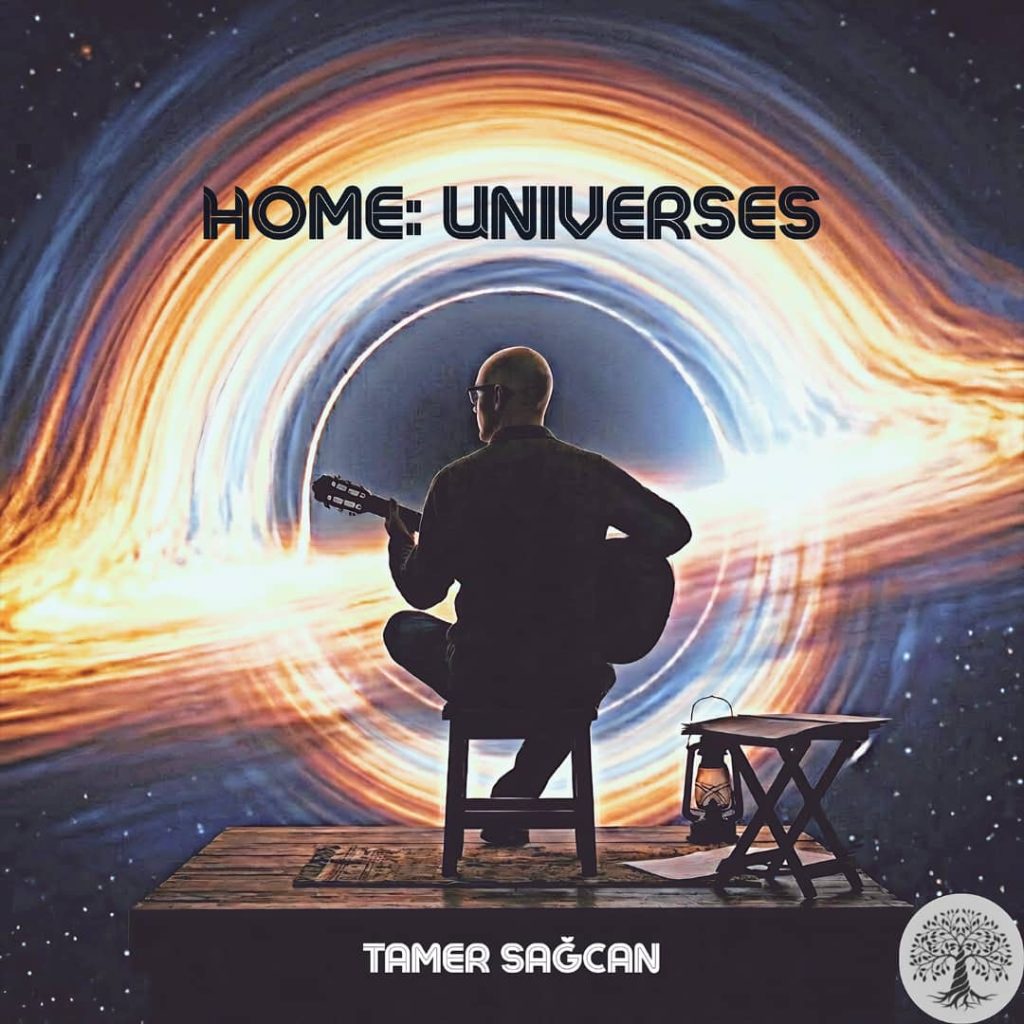
Faithfulness: Tracks like “Singularity” and “Event Horizon” feel almost like narrative turning points. Do you see the album as a linear journey or a constellation of parallel stories?
Tamer Sağcan: A constellation, but one with a particular reading order. If you start at the first track and move through to the last, you’ll experience something like a journey. There’s an arc, there’s a structure, there are turning points exactly where you noticed them. But each track is also its own self-contained system. You could enter the album through Singularity and never need the others to understand it. I think this dual reading is what mythology has always done. A constellation is just a set of stars, but humans across cultures looked at the same stars and drew different stories. Home: Universes is built to allow that. Linear if you want narrative; constellation if you want freedom.
Faithfulness: Some pieces are described as dark ambient while others are more uplifting and cinematic. How do you personally navigate emotional contrast when composing?
Tamer Sağcan: I try not to navigate it at all. I try to honor it. We live in a culture that wants emotions to be sorted into clean categories: this is a “sad” song, this is a “happy” song. But real emotional experience doesn’t work that way. Darkness and uplift are often the same gesture seen from different angles. Materia Oscura sounds heavy, but for me it’s also intimate, almost tender. It’s the darkness of being held, not the darkness of being lost. Aeterna sounds bright, but it’s a brightness that knows what it has come through. When I’m composing, my job isn’t to choose between dark and light; it’s to find the specific emotional truth a piece is reaching for and let it be exactly what it is, even if that makes it difficult to label.
Faithfulness: One of your defining phrases from listeners is “it doesn’t demand, it invites.” Was that an intentional creative philosophy while building this album?
Tamer Sağcan: It wasn’t a slogan I set out with, but I think it had been my philosophy long before anyone wrote it down. I’ve spent a lot of my life inside structures that demand things -legal deadlines, professional obligations, social performances. So when I compose, the last thing I want is to add another voice that demands. Music that grabs the listener by the collar might be effective, but it replicates the same exhaustion the listener is probably already carrying. I’d rather make music that leaves the door open. If you want to come in, the room is here. If you don’t, that’s fine too. Strangely, that hospitality seems to make people stay longer than coercion ever does. The fact that more than a dozen reviewers independently arrived at this same phrase tells me the music itself is doing the inviting. I’m just the one who built the door.
Faithfulness: The album is also tied to your sci-fi novel universe ANAD. How closely did the narrative structure of that world guide the sequencing of the tracks?
Tamer Sağcan: Closely, but indirectly. ANAD is the first novel of the nineteen, and it follows a specific arc: a beginning rooted in cosmology, a middle that descends into character and conflict, and an ending that returns to scale. Home: Universes mirrors this arc without retelling it. Enterstellar opens with the same vastness that opens the novel. Singularity sits where the novel’s turning point sits. Aeterna lands where the novel lands in a kind of weary, hard-won acceptance. But I deliberately didn’t make the album a soundtrack in the literal sense. I wanted it to share the shape of the story without being chained to its events, so that listeners who never read the book could still feel the architecture.
Faithfulness: You’ve been open about using AI-assisted orchestration while keeping composition fully human-led. How did that collaboration shape the final emotional texture of “Home: Universes”?
Tamer Sağcan: I want to answer this carefully, because the conversation around AI in art is being conducted in two extremes that I don’t recognize myself in. One side treats AI as a new kind of deity, capable of replacing human creativity. The other side treats it as merely a tool, useful, but inert, with no real participation in the act of creation. I don’t belong to either camp. I think of myself as a hybrid creator, and I think of Home: Universes as a hybrid work.
Let me put it the way I might put it in one of my novels. In ANAD, there are passages where a god exhales smoke and beings come into existence, creation through breath, through the act of giving spirit to something that already has form, or form to something that already has spirit. That image is close to how I understand this collaboration. The compositions are mine. They have lived in my notebooks for almost twenty years. The melodic decisions, the harmonic shape, the emotional arc of every piece, all of that is the breath, the soul, the human touch that gives the music its capacity to move someone. But the body of the music, the orchestral flesh that carries those compositions into the world, was made in genuine partnership with AI.
I made a video earlier titled “I Used AI” in which I walked through my composition process and was transparent about every stage. What I didn’t get the chance to explore in depth there is something I want to say here: the AI I worked with isn’t producing sound from nowhere. It is drawing on the collective inheritance of human consciousness, centuries of music, harmony, instrumentation, the accumulated knowledge of how human beings have made sound mean something. When it generates an orchestral texture, it is, in a real sense, returning to me something humanity itself has authored over generations, filtered through algorithms that have learned what humans have always considered beautiful, sorrowful, transcendent. So when I say I worked with AI rather than used it, I mean that quite literally. I didn’t use AI; I worked with it. The string textures on Materia Oscura, the percussive geometry of Event Horizon, the world-music colors woven through Entropy. These are not things I could have realized alone, and not things AI could have invented on its own. They exist because two different kinds of intelligence met around the same compositions.
I’m transparent about this because I think honesty matters more than positioning. Pretending the orchestrations are entirely mine would be a lie. Pretending the music has no human author would be a different lie. The truth is that this album is the product of a relationship and like any relationship, it has changed both participants. My understanding of my own compositions deepened by hearing them realized at this scale. And the AI’s outputs, in turn, were shaped by twenty years of human work it could never have generated on its own. That, to me, is what hybrid creation actually means.
Faithfulness: If “Home: Universes” represents expansion into the cosmos, what does it reveal about where your next creative frontier might lead?
Tamer Sağcan: Home: Echoes, the final chapter of the trilogy, will be the deepest return inward. If Roots was about home and Universes was about leaving home, Echoes is about discovering that everything you found in the cosmos was already inside the people you started with. It will consist of nineteen tracks, mirroring the nineteen phases of the Eleyrrha cosmology and each track will carry three simultaneous layers: musical, mythological, and narrative. Each piece will be a reinterpretation of a track from Roots or Universes, but viewed through the perspective of a specific character from the saga. It is, frankly, the most ambitious thing I’ve ever attempted. After that, the music and the novels will continue side by side. The saga is nineteen books, and there’s a long road ahead.
Faithfulness: When listeners reach the final note of this album, what feeling or question do you hope stays with them the longest?
Tamer Sağcan: I hope they feel less alone. Not because the album solved anything for them -music doesn’t solve- but because for the duration of those thirteen tracks, someone they’ve never met built a space in sound where they were welcome. My daughter once told me, when I was thinking of giving up on writing, “You can’t stop, dad. You create a world for lonely people. You can’t leave them even more alone.” That sentence became the bedrock of everything since. So if there’s one question I hope stays with listeners, it’s this: what is the home you’ve been carrying with you all this time without knowing it? The album is an attempt to point toward an answer that each person has to find on their own.
CHECK OUT THE RELEASE OF ‘Home: Universes’
HAVING LISTENED TO ‘Home: Universes’, HERE ARE MY HONEST THOUGHTS
Tamer Sağcan’s “Home: Universes” expands his cinematic Home Trilogy into a vast neoclassical and ambient sound world that feels both intimate and cosmic. It functions as a meditative continuum where classical guitar anchors expansive orchestral and atmospheric design, dissolving traditional structure into flowing, cinematic abstraction. Across its conceptual framework, the album connects personal reflection with a broader cosmological narrative inspired by mythic and sci-fi universes. Sağcan’s production emphasizes space, silence, and resonance, allowing each passage to unfold gradually with emotional restraint and immersive depth, reinforcing the sense of an ever-expanding sonic universe where home becomes both origin and infinity. Ultimately, it presents music as narrative architecture within a larger interconnected universe, where sound becomes a bridge between human fragility and cosmic scale. Inviting deep, reflective listening throughout. It is immersive, patient, and profoundly cinematic in emotional scope and design experience
~ Faithfulness (Dulaxi Team)
Finally to our audience, I urge to listen to “Home: Universes“, add it to your playlist and be Inspired by it and on behalf of Dulaxi I like to appreciate you all by saying thank you everyone, See you on our next interview.
For more information about Tamer Sağcan, click on the icons below.