
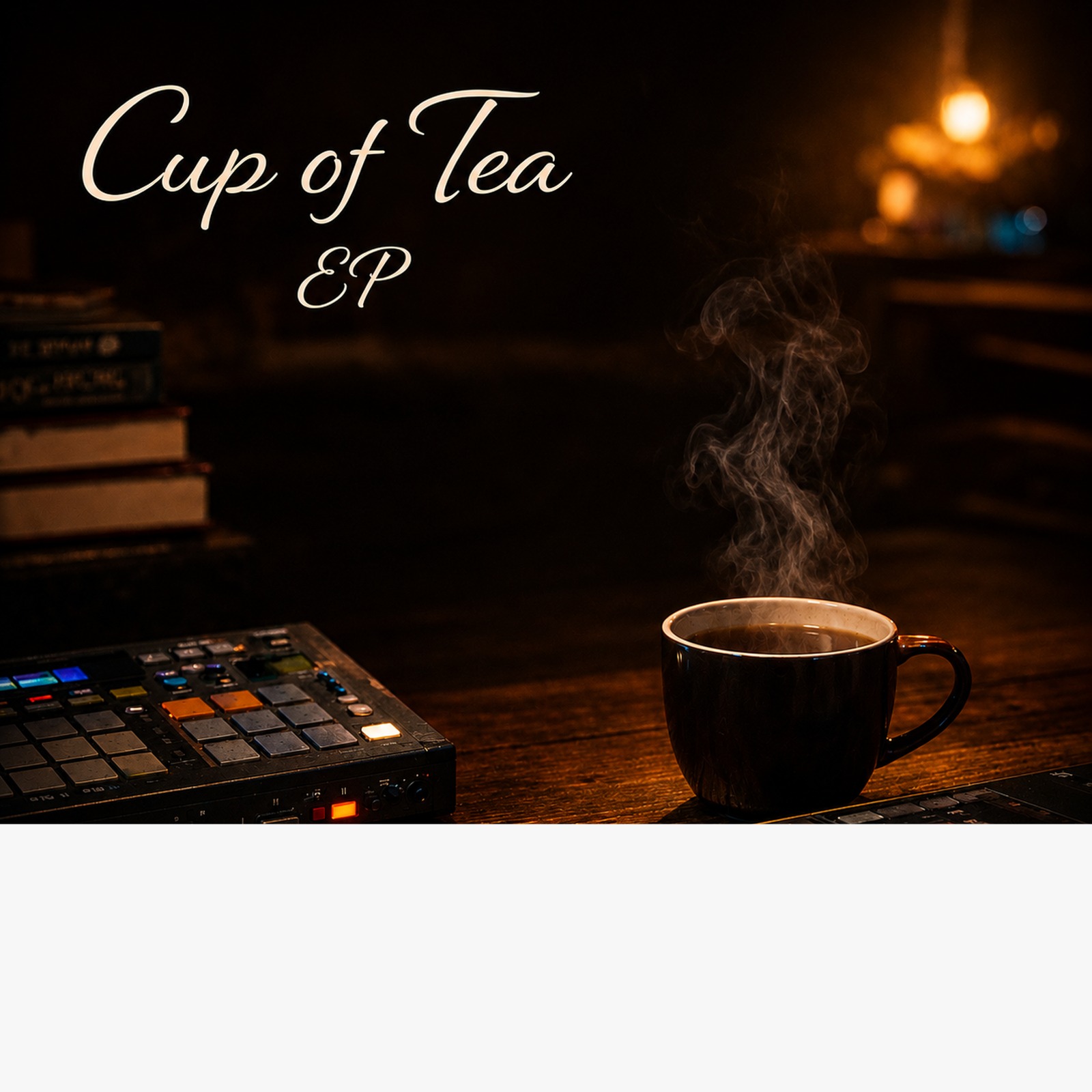
Hello everyone, it’s your host Oliver from DULAXI, and today I’m delighted to be joined by Washington, D.C. artist, songwriter and producer R. Nelson. Working across R&B, soul, hip-hop, and groove-driven contemporary sounds, R. Nelson has spent 2026 building an increasingly expansive catalogue through releases that explore relationships, vulnerability, self-reflection, identity and personal growth. Today, we’re discussing his new six-track EP, Cup Of Tea, released on August 28, 2026.
Originally introduced as part of Songs and Music by R. Nelson, Vol. 1: Grown Man Energy, “Cup Of Tea” has now developed into a complete project of its own. Released through Nelson Creative Group LLC / Ashy Knuckle Productions, the EP examines how one musical idea can develop through different productions, perspectives and stages of creation without losing the identity of the original.
Before we begin our conversation with R. Nelson, here’s what you need to know about today’s featured project.
About R. Nelson
R. Nelson’s music is rooted in storytelling, emotional observation and the everyday experiences that often remain unspoken. Based in Washington, D.C., the artist, songwriter and producer draws from R&B, soul, Go-Go and multiple generations of Black music tradition while building songs around personal experiences, emotional questions and larger narrative ideas. His approach is not limited to writing individual songs. Many of his releases form part of a wider creative world developed through Nelson Creative Group LLC and Ashy Knuckle Productions.
That storytelling approach has been particularly visible throughout 2026. Releases including “Gravity,” “Why Are You So Beautiful?,” “Let It Drop,” “Do I Deserve Love?,” and “Unable To Love” have been followed by the full-length Songs and Music by R. Nelson, Vol. 1: Grown Man Energy, a project designed as a larger narrative experience. Rather than treating each track as an isolated moment, R. Nelson structured the album through songs, acts and interludes, describing the result as a “movie for the ears.” Each part contributes to a broader journey while still carrying its own emotional purpose.
Cup Of Tea takes one of those ideas and brings the listener much closer to it.
The six-track EP began with the original “Cup Of Tea,” which first appeared on Grown Man Energy. Rather than simply revisiting the song through a series of remixes, R. Nelson discovered that the composition contained several different creative possibilities. The result is a project that gradually expands from one song into multiple interpretations, another perspective, a relationship conversation and finally a connection between two sides of R. Nelson’s wider musical identity.
The EP opens with the original “Cup Of Tea,” establishing the central idea before moving into “Cup Of Tea (Def Alt)” and “Cup Of Tea (Early Draft).” The two versions offer different glimpses into the song’s development. “Def Alt,” short for “Definite Alternate,” represents a different production direction, while “Early Draft” provides an earlier version of the concept that ultimately became part of the song’s creative DNA.
The project then changes perspective with “You’re My Cup Of Tea,” imagining a female response to the uncertainty expressed in the original. What begins as one person’s internal questioning becomes a second point of view, allowing the story to move beyond assumption and into possibility. That idea develops further through “Perfectly Steeped (Two Cups of Tea),” where the two perspectives finally meet and become a direct conversation.
The final track, “I Didn’t Change, I Expanded. (feat. Geese Da Goon),” broadens the concept beyond relationships and into identity. Geese Da Goon is another artistic identity used by R. Nelson, one that predates his R&B releases and is connected to his earlier work within the roller-skate community. Bringing that identity into the final chapter allows the EP’s central idea to operate on another level. Just as “Cup Of Tea” demonstrates that a song can grow without abandoning its original character, R. Nelson’s own creative journey demonstrates that an artist can expand into new spaces without erasing the person they were before.
The project also reflects the artist’s wider philosophy toward creativity. R. Nelson approaches technology as another instrument within the production process, including AI-assisted workflows where useful, while maintaining that the human decisions behind the music remain his responsibility. Whether working with instruments, production tools, alternate arrangements or ideas from earlier drafts, the goal remains to follow the emotional and narrative direction of the song.
Having this brief introduction to today’s featured project, I’m sure both new listeners and longtime fans are excited to hear directly from R. Nelson. So, without further ado, let’s begin today’s interview.
INTERVIEW SESSION
Oliver:
You describe your music as a form of storytelling and emotional documentation, often focusing on vulnerability, growth, relationships, accountability, and the quieter experiences people do not always discuss openly. How have those themes developed through your own life, and what made them central to the artist you have become?
R. Nelson:
Some of it comes from experience. I’ve lived long enough to see both the good and the bad sides of relationships and situationships. I’ve experienced the possibilities of a new relationship that looked like it might become something, only for it to fall through, and I’ve also experienced the surprise of finding something meaningful when I wasn’t necessarily expecting it.
A lot of those emotions end up getting written down. Sometimes it starts as a thought, a feeling, or something I’m trying to make sense of, and eventually I figure, why not turn it into a song?
Because even though the details may be personal to me, the emotions usually aren’t. Most of us, at some point in our lives, have experienced attraction, disappointment, uncertainty, hope, rejection, connection, or the surprise of meeting someone who makes us look at things differently.
That’s really what made those themes central to R. Nelson. I’m taking those quieter experiences that we don’t always talk about openly and putting them into music, because somebody listening has probably felt some version of the same thing.
Oliver:
There is a strong sense of maturity in the way you approach R&B, particularly in the tension between confidence and self-doubt, strength and sensitivity, and distance and connection. How have your experiences shaped the way you understand vulnerability, and how does that understanding influence what you choose to put into a song?
R. Nelson:
Experience is the best teacher. Funny enough, I picked that little tidbit up from a toy when I was a kid. 😂 As an adult, I’ve found out just how true it really is.
You can have an idea of what confidence is, what vulnerability is, what love is, what disappointment is, but experiencing those things gives you a completely different understanding of them.
As far as putting the uncomfortable things into a song, I do and I don’t do it deliberately, if that makes sense. I don’t sit down and say, “Okay, I’m going to expose something uncomfortable about myself today.” 😂Usually I’m following the thought or the emotion wherever it takes me.
But if it takes me somewhere uncomfortable, I don’t necessarily avoid it either. Sometimes that’s the part that makes the song honest. Confidence and self-doubt can exist in the same person. You can be strong and still be sensitive. You can want a connection with somebody and still keep your distance. Experience has taught me that those things aren’t contradictions. They’re just part of being human.
So when they show up in the music, I let them show up. I’m not deliberately chasing vulnerability, but I’m also not going to edit it out just because it makes me uncomfortable.
Oliver:
Your work draws from classic soul traditions while also embracing modern sound design and emerging technology. What do you believe makes a song feel timeless to you, and how do you balance that with your interest in contemporary production?
R. Nelson:
It’s a feeling. You can feel it in your bones. A timeless song just has something about it that makes you go with it. It doesn’t really matter when it was made if the feeling still connects.
As far as technology goes, I treat it like an instrument. You learn how to use it well enough to get the best possible result from it, the same way you would with a guitar, drums, a keyboard, or even a drum machine.
The technology itself isn’t what makes the music timeless. It’s what you do with it.
The feeling still has to be there.
Oliver:
“Cup Of Tea” originally appeared as part of “Songs and Music by R. Nelson, Vol. 1: Grown Man Energy,” but you later chose to build an entire EP around it. What did you hear in the original song that made you believe its idea could support a much larger creative conversation?
R. Nelson:
(Singing) “Or maybe I’m not your cup of tea / Maybe you want sugar, I’m just plain old me…”
Out of all the songs I’ve made, that one is probably my favorite. I love that damn song.😂
There are actually a few stories connected to it. When I was deciding which songs should be singles leading into the album, “Cup Of Tea” was one of the choices. My COO ended up choosing “Gravity,” “Do I Deserve Love?,” and “Unable To Love.” We debated it, he won out, but we agreed that “Cup Of Tea” would become the post-album single.
And now “Cup Of Tea” is doing better than two of his choices, which I remind him of every opportunity I get, including right now. 😂
But creatively, there was always a lot going on inside that song. To me, it’s probably the song that sits closest to “Gravity.” There’s a lot being said underneath what sounds like a very simple idea.
At some point I listened to the original and thought, “You know what, what if she has an answer to this?” So I wrote the response.
Then I listened to the original and the response together and realized, by Jove, I had written an entire conversation. That’s really where “Perfectly Steeped” came from. I combined both sides of that conversation into one song.
The “Early Draft” came from a different direction. That was literally the concept version. At first, I didn’t really see how much potential was sitting inside it. Later, while I was digging through notes and ideas for another project, I came across that early version again and really looked at it. I remember thinking, “Okay, this might actually have something.”
Then when I finally heard how it sounded, it amazed me.
That’s when I really started seeing how many different elements were already living inside “Cup Of Tea.” Each version pulls something different from the same central idea, and once I recognized that, the larger creative conversation almost started building itself.
Oliver:
Instead of treating the EP as a collection of remixes, you have described it as an exploration of how one musical idea can change through production, perspective, and presentation while keeping its original character. What did the process of making these different versions teach you about the flexibility of a song?
R. Nelson:
Honestly, I had a feeling and I went with it.
Like I mentioned before, I love that song, so I probably spent more time looking at it than I did some of the others. Because of that, I started noticing different things inside it and different directions the idea could go.
I think the biggest thing it taught me is to really analyze a song before you decide you’re finished with it. Sometimes there may be more sitting inside the original idea than you realized the first time around.
You might be able to change the production, shift the perspective, or present the same thought in a completely different way without losing what made the song work in the first place.
So I guess the lesson for me was simple: really listen to the song, because you might be able to pull more from it than you thought.
Oliver:
“Cup Of Tea (Def Alt)” and “Cup Of Tea (Early Draft)” allow listeners to hear different stages or interpretations of the same idea. What did you want those versions to reveal about the song that might not be immediately obvious in the original recording?
R. Nelson:
Okay, this is a very interesting and good question, Oliver.
When I was going through versions of the original “Cup Of Tea,” I’m going to be honest, there were at least 15 different ways that original song could have gone. My COO and I eventually narrowed it down, and the final two were the version that became the album cut and what became “Cup Of Tea (Def Alt).”
“Def Alt” actually means “Definite Alternate.” That was a production note I forgot to remove, but it worked, so I left it. 😂
If you listen closely, the Definite Alternate has a different groove from the album version. The original ended up winning the spot on the album because of one very small detail that I loved more in that version. It’s the held note on “When they say my name.” That moment worked better to me in the original than it did in the Def Alt.
Now, I’ll admit something else: I actually think the groove is better on the Def Alt. 😂
The “Early Draft” is a different story. I originally wrote that version and looked at it like, “Okay, this is cool, but I know I can write better. I’ll use this as a reference.”
And that’s really what happened. You can hear pieces of that early version showing up in the later songs, especially the chorus: “I don’t shine like a fantasy, I’m real when it matters honestly.”
Then, like I mentioned earlier, I rediscovered the Early Draft later and suddenly it looked different to me. I recorded it, listened back, and thought, “Whoa. This actually could have worked on the album.”
What’s interesting is that the Early Draft is actually a much more confident song than the version that ended up on “Grown Man Energy.”
And here’s the funny part: even though it was written before everything else, it was actually recorded after everything else. 😂
So I think those two versions reveal how much can change during the life of a song. “Def Alt” shows how one production decision or groove can completely change the feel of the same composition, while “Early Draft” shows that something you initially consider just a reference can turn out to have its own identity and strength once you hear it with fresh ears.
Oliver:
“You’re My Cup Of Tea” changes the perspective by introducing a female response to the original concept. Why was it important for you to bring another perspective into the conversation, and how did that change the emotional meaning of what you had already written?
R. Nelson:
“You’re My Cup Of Tea”… “You’re My Cup Of Tea”…
Well, if you listen to “Cup Of Tea,” he initially has doubts about whether he’s enough for her. By the end, though, he basically says, “You know what?” and goes for it.
“You’re My Cup Of Tea” is a hypothetical response to that. What if she’s noticing all of this too? What if, while he’s wondering whether he’s enough for her, she’s looking at him and thinking that he is?
I mean, you never really know unless you ask, right? 😂
That’s why I wanted another perspective in the conversation. The original is mostly about his uncertainty and what’s happening inside his head. Giving her a response changes that because suddenly there’s another possibility. Maybe the things he’s worried about aren’t the things she’s worried about at all. Maybe while he’s questioning whether he measures up, she already sees something in him that he doesn’t see in himself.
And the funny thing is, “Cup Of Tea” is loosely based on a situation happening now.😂So I guess life has a sense of humor.
Oliver:
The project then develops that conversation further with “Perfectly Steeped (Two Cups of Tea),” moving from one person’s perspective toward a fuller relationship concept. What did the idea of two cups allow you to explore about connection, reciprocity, and how two people can experience the same relationship differently?
R. Nelson:
Listening to “Cup Of Tea” and “You’re My Cup Of Tea” separately is almost like listening to two people having a conversation that the other person can’t hear.
And I remember thinking, “These two need to talk.” 😂
So that’s what I did with “Perfectly Steeped.” I put them together and let them have the conversation.
Because you never really know what the outcome of something will be if you don’t communicate. One person can be sitting there wondering, “Am I enough for you?” while the other person could be thinking, “You’re exactly what I’m looking for.” But neither one knows because they’re both having that conversation internally instead of having it with each other.
Putting the two perspectives together allowed me to take those separate thoughts and finally let them meet. And once they meet, the relationship isn’t being defined by just one person’s fears, hopes, or assumptions anymore. Now both people get to participate in what the relationship could actually become.
Come to think of it, I probably should just go have this same conversation with her, huh? 😂😂😂
Oliver:
The phrase “I Didn’t Change, I Expanded” becomes particularly significant because it also describes the creative philosophy of the entire EP. What does that statement mean to you beyond the music, especially in relation to personal growth and becoming more comfortable with who you are?
R. Nelson:
To really understand “I Didn’t Change, I Expanded,” you REALLY have to get into the mythos of who I am.
I also release music as Geese Da Goon. That’s where I get to really cut loose. Before R. Nelson, which is actually my given name, started releasing R&B records, Geese Da Goon already existed and was primarily making music for the roller-skate community.
With that came a lot of gatekeeping and discouragement from parts of that community, mainly because I’m very outspoken and very critical about almost everything involving it.
There’s a line in “I Didn’t Change, I Expanded” where I say, “Took it personal when I spoke, tried to shut me down / Couldn’t do it with words, so they blocked my sounds.”
That wasn’t just a line. That actually happened.
I guess some people thought that community was my ceiling.
So I started releasing music as both R. Nelson and Geese Da Goon, and instead of keeping everything centered around the skate community, I started moving the music out into the actual world. And guess what? The world responded in ways I’m still incredibly thankful for.
I think people also tried to put Geese into this box of being the disgruntled skater who makes music. But as I continue doing this, I’m realizing that I’m much more than they could possibly know.
There’s another line in a Geese song directed toward a DJ: “You can have the rinks, I’m after the world!”
That pretty much sums it up.
There are people who peek in on what I’m doing now and say that I changed. I tell them I didn’t change. I merely expanded beyond the rinks.
That wasn’t my ceiling, and it isn’t my target audience anymore.
And beyond music, that’s what the phrase means to me. Growth doesn’t always mean becoming somebody different. Sometimes it means realizing that the version of you other people became comfortable with was never the full version of you in the first place.
Oliver:
You bring Geese Da Goon into the closing track, “I Didn’t Change, I Expanded.” What made him the right artist to contribute to that final chapter, and how did his presence affect the way you wanted the EP to conclude?
R. Nelson:
Umm… I am Geese Da Goon. 😂
I feel like Tony Stark at the end of the first “Iron Man” right now.
Geese is the other side of who I am. I wanted to show the connection between the two because R. Nelson and Geese Da Goon have different thought processes, different points of view, and musically they can go in very different directions, but ultimately they come from the same person.
“I Didn’t Change, I Expanded” also appears on Geese’s “Outside” EP, just in case the skate community is watching.
They aren’t. 😂
But I did that intentionally because I wanted to show that I’m a LOT more than just the Geese they knew. The person who wrote an anti-house-music house music album, and yes, that really happened, is the same person who wrote a critically acclaimed R&B album.
So having Geese close “Cup Of Tea” brings those two sides together. The EP spends all this time showing how one song can expand into different productions, perspectives, and conversations without losing its identity. Then the final track basically reveals that I’ve been doing the same thing with myself.
R. Nelson didn’t replace Geese Da Goon, and Geese didn’t disappear because R. Nelson started making R&B.
I didn’t change. I expanded.
Oliver:
That collaboration also connects “Cup Of Tea” with Geese Da Goon’s “Outside” project, creating a bridge between two releases within the Ashy Knuckle Productions world. How important is it to you to create connections between different artists and projects rather than treating every release as an isolated piece of work?
R. Nelson:
I think I might have accidentally answered part of this with the last question. 😂
The connection between “Cup Of Tea” and “Outside” was very intentional. Putting “I Didn’t Change, I Expanded” on both projects was my way of creating that bridge between R. Nelson and Geese Da Goon.
One way to understand it is something like Donald Glover and Childish Gambino. Geese Da Goon is R. Nelson, even though, musically, Geese Da Goon was the first artist identity people heard from me.
The two identities have different perspectives and can go in completely different musical directions, but they come from the same person. So I don’t necessarily want everything I create to live on its own little island. Sometimes one project can add context to another, or a song can mean something slightly different depending on which side you approach it from.
In this case, you can come to “I Didn’t Change, I Expanded” through “Cup Of Tea” and see it as the conclusion of an EP about taking one idea and expanding it. Or you can come to it through Geese and “Outside” and hear it in the context of expanding beyond what people thought Geese was supposed to be.
Same song. Same person. Two different roads leading to it.
So yes, those connections matter to me. I like the idea that if somebody digs a little deeper into the projects, they start finding the bridges between them.
Oliver:
Your previous album “Grown Man Energy” was structured almost like a movie for the ears, using songs, acts, and interludes to build a larger story. How did working on that larger narrative influence the decision to zoom in on one song and examine it from multiple angles through “Cup Of Tea”?
R. Nelson:
Man, you got the concept of “Grown Man Energy!” 😂 That’s EXACTLY what I was going for.
“Grown Man Energy” was designed as a movie for the ears. Each song tells its own individual story, but every one of those stories is connected to the larger story of the album. And it’s linear. You’re moving through something from beginning to end, which is why the acts and interludes are there.
So when I started looking more closely at “Cup Of Tea,” I realized that one song, especially with all the different angles I found inside of it, could almost support its own subchapter within that larger story.
The album pulls the camera back and lets you see the entire journey. With the “Cup Of Tea” EP, I basically pushed the camera in and said, “Okay, what happens if we stay right here for a while?”
Now you get the original perspective, another groove, the early concept, her hypothetical response, the two perspectives finally communicating, and eventually the larger idea of expansion itself.
And “Cup Of Tea” might not be the only song where something like that happens. There’s another song that has a similar arc of its own. It doesn’t go quite as deep as this one, but…
I’ll reveal that in the coming months. 😉
Oliver:
There is a fascinating contrast between the EP’s simple central image of a cup of tea and the much broader ideas of communication, attraction, perspective, and emotional connection that develop around it. What does that metaphor allow you to say about relationships that a more direct concept might not have captured?
R. Nelson:
I’m actually an avid tea drinker. In fact, I’m looking at the time now and it’s about time for me to have some tea. 😂
When I was writing the Early Draft, I was drinking tea. Hibiscus, a little lemon, a little clove, a little cinnamon, and orange blossom honey.
I was thinking about the person and I remember having the thought, “Maybe I’m just not her type.” Then I took a sip of the tea and thought, “Maybe I’m not her cup of tea.”
Just like the old expression.
And I thought, “That would actually make a pretty good title for a song.”
From there, the metaphor just kept expanding, and the subsequent songs followed suit. Once “Cup Of Tea” became the title, it gave me this language that I could keep playing with as the different perspectives developed.
Because being somebody’s “cup of tea” is really about preference. You can be a perfectly good person and still wonder whether you’re what somebody else wants or is looking for. That doesn’t make you any less of a person.
I may or may not be for her.
I don’t know. That uncertainty is part of the whole point. 😂
And that idea allowed me to talk about attraction and uncertainty without automatically turning it into, “What’s wrong with me?” Sometimes nothing is wrong with you. Sometimes you simply don’t know how the other person sees you until that conversation actually happens.
The tea metaphor gave me a softer and more interesting way to explore that, and once I started down that road, apparently I just kept making more tea. 😂
Oliver:
Your catalogue includes songs such as “Gravity,” “Why Are You So Beautiful?,” “Do I Deserve Love?,” and “Unable To Love,” which all touch different sides of emotional connection and self-reflection. How do these songs connect with the person you were becoming while you were creating “Cup Of Tea”?
R. Nelson:
(Singing) “Why are you so beautiful, why are you so handsome…”
That is a beautiful song. I still can’t believe I wrote something like that. 😂
If you didn’t know, I actually have multiple versions of “Why Are You So Beautiful?” And honestly, if it wasn’t for the duet version of that song, I don’t think we would have gotten “Perfectly Steeped.”
I had to first figure out how to write a duet.
That song taught me how to write two perspectives into the same record and make them feel like they were actually responding to each other. Later, when I had “Cup Of Tea” and “You’re My Cup Of Tea” sitting there like two people who needed to have a conversation, I already had some experience figuring out how to make that work.
As I mentioned before, “Gravity” and “Cup Of Tea” are VERY closely related, probably more than people realize.
Actually, let me correct that. They’re triplets. 😂
“Is It Still Cool” is closely related to those two as well.
Funny story about “Gravity”: I actually wrote that song at work, right in front of the person, while listening to “Cup Of Tea.”
She knows about “Gravity.” I don’t think she knows about “Cup Of Tea.”
Her manager probably does, though. 😂
Now, “Do I Deserve Love?” and “Unable To Love” come from somewhere different.
Wait, you listened to THAT song?! Incredible! 😂
Those two actually come from another source entirely: my books of poems and journals.
So when I look across those songs, I’m really looking at different ways I was processing thoughts and experiences during that period. Some were coming from things happening around me in real time. Some grew out of another song. Some taught me techniques that I would use later. And others came from things I had already written privately in poems and journals.
They’re all connected through emotional reflection, but they didn’t all arrive through the same door.
Oliver:
You work independently under Ashy Knuckle Productions and as part of the wider Nelson Creative Group, while also incorporating AI-assisted workflows into your creative process. How do you decide where technology can help you expand an idea and where the emotional or human decision-making behind the music has to remain yours?
R. Nelson:
NCG has gotta be the worst-kept secret ever, but it probably shouldn’t be. 😂
Usually, I’ll have an idea for a song and start working on it with the tools I already have. Maybe I’m using a synth or another instrument and I can hear what I want in my head, but what I’m getting isn’t hitting EXACTLY the way I need it to.
Sometimes I’ll literally hum the part I’m looking for and see what the AI gives me.
And I’ll tell you right now, it’s a crapshoot too. 😂
A lot of times it’ll get close, but then I’ll do what I call, “Dr. Dre that shit.”
What I mean by that is, I understand Dr. Dre is known for being a perfectionist to the extreme, but he gets the result he wants. So if I’m working on a melody and the melody is right but the instrument isn’t, and I’ve already exhausted the tools I have available, I may use AI to help me get closer to what I’m hearing.
But I’m still working it from there.
I’ll tweak what the machine gives me. I’ll tweak what the instruments give me. I’ll combine things, change things, move things around, and keep working until I get what I actually wanted in the first place.
Now the voices? Unless I want to be charged with a crime against humanity for trying to sing, I’m going to give that part to the machine. 😂
But even then, I’m still directing it.
At the end of the day, the technology can help me expand the idea, but it doesn’t decide what the idea is supposed to become. I’m the one making the decisions about how the song should sound, what belongs, what doesn’t belong, what direction it should go in, and when it finally feels right.
So yes, I use AI as part of the process, but the creative decisions still have to come from me.
It’s all mine at the end because I had to decide what the song was supposed to be.
Oliver:
R&B has always had a strong relationship with intimacy, conversation, and emotional honesty, but your approach also gives those qualities a cinematic scale through layered production. What are you listening for during production when you want the arrangement to support the emotional story rather than overpower it?
R. Nelson:
Picture this, and I’ll give you the PERFECT example: “Good Morning, Beautiful.”
I wrote that song to be very light, so I built the accompanying music to be light and upbeat as well. I didn’t want to overcomplicate it.
I wanted the music and the lyrics to work hand in hand to show you a scene.
That’s really my approach to all of my songs. I don’t want the production fighting for attention with what I’m trying to say. If the lyrics are telling you one thing emotionally and the music is pulling you somewhere completely different for no reason, then they start competing with each other.
The arrangement should help you see and feel what the lyrics are describing.
That doesn’t mean the production can’t be layered or cinematic. It just means every layer needs a reason to be there. If something isn’t helping tell the story, I have to ask whether the song really needs it.
The music and the lyrics should be teammates rather than competitors.
Oliver:
You have released a substantial amount of music during 2026, moving from individual singles to the full-length “Grown Man Energy” and now this focused six-track EP. What has this period of intense creative output taught you about your discipline, your artistic instincts, and the kind of catalogue you want to build?
R. Nelson:
Yoooooo… I was literally just going over this with my COO. 😂
He said to me, “This is the most music you’ve ever put out.”
And I looked back at everything and said, “Yeah… you’re right.”
The crazy thing is, I have a LOT more that I could put out.
But after the next release coming up, I realized I can really stop for a while and focus on actually promoting these songs. I’ve built enough material to have good, working catalogues for the next couple of months without feeling like I constantly have to put something new out.
And I think that’s one of the biggest things this period has taught me: just because I write and record something doesn’t mean I should release it.
I have a pseudo A&R team now that helps me with that. I call them the Senate and the Prez, respectively. 😂 They help me get outside of my own head and decide what actually needs to come out, what might need more work, and what can stay in the vault.
So the discipline now isn’t necessarily about proving that I can keep creating. I know I can create.
It’s learning when NOT to release something.
I’ve built the beginnings of real catalogues now, and I want to give that music room to work instead of immediately burying it underneath the next release.
It also means I can start putting more energy into the other side of what I’m building. I need to get heavier into the other aspects of Ashy Knuckle Productions and the other divisions of Nelson Creative Group.
So this year taught me that building a catalogue isn’t just about how much music you can make.
Eventually, you have to stop feeding the machine long enough to build the rest of the factory. 😂
Oliver:
One of the strongest ideas behind “Cup Of Tea” is that the original song does not have to be replaced in order for it to grow. How has that idea changed the way you think about revisiting your own work, especially songs that may contain possibilities you did not recognise the first time around?
R. Nelson:
Honestly, it depends on the song.
I don’t necessarily hear every song I’ve made and think, “Okay, how many other versions can I get out of this?” 😂
But if I’m going to explore multiple versions or perspectives of a song, I’d rather do that BEFORE the song is ever released. That way I have options later if I decide there’s enough there to release an EP or another version of the idea.
“Cup Of Tea” is actually a perfect example because the version on “Grown Man Energy” came FROM the Early Draft.
The Early Draft was written first. At the time, I thought it was cool, but I also thought I could write it better, so I used it as a reference while developing what eventually became the album version.
Later, I went back to that Early Draft, recorded it, and realized, “Wait a minute. This could have worked too.” 😂
So it wasn’t a case of taking the finished album song and then creating an Early Draft afterward. That earlier version was already part of the song’s DNA.
That experience made me appreciate keeping those different ideas around while I’m developing a song. Something I decide not to use in the final version might still have its own character or reveal another side of the idea.
But I typically only do this with songs where I see a much deeper meaning or feel like there’s something underneath the original concept worth exploring.
Revisiting something doesn’t necessarily mean the first choice was wrong.
Sometimes you just realize there was more than one good road leading out of the same idea.
Oliver:
Finally, when someone reaches the end of “Cup Of Tea” and hears how one song has expanded into different versions, another perspective, a relationship conversation, and a collaboration, what do you hope they understand about growth, connection, and the idea behind “I Didn’t Change, I Expanded”?
R. Nelson:
First, I want to thank anybody who listened to the EP. I really hope it makes them want to explore more of the R. Nelson catalogue and even go over and explore the Geese Da Goon catalogue, because then you really start to understand what “I Didn’t Change, I Expanded” means.
You’re seeing one person who can write and produce in so many different and dynamic ways that sometimes even I look at it and think it’s astounding. 😂
Yes, there’s R. Nelson, who writes from a very mature, introspective, and thoughtful place. But there’s also Geese Da Goon, who can really shake a crowd and get your blood pumping.
Those things don’t have to contradict each other.
And I think that’s ultimately what I want people to take from the entire project. Growth doesn’t always mean throwing away what you were and replacing it with something new. Sometimes growth is discovering how many different things were already inside of you and finally giving yourself permission to explore them.
That’s what happened with “Cup Of Tea.” One idea became different productions, different perspectives, a conversation, and eventually a bridge into another side of who I am.
The original never had to stop being the original for any of those other ideas to exist.
And neither did I.
I didn’t change. I expanded.
That… and hopefully by the end of all this you don’t think I’m crazy.😂😂😂
“What makes ‘Cup Of Tea’ particularly compelling is the way R. Nelson turns a seemingly simple song into a study of perspective, communication and identity. The project keeps widening its frame without losing sight of where it began, making the EP feel less like a collection of alternate versions and more like a creative conversation that keeps discovering new rooms.”
~ Oliver (DULAXI Team)
EDITORIAL PERSPECTIVE
Listening to Cup Of Tea through the context of this conversation reveals a project built around curiosity. R. Nelson is interested in what happens when an idea is given enough room to develop, whether through a new groove, an earlier draft, another perspective or another side of his own identity. The result is a project where songwriting and production work together to explore emotional uncertainty while the larger concept quietly becomes a statement about creative growth.
~ Oliver (DULAXI Team)
CLOSING
Our conversation with R. Nelson offers a revealing look at the ideas behind Cup Of Tea and the wider creative world surrounding his music. What begins with a question about whether someone can be another person’s “cup of tea” gradually develops into a much broader exploration of communication, perspective, relationships, artistic identity and growth.
Thank you to R. Nelson for taking the time to speak with DULAXI and for sharing such an open and entertaining look into the stories, decisions and creative thinking behind the project. His willingness to discuss both the serious and humorous sides of the process makes the journey behind Cup Of Tea feel just as personal as the music itself.
For readers discovering R. Nelson for the first time, Cup Of Tea provides an interesting entry point into a catalogue that continues to expand across different sounds, ideas and creative identities. We encourage you to spend time with the EP, explore the wider R. Nelson catalogue, and discover the connections that lead into the music of Geese Da Goon and the broader Nelson Creative Group world.
Thank you for spending time with DULAXI. I’m Oliver, and we’ll be back with more conversations with artists, songwriters, producers and creative voices from around the world.