
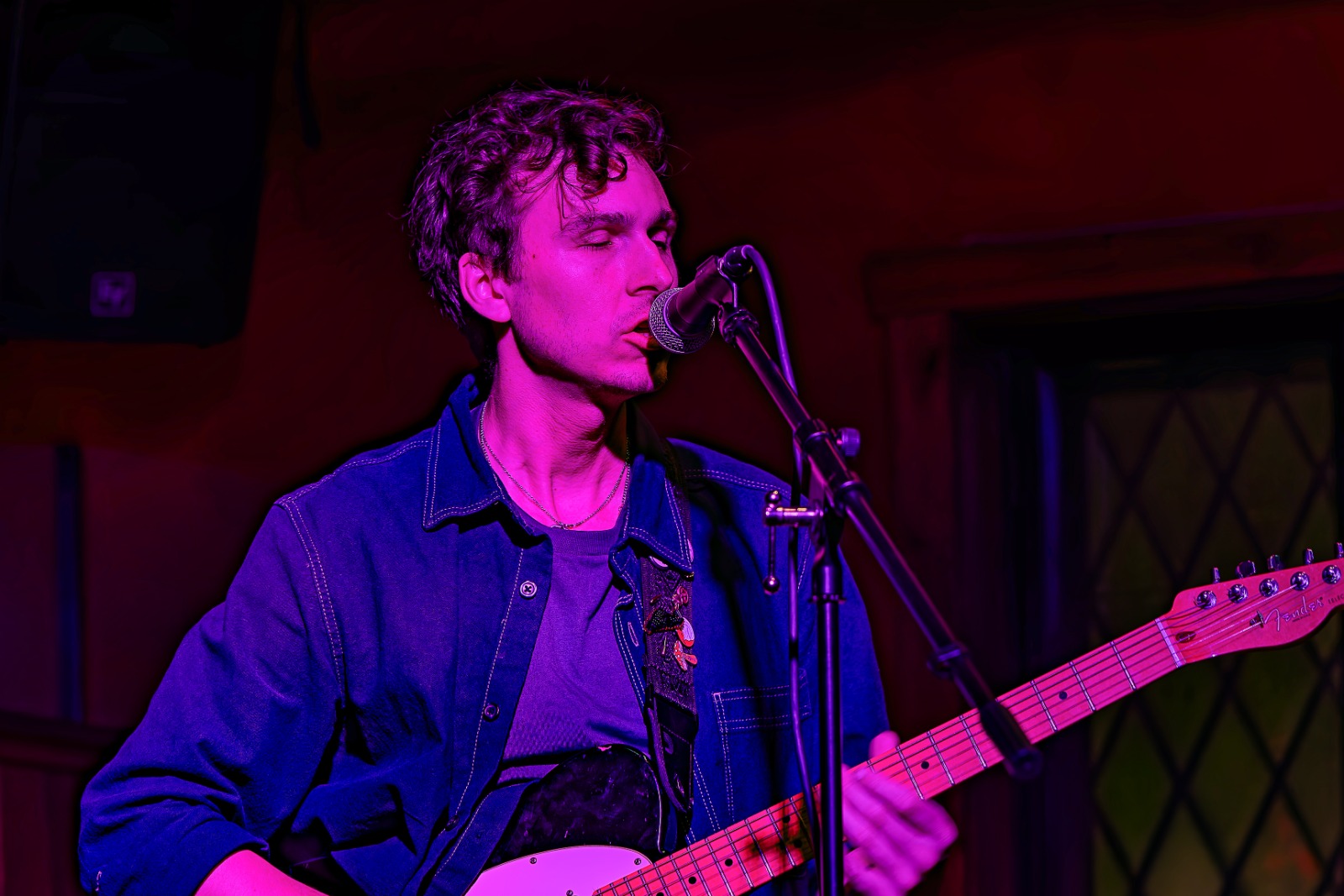
Hello everyone, it’s your host Tehillah from DULAXI, and today I’m delighted to be joined by Philadelphia-based indie folk singer-songwriter Ryan Yingst to discuss his latest single, “Ordinary Means.” Released on August 22, 2026, the folk track introduces a deeply human idea that sits at the heart of Ryan’s upcoming EP, A Nice Neighborhood to Have Bad Habits In. Rather than focusing solely on his own experiences, Ryan draws from conversations with fellow working musicians to explore what it means to create meaningful art while existing far outside the attention of the mainstream.
Before we begin our conversation with Ryan Yingst, here’s what you need to know about today’s featured project.
About Ryan Yingst
Ryan Yingst’s musical journey has been shaped by movement, experimentation, performance, and a willingness to explore different corners of songwriting. Originally from Hershey, Pennsylvania, Ryan began touring with bands in Pittsburgh after studying jazz guitar and audio engineering at Duquesne University. His early experiences eventually led to his first solo album, recorded while he was working at +/- Recording Studio in Pittsburgh in 2020. From there, his path continued to Nashville, where he released a series of singles and EP projects while working alongside local producers, friends from across the country, and Nashville-based folk artists including Tophouse.
After relocating to Philadelphia in late 2023, Ryan continued performing throughout the Northeast and occasionally elsewhere across the country, while developing an increasingly independent approach to his music. His recent work includes the entirely self-produced All Dressed Up for the End of the World and the live-recorded folk ballad “U-Haul.” Across these different stages of his career, his songwriting has remained connected to themes including loss, love, addiction, fear, and hope, while his experiences as a touring and working musician have continued to influence the way he approaches both music and recording.
“Ordinary Means” represents another step in that progression, but its perspective is deliberately broader than Ryan’s own story. The song grew out of late-night conversations with other small artists and performers who shared experiences of working long hours, accepting difficult conditions, and performing wherever opportunities were available simply because they wanted to continue making music. Four-hour cover sets in bars, busking in subway stations, and restaurant performances where musicians are expected to remain quiet enough to function more as background than the centre of attention all became part of the world surrounding the song.
That experience led Ryan to consider a larger question: how much beauty goes unnoticed simply because it appears in a setting that people do not associate with something valuable? “Ordinary Means” does not treat that question as a personal grievance. Instead, it brings together the frustrations and observations of a wider community of working artists, while encouraging listeners to develop their own sense of what deserves attention.
The song’s influences are equally broad. Ryan points to Townes Van Zandt, Theo Katzman, Bob Dylan, and Gregory Alan Isakov among the recognised artists who influenced the track, while the harmonica tone draws inspiration from The Seatbelts, the band best known for the music of Cowboy Bebop. Yet the most important influence on the song was arguably closer to home: the smaller artists Ryan has met throughout years of performing around the country, particularly during his time in Nashville.
The song also sits within a larger creative period for Ryan. “Ordinary Means” serves as the preceding single to his upcoming EP, A Nice Neighborhood to Have Bad Habits In, a collection named after a Raymond Chandler quote and scheduled for release on September 12. Alongside the release, Ryan continues to perform regularly throughout the Northeast, bringing the same experiences that helped shape his songwriting into the spaces where he performs.
Having this brief introduction to today’s featured project, I’m sure both new listeners and longtime fans are interested in hearing directly from Ryan about the ideas, people, recording decisions, and experiences that shaped “Ordinary Means.” So, without further ado, let’s begin today’s interview.

INTERVIEW SESSION
Tehillah:
You built “Ordinary Means” from late-night conversations with other small artists rather than from one event in your own life, which gives the song an unusual collective perspective. What was it about those conversations that stayed with you long enough to become music, and when did you realize that the frustrations you were hearing were really part of a much larger story about making art?
Ryan Yingst:
It was the regularity for me. I would hear all these same stories from so many performers. Often from folks who were concerned that bringing them up with anyone but other artists in the same boat would mean losing access to the gigs. Basically, the idea that any complaint made you ‘ungrateful’. I think it’s a large part of the reason the musicians union isn’t as strong as it could be. I think I realized there was a piece of art to be made when I had these conversations with friends outside of the music industry who had no idea that these frustrations existed. I just assumed everyone knew.
Tehillah:
There is a very specific kind of irony behind the song, from finishing a four-hour set and being asked what you do for a living to playing an original song only to hear someone shout “play Freebird!” from the back of the room. Why were those small, almost absurd moments more powerful to you than making the song about the larger struggles artists face in a more obvious way?
Ryan Yingst:
I think this ‘job’, if you wanna call it that, lends itself to a lot of absurd moments, and I love that. Absurdity is human in a lot of ways. Little moments have always made better music to me. I like to romanticize or criticize the little moments, and I think metaphor (when done well) is the backbone of good writing. Relating larger ideas through small moments brings people with different experiences into understanding together.
Tehillah:
The phrase “ordinary means” suggests that something extraordinary can be overlooked simply because of where or how it appears. What does that phrase mean to you in the context of this song, and what made the ordinary become the central setting through which you wanted to examine artistic value?
Ryan Yingst:
The means of a persons development have an undeniable impact on their reach. In the arts, the means of an artists beginnings can often be more impactful than any other metric. Hard work isn’t a guarantee of success, but worse so, it seems in the arts that money/circumstance can be a means of avoiding hard work entirely. If people don’t learn to absorb the artistic beauty of people in their own backyard, so to speak, the world of music can easily be turned into a play area for the rich. People need to learn to find things they like without anyone telling them to like it. The more people develop their own taste separated from algorithms and advertising, the more varied and accessible art will become. Tickets will be cheaper, small shows will be better and art will exist for the people, not for profit, if people can make small efforts to separate their taste from the advertising.
Tehillah:
You have described the song as being less about yourself and more about the friends and artists who share this experience with you. How did you approach writing from a collective point of view without speaking on behalf of people whose individual stories and struggles are not exactly the same as yours?
Ryan Yingst:
I didn’t want this song to be a collection of my frustration. I always hate to leave a complaint without giving an idea for a way forward. I’d rather celebrate the good to find more of it, than dwell on the bad. Its a tricky line to walk in a song, but I just kept reminding myself in the writing process to focus on the inspirations from other artist and find the common experiences that I’ve not only felt, but heard repeated to me.
Tehillah:
The Joshua Bell subway experiment became an important reference point for the thinking behind the song, particularly the idea that extraordinary art can exist in front of thousands of people and still go unnoticed because the setting tells them not to pay attention. What did that story make you reconsider about the way people decide what is worth noticing?
Ryan Yingst:
This story has always made me feel better about performing. I’m not a big busker, but it applies to a lot of gigs. I wish I could say “aha, this experiment proves we just need to ____”. All it showed me is that there is no threshold of beauty of performance that will make everyone who is unwilling stop and engage. I think we are so bombarded with talent and well-curated experiences online that people are largely numb to it when it happens in front of them. It seems experiences need to reach out and grab attention dramatically, and that feels like advertising to me. I see the value in it, but I’m not in advertising. That’s not what I do, and that’s ok.
Tehillah:
“Ordinary Means” does not appear to offer a simple solution to the frustrations it describes, which is interesting because the Joshua Bell story itself does not end with an easy lesson either. Why was it important for you to leave the song reflective rather than turning it into a direct protest or a conventional call to action?
Ryan Yingst:
It was important to me because there’s no way to give a simple solution without directly feeding into the problem we both investigated in our works. Both the experiment and the song ask people to invest in their own individualism, in a way. A call to action suggests I know better and have the answer. I don’t, but I think the first step to the problems I constantly hear enumerated is for everyone to find a way to embrace the beauty around them, especially when it comes from places you don’t expect. It’s not a solution; it’s a practice.
Tehillah:
The influences behind the track range from Townes Van Zandt, Bob Dylan, Gregory Alan Isakov, and Theo Katzman to the very different musical world of Cowboy Bebop, particularly in the harmonica tone. How did those influences come together without overwhelming a song whose strength ultimately depends on simplicity?
Ryan Yingst:
I don’t think these artists are as different as would be obvious. I don’t love the idea of genre as a hard wall to keep things separated. The Seatbelts (the Cowboy Bebop band) have virtuosic live performances, and the beauty of all these artists comes from recordings that capture live performance. I tried to do that with my own recording style. Guitar and vocals tracked together solve about as many problems as it creates, but it’s a choice, like everything in good studio recording. Eoin came in to do his harp tracking without having a clear plan from me; we had him improvise over the tune a few times and then just go for it. I find that with a featured instrument like harmonica that helps keep the tone on the edge. You can hear the technique and balance of someone who knows how to weave a line in real time. A great live performance, tracked well, is always my goal in the studio.
Tehillah:
The recording begins with guitar and vocal captured together in a single take, placing the performance itself at the centre rather than building the song piece by piece. What did keeping those two elements together preserve emotionally, and were there imperfections in that take that you deliberately chose not to remove?
Ryan Yingst:
There were voice breaks and phrasing elements that I certainly have done differently live, even take to take. Emotionally, it allowed me to feel like I was in a room for a gig. I sat on a stool I use for lots of gigs, so the vibe was the same for me. There’s something about playing live that doesn’t feel like recording; you’re not trying to play everything perfectly, just the next note. This take captured that feeling for me. It didn’t feel like I was thinking about the second chorus during the first verse; I just felt like I wanted to share my song.
Tehillah:
Eoin Kelly’s harmonica was recorded without a predetermined part, leaving him room to improvise and develop the melody during the session. What did that spontaneity bring to “Ordinary Means,” and how did you recognize that the improvisation had found the right emotional place within the song?
Ryan Yingst:
Eoin has a ton of live experience, and that is why he was perfect for this track. His style in his own projects (s/o Limpin Lemon Lincoln and Midnight Dispatch) is focused around blues rock and improvisation, so I knew he had the chops. I had also just had him in my studio to track for an album I’m producing for folk artist Rachel Folmar, so I knew he could handle the genre. Once you know those two things about a player, I find it’s best to let them create. Collaboration has bailed me out of many tight spots. Eoin understood the vision, and once I gave him a reference for tone, he was on it. Emotionally, I knew it had clicked almost instantly. The first few passes of tracking I couldn’t wipe the smile off my face, and I knew we found the warmth of tone I was missing.

Tehillah:
You also layered your own vocals to create a broader choral feeling around the chorus, which gives the track more weight without abandoning its sparse arrangement. What did you want those stacked voices to communicate that a single vocal could not?
Ryan Yingst:
One of my favorite things about the studio is using arrangement like a highlighter. I wanted to widen that part of the track without losing focus on the center. I thought direct harmonies of the main melody would detract from the flow of the performance. I think everything in music comes down to ‘tension and release’. These vocals helped me to push the natural tension of the chord progression, dynamics, and width without compromising the lyrics’ position in the forefront.
Tehillah:
The song was mastered to tape by Michael Cumming at Treacle Mine Recording, reinforcing the warmth and physical character of a deliberately human recording. What were you hoping the tape process would preserve or enhance, especially in a song whose entire message is concerned with resisting the disappearance of human character from art?
Ryan Yingst:
Technically, there are things with the noise floor, warmth in the midrange, subtle compression elements, and more that can be enumerated for the audiophiles in the readership, but these come together in such an interesting way when you A/B the tracks before/after. There is something about tape recording that really imparts humanity into the result. I’m sure there’s a simple explanation for my feeling. Maybe it’s that all my favorite recordings were recorded that way; maybe it’s the warmth in the low mids, maybe it’s magic. All digital music is made up of samples, tiny snips of the audio file, tape doesn’t have these snippets- it’s just the whole waveform, rolling peak to valley. Maybe that’s where the humanity comes in? Regardless, Michael is a wizard behind the board. Beautifully curated gear collection, insane knowledge about it, and a musical mind for connecting meaning and intention into the final product.
Tehillah:
Your fiancé Madison created the physical artwork using linocut, adding another handmade element to a release that is already built around live performance, improvisation, and imperfect recording. What did that visual contribution add to the story of “Ordinary Means,” and why did a handmade object feel more appropriate than polished digital artwork?
Ryan Yingst:
I couldn’t do much without her help. We talked about ideas for the cover on walks around South Philly. She got to understand the quote I used for the album, what it meant to me, what my visions were for the cover, and helped brainstorm ideas for the image. I was thinking of a photo at first, but it felt too polished. She’s a great photographer and offered to help me scope out a photo, but I just couldn’t find the feeling. It was like when an animated series gets a bad live-action remake; it just felt off. She made the linocut on a whim one night, and her mock-up was perfect. It hit me right away. She enlarged it, used 3 blocks of linocut material to get the detail, and absolutely nailed it. I always prefer physical media as a starting point for an album cover. I guess I find myself regressing further away from digital spaces as digital spaces encroach further into our lives.
Tehillah:
The song arrives alongside a carefully arranged series of performances, from bars and restaurants to a curated house show in Philadelphia. Because your own experiences performing in ordinary spaces directly informed the song, how does stepping onto those stages now affect the way you hear and understand the record?
Ryan Yingst:
It’s interesting; I don’t think it changes my own listening, but I find it does change the audience. When I get the chance to bring up this song and its meaning to the audience, I see them engage in some active reflection. I love that, because it really don’t want this song to be alienating. Not every space can be a listening room, but I love seeing someone engage with this song as a kind of question or exercise, like, “What beauty do I pass every day without noticing?” I hope it invites people to recognize positivity around themselves almost like a meditation.
Tehillah:
There is a deeper question underneath the song about who gets to determine what “good art” looks like, especially when popularity, venue, audience expectations, and financial value can influence what people notice. What do you think artists lose when they begin measuring the worth of their work primarily through those external signals?
Ryan Yingst:
I think you lose the ability to make something for yourself. I think when we start conflating good=popular, we stop people from using their judgment. I think simple answers and statistics can lead to some dreadfully boring conversation. Numbers can tell me what is popular, but they can’t tell me why. I like bar room debates about things like “what is the best late night food?” or “are there more doors or wheels in the world?” If you like something, I wanna hear about why; I wanna argue; I want you to try and convince me. It’s even better if after an hour of back and forth, we still disagree.
Tehillah:
Your work has moved through jazz guitar and audio engineering, touring, Nashville collaborations, self-production, and now this very stripped-back Philadelphia recording approach. What did all of those earlier experiences teach you about restraint, and why was simplicity the right musical choice for this particular idea?
Ryan Yingst:
Individually, what they taught me about restraint, in order: jazz guitar taught me it’s easier to play in a trio than a quartet, and playing more isn’t playing better. Audio engineering taught me that what might start as “recording on a budget” can become a highly sought-after recording style if done with intention. Touring (on bass) taught me that a stable foundation is more important than anything stacked on top of it. Nashville collaborations taught me that writing HAS to be personal to someone, but production should be collaborative. Self-production taught me that there are three jobs in a studio (engineer/artist/producer) and you can do any two of those three at one time, but all three, all the time, gets you into trouble. This stripped-back Philly approach has taught me that capturing a good performance will make you happier than creating a great recording you can’t recognize.
Tehillah:
“Ordinary Means” ultimately asks listeners to pause long enough to notice beauty where they have been trained not to look for it. After carrying that idea through the writing, recording, artwork, and live performances, what do you now find yourself noticing differently in the ordinary parts of your own life?
Ryan Yingst:
The first thing I noticed is I spend longer with my cats. I love animals, always have. They move slowly and intentionally, and I want more of that in my life, with less anxiety. I’m trying to dive into physical media much more as well. I buy DVDs from the thrift store with my fiancé, and we buy up CDs from artists we’ve never heard of. It feels related, though I guess I’m not sure exactly how. I like being surprised by beauty that I didn’t see coming.
“Ryan Yingst’s ‘Ordinary Means’ does not try to solve the complicated relationship between art, attention, and recognition. Instead, it leaves us with a more personal challenge: to slow down, trust our own taste, and become willing to notice the remarkable things that can exist right in front of us.”
~ Tehillah (DULAXI Team)
EDITORIAL PERSPECTIVE
“Ordinary Means” becomes more revealing when its music and its philosophy are considered together. Ryan’s decision to preserve the immediacy of a live guitar and vocal performance, allow the harmonica to develop through improvisation, and bring handmade artwork into the project gives the release a clear sense of intention without making it feel overly constructed. What stayed with me most is the way the song encourages attention rather than demanding agreement. Its ideas about artistic value become especially compelling because Ryan leaves room for listeners to decide what beauty means to them.
~ Tehillah (DULAXI Team)
CLOSING

Our conversation with Ryan Yingst offers a thoughtful look at what can happen when an artist chooses to examine the parts of creative life that are usually easy to overlook. “Ordinary Means” grows from conversations between working musicians, but its questions reach beyond the music industry. It considers how we decide what deserves our attention, how much our surroundings influence our judgement, and whether something needs to be widely recognised before we can consider it meaningful.
Thank you to Ryan for taking the time to share the experiences, creative decisions, and personal reflections behind the release with DULAXI. His thoughts give “Ordinary Means” another dimension, particularly in the way the song connects its recording approach, artwork, live performances, and central ideas about beauty and attention.
We encourage readers to spend some time with “Ordinary Means” and experience the song for themselves, while also keeping an ear out for Ryan’s upcoming EP, A Nice Neighborhood to Have Bad Habits In. Most importantly, perhaps, take the question at the centre of Ryan’s work with you beyond the music: what beauty might be sitting in front of you that you have simply learned not to notice?
Thank you for spending time with DULAXI and joining Tehillah for this conversation with Ryan Yingst. We look forward to bringing you more conversations with artists, musicians, and creators from around the world.