
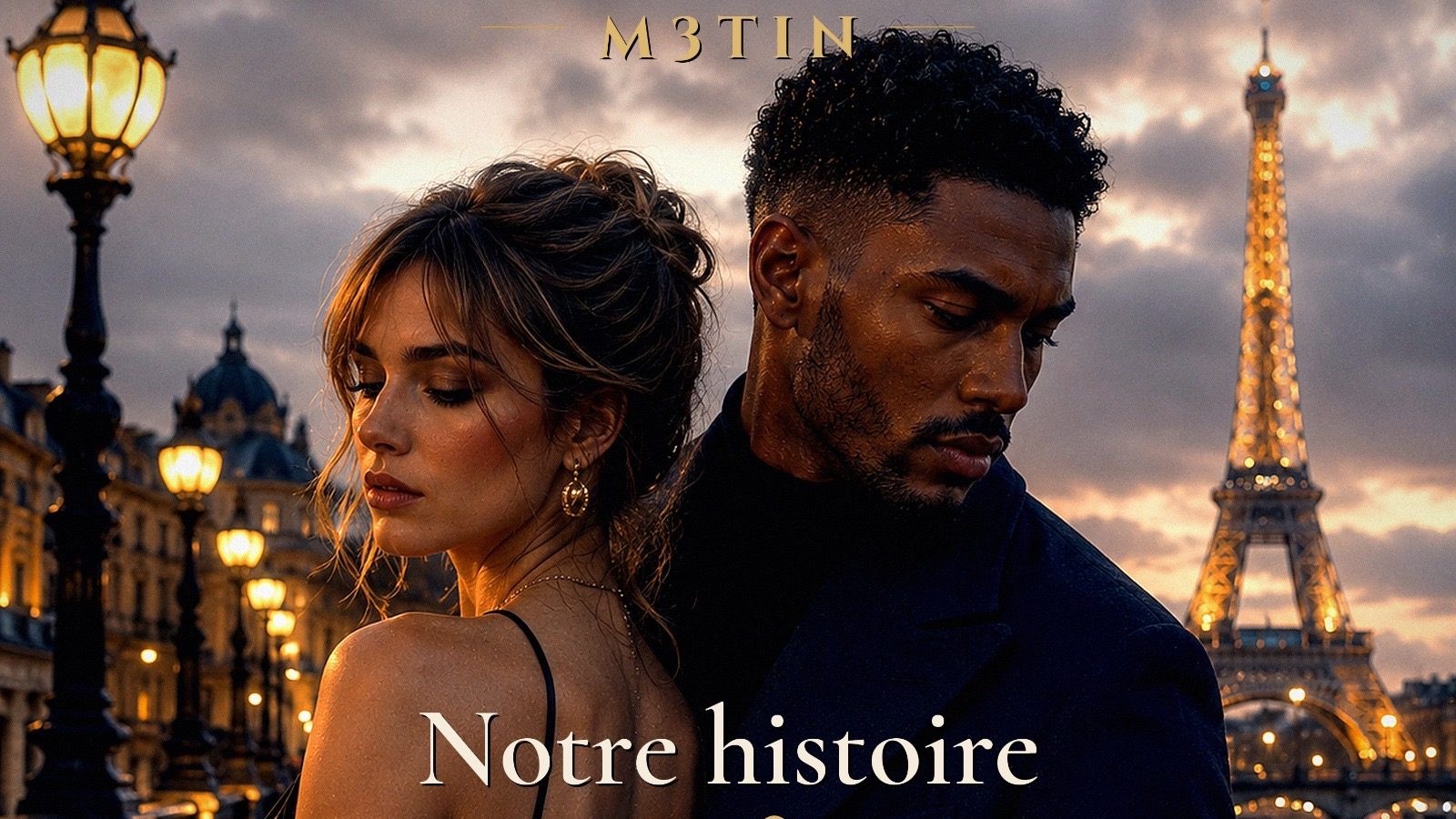
Hello everyone, it’s your host Oliver from DULAXI, and today I’m delighted to be joined by Ahmet Metin Oktay, songwriter, music architect, and founder of © M3TIN Records, the creative force behind M3TIN. Based in Istanbul, Turkey, M3TIN works across contemporary pop, alternative pop, cinematic songwriting, and pop urbaine, with a distinctive approach to emotional storytelling and multilingual music. Today, we are discussing “Notre Histoire Est Finie”, the French heartbreak single released on 10 July 2026.
The song represents the fourth voice of a story that has travelled across cultures, beginning with the Turkish composition “Sayfa Kapandı” before being reborn as native adaptations in Kazakh, Arabic, Khmer, French, Portuguese, and Spanish. Rather than treating language as a simple translation tool, M3TIN treats each language as part of the creative identity of the song, with every adaptation shaped and confirmed by native speakers.
Before we begin our conversation with Ahmet Metin Oktay, here’s what you need to know about today’s featured project.
About M3TIN
M3TIN is an independent music project built around an unusual creative principle: one story can have many voices without losing its emotional identity. Founded by Ahmet Metin Oktay, the project divides its catalogue between works that are intentionally created for a single language and “Song Families”, where one story is reborn through several languages as native adaptations. The distinction is important to the project’s philosophy. These versions are not translations. The story, emotions, and melodic heart remain connected, while the expression is rebuilt for the cultural and linguistic character of each audience.
Oktay’s own background has contributed strongly to this perspective. Born in Turkey, educated in the United States and England, and having lived for years across England, Germany, Turkey, and the CIS, he has spent much of his working life among people whose first languages were different from his own. That experience became part of the foundation for M3TIN’s understanding of emotional communication. Rather than viewing language as a surface placed over an existing song, the project treats language as one of the places where emotion itself lives.
“Notre Histoire Est Finie” emerged from that philosophy. The story was originally written in Turkish as “Sayfa Kapandı” but was deliberately held back, allowing the song to travel first through other languages. The Kazakh version arrived in May, followed by Arabic and Khmer in June, with the French version released on 10 July 2026 and Portuguese and Spanish versions continuing the journey. The Turkish original is planned for 2027, completing what M3TIN calls its “homecoming last” principle.
Musically, the French version places the story within contemporary pop urbaine, bringing intimate verses into a broader cinematic chorus. The song’s male and female voices offer two perspectives on the same ended relationship, allowing the emotional experience to exist without assigning blame to either person. Its accompanying visual project, “Le Film”, extends that restraint into 32 shots across 11 scenes, using a slow-cinema approach rather than relying on conventional fast-cut music-video language.
The response to the story has already given M3TIN a significant international audience. “Notre Histoire Est Finie” has surpassed 4 million views and 300,000 likes on TikTok, while the full-film post has generated more than 6,000 shares. The wider M3TIN project has also accumulated more than 14 releases across seven languages, radio rotation in France, Belgium, and Italy, and press attention in France, Brazil, and Mexico. Its TikTok account has grown to 114,000 followers and 1.7 million likes, with more than 16 million video views recorded in July alone. The Brazilian Portuguese version, “A Nossa História Acabou”, also collected more than 75,000 likes during its first two weeks.
Having this brief introduction to today’s featured project, I’m sure both new listeners and longtime fans are excited to hear directly from Ahmet. So, without further ado, let’s begin today’s interview.
INTERVIEW SESSION
Oliver:
M3TIN’s story is already unusual because the music is being created with a clear idea of movement across languages and cultures, while still keeping a strong sense of artistic identity. Before we get into that journey, what experiences in your own life first shaped the way you understand love, separation, longing, and the emotional moments that eventually find their way into your music?
M3TIN:
I was born in Turkey, educated in the United States and England, and then lived for years in England, Germany, Turkey and across the CIS. English, Turkish, passable Russian, some German. More importantly, I have spent my working life among people whose first language was none of those.
That teaches you something early: the same feeling does not arrive the same way twice.
I have watched people say goodbye in a dozen languages, including several I do not speak. The grammar changes, the gestures change, the amount of silence people permit themselves changes enormously. But the moment underneath is recognisable every time, in every one of them.
What shaped me most was not one great heartbreak. It was noticing that dignity is the hardest thing to hold on to when something ends, and that almost nobody sings about it. There is always blame, or pleading, or revenge. Very rarely is there the quiet sentence: this is over, and I will not diminish either of us on the way out.
That sentence is the emotional centre of everything I write.
Oliver:
There is a very deliberate philosophy behind the project: some songs remain rooted in one language because that is where their story belongs, while others are created to travel and be reborn for different audiences. Where did this way of thinking come from, and what did you learn about yourself as an artist while developing a project that treats language as part of the creative process rather than simply as a means of communication?
M3TIN:
It came from a frustration. We repeat that music is universal, and then the industry treats songs as though they need passports.
So I split the catalogue in two, deliberately. Some works are Native Works — born for one language, complete in one voice, and they stay there because that is where the story belongs. Others become Song Families — one story reborn natively across several languages. A song is not written to travel. It is born native in its own language, and then it chooses its path.
What I learned about myself is less flattering than it sounds: I had been assuming that language was the surface and emotion was the depth. It is the opposite. Language is where the emotion actually lives. Change the language carelessly and you have not translated the song — you have replaced it with a polite stranger.
That discovery reorganised how I work. Now the language question comes before the arrangement, before the tempo, before anything.
Oliver:
Your work sits somewhere between contemporary pop, alternative pop, cinematic songwriting, and pop urbaine, but there is also a strong emphasis on emotional storytelling. When you think about M3TIN as an artistic identity, what do you want people to immediately understand about the kind of stories, emotions, and experiences you are trying to bring into music?
M3TIN:
That the song is about a real moment, and that it is not trying to be bigger than that moment.
Everything else — the cinematic production, the multiple languages, the visual work — exists to protect one small human sentence at the centre. If the production ever becomes more interesting than the confession, I have failed.
I would like someone to hear a M3TIN song and think: this is a specific person, on a specific night, telling the truth. And then discover afterwards that the same night exists in five other languages.
Oliver:
“Notre Histoire Est Finie” is particularly interesting because the French version was not simply translated from another language. It began as “Sayfa Kapandı,” then travelled through different cultures before arriving in French, with the same emotional story and melodic heart being preserved while the expression changes naturally from one language to another. What does that process teach you about the different ways people experience and express heartbreak?
M3TIN:
It taught me that cultures disagree about where the pain is located.
In some languages the wound is in the memory — what we had is now unreachable. In others it is in the future — what we will never build. Turkish tends to close the page; the metaphor is architectural, a chapter ending. French reaches for the definitive: fini, and the word itself does the work.
So the French version leans on that finality. The repetition of fini is not a translation decision, it is a cultural one. A native speaker told me the line landed harder if the word simply stopped, without softening. He was right, and no dictionary would have told me that.
The story is identical. The melodic heart is identical. What changes is the exact place where the listener is expected to flinch.
Oliver:
The decision to leave the Turkish original unreleased until 2027 adds another layer to the journey, because the story begins at home but reaches several countries before eventually returning to its starting point. What was the thinking behind this “homecoming last” idea, and what does saving the Turkish version for the finale mean to you personally and artistically?
M3TIN:
Most artists begin locally and dream of going global. I reversed the map.
Artistically, it removes an excuse. If I released in Turkish first, every other version would inevitably be read as a translation — a derivative, an export. By holding the original back, each adaptation has to stand on its own feet, in its own language, judged by its own audience.
Personally it is harder than it sounds. I am Turkish. There is a version of this song in my own language sitting finished, and I do not get to hear anyone react to it. That is a strange kind of patience.
But when the Turkish original arrives in 2027, it will not arrive as the source material. It will arrive as the homecoming — the last voice, returning to a story the world already knows. That is worth waiting for.
Oliver:
At the heart of “Notre Histoire Est Finie” is the end of a relationship, but the song presents that ending through both male and female voices, allowing two sides of the same emotional experience to exist within one story. What did you want listeners to understand about heartbreak by giving the song these two perspectives rather than presenting the ending from only one point of view?
M3TIN:
That there is no villain, and that this is the most painful version.
A single-voice breakup song always ends up making an argument. Someone is wronged, someone is guilty, and the listener is invited to take a side. But most real endings are not like that. Two people who genuinely loved each other arrive at the same conclusion from opposite directions, and both are right.
The duet form makes that structural rather than lyrical. You do not have to say “neither of us is to blame.” You just let both voices be reasonable, and the listener feels it.
There is also something quietly devastating about two people singing in the same musical space about no longer sharing a space.
Oliver:
The French version has an intimate quality in its verses before expanding into a much wider, cinematic chorus, creating the feeling that a private breakup is gradually becoming something much larger. How did you approach that emotional progression when shaping the song, and what did you want the listener to feel at the exact moment the chorus opens up?
M3TIN:
I think of it as the difference between what you say and what you finally admit.
The verses are close, almost muttered — the register of someone talking themselves through a decision at two in the morning. Everything in the arrangement stays near: piano, restraint, very little air.
The chorus is the moment the private thing becomes true. It is not triumphant, it is not cathartic — it is wider. The sound opens because the fact has stopped being deniable.
What I want the listener to feel is not release. It is recognition. The floor giving way slightly, in a place they have stood before.
Oliver:
The lyrics remain central to the identity of this project, particularly because every line in each adaptation is checked by a native speaker before release. How do you protect the emotional meaning of a lyric when moving a story between languages, and what are some of the challenges involved in making sure a line feels genuinely native rather than sounding like a translated version of another song?
M3TIN:
The rule is simple to state and difficult to follow: the story, the emotions and the melodic heart are untouchable. Everything else is free to change.
The hardest part is that a line can be grammatically perfect and emotionally wrong. It scans, it rhymes, a translator would approve it — and a native speaker hears it and says, nobody would ever say that to someone they loved. That sentence, from that person, is worth more than any amount of technical correctness.
So every line in every version is confirmed by a native speaker before release. Not reviewed. Confirmed — meaning they are asked whether it breaks the heart in the right place, not whether it is accurate.
The harder challenge, and the one nobody warns you about, is that a language is never one language.
Say you are making a Spanish version. Which Spanish? Peninsular or Latin American — and if Latin American, whose? Mexican, Argentine, Colombian and Chilean Spanish carry different expressions, different rhythms, different degrees of directness about heartbreak. Arabic is harder still. Levantine, Egyptian, Gulf, Moroccan and Algerian are not accents of one thing; they are separate emotional registers with separate vocabularies for loss.
So where do you draw the line, especially as someone who is not native to any of them?
You draw it deliberately and you say so. Our Arabic version is Levantine — not a neutral pan-Arabic construction, because that would belong to nobody. Making that choice means accepting that a listener in Casablanca will hear something that is not quite theirs. That is a real cost, and pretending otherwise would be dishonest.
You cannot please everyone. What you can do is commit to one specific place, do it properly, and be transparent that a choice was made.
The other challenge is idiom. Every language has ways of saying goodbye that are so specific they cannot be carried across. When we find one, we do not force it. We find that language’s own equivalent gesture, even if the words look nothing alike. What travels is the feeling, not the vocabulary.
Oliver:
“Notre Histoire Est Finie” carries a title that is simple but emotionally final: “Our story is over.” When you look beyond those words, what do you believe the song is really saying about the period after a relationship ends, especially the memories, unanswered questions, and emotional weight that can remain even when the relationship itself has reached its final chapter?
M3TIN:
That endings are not events. They are climates.
The song is not about the moment of separation — that has already happened before the first line. It is about the strange administrative afterwards: deciding not to answer the phone, watching shared memories quietly change ownership, understanding that the version of you that existed inside that relationship is also gone.
And the unanswered questions never get answered. That is the part most breakup songs lie about. There is no final conversation where everything is explained. You simply carry the questions until they get lighter.
The song refuses to offer a resolution because offering one would be dishonest.
Oliver:
Alongside the single, you created “Le Film,” a 32-shot cinematic video built across 11 scenes with a deliberately slow-cinema approach. What was happening creatively when you decided that this particular song needed more than a conventional music video, and how did you translate its emotional atmosphere into visual storytelling?
M3TIN:
The song does not have a dramatic peak, so a conventional video would have had to invent one — and inventing one would have contradicted the song.
“Le Film” is 32 shots across 11 scenes, cut with a slow-cinema logic. Long holds, very little movement, space between events. That was a deliberate refusal of the fast-cut grammar most music videos use.
Because a separation is not a shock. It is a material that settles. You do not see it happening; you notice one day that it has happened. Slow cinema is the only visual grammar that tells that truth.
The restraint was the hardest discipline. Every instinct says to add another cut, another angle. Leaving the camera still, and trusting the viewer to stay with it, was the entire creative decision.
Oliver:
The response to this particular story has already been significant, with more than 4 million views and over 300,000 likes on TikTok, while the full-film post has generated more than 6,000 shares. When you first saw people responding to the story at that level, what did that reaction make you realise about the emotional experiences that music can connect across language and geography?
M3TIN:
That I was not the author of what the song meant to them.
The comments arrive in languages I do not read. People attach the song to their own divorces, their own migrations, their own recoveries. The most common message is not “I like your song.” It is “this is my story.”
That reframes everything. The song stopped being a composition and became a container. People put their own endings into it.
And the numbers matter far less than the pattern behind them. The pattern is that the melody crossed the border before any campaign did, and each language then gave it somewhere to live. That is exactly the thing I set out to test, and it turned out to be true.
Oliver:
The project has also moved beyond digital audiences, reaching radio listeners in France, Belgium, and Italy and gaining attention from music media. How has that wider response influenced your understanding of where M3TIN belongs within the contemporary pop landscape, and has it changed anything about the way you approach the music?
M3TIN:
Radio taught me something the internet could not. Online, a song reaches people who were already looking for something. On the radio it reaches someone driving home who did not choose it. When a station in France or Belgium or Italy plays a song and it holds, that is a different kind of proof.
The more useful part of the response has been the criticism.
Creators and people I respect in this industry have told me the work sits between things — that they expected more of one genre and less of another, that I have mixed elements they would have kept separate. That is fair, and I take it seriously. I am not going to pretend the musicality cannot improve. It can, and improving it is a matter of consulting and working with professionals, which is exactly what I intend to keep doing.
But there is a Turkish saying that tastes and colours cannot be argued. How do you explain the taste of chocolate to someone who has never tasted it? People recognise what they already know, and something that does not sit inside a familiar category will always be described first by what it is missing.
So I hold two things at once. The professionals are right that the craft can be better, and I need their judgement. And the listeners are telling me something the craft conversation cannot measure. You can have technically excellent music, and if it does not reach anyone, it means nothing.
Where does M3TIN belong? Honestly, nowhere comfortable yet. It is too pop for the world-music shelf and too multilingual for the pop shelf. I have stopped trying to solve that. The category does not exist, and the work is more interesting than the category.
What none of it has changed is the writing. The response arrives after the song is finished. If I started writing toward it, I would lose the only thing that makes any of this worth doing.
Oliver:
There is an important creative principle behind M3TIN’s production philosophy: the studio openly uses modern tools, including AI, while maintaining that the lyrics and creative decisions remain the original work of founder Ahmet Metin Oktay. How do you define the relationship between technology and authorship in your work, and why was transparency about the tools used important enough to become part of the project’s artistic philosophy?
M3TIN:
The brush is not the painter. The tool is not the artist.
I use modern tools, including AI, openly. They do not choose the story. They do not decide the emotional truth. They do not define the cultural intention. They do not ask a native speaker whether a line breaks the heart in the right place, and they certainly do not decide to hold a language back for three years.
Every lyric, every creative decision and every final approval originates with me, and I am accountable for all of them. The records are mixed and mastered by professional engineers, and every adaptation is confirmed by a native speaker before release — the work passes through human hands at every stage that matters.
Transparency became part of the philosophy because the alternative is corrosive. If you hide the tools, you spend your career defending a lie, and eventually the lie becomes more interesting than the music. Say it plainly at the start and the work can be judged on its merits.
There is also a principle underneath. Audiences are owed the truth about how something was made. That is not a marketing position. It is just the correct way to treat people.
Oliver:
You describe the technology as an instrument rather than the artist, comparing the creative process to a conductor leading an orchestra. In practical terms, where do you draw the line between what technology can help you achieve sonically and what must always come from human imagination, emotion, judgment, and artistic intention?
M3TIN:
The line is authorship, and it is not blurry.
Technology can extend a texture, hold a sound I could not hold, help me hear an arrangement before it exists. It works on the how.
It never touches the what or the why. What the song is about, which language it is born in, whether a line is honest, whether the chorus arrives too early, whether this version deserves to exist at all — those are mine. Not because a machine could not produce an output, but because there would be nobody accountable for it.
A conductor does not play the violin. But nobody confuses the orchestra for the interpretation. Every decision that carries responsibility is made by a person, and in this project that person is me.
There is also a chain of people around the work that I am careful to credit. Professional mixing and mastering engineers handle the final sonic stage of every release. Native speakers confirm every line. These are human judgements, made by people with expertise, and they happen after the tools have done whatever they can do. A record does not get finished by software. It gets finished by professionals deciding it is finished.
Oliver:
Looking at the wider journey, M3TIN has moved from the first Turkish version through Kazakh, Arabic, Khmer, French, Portuguese, and Spanish, with the project deliberately refusing to treat these versions as simple translations. What has been the biggest creative lesson you have learned from working across so many languages and cultural perspectives, and has the process changed the way you write or compose?
M3TIN:
It changed how I write at the level of the first draft — and not only the words.
The melody is what crosses the border first. Before a single lyric exists, I already know whether a melody will travel. Some melodies are beautiful and belong so completely to one tradition that carrying them elsewhere would be an act of violence against them. Others have something open in their shape — an interval, a phrase length, a place where the line breathes — that lets another culture stand inside them without discomfort.
I have no technical method for that. I listen, and I know. It is the one part of this process I cannot explain and would not want to systematise.
The lyrics follow the same logic. I used to write a line and ask whether it was good. Now I ask whether the feeling underneath it survives being rebuilt from nothing in another language. Clever wordplay almost never survives. A true observation always does.
The third lesson took longer and surprised me most: the performance matters as much as the writing, and it does not matter equally in every language.
Accent lives in the vowels. Some languages place enormous weight on their vowel sounds, and in those languages a foreign accent has nowhere to hide — a single sustained vowel will expose it across an entire phrase. Other languages carry more of their character in consonants and rhythm, and they are far more forgiving. So the vocal demands of a French version and a Khmer version are not comparable, even when the melody is identical. That changed how I think about casting a voice for each language.
And the biggest lesson underneath all of it: cultural specificity does not weaken a universal story — it is the thing that makes it universal. The more precisely a version belongs to its own language, the more people outside that language recognise it.
Oliver:
Every artist eventually reaches moments where an ambitious idea becomes difficult to execute, and a project involving several languages, native adaptations, cinematic visuals, and different markets brings its own challenges. What has been the hardest part of building this project so far, and what did you have to change in your approach to keep the original artistic vision intact?
M3TIN:
The hardest part is time, and refusing to buy it back cheaply.
Every version requires finding the right native voice, writing inside a culture I do not always live in, and then waiting for someone to tell me a line is wrong. That process cannot be rushed, and there is a constant temptation to rush it — to accept a translation that is merely accurate, because it is Tuesday and the release calendar exists.
I have delayed releases rather than ship something I was not certain of. The Vietnamese single was postponed for exactly that reason — in Vietnamese the accent is so decisive that an approximation is not a slightly weaker version, it is a different word. Getting it nearly right would have been worse than not releasing it.
And one Arabic adaptation is still unfinished, sitting in the studio, because every person I consult tells me something different. Levantine, Gulf, Jordanian, Egyptian — each speaker is confident, and each is confident about a different answer. I have not resolved it yet. I would rather it stay unreleased than release something that belongs to nobody.
That is the discipline the whole project rests on. Break it once and every previous version becomes suspect.
The second hardest thing is that the tools are not equally good at every language, and I think it is worth saying plainly.
English, Spanish, Portuguese and French are comparatively easy to work with. Southeast Asian languages are not. Where tone carries meaning, where a sound has to land in an exact place or the word becomes a different word, the technology struggles — and no amount of patience fully closes that gap. The Khmer version was the hardest thing this project has produced.
I suspect the reason is simply that far more attention has been spent on the major Western languages than on the rest of the world. That is not a neutral fact. It means the easiest path is always toward the languages that already dominate, which is the exact opposite of what I am trying to do.
So those versions take longer, cost more, and demand more from the people helping me. I think they are the most important ones in the catalogue.
What I changed was my own expectations about pace. I built the project around the work instead of the calendar. That is a luxury an independent label has and a major does not, and it is the main reason M3TIN Records exists at all.
Oliver:
With “Notre Histoire Est Finie” now becoming another chapter in a story that has already travelled across several countries, what would you say has changed most in you creatively from the beginning of this journey to where M3TIN stands today?
M3TIN:
I have become much less interested in being impressive.
Early on, some part of me wanted the project to be admired for its ambition — the languages, the concept, the scale. Now I mostly want a specific person in a specific country to feel less alone at two in the morning.
And that has happened in places I had no reason to expect. Peru. Chile. Benin. Mozambique. Cambodia. Indonesia. Egypt. I did not build a campaign for any of those countries. The song simply arrived there and someone recognised it.
I am under no illusions about how far there is to go. The musicality can improve, and I know precisely how — by working with better people and listening to them. That part is solvable.
What is not solvable by expertise alone is whether something reaches anyone. If I had the most accomplished record in the world and it touched nobody, I do not think I could keep doing this. The other way around, I can live with — and keep improving.
I have also become far more willing to wait. That may be the biggest change of all.
Oliver:
The Turkish original is scheduled to complete the journey in 2027, while Portuguese and Spanish versions continue to expand the story into new audiences. When you look beyond the current releases, what do you want M3TIN to become over the next few years, and what kind of body of work or legacy would make you feel that this journey achieved what you originally imagined?
M3TIN:
I want a catalogue in which people can be heartbroken, understood and eventually healed in their own language, without ever feeling like a secondary market. That includes major languages. It also includes languages global pop tends to ignore, and eventually languages genuinely at risk of falling silent. When a song lives in a language, that language lives a little longer.
But there is something more specific I want, and it has nothing to do with charts.
I want these songs to be performed by real musicians. Singers in bars, in cafés, on cruise ships, in small rooms where somebody is working for a living — people with a voice and an instrument and an audience of forty. I want a singer somewhere to pick up one of these songs because it works in their language and it suits their voice, and to perform it as their own.
And I want them to do that without looking down on it. There is a reflex in this industry: if a song was made with modern tools, by someone who is not globally famous, it is treated as somehow lesser — as if the origin disqualifies the material. I have never claimed to have the best mixing, the best mastering, the best of anything. That is not the claim.
The claim is that the cement is there. The bricks are there. The structure holds. What I want is for a real artist to take it to town.
That would be the legacy: not that I performed these songs everywhere, but that they turned out to be worth performing by other people, in their own languages, long after I stopped being the reason anyone listened.
And in 2027, when the Turkish original finally comes home, the circle closes — not because home was forgotten, but because it was saved for the finale.
One artist. Many voices.
“Notre Histoire Est Finie” shows how a single emotional truth can travel without becoming diluted, with M3TIN turning language, perspective, and restraint into essential parts of the story rather than barriers around it.
~ Oliver (DULAXI Team)
EDITORIAL PERSPECTIVE
What stands out about “Notre Histoire Est Finie” is how deliberately every creative choice serves the central human experience. The duet structure avoids reducing heartbreak to blame, while the movement from intimate passages into a wider arrangement gives the song room to acknowledge its finality without forcing a conventional resolution. The multilingual philosophy adds another dimension, showing how cultural specificity can reshape the expression of the same emotional truth. Speaking with Ahmet also makes clear that the ambition behind M3TIN is matched by a willingness to question, refine, and wait when the work demands it.
~ Oliver (DULAXI Team)
CLOSING
Our conversation with Ahmet Metin Oktay offers a revealing look into the ideas behind M3TIN and the unusual journey of “Notre Histoire Est Finie”. From its beginning as “Sayfa Kapandı” to its French adaptation and the many voices still to come, the project raises interesting questions about language, authorship, cultural identity, technology, and the ways music can carry an emotion beyond its original setting.
A sincere thank you to Ahmet for taking the time to speak with DULAXI and for sharing such thoughtful insight into his creative process, the challenges of building a multilingual catalogue, and the artistic principles guiding M3TIN Records. We encourage readers to experience “Notre Histoire Est Finie” and “Le Film” for themselves, and to follow the continuing journey as the story moves through Portuguese and Spanish before eventually returning home to its Turkish original in 2027.
Thank you for spending time with DULAXI. This has been Oliver, and we look forward to bringing you more conversations with artists whose music, ideas, and creative journeys deserve to be heard.