
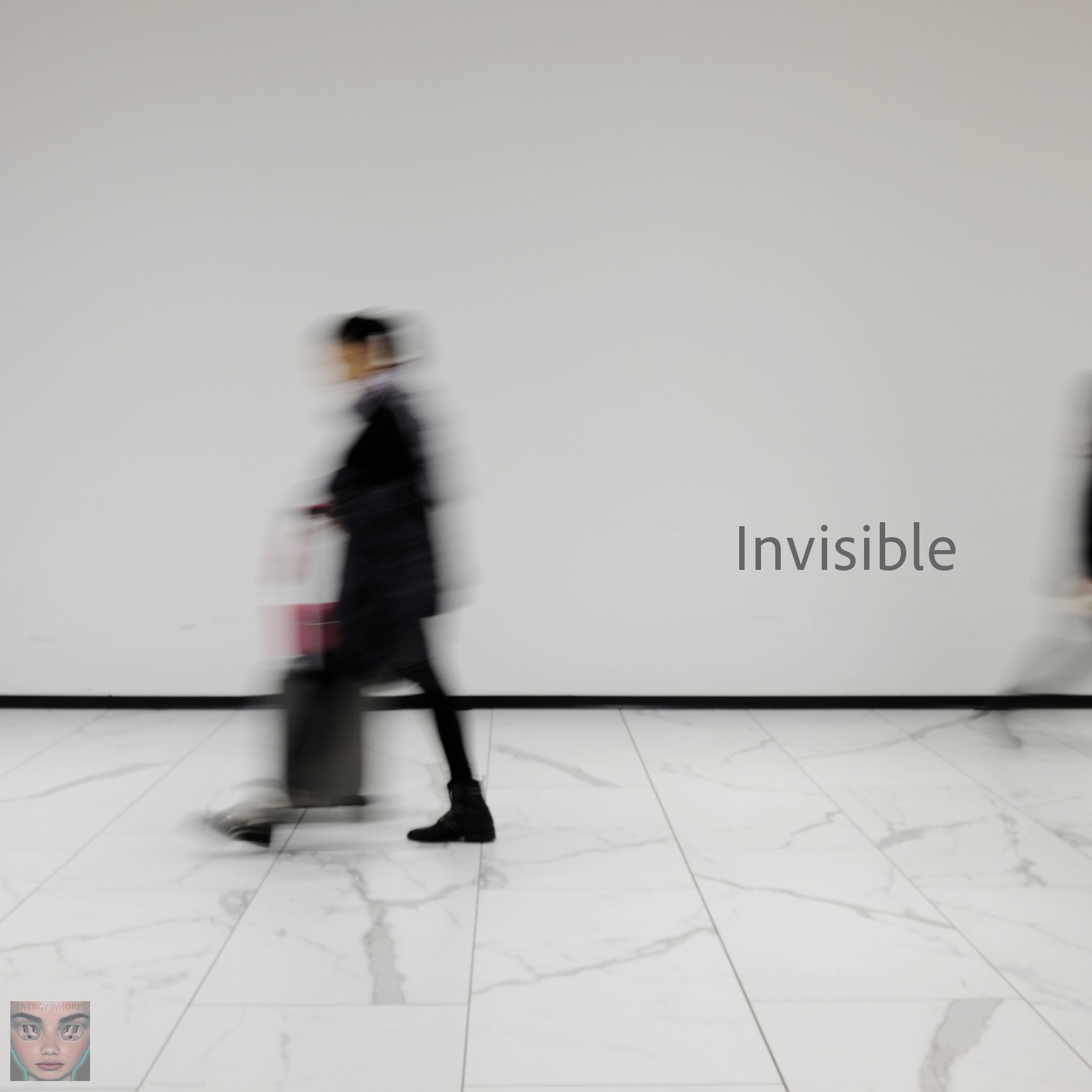
Energy Whores’ “Invisible (Four Ways),” released on August 21, 2026, takes a single composition and reshapes it into four separate productions built around the same lyrics and melody but carrying different emotional temperatures. Instead of presenting the additional versions as remixes, the project treats each arrangement as its own interpretation of one idea: the discomfort of being physically present while going unnoticed. Carrie Schoenfeld, the songwriter, vocalist and producer behind Energy Whores, wrote “Invisible” around a feeling she describes as becoming transparent to the people around her, and the EP uses shifts in instrumentation and mood to explore how differently that experience can register from one setting to the next. Working with guitarist Attilio Valenti and producer, mixer and mastering engineer Grant (NYC), Schoenfeld turns a single lyrical premise into a study of tone, letting production choices change how the same words land from one version to another.
The three versions covered here approach that premise from different angles. The Synth Pop version pushes the frustration outward through insistent repetition and a controlled, almost mechanical vocal presence. The Lo-Fi version pulls the same idea inward, treating invisibility as something quieter and more private. The Cinematic version widens the focus further, connecting personal isolation to the position of service workers and others whose labor goes unacknowledged. Heard together, the three interpretations show how differently the same lyric can land depending on the arrangement around it: the confrontational edge of the Synth Pop version, the hush of the Lo-Fi version, and the broader scope of the Cinematic version each pull the words in a distinct direction.
Invisible (Synth Pop Version):
“Invisible (Synth Pop Version)” turns the experience of being overlooked into a synth-pop track built on repetition, using that repetition to mirror the specific problem it describes: the frustration of remaining present in a room, a job, or a life while going unrecognized. The song isn’t only about loneliness. It targets the imbalance of a system that benefits from certain people’s labor while withholding basic acknowledgment of who they are. Schoenfeld delivers the vocal with a steady, near-mantra-like cadence that plays like a thought returning again and again because the underlying situation never resolves. There’s a deliberate coolness to the performance, an emotional distance that keeps the track from tipping into melodrama, and that restraint ends up communicating something closer to exhaustion: the fatigue of asking to be seen by people who have stopped looking. By setting ordinary human presence against that indifference, Schoenfeld frames invisibility as something done to a person rather than a condition anyone chooses, turning the song into a pointed statement about who gets discarded and what that erasure costs.
The production wraps that message in a lean, minimalist electronic framework. Pulsing synthesizers and programmed percussion establish a rhythm that feels intentionally mechanical, echoing the coldness of being treated as replaceable instead of acknowledged as a person. Tight, repeating loops keep the arrangement locked in place, while wider pads open up the space around them, so the track holds two contradictory sensations at once: confinement and emptiness. Layered vocal processing and reverb push Schoenfeld’s voice slightly out of reach even as it stays rhythmically close to the listener, mirroring the song’s central contradiction of being near enough to be seen and still going unseen. The finish is polished and contemporary, but that polish sits over something uneasy: the repetition tracks the cycle of being overlooked, the stiff percussion mirrors an indifferent system, and the open space around the vocal makes the track feel like a large room with no one paying attention to the person standing in it.

Invisible (Lo-Fi Version):
“Invisible (Lo-Fi Version)” reframes the same subject as something private, less a confrontation than a slow turning-over of the same worry in a quiet room. Where the Synth Pop version pushes outward, this version stays inward, tracing what prolonged neglect starts to feel like once it settles into how a person sees themselves. Schoenfeld’s vocal is sparse and half-whispered, closer to thinking out loud than performing, and the repeated return to the word “invisible” plays like a thought that keeps resurfacing whenever she’s left alone with it. The detachment in her delivery reads less like indifference and more like someone quietly working out whether they matter to a world that hasn’t given them much reason to think so. That question, whether one’s presence or effort carries any real significance, sits underneath the entire track, and it’s what separates this version from the others: it’s less about being ignored by other people and more about what happens internally once that neglect becomes familiar. The mood stays melancholy without tipping into despair, leaving room to notice a kind of alienation that rarely announces itself.
The Lo-Fi arrangement backs that inward focus with a warm, deliberately worn production style. Soft, restrained percussion keeps a steady pulse without pushing the track forward too hard, while muted melodic lines hang just behind the vocal instead of competing with it. Tape-style saturation and light surface crackle give the recording a used, imperfect quality that suits the fragility of what’s being described. The arrangement stays uncluttered, giving each sound room to sit rather than stacking layers on top of each other, and that spareness is what keeps the reflective tone intact from start to finish. Instead of marking its shifts in mood with dramatic instrumental changes, the track leans on texture and repetition to hold its tone steady. The warmth of the lo-fi processing works against the loneliness in the lyric, so the track ends up sounding comforting and melancholy in the same breath, while the unhurried beat and hazy melodic details create the impression of someone lost in old memories, without working toward any clear resolution.
Invisible (Cinematic Version):
“Invisible (Cinematic Version)” widens the song’s scope into a statement about dehumanization and the people whose contributions keep everyday life running while going largely unrecognized. This version reaches beyond ordinary loneliness to focus on the contradiction of being directly encountered, relied on, and served by others while still functioning as background to them. Schoenfeld’s vocal carries a mix of vulnerability and resignation that suits the seriousness of what’s being described, and the track’s real target becomes clear as it unfolds: service workers and other overlooked people whose labor is used constantly while the individuals doing that labor go unacknowledged. It’s a pointed observation about how easily people notice the comfort or convenience someone provides without noticing the person providing it. The restraint in the performance is what makes the criticism land: instead of anger, Schoenfeld sounds worn down by repetition, and that sense of accumulated fatigue is what makes the song’s underlying argument, that recognition is a basic form of dignity, hit harder than outrage would.
The cinematic treatment carries that message through an arrangement that pairs electronic production with orchestral scoring. A plain piano line opens the track and establishes its vulnerability, while strings build gradually underneath the vocal, raising the scale of the song as it continues. Deep bass frequencies anchor the mix, and generous reverb makes the space around the vocal sound enormous, as if the person singing is small within everything surrounding them. Combining electronic textures with orchestral scoring gives the track a hybrid identity, borrowing the vocabulary of film composition while keeping Energy Whores’ electronic foundation intact. The arrangement builds from a fragile opening toward a fuller, more dramatic close without losing its underlying melancholy, and that shift mirrors the song’s own move from one person’s experience into a wider social observation. The same spacious mix that makes the track feel large also reinforces its argument: the vocal stays close and human while the space around it keeps widening, capturing what it feels like to be present in a room and still functionally alone in it.
Energy Whores is built around Schoenfeld’s background as a multidisciplinary artist. A classically trained pianist who studied at Mannes as a child, she later worked in visual art and directed an independent film before returning her attention to songwriting and production, and she also directs Energy Whores’ videos and visual concepts herself. That range shows in how deliberately different these three versions sound from each other: each one required its own visual and sonic decision-making instead of a shared template. “Invisible (Four Ways)” also includes a fourth interpretation, an Indie version, rounding out the project’s stated aim of testing how far one song can stretch across different productions. The EP follows Energy Whores’ 2026 album “Arsenal of Democracy” and the releases “Fade to Gray” and “Planet B,” continuing a run of music that draws on reference points like Massive Attack, Portishead, Björk, St. Vincent, Depeche Mode and Radiohead, artists who share an interest in pairing electronic production with direct, unguarded songwriting.

Energy Whores — Invisible (Four Ways)
Taken together, the Synth Pop, Lo-Fi and Cinematic versions turn “Invisible” into something closer to a study than a single statement, using contrasts in arrangement to show how differently the same complaint, being unseen, can register depending on who’s experiencing it and where. The synth-driven version makes the frustration confrontational, the lo-fi version makes it personal, and the cinematic version makes it collective, extending the song’s reach from one person’s private experience to a broader claim about who societies choose to notice.
Invisible (Four Ways) Turns One Song Into Three Distinct Arguments For Why Being Overlooked Never Feels The Same Way Twice
~ Daniel (DULAXI Team).
Across three very different productions, “Invisible” keeps returning to the same basic question: what does it take to be truly seen by the people and systems around you? Energy Whores answers that question three separate ways without settling on a single tone, letting repetition, restraint and scale each carry their own version of the same frustration. The result is a release that treats a familiar feeling, going unnoticed, as something worth examining from more than one angle, and it makes a strong case that the way a song is built can change what its words are actually saying.
For more information about Energy Whores, click on the links below.