
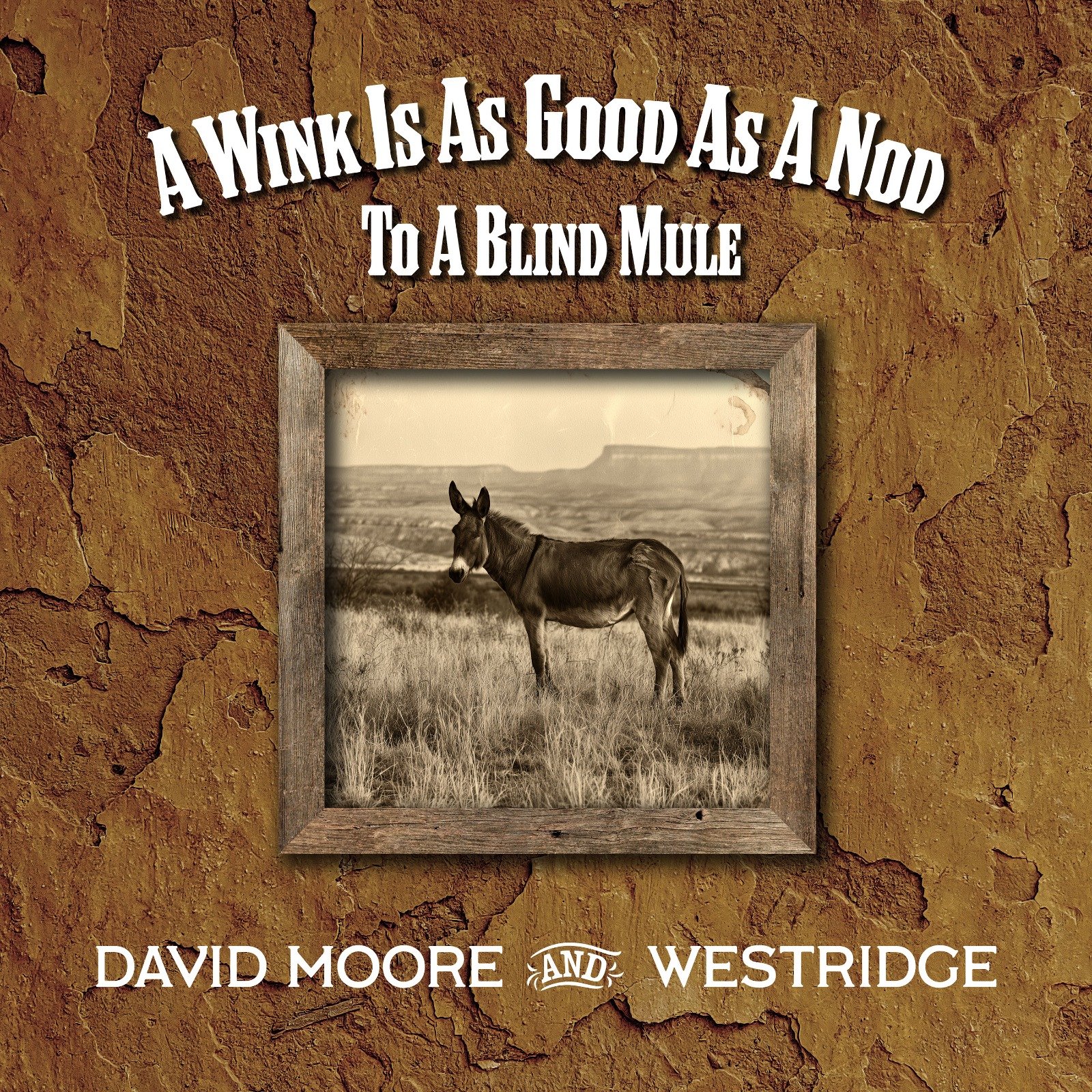
Hello everyone, it’s your host Oliver from DULAXI, and today I’m delighted to be joined by David Moore, the Knox City-based musician behind the studio album A Wink Is As Good As A Nod To A Blind Mule. Drawing from rock, electric guitar-based music, classic rock, rhythm and blues, and blues, the album was released on August 24, 2026, and is a deeply personal tribute to Moore’s late friend, writing partner, and brother figure, James Masters Patterson.
The album brings together nearly two years of work and contributions from musicians and recording professionals across the United States and the United Kingdom. Every track was either written, co-written, or inspired by Patterson, whose musical abilities and friendship had a lasting influence on Moore’s life and creative journey.
Before we begin our conversation with David Moore, here’s what you need to know about today’s featured project.
About David Moore
David Moore’s journey into music began at a major turning point in his life. An injury ended his dream of playing professional soccer, but music was already part of his world. He had been playing guitar and writing songs since the age of 16, and the change in direction ultimately led him toward a creative path that would become closely connected to James Masters Patterson.
Patterson, who lived from 1956 to 2013, became far more than a musical collaborator. He was Moore’s writing partner, best friend, and a brother figure during a period when Moore particularly needed that friendship. Patterson was also an exceptionally gifted guitarist and musician, capable of playing the music of major guitarists such as Jimmy Page, Eddie Van Halen and Jeff Beck with remarkable ability. His influence became an important part of Moore’s own development, particularly as Moore explored recording and production.
The idea for A Wink Is As Good As A Nod To A Blind Mule began with Moore’s desire to ensure that Patterson’s music, personality, and contribution would not disappear with his passing. The album became a way of preserving songs that Patterson had written, co-written, or inspired while also bringing together musicians who could help realise the project at the level Moore felt it deserved.
A major turning point came when Moore reconnected with Brian Patterson, who is not related to James Masters Patterson, after more than three decades. Brian’s involvement with The Speaker Wars eventually introduced Moore to guitarist Jay Michael Smith. That meeting proved crucial. Moore felt that Smith possessed the guitar ability necessary to honour Patterson’s original playing without reducing the musical core of the songs.
The album was subsequently assembled piece by piece, with musicians recording from different locations. Smith recorded guitar parts at his studio in Dallas, Texas, while Brian Patterson recorded bass at his home. Vocal contributions came from Albuquerque and Pittsburgh, with additional work taking place in the United Kingdom. Stuart Epps contributed from his UK studio, while the completed songs were mixed by Moore at Ground Zero West in Texas. Mastering was handled by Jeff Lowes at OTR Mastering, with Garry Simmons mastering “Love Is The Victory.”
The album also brings together a diverse group of contributors, including Brian Patterson and Jay Michael Smith of The Speaker Wars, Hollan Holmes of the Spotted Pecary Label, Fred Sullivan of the 56 East Band and Daphunk, Ralph Galetti of Disclaimers, Abbie McKinney, Jackie Dwire of the AmberAlexis Band, and Stuart Epps. Each contributor became part of a larger collaborative effort centred on preserving Patterson’s musical legacy.
Having this brief introduction to today’s featured project, I’m sure both new listeners and longtime fans are excited to hear directly from David. So, without further ado, let’s begin today’s interview.
INTERVIEW SESSION
Oliver:
Before we get into the album itself, your path into music came after an injury ended your dream of playing professional soccer. How did that major change in direction affect you personally, and what did discovering music give you at a point when one part of your future had suddenly changed?
David Moore:
Really, it was a pretty seamless transition. I had been playing a guitar and writing songs from the age of 16, so meeting Jim when I did was providential in the fact that I had no time to dwell on the change. Another part of it is, especially at that time in my life, I lived in the moment and had a very myopic view of time…the past was memories (still is) and the future was something I did not dwell on. Fortunately, as the years progressed, I discovered I could still play soccer…just not at the same level. So I played indoor soccer until I was 56 and my love of the sport still had an outlet.
Oliver:
James Masters Patterson became your writing partner, best friend, and, as you describe him, a brother during an important period of your life. What was Jim like as a person, and what was it about the two of you that made your creative partnership so meaningful?
David Moore:
Jim was an amazing human being. Very easygoing, hard-working, not at all prone to emotional outbursts. Something which shows a bit of Jim’s character is that when we were playing a gig and taking a break between sets, Jim would often spend the entire break up on stage while the rest of us sat at a table with friends and girlfriends, talking to a random inebriated patron who went up to the stage to start a conversation with him. Understand, Jim was the centerpiece of the band…a lead guitarist who could play anything that was on the radio note for note. Jimmy Page, Eddie Van Halen, Jeff Beck, Jimmy Hendrix…you name it and he could play it. The rest of us found it amusing, but that is the kind of person he was. Fortunately for me, our chemistry was such that we enjoyed spending time together, whether playing music, throwing frisbee, playing with our cats, or spending time with our girlfriends. The bond we shared was such that I can not recall us ever having harsh words with one another.
Oliver:
You have said that the idea for this project began on the day Jim was buried, with a desire to make sure the world knew about the person and musician you had lost. What stayed with you from that moment, and how did that initial thought eventually become this album?
David Moore:
Without the fortuitous meeting of Jay Michael Smith, which came about because I had reconnected with Brian Patterson (no relation to Jim) after over 30 years and Brian was playing with Micheal in Stan Lynch’s new band The Speaker Wars and invited me to a private showing they had before the release of their first album. Although I had wanted to do the album for quite some time, my guitar playing is not up to that level, and due to the fact that I live in a very rural part of Texas and do not have the talent pool in this area; until I met Michael it was just an idea. Once Michael agreed to be part of the project it was just a matter of putting together a representative list of songs to include and go from there.
Oliver:
Every track on “A Wink Is As Good As A Nod To A Blind Mule” was written, co-written, or inspired by Jim. How did you approach preserving his creative voice while also allowing the finished recordings to become your own tribute to him?
David Moore:
That was pretty easy due to the fact that Jim was such a good guitar player, so all the songs were centered on that ability. The only exception is “Love Is Blind”, which is the only song on the album I wrote and played the guitar part on, but was included on the album because it was part of our setlist and Jim would play bass. Brian Patterson recorded the bass track and did a great job of recreating Jim’s bass playing. Also Jim is credited with drums on four of the songs. I used MIDI to sequence his drum parts from old recordings, so Jim’s abilities are woven throughout the entire album.
Oliver:
The album title comes directly from Jim’s distinctive sense of humor, and you have said you knew he would have loved it. Why did that particular expression feel like the right title for a project carrying so much personal meaning?
David Moore:
There are probably many expressions similar to that I could have chose from, but that one just felt right. Along that line I will never forget one year he gave me a business card as a Christmas card which read “Money’s tight, times are hard, here’s your f**king Christmas card”. I still laugh about that to this day.
Oliver:
One of the most remarkable parts of the project is the reconstruction of the drum performances from older recordings. You entered the notes measure by measure using MIDI and rebuilt the parts without AI assistance. What was that process like emotionally and technically, knowing that you were working with performances connected to Jim and the original recordings?
David Moore:
You know, I’ve been asked that before, and honestly there wasn’t any emotion involved. I was way too busy reconstructing the drum parts. I am a play-by-ear type of person, so it was very tedious without the musical knowledge and training which could have simplified the process immensely. A lot of trial and error was involved. On the upside, I did get better with it over time.
Oliver:
Once those reconstructed drum parts were ready, the album was built track by track, with different musicians recording from different locations. How did you maintain a consistent musical identity across recordings made in Dallas, Pittsburgh, Albuquerque, the UK, and other places?
David Moore:
I think Michael got a good feel for Jim’s style throughout the recording process. Guys that play guitar that well are wizards to me. So the underlying formula was for me to have the drum part ready, with perhaps a rhythm guitar or bass track also, depending on the song, and then let Michael do his thing. So then having someone else record a vocal, bass, synth track…whatever, just put another layer on the already developed foundation. The one exception would be “Love Is The Victory”, where the only recording I had to work from was Jim playing acoustic guitar and me singing. Stuart Epps did a lot of the fleshing out of that song. Michael recorded the acoustic guitar and Stu played all the other tracks except for the string and horn arangements.
Oliver:
Reconnecting with Brian Patterson after more than three decades eventually led you to Jay Michael Smith, whose guitar work became central to the project. How significant was that reconnection in turning an idea that had existed for years into an actual album?
David Moore:
Without that, the album would still be a seed in my mind…Michael was pivital to the project. I suppose I could have scaled back the guitar parts to something I could pull off, but to me it was crucial for a tribute album to not water down the central core, which was to honor not only Jim as a person but also for the talented guitar player/musician he was.
Oliver:
On “Mysteries Of Life,” Jay Michael Smith’s playing captures Jim Patterson’s guitar style so convincingly that you have said it sounds as though Jim himself is playing. What was the first moment you heard Jay’s performance in that context, and what did that experience mean to you?
David Moore:
When I got the guitar tracks back from Michael and loaded them up in the DAW and heard them for the first time was absolutely the most emotional moment of the whole project. Michael had already recorded tracks for “Chasing The Mothership” and “The Wizard”, so I don’t know why “Mysteries Of Life” hit me the way it did. Something about it had a spiritual like connection, which is a moment that stands out to me.
Oliver:
There is a delicate line between recreating something from the past and creating something new from it. How did you and the other contributors approach Jim’s original guitar parts and musical ideas without making the album feel like an exercise in simply reproducing history?
David Moore:
There was no conscious effort from the beginning to follow a preordained production formula. Some of the songs I used production ideas which were present in old recordings we made, and some of the songs I added some elements being careful to still retain the original characteristics of the song. I wanted to maintain a vintage feel with a kind of live-sounding production.
Oliver:
The project brought together contributors including Brian Patterson, Hollan Holmes, Fred Sullivan, Ralph Galetti, Abbie McKinney, Jackie Dwire, and Stuart Epps. What did each person bring to the album, and what was it like watching so many musicians from different places become part of a tribute to someone they may have known in very different ways?
David Moore:
Brian and I met while working together at American Airlines. Brian, Jim and I jammed together a few times with the idea of starting a band, however Jim was living in Denton, Texas at the time which was a pretty long drive to get to rehearsals so that project kind of fizzled out. I have an old cassette tape of one of our practices which I converted to digital and sent to Brain when we reconnected…we both got a kick out of that. Hollan and I also met at American and played together in the last live band I played in. Hollan is not only big in the ambient/electronic world, being signed on the Spotted Peccary label, but he is also a very gifted graphic designer and painter. Hollan designed the CD cover for “A Wink Is As Good As A Blind Mule’ which will be out soon. Fred Sullivan and Ralph Galetti both joined the project when I put out inquiries for a male vocalist. I have to be picky about what tracks I sing on because my tonal quality is not a true rock sound. Ralph stepped in on “Mysteries Of Life” and did a wonderful job. For “The Wizard” I wanted a strong “rock” sound and Fred fit the song perfectly. In fact, Fred went on to record the vocals for “Love Is The Victory” and “Y-Grene Fosecruos Atanos” also. Abbie is Ralph’s daughter and she did a wonderful job in the duet “Land Of Sunshine”. On the old original recording I sang both parts, but I though it would be nice to make it a male/female duet. Abbie has such a sweet, fresh sound that I feel fits the song perfectly. For “Emotional Deceiver” I though it would be fitting to have a female sing the song which gives the song a different emotional aspect. I was introduced to Jackie Dwire by Garry Simmons, who not only recorded all of Fred’s vocal tracks for me at his home studio, but also mastered “Love Is The Victory” and recorded Jackies vocals. Jackie put some great emotion into her vocals and has a wonderful tonal quality.

Oliver:
Stuart Epps has worked on major recordings involving artists such as Led Zeppelin, Jimmy Page, Paul Rodgers, and Bill Wyman. What did having someone with that level of recording experience contribute to “Love Is The Victory” and to the album as a whole?
David Moore:
It was great having the opportunity to work with Stuart Epps. As I mentioned earlier Stu had a big impact on how “Love Is The Victory” sounds, having played most of the instruments in the song. Doesn’t hurt to have his name in the credits…years of experience with top acts.
Oliver:
Seven tracks were released as singles beginning in late 2025, meaning parts of Jim’s story reached listeners before the complete album was available. How did releasing the songs individually change the way you experienced the project, and did listener responses affect your relationship with the album?
David Moore:
Releasing some songs early was just a promotional strategy; it did not affect the overall project as the blueprint for the album was basically set before recording began.
Oliver:
Nearly two years of work went into completing this project, with delays eventually moving the album from its original planned release period to August 2026. What kept you committed during those delays, especially when the personal importance of finishing the album was so great?
David Moore:
I wound up cutting one track because I intended for the album to release late May/early June, but various delays caused the album to get released two months late. Staying committed was not a problem because the subject matter was so dear to me, and honestly the whole project was fun. Not only meeting and collaborating with others, but I also enjoy the technical side of mixing and constantly learning and improving.
Oliver:
You produced and mixed the songs at Ground Zero West, bringing together performances recorded in multiple locations before sending the completed work for mastering. What did you learn about your own abilities as a producer during the process of managing such a complex studio project?
David Moore:
Actually, I am blessed with a drive and work ethic, probably as a result of being more of an athelete at heart. It did test my patience a little when the release kept getting moved back, however in those moments I fell back on my natural trait of putting the head down and working a little harder to make things happen. Inaction is never a recipe for results.
Oliver:
Your own musical journey began at a difficult turning point, while Jim’s belief in you helped shape your development as an artist. Looking back now, how much of the confidence you have as a songwriter and producer can you trace back to what Jim saw in you during those early years?
David Moore:
As a songwriter, nothing at all. I would still be strumming an acoustic guitar and formulating melodies and lyrics to go along. As a producer, EVERYTHING. As a teenager I used to lay on my back with speakers on either side of my head (I had no headphones) and listened to all the parts that made up a song. Although I loved Led Zeppelin’s music, it was Jimmy Page’s production abilities which I learned a lot from. So I had a natural interest in multitrack recording when Jim and I met. He encouraged my development by the hours we spent playing and recording together. As bad as I was in the beginning, it was his continual involvement and never displaying frustration which allowed me the time and experience to grow.
Oliver:
The album is clearly a tribute, but it is also a body of original songs that now exists independently for listeners who never knew Jim. What do you hope someone who has no personal connection to him discovers about his character and talent simply by spending time with these songs?
David Moore:
I think the songs speak for themselves on that. Although Michael played the guitar parts, they were a manifestation of Jim’s playing and writing abilities which give each song it’s voice to say “Hey, this is James Masters Patterson speaking, hope you enjoy listening!”
Oliver:
There are no live performances planned because of the number of contributors and the logistics involved. Does that make the recorded album feel even more important to you as the permanent form of this collaboration and tribute?
David Moore:
I knew from the beginning there would be no live performances, so the recording process had it’s own importance to me from day one. I approached it with a do the best you can attitude; influenced alot by the nature of the project. I started recording and releasing albums four years ago after almost 20 years away from music while I raised a family, so one would hope that as long as I continue to record I will continue to improve. That being said, I know I gave 100 percent to this project and I did as good a job as I could with my current abilities.
Oliver:
Finally, after almost two years of reconstructing performances, coordinating musicians across different locations, producing, mixing, and completing the album, what does “A Wink Is As Good As A Nod To A Blind Mule” mean to you now, and what do you hope Jim’s legacy will be when listeners hear this record?
David Moore:
Pride. Not from an egotistical viewpoint, but proud that I had such a special friendship that only comes along once in a lifetime, and so very proud of my friend who’s music has not died, but has been reintroduced to the world with the help of some very talented people who gave of their time to help complete a story and a persona most of the world would have never been aware of. Of Jim’s legacy, I hope the listeners will say…”WOW, he was GOOD!” And for me…..he was my friend.
“A Wink Is As Good As A Nod To A Blind Mule” is a rare kind of musical remembrance, one where the purpose is not simply to look backward, but to give a friend’s work another chance to be heard, understood, and remembered.
~ Oliver (DULAXI Team)
EDITORIAL PERSPECTIVE
What stays with me most about this project is the care behind its construction. Moore did not simply revisit old material. He spent nearly two years finding ways to preserve the musical identity connected to James Masters Patterson while allowing new contributors to complete what had remained unfinished. The result is a recording shaped by friendship, technical patience, collaboration, and a genuine desire to keep someone’s music alive.
~ Oliver (DULAXI Team)
CLOSING
Our conversation with David Moore offers a deeply personal look at the story behind A Wink Is As Good As A Nod To A Blind Mule, but perhaps more importantly, it gives listeners a clearer understanding of the person at the centre of it all. James Masters Patterson’s presence runs through the project not only through the songs themselves, but through the memories, musical ideas, performances, and friendships that helped bring the album into existence.
David, thank you for taking the time to speak with DULAXI and for sharing such personal and detailed insight into Jim, your friendship, your creative partnership, and the long process of completing this album. Your openness gives the project an additional dimension for anyone discovering it for the first time.
For readers who have not yet experienced A Wink Is As Good As A Nod To A Blind Mule, this conversation provides a meaningful starting point. The album can be heard not simply as a collection of recordings, but as a musical document carrying the memory of a friendship and the work of a musician whose talent David Moore remains determined to keep alive.
Thank you for spending time with us here at DULAXI. We hope you will take the opportunity to experience David Moore’s latest project and continue following his journey as he develops his music and production work.
From Oliver and the DULAXI Team, thank you for reading. We look forward to bringing you more conversations with artists, musicians, composers, and creative voices from around the world.