
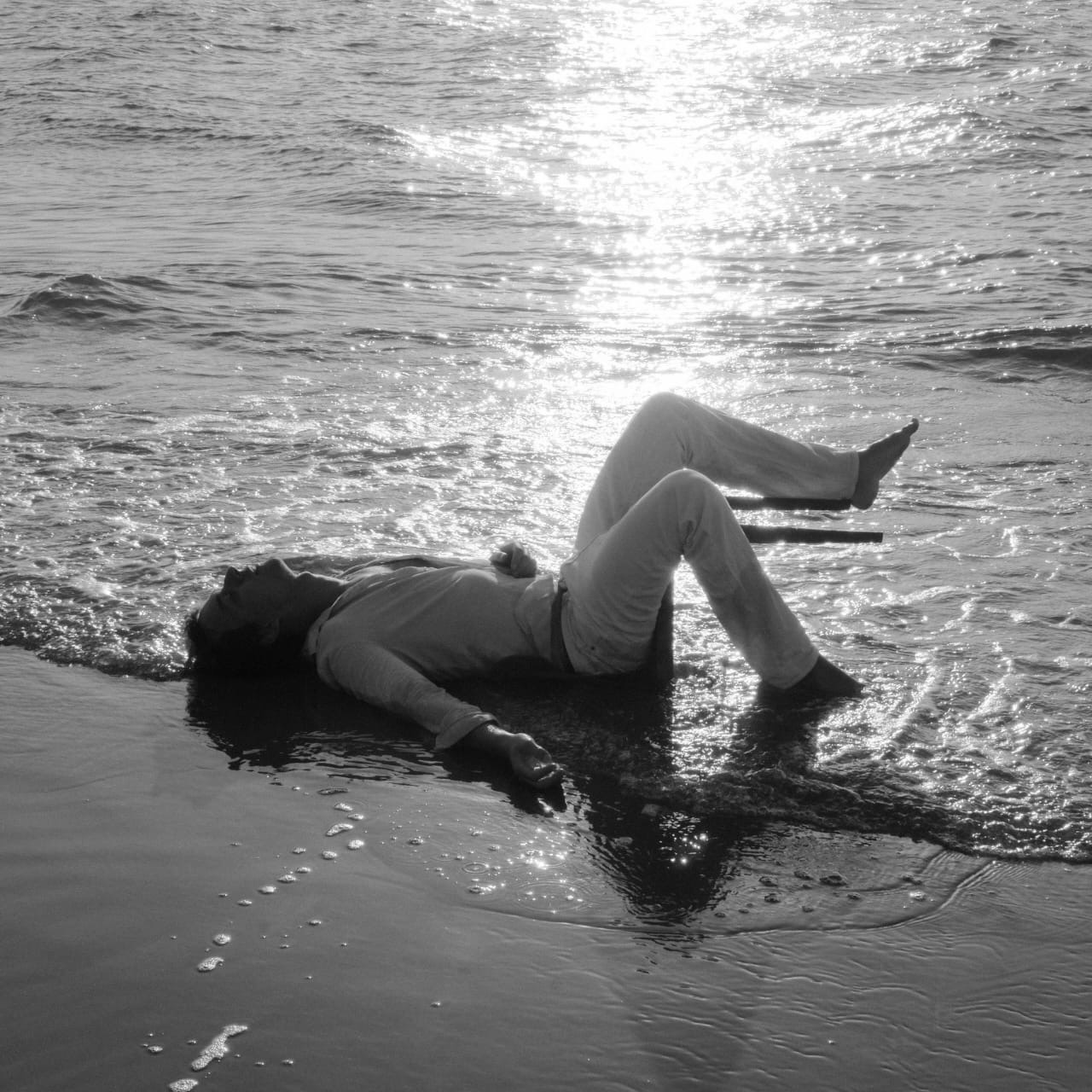
Hello everyone, it’s your host Oliver from DULAXI, and today I’m delighted to be joined by Tom Hartman, a Dutch singer-songwriter based in Rotterdam whose music brings together folk, blues, acoustic rock, and thoughtful storytelling. His latest single, “Storm,” released on 16 October 2026, explores the frightening experience of losing confidence in one’s own reality through the story of a sailor caught in a violent storm. With its dark acoustic folk-rock sound and Celtic influences, the track draws listeners into a deeply personal chapter of Hartman’s life. Before we begin our conversation with Tom, here’s what you need to know about today’s featured project.
About Tom Hartman
Tom Hartman is a Dutch singer-songwriter whose musical identity has developed through years of travelling, performing, and absorbing different songwriting traditions across Europe. Working across folk and blues, he brings together personal experiences, psychological exploration, philosophical questions, and observations about the absurdities of existence. His writing balances dark subject matter with humour, while his interest in storytelling allows him to explore complicated emotions through vivid characters and unusual situations. Having performed hundreds of shows across Europe, Hartman has also developed an expressive live approach as a one-man band, combining guitar, harmonica, stomp-box, vocals, and African percussion to create performances that are energetic, spontaneous, and unpredictable.
Released on 16 October 2026, “Storm” is Hartman’s third single of the year, following “I’ve Been Away” and “High Tree Climb.” The song emerged during a particularly difficult period when he had begun experiencing hallucinations and feared that he was losing his grip on reality. Rather than recounting those experiences directly, he channels them through the image of a sailor struggling to survive a violent storm. This maritime setting gives the song room to explore fear, confusion, and the unsettling relationship between the mind and the world around it. The storm becomes more than a natural disaster, reflecting an internal struggle that left a lasting impression on the songwriter.
The track’s arrangement plays an important role in bringing this story to life. Built around a rolling rhythm with Celtic folk-rock influences, “Storm” uses its instrumentation to mirror the movement and danger of the sailor’s surroundings. The drums evoke thunder and lightning, the bass moves like waves beneath the surface, and the acoustic guitars suggest a ship struggling to escape the chaos. Its surreal imagery, including blue worms consuming the horizon and a threatening bird bearing Hartman’s own signature, adds another dimension to the narrative. These details connect the external danger facing the sailor to the fears and experiences that inspired the song. The recording also features drums performed by Jelle Peeters, whose contribution helps give the arrangement its expressive, full-bodied character.
Hartman’s broader musical development reflects a willingness to explore unfamiliar territory rather than remain within a fixed creative identity. His experience producing music for other artists has informed his approach to arrangement and sound, while his work as a songwriter continues to draw on the darker theatricality of Tom Waits, Bob Dylan’s distinctive delivery, and the Celtic-inflected rhythms of The Waterboys. Following a period away from music, his 2026 releases represent a renewed effort to establish his artistic direction. With further singles planned and performances scheduled throughout the year, Hartman is increasingly interested in exploring mysticism and incorporating African rhythms and electronic elements into his folk and blues foundations. “Storm” offers an insight into that developing identity, presenting a songwriter willing to confront difficult experiences while leaving room for mystery and personal interpretation.
Having this introduction to Tom Hartman and the story behind “Storm,” it is time to hear directly from the songwriter about his creative influences, the experiences that shaped the single, and the musical direction he hopes to explore in the years ahead. So, without further ado, let’s begin today’s interview.
INTERVIEW SESSION
Oliver:
Tom, your biography describes you as a musical adventurer and wanderer who has been travelling across Europe, absorbing different songwriting and poetic traditions. Beyond the places you’ve visited, how have those experiences shaped the way you see people, relationships and the world around you, and how much of that perspective eventually finds its way into your songwriting?
Tom Hartman:
Making music in different places has taught me mainly that people are the same kind of people everywhere. Cultures are different and those differences can be heard in music. A lot of that comes from the landscape as well, which I find very intriguing. I am Dutch, and for me it is typically Dutch to ‘borrow these different forms of cultures’, our orchestrated landscape and merchant culture lends itself nicely for that. The combination of small elements of those different spheres gets itself in different songs.
Oliver:
You have described your music as a meeting point between personal confession, psychological exploration and sharp observations about everyday life. There’s also an interesting balance between nihilism and humour in your writing. Where do you think this outlook comes from, and has it always been part of your personality, or did certain life experiences gradually change the way you approach difficult subjects?
Tom Hartman:
Did I say sharp observations? Oh, excuse me, I am not allowed to say that about myself. There has always been some nihilism in my writing, yes. It has always been in my personality to find existence completely absurd and abundant. Personal confessions grew more later on, it helped me with my emotion regulation as well.
Oliver:
Your journey as a musician has included hundreds of performances across Europe, often appearing as a one-man-band with guitar, harmonica, stomp-box and African percussion. Performing alone requires a different kind of confidence and independence from working within a traditional band. What initially attracted you to this approach, and how has spending so much time performing on your own influenced your relationship with audiences?
Tom Hartman:
What attracted me was the freedom and the speed with which I can now operate. It is nice to be in charge and be able to make quick decisions and decide the course. Being in a band has always been like being in a marriage with multiple people, which asks a lot of attention. However, I do miss it sometimes, maybe in a later stage, when I feel more defined as an artist, I might invite more musicians into my journey. The relationship with the audience gets a lot more personal, it almost feels like they replace the band members in some way. They are the first that make this artistic journey less lonely.
Oliver:
You have also worked as a producer for other artists and projects before taking responsibility for producing your own music. Working behind the scenes can offer a different understanding of how songs are developed and recorded. What did producing other people’s music teach you about arrangement, sound and artistic identity, and how have those lessons influenced the way you approach your own recordings?
Tom Hartman:
Every musical element has its place and they all contribute to the greater part. A statement like this makes a lot of sense, but when I was producing other artists or music for different projects, that’s when I learned to practice with a statement like that. It makes the piece humble to the audience and the musical instruments humble to the piece. With respect to sound there are definitely a couple of techniques which I consider my style by now. This really helps in determining a style and sound.
Oliver:
Bob Dylan, Tom Waits and The Waterboys are among the musical references associated with your work. Each has a distinctive approach to storytelling, atmosphere and musical expression. What initially drew you towards this kind of songwriting, and what have you learned from these artists about creating songs that remain interesting beyond their melodies?
Tom Hartman:
Bob Dylan: his deliverance, this almost angry ‘you have to listen to me’ tone
Tom Waits: his ‘grit’ and theatrical darkness, which suits the song
The Waterboys: their Celtic folkrock writing, from them it is definitely the rhythm and the melody
Oliver:
Let’s talk about your new single, “Storm”, released on 16th October 2026. You describe it as a dark acoustic folk-rock song about a sailor caught in a violent storm, but its meaning reaches much further than a traditional maritime story. What was the first image, thought or musical idea that inspired you to begin writing this particular song?
Tom Hartman:
The hallucinations had just started, I almost didn’t sleep and a half-Irish friend of mine started playing 4 chords at a gathering. There was so much inside me to process that I started singing along, writing some lyrics, and it took only a couple of minutes to write it out and finish it.
Oliver:
You’ve explained that “Storm” emerged during a period when you had begun experiencing intense hallucinations and were struggling to understand what was happening to you. You have described the fear of losing control of your own reality as an extremely difficult experience. Looking back, how challenging was it to turn something so frightening and personal into a song, and did writing become a way of making sense of experiences that were otherwise difficult to explain?
Tom Hartman:
I genuinely thought I was going to lose from some deity, at that point. The writing was easy, it just came out. It came into existence quicker than breakfast. In this case, it was almost automatic, which I translate as venting.
Oliver:
One particularly unsettling experience involved looking into a bathroom mirror and feeling that your own reality had completely distorted. Moments like that can leave a lasting impression on someone’s understanding of themselves and the world around them. Without feeling obliged to revisit anything you’re uncomfortable discussing, how did that experience influence your creative imagination, and did it change the way you approached storytelling after that period?
Tom Hartman:
It was the first time I saw my own corpse, which was really unsettling. I only hallucinated that experience for a month or 2 at maximum. However, I did walk around with depression after that for a couple of years. The songs got really dark after that. It wasn’t storytelling anymore, it was just vomiting darkness.
Oliver:
The sailor at the centre of “Storm” provides a powerful way to communicate fear, confusion and the struggle to survive something beyond one’s control. Why did you choose a maritime setting rather than telling the story directly through the language of psychological distress, and what possibilities did the sailor’s struggle give you as a songwriter?
Tom Hartman:
There is something very scary about being alone at sea during a storm. It is so natural, but also so unnatural for us humans at the same time. It also really fit the Celtic tradition really well. Being close to Rotterdam, NL, there are so many boats here too.
Oliver:
The imagery of the “blue worms” emerging from the ground is particularly unusual, especially when understood as a representation of waves consuming the horizon. Your description of the “grinning bird” is equally intriguing because it carries your own signature carved into its beak. How do you develop these surreal images, and what interests you about allowing symbolic characters and objects to represent internal fears rather than explaining everything directly to the listener?
Tom Hartman:
I don’t invent surreal images to be strange. I use the ones that felt true, even if they weren’t logical. The blue worms started as waves. The bird has my own signature carved into its beak. If I explained it all, I’d kill it. I’d rather people recognise their own fear in it.
Oliver:
There’s a fascinating idea behind the threatening figure in “Storm”: the monster is not entirely an external enemy but something connected to the songwriter himself. That creates a different relationship between the sailor, the storm and the danger surrounding him. What does this self-created monster represent to you, and how important was it to preserve that connection when developing the song’s final narrative?
Tom Hartman:
There was this idea that the creation of that period had to do with me, more than external entities. This self-created monster was how I treated myself, how I got entangled with my own being. That connection was the most true to me, the relationships between the chaos, the main character and the externalized monsters.
Oliver:
Your approach to the arrangement is closely connected to the imagery in the lyrics. The drums represent thunder and lightning, the bass moves like waves, and the acoustic guitars become the wooden ship attempting to navigate the chaos. How did you translate these visual ideas into actual musical decisions, and how do you determine which instruments or sounds are best suited to communicating a particular emotion?
Tom Hartman:
It has a lot to do with the timing, to be honest. Thunder and crashes (represented by the drums) are quite attacking sounds. The Celtic rhythm of the songwriting lends itself to both the quick thunderstrikes from the drums and the rolling waves from the bass. The guitars are actually rushing in the music, being played a little bit ahead of the beat, to represent the fleeing of a ship. The bass, which is the waves, is a little bit behind the beat.
Oliver:
The rolling, Celtic-tinged rhythm gives “Storm” a strong sense of movement, almost as though the listener is travelling through the same conditions as the sailor. At the same time, the acoustic foundation keeps the song connected to traditional folk storytelling. What attracted you to this rhythmic direction, and how did you balance the darker atmosphere with the folk-rock character you wanted the track to retain?
Tom Hartman:
I think the darker atmosphere complements the folk-rock character of the song, however, it was quite challenging for me to combine the different elements. The drums, which were recorded by Jelle Peeters, are quite expressive and full, and the guitars would be more natural being acoustic and high-sounding. The bass would sit below that as a more rolling sub. This type of rhythm lends itself really well to both the quick movements of a thunderstorm and the slower movement of a roaring ocean.
Oliver:
You have described “Storm” as both a look back and a point of no return, suggesting that although the experiences behind it belong to the past, their effects have not simply disappeared. Do you think songwriting has helped you develop a different relationship with those memories, and has your understanding of the experiences that inspired the song changed since you first wrote it?
Tom Hartman:
Songwriting is a part of my character and I believe, in times of fleeing, one can flee in parts of their character, which is why songwriting didn’t really help, as much as that it made it worse. Years later, in order to get out of this depression, I actually had to stop making music. It was because I fled into music to not feel myself. However, in order to heal myself, I should feel myself. That’s how I interpret that story now.
Oliver:
“Storm” is your third single of 2026, following “I’ve Been Away” and “High Tree Climb”. The latter also received encouraging attention from music publications, with reviewers highlighting your songwriting and musical ability. As you look at these three releases together, what do you think they reveal about your development as an artist, and have you noticed any changes in the subjects or musical ideas you’re increasingly drawn towards?
Tom Hartman:
Those three releases reveal a certain groundwork. For me it feels like a start for building a new artist identity. It is like a broad triangle in which the next work is going to develop and yes, there are some ideas that really come to mind now. I feel there is a certain amount of mysticism in those releases, which is a subject I would like to look into deeper.
Oliver:
Your songwriting is often described as having a haunting quality, with psychological and existential themes running beneath the surface of the music. However, your live performances are also described as exuberant, playful and unpredictable. How do you reconcile these seemingly different sides of your artistic personality, and do you find that performing live allows you to express aspects of yourself that might not come through as strongly in your recorded music?
Tom Hartman:
For me those are the same side. If existence is absurd, a song about hallucinations and a stomping one-man band can share a room. Recording is where I’m alone with the heavy stuff. Live, the audience helps carry it, and a dark song can feel lighter when people move along. I also don’t have to be serious on stage, which is a relief.
Oliver:
Having performed hundreds of shows across Europe, you’ve had considerable opportunities to observe how different audiences respond to your music. When performing songs that explore complicated subjects such as perception, fear and existential uncertainty, what kinds of reactions have stayed with you, and have any audience responses changed the way you understand the stories you’re telling?
Tom Hartman:
What I notice is that heavy songs get a silence afterwards, and then people respond more personally than I expect. Fear and uncertainty are something almost everyone recognises. It hasn’t changed the stories, but it makes me feel less alone with them, as if the audience is part of the band.
Oliver:
Your return with a series of singles throughout 2026 suggests a period of renewed creative activity, particularly after spending considerable time writing and recording. You also have selected European performances planned around these releases. How are you managing the balance between developing new material, recording and returning to live performance, and what has been the most rewarding part of this particularly active period?
Tom Hartman:
One release at a time. I record at home, so writing and recording flow into each other, and I plan the shows around the releases. After years away from music, the whole thing gives me energy: writing, releasing, booking, working out what I stand for. The most rewarding part is that this time I’m not using music to flee from myself.
Oliver:
You have built your musical identity around storytelling rather than simply following a particular genre or commercial direction. As an artist who writes, performs and produces his own music, you have considerable creative independence. At this stage of your career, are there still musical territories or forms of collaboration you feel you haven’t explored, and what would you like to challenge yourself with creatively in the coming years?
Tom Hartman:
Plenty. Mysticism comes first: it runs through all three releases and I want to go deeper into it. Musically, I want to bring African rhythms and electronic elements into folk ‘n blues. And when I feel more defined as an artist, I might invite other musicians into the journey. For now, my challenge is to write about things I can’t explain yet.
Oliver:
Finally, Tom, “Storm” tells the story of someone trying to survive a violent force that threatens to consume everything around him, while its deeper meaning comes from your own experience of confronting a period of fear and uncertainty. If listeners take one thing away from this song, what would you hope they understand about the relationship between personal struggle, creativity and survival? And when you look back on your journey so far, what do you hope people will remember most about the music and stories you’ve chosen to share?
Tom Hartman:
That feeling yourself is the way through, even when everything in you wants to flee. Music can be a place to hide or a place to look, and it took me years to learn the difference. If Storm helps someone recognise their own storm and feel less alone, that’s enough. As for what people remember: honest, absurd and slightly mystical stories from a one-man band.
Thank you again for the opportunity.
“Storm” reveals what happens when the mind becomes unfamiliar territory, turning a deeply personal struggle into a story of a sailor facing forces he cannot control. What stays with me is Tom Hartman’s recognition that music can offer both refuge and escape, and that learning the difference can be just as important as finding the words to tell the story.
~ Oliver (DULAXI Team)
EDITORIAL PERSPECTIVE
“Storm” brings together maritime imagery, Celtic-influenced folk-rock, and a personal story that resists easy explanations. Hartman’s attention to rhythmic placement gives the arrangement an identifiable sense of movement, with the instruments reflecting the sailor’s struggle rather than simply accompanying the lyrics. His willingness to leave surreal images unexplained also gives listeners room to bring their own experiences to the song. What makes this conversation particularly revealing is Hartman’s understanding of creativity as something that can both conceal difficult feelings and help expose them. His developing interest in mysticism suggests that this exploration is far from finished.
~ Oliver (DULAXI Team)
CLOSING
Our sincere thanks to Tom Hartman for joining DULAXI and sharing the personal experiences, creative decisions, and reflections behind “Storm.” His openness offers a deeper understanding of a song that uses the struggle of a sailor at sea to explore the difficult relationship between fear, perception, and self-understanding. We also appreciate his thoughts on the freedom of performing as a one-man band, the musical influences that have shaped his work, and the creative directions he hopes to pursue next.
We encourage readers to listen to “Storm” and discover how its rolling folk-rock rhythms, acoustic instrumentation, and surreal imagery come together to tell a story that extends beyond the sea. Those interested in Hartman’s wider musical development can also explore his earlier singles, “I’ve Been Away” and “High Tree Climb,” as he continues building his artistic identity through new releases and live performances.
Thank you for spending time with DULAXI and following our conversations with artists who bring their own perspectives, experiences, and ideas to music. I’m Oliver, and we look forward to welcoming you back for more interviews exploring the people and stories behind the music.