
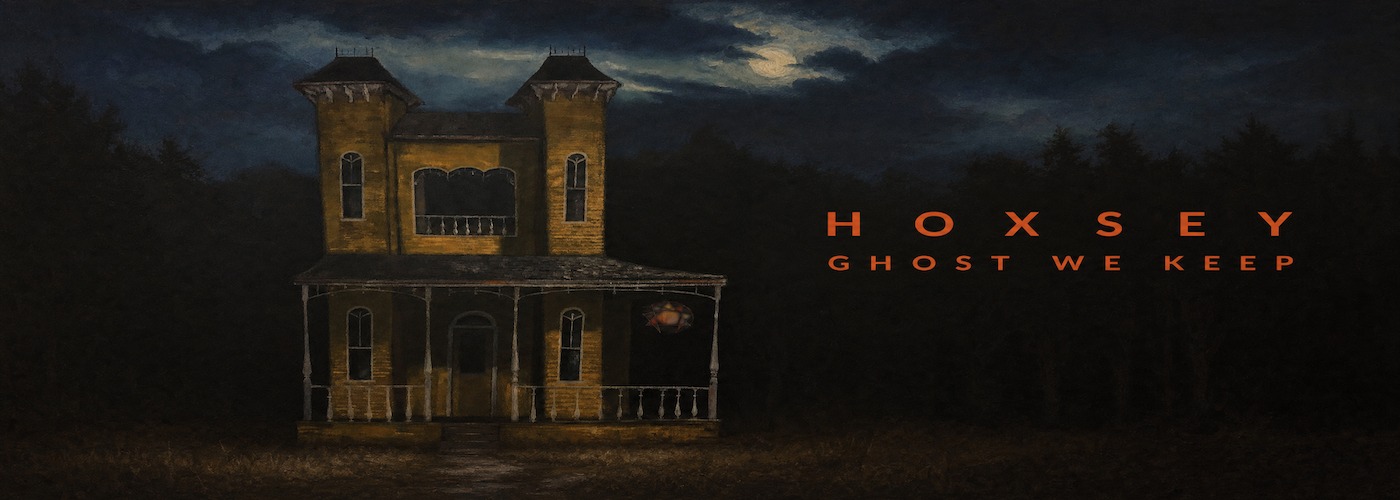
Hello everyone, it’s your host Oliver from DULAXI, and today I’m delighted to be joined by Hoxsey, the Austin-based independent artist behind Ghost We Keep, an 11-track album that moves through alternative rock, indie rock, gothic rock, punk, and experimental sounds. Released on 25th August 2026, the album builds a strange and atmospheric world around traveling performers, forgotten towns, haunted landscapes, mysterious characters, and the memories that refuse to disappear.
Before we begin our conversation with Hoxsey, here’s what you need to know about today’s featured project.
About Hoxsey
Based in Austin, United States, Hoxsey has developed an approach to music that refuses to stay neatly inside one genre. Alternative rock, indie rock, punk, acoustic music, gothic textures, and experimental sounds all become part of a wider musical vocabulary, with narrative-driven songwriting sitting at the centre of the work. Rather than treating genre as a fixed identity, Hoxsey approaches each song according to what the composition and its story require.
Released on 25th August 2026, Ghost We Keep brings that freedom into an 11-track collection shaped by a loose but cohesive world of dirt roads, traveling carnivals, forgotten places, strange characters, and ghosts both literal and metaphorical. The album was created in collaboration with Peppermilk, whose contribution became an important part of the record’s musical identity. Together, they developed a project that feels theatrical without being confined to a straightforward concept.
The travelling-circus imagery runs throughout the album, but the story behind Ghost We Keep developed organically rather than from a rigid narrative blueprint. One of the album’s most important pieces, “The Road,” began taking shape during a period when Hoxsey was travelling back east. Parts of the song were recorded during that journey, including a vocal captured while driving through South Carolina with the car window slightly down. Other elements developed in places such as Philadelphia, Savannah, and New Orleans. That travelling experience ultimately became an important thread in the album’s atmosphere.
The songs themselves introduce a collection of unusual characters and situations. “The Introduction of Sgt. Capone” grew from the memory of an unusually commanding Chihuahua, while “Old Man McKenzie’s Basement” emerged from a more playful character-driven idea. Elsewhere, “Corpses Ball Room” moves into more personal territory, using the imagery of death as a metaphor for the end of a relationship. “Josaphina” similarly grew from a spontaneous voice memo recorded while Hoxsey was walking late at night, eventually developing into one of the album’s more playful moments.
With its shifting sounds and collection of stories, Ghost We Keep ultimately becomes less about following a single narrative and more about experiencing a connected atmosphere. It is a record built from different moments, different characters, and different creative impulses that found their way into the same musical world.
Having this brief introduction to today’s featured project, I’m sure both new listeners and longtime fans are excited to hear directly from Hoxsey. So, without further ado, let’s begin today’s interview.
INTERVIEW SESSION
Oliver:
When you look at the person behind Hoxsey, what parts of your own life and experiences have most influenced the way you write and create music?
Hoxsey:
Well, I don’t know. Experience shapes everyone’s experience here in their own way. I would narrow it down to maybe a trait: I’m stubbornly curious and interested.
Music was interesting to me, and I liked making it. The musical influences I looked up to were attractive to me because they were bold and didn’t fit in a box. That was very appealing to me, especially since I wasn’t musically trained. It gave me a sense that music could be a very free form of expression.
Oliver:
Your music moves between alternative rock, indie, punk, acoustic, gothic, and experimental sounds rather than staying within one genre. What have you learned about your own artistic identity from allowing each song to determine what it needs?
Hoxsey:
I don’t really think in terms of genre, but I do appreciate a cohesive sound. Honestly, all the genres you listed have very similar traits that are wonderful for creating dynamics.
I like a strong-themed song, where the music and lyrics each paint their own picture. If a part sounds good with an acoustic guitar centered and a flute to the left, why not? Or maybe a dirty guitar being palm-muted through a Rat pedal into a Marshall stack at 12.
None of that was used on this album, by the way.
Oliver:
“Ghost We Keep” creates a world filled with traveling performers, dirt roads, worn tents, forgotten towns, old cemeteries, and mysterious characters. Where did your fascination with this traveling-circus imagery begin?
Hoxsey:
It does have that feel. I would say it was designed that way, but it was a little more organic.
Peppermilk and I share similar musical DNA. The traveling circus was always in the back of my mind with the album.
I would say the root or heart of the whole album might be “The Road,” which was written and recorded almost entirely in a car. I was going through a lot at the time and traveled back east. I was staying in Philly and started playing on an old keyboard. The song took root there.
I recorded parts as I traveled. If you listen closely to the opening line, you may hear some static because I recorded that particular line with the window slightly down while driving through South Carolina.
Parts of the song and verses took shape as the travels continued, like the second verse about the person I met in a back alley in Savannah. Guitars were recorded in New Orleans, etc. Never thought about it before, but that might be the progenitor theme of the album.
Oliver:
The album is more than a Halloween-themed collection. When did you realize the record was becoming something deeper than a seasonal project?
Hoxsey:
I look at it as more of a fall album. The themes and ideas were there, but it was organic. I feel that parts of me and Peppermilk are sprinkled throughout.
Also, it’s fun to have personas and characters and play them up!
Oliver:
Why was leaving room for uncertainty and personal interpretation important to you when constructing the album?
Hoxsey:
I feel that’s important in every song. I don’t try to write very personal songs. I have an imprint, but it’s up to the listener to take that next step when listening.
There’s room to be transported into the world and see it through their eyes, and maybe relate in some way. I feel any great story does that. Leave room for a maybe.
Oliver:
How do the characters emerge when you are writing, and do you see them as fictional creations or as vessels for real emotions, memories, or observations?
Hoxsey:
Sgt. Capone was really influenced by an ex-girlfriend’s old, mean, vicious Chihuahua. This dog walked around like it was giving orders. Its name was Capone, and it strutted around like it was Napoleon reincarnated.
The idea started there, and the song is really designed absurdity. It did kind of morph into an anti-war song in my eyes.
Old Man McKenzie was Peppermilk on the goings-on, and I envisioned being captive in a basement with Old Man McKenzie barking orders. Ha ha, so yes, some are rather funny creations.
“Corpses Ball Room” is more personal. It’s of course metaphorical for the death of a relationship and the feelings that stir.
Oliver:
How did you decide which stories belonged within the larger fictional world and which needed to feel more personal?
Hoxsey:
There are a lot of personal elements in each song, some more than others. I feel the ultimate gauge is the cohesiveness of the sound rather than a flowing narrative.
The album itself isn’t really a concept album, but rather a loose agreement on a theme and sound. I feel that’s what maybe makes the songs feel like they really flow or mesh together. They actually kind of do, but it was organic and wasn’t really that much of a concern story-wise.
Each song was written at different times. The only one, “Skeleton Key,” was written later and designed with a little bit of narrative in the beginning. With most of the songs already done, we were able to incorporate some of the themes into it.
Oliver:
“The Road” seems particularly connected to the idea of leaving places behind while continuing to carry parts of them with you. What does the road represent within the world of “Ghost We Keep”?
Hoxsey:
Well, you’re right. As I mentioned earlier, “The Road” may be the most personal song, at least for me, on the album.
Oliver:
“Josaphina” also brings the record toward a more personal emotional space. What did you want that character or story to reveal?
Hoxsey:
“Josaphina,” I feel, was more cheeky.
An interesting fact about “Josaphina” is that the very beginning of the song, when I whisper “Josaphina,” was a voice memo I made while walking late at night on a sidewalk to a friend’s house. That simple little start was the creative influence for the whole song. That’s why I put it at the very beginning. I liked the way it sounded.
I’ve never been a fan of dolls, so it created instant imagery. It’s a cheeky, sort of funny song, and we also wanted to have that beer-on-the-wall sing-along feel at the end of the chorus.
Oliver:
The album was created in collaboration with Peppermilk. What did that collaboration bring to “Ghost We Keep”?
Hoxsey:
Peppermilk and I have been besties forever. She was an absolutely huge part of making the album.
She is a fabulous writer and quite crafty on the keys and an array of instruments. Again, we share musical DNA, and her talent and unique perspective were huge.
Oliver:
How did you use the strange or surreal elements of the album to approach emotions that might have been harder to express in a straightforward song?
Hoxsey:
No response was provided to this question.
Oliver:
How do you know when an unusual musical idea strengthens the story rather than simply making the song more experimental?
Hoxsey:
I feel like we just did what we liked or heard. There wasn’t any thought of whether we should or shouldn’t try something.
We would try to execute the playing, and if it fit the scope of the theme of the song, we were happy.
I didn’t really feel that way with this particular album, but I have felt that way with the current one I’m working on.
Oliver:
With eleven tracks contributing to one larger universe, how did you think about the sequencing of the album?
Hoxsey:
Yes, I had to sit on that for a week and try different lineups. I kind of felt what was right.
I think the track order works with the dynamics of the tracks.
Oliver:
What does the phrase “Ghost We Keep” mean to you personally now that the album is finished?
Hoxsey:
The album name does reflect the album. It’s perfect for it.
You would usually be ready to get rid of a ghost, right? We all keep a couple of them.
Oliver:
You have called “Ghost We Keep” a potential classic Halloween album for the next 50 years. What would you want someone listening to it years from now to understand?
Hoxsey:
Ha ha, I did say that! I was being cheeky.
I don’t think it’s a Halloween album. It’s more of an early fall album. It’s about dealing with change and renewal, but also carrying that little bit of baggage.
Oliver:
How has being based in Austin influenced the way you approach your sound, storytelling, and independence as an artist?
Hoxsey:
Austin is great. There is so much musical flavor here, and it’s a hot spot for touring bands, so there are so many great acts playing every night.
Oliver:
Looking back at the making of “Ghost We Keep,” was there a particular song, character, or moment that surprised you by becoming more important to the album than you originally expected?
Hoxsey:
What really stands out about the album was the time spent making it—the people and experiences.
It was a wonderful time. I’ll remember the era more than anything.
Oliver:
What have you learned about yourself through creating an album focused on what remains after people, places, and moments have passed?
Hoxsey:
They do. Be kind of aware of your own mortality. I feel that it’s healthy to carry that around.
People and places come and go. Even really, really close people may not be that close in the future. You carry that with you.
Ever hear a song and have it transport you to a time or place? I feel that’s one of the most powerful effects of music.
Oliver:
Once someone has travelled through all eleven tracks of “Ghost We Keep,” what do you hope they are left thinking about?
Hoxsey:
I would hope that it really took you away for a moment, like a great show or movie.
I would hope they come away with thoughts and feelings that stay with them. Maybe they related to a song and thought of a person, place, or feeling.
That’s what it’s all about.
“Ghost We Keep” finds its strength in the space between the strange and the familiar, turning roads, characters, memories, and imagined ghosts into a world that listeners can enter without being told exactly what they should find there.
~ Oliver (DULAXI Team)
EDITORIAL PERSPECTIVE
What makes Ghost We Keep particularly interesting is the way its theatrical atmosphere grows from genuinely personal moments rather than from a rigid concept. The album can move from absurd characters to intimate memories without losing its identity, while its shifting instrumentation keeps the experience unpredictable. Hoxsey’s approach gives the songs room to exist as individual stories while still belonging to the same world. The result is an album that feels less like a seasonal novelty and more like a collection of memories viewed through a surreal autumn landscape.
~ Oliver (DULAXI Team)
CLOSING
Our conversation with Hoxsey offers a fascinating look into the people, places, experiences, and creative accidents that shaped Ghost We Keep. What begins as a world of travelling performers, strange characters, old roads, and ghosts gradually reveals something much more familiar: the memories we carry, the places that change us, and the parts of our past that remain long after we have moved on.
Thank you to Hoxsey for taking the time to speak with DULAXI and for sharing the stories and creative ideas behind the album. For listeners discovering Ghost We Keep for the first time, the best way to understand its world may simply be to step inside it and allow the songs to create their own associations.
And to everyone reading, thank you for spending time with DULAXI and joining Oliver for another conversation with an independent artist. We look forward to bringing you more interviews, more stories, and more music from artists creating their own paths.