
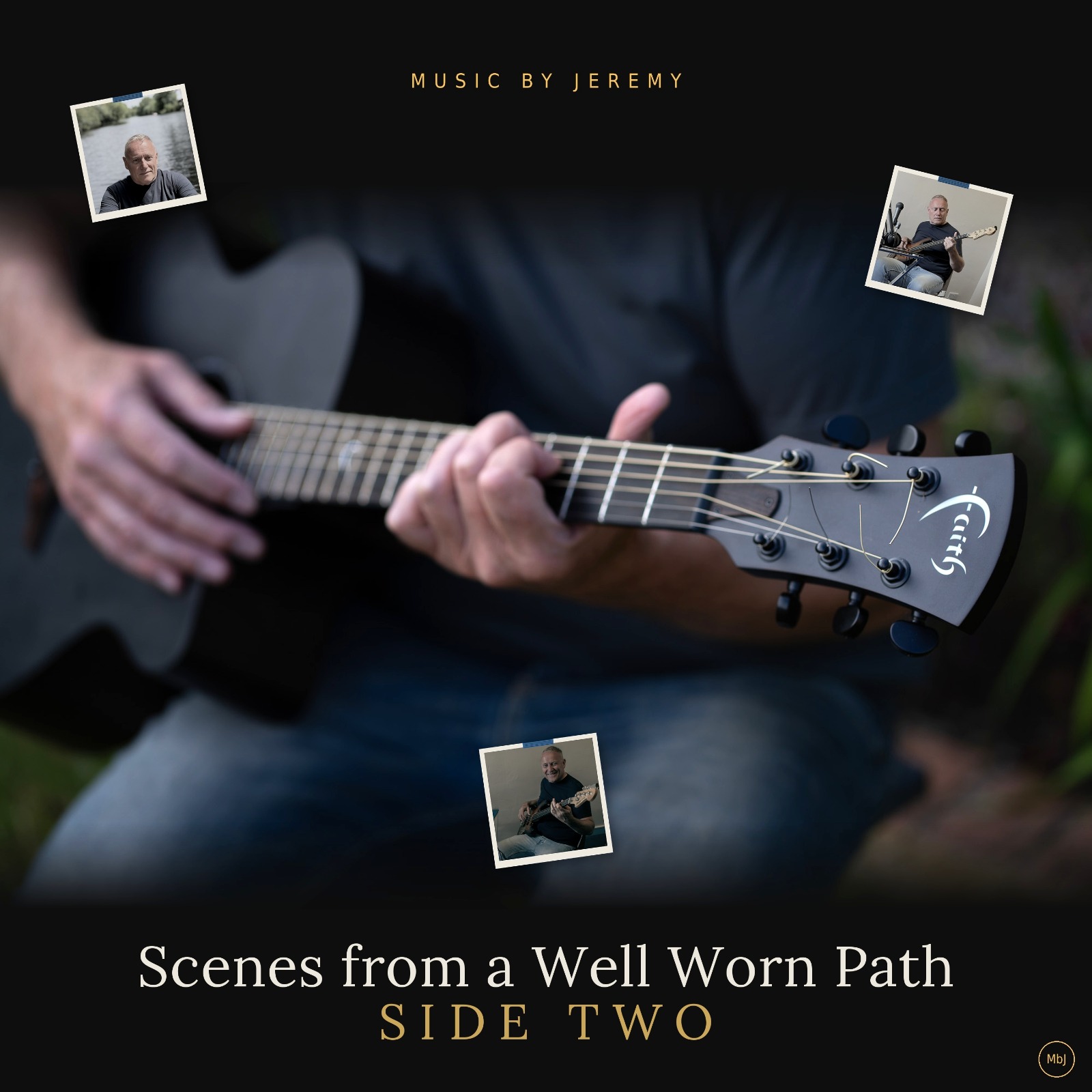
Hello everyone, it’s your host Oliver from DULAXI, and today I’m delighted to be joined by Jeremy, the songwriter and multi-instrumentalist behind Music by Jeremy, from Banbury, England. Working across acoustic rock, alternative rock, melodic pop rock, indie, and adult-oriented rock, Jeremy is currently presenting the second instalment of his ambitious four-part debut project, Scenes from a Well Worn Path – Side Two, released on 25th September 2026.
The project is part of a 24-track double album being released across four separate sides, with Side One arriving in August, followed by Side Two in September, Side Three in October, and Side Four in November. Built independently from a small studio in Oxfordshire, the project brings together songwriting, personal reflection, guitar-based musicianship, and an unconventional production process involving generative AI tools used to help realise the wider musical arrangements.
Before we begin our conversation with Jeremy, here’s what you need to know about today’s featured project.
About Music by Jeremy
Music by Jeremy is the musical project of Banbury-based singer-songwriter and multi-instrumentalist Jeremy, whose debut arrives not as a cautious introduction but as a substantial body of work developed across 24 tracks. Scenes from a Well Worn Path is being presented in four sides, allowing the story to unfold gradually while preserving the sense of a much larger artistic statement.
Jeremy’s songwriting has been shaped by a lifelong affection for artists who combine strong storytelling with personal honesty. John Lennon, Paul Simon, Randy Newman, Bob Dylan, and Bruce Springsteen are among the writers he identifies as important influences, while the pitch for the project also points to the impact of David Bowie and his willingness to continually reinvent his musical identity. Across these influences, there is a common interest in songs that do more than communicate an immediate feeling. They examine people, relationships, contradictions, and the circumstances that shape how we understand ourselves and one another.
That approach is particularly relevant to Scenes from a Well Worn Path. The project explores the distance between expectations and reality, the challenges of genuine human connection, and the personal courage involved in confronting difficult truths. Rather than treating emotion as something simple or neatly resolved, Jeremy’s writing allows conflicting feelings to exist alongside one another. Pain can sit beside joy, grief can exist within a fulfilled life, and personal uncertainty can become part of a broader reflection on how people navigate the world.
Side Two continues that larger journey. Among its featured songs are “Do Birds Sing the News” and “Idonella Sakaiensis”, two tracks that approach very different subjects while sharing an interest in making the listener pause and consider the world around them. “Do Birds Sing the News” emerged from Jeremy’s thoughts about media, public opinion, and the way information can shape perception, while the idea for “Idonella Sakaiensis” developed after he encountered an article about a plastic-eating bacterium and began reflecting on society’s dependence on people and systems that are often presented as indispensable.
The songs were created within Jeremy’s small studio in Banbury, Oxfordshire. Much of the writing began with an old Faith acoustic guitar, sometimes while he was sitting in his garden. From there, the material developed through his own playing, songwriting, and production. Jeremy wrote the music and lyrics himself, while generative AI tools were used to help create vocals, drumming, and the broader band environment that he could not assemble in person.
That production approach forms an unusual part of the project’s identity, but it is not presented as the purpose of the music itself. For Jeremy, the technology functions as a means of overcoming practical and personal limitations while keeping the songwriting at the centre. Working without a conventional band also gave him a level of privacy that allowed him to explore parts of himself he might previously have kept hidden. The result is a project built around the tension between traditional songwriting values and contemporary production possibilities.
With the complete album now finished and the remaining sides scheduled for release on 25th October and 25th November, Scenes from a Well Worn Path is gradually revealing itself as a single artistic journey rather than four disconnected releases. Side Two therefore occupies a specific place within that journey, carrying the listener further into Jeremy’s experiences while continuing to develop the themes established by the opening side.
Having this brief introduction to today’s featured project, I’m sure both new listeners and those who have already discovered Side One will be interested to hear directly from Jeremy about the experiences, ideas, technology, and songwriting behind Scenes from a Well Worn Path – Side Two. So, without further ado, let’s begin today’s interview.
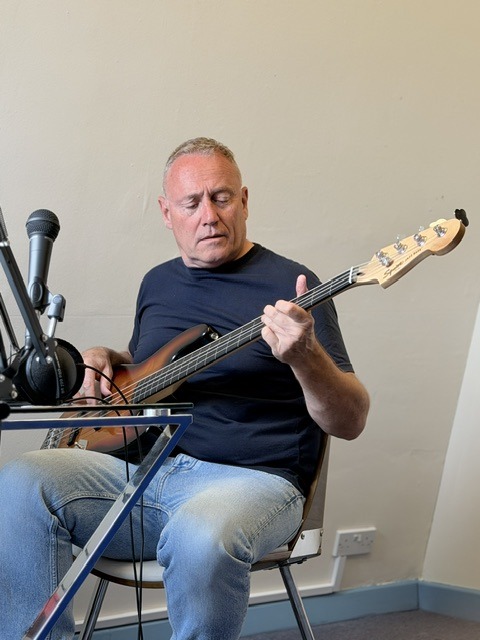
INTERVIEW SESSION
Oliver:
Coming from Banbury and building this project independently from your own small studio in Oxfordshire, what parts of your personal life and upbringing have shaped the way you understand people, emotions, and the stories you now explore through your songwriting?
Music by Jeremy:
Environment makes up a huge part of a person’s worldview and I’m lucky enough to have lived and worked in different places and engaged with people from very many cultures and backgrounds. This has helped me to appreciate that people can have different – and entirely valid – feelings and emotions.
My current base of Banbury, and the surrounding countryside, has been home to people for thousands of years and I think that aspect gives a real grounding and perspective on life.
Oliver:
You have described your writing as something that interrogates feelings rather than simply presenting them. Where did that instinct come from, and what have you learned about yourself by being willing to examine difficult emotions instead of simply writing about them from a distance?
Music by Jeremy:
I wouldn’t describe it as an instinct, but rather a result of the way I’m producing this material. When I started on this project my songs were fairly typical of the kind of work I’ve always produced, but working alone with a couple of guitars and a PC for company I found the freedom, and lack of self consciousness, to share things I’ve never expressed before. This has actually been cathartic for my relationship with myself! And has given me an opportunity to reconcile fully with my younger self!
Oliver:
Much of your artistic identity has been shaped by storytellers and confessional songwriters such as John Lennon, Paul Simon, Randy Newman, Bob Dylan, and Bruce Springsteen. What is it about their honesty, storytelling, or willingness to examine human behaviour that has stayed with you, and how have those influences developed into something that feels distinctly your own?
Music by Jeremy:
These are artists that I have always loved, and people that have supported me through some very challenging times in my life (thanks chaps!), but I’m only now starting to understand the strength and fortitude they possessed to enable them to do that. I think realising that it’s not just about talent but the mental toughness it takes to bleed on stage is the thing I most admire and aspire to.
Oliver:
Your music sits across acoustic rock, alternative rock, melodic pop rock, indie, and adult-oriented rock, while the writing remains central to the work. How do you balance the importance of strong songwriting and lyrical meaning with your desire to explore different musical directions?
Music by Jeremy:
For me, everything is about the Song and the form is just whatever best serves it. The chords, melody, and theme are locked. After that, it’s really about finding a style that serves them. Having said that, writing on different instruments, or even just a new guitar sound, is a great way to avoid getting stuck in a musical rut.
Oliver:
The idea of a 24-track double album being released across four separate sides is a remarkably ambitious way to introduce yourself as an artist. When did you realise that these songs belonged together as one larger statement, and what did you want the complete project to say that a conventional single or shorter album could not?
Music by Jeremy:
I composed the songs in a relatively short period, and it always felt like they belonged together. Without too many spoilers, Side One is an introduction and backward-looking; Sides Two and Three are more about my life experiences and worldview.
Four brings us right up to date and deals with reflections on everything that came before and thoughts about what is left to come.
There was too much to fit into a conventional album format, and dropping 24 tracks would be too much to expect people to buy into from an unknown artist. So this seemed like a great way to introduce myself and make the album I’ve always wanted.
Oliver:
Side Two moves through pain, grief, joy, and fear, while also carrying the perspective of someone who describes himself as living a very fulfilled life. How do those apparently different emotional states coexist within the person and songwriter behind this record?
Music by Jeremy:
I have heard it described as the ‘duplicity of adulthood’. We survive by accepting conflicting views, opinions, and emotional states. The people that I love the most also bring pain and frustration. I think I’m a good person, but I’m capable of doing shitty things. For me, music has always been profoundly supportive through this turmoil and has helped me to see the beauty and joy in life.
Oliver:
“Do Birds Sing the News” and “Idonella Sakaiensis” are singled out for their thought-provoking writing and their ability to make people stop and consider how they live. What personal questions or observations were you wrestling with when you wrote those songs, and what made you feel those ideas needed to become music?
Music by Jeremy:
‘Birds’ was a lovely accident! I’d been struggling with the way that the media is used to manage and manipulate public opinion. One morning we woke up to a very loud ’dawn chorus,’ and my wife asked if I thought they were “singing the morning news”. I’d been playing with a lovely ’tweety’ riff on my acoustic the day before and everything just clicked!
‘Ideonella’ came from an article I read in New Scientist about a plastic-eating bacterium, and I got to musing about all the noisy politicians and managers telling us the world can’t survive without them. It’s actually unusual for me, but here the lyrics came first, and I had to find the chords and melody to carry them. Ideonella was actually one of the harder songs to write because the theme is so strong, the music had to be able to carry it so it went though a few iterations before I got it right!
Oliver:
Your songwriting often examines the gap between what people are promised and what they ultimately receive, as well as the difficulty of authentic human connection. Why are those tensions so important to you as a writer, and how do your own observations of relationships and everyday life find their way into that subject matter?
Music by Jeremy:
Your question made me think of Mick & Keith singing ‘you can’t always get what you want’. It’s hard not to slip into clichés here, but I think really seeing and appreciating what you get is essential to avoid getting caught up in our consumerist society.
Which takes me neatly to human connection. I wrote a song on Side Three about looking out on the Banbury market from my studio that highlights the simple joy of ordinary people just chatting and laughing. This is where life sits, and I think it’s worth celebrating.
Oliver:
You have spoken about writing much of this music on an old Faith acoustic guitar, sometimes sitting in your garden. What is it about that particular setting and instrument that helps you access the kind of honesty and reflection that sits at the centre of your songwriting?
Music by Jeremy:
It’s a place of genuine peace for me where I have the space to let my thoughts roam freely and I feel safe enough to express myself uninhibited.
I find an acoustic guitar to be the most wonderful instrument. Even after years of playing, there’s always a chord or phrase that excites and surprises me.
And we have the birds singing for inspiration!
Oliver:
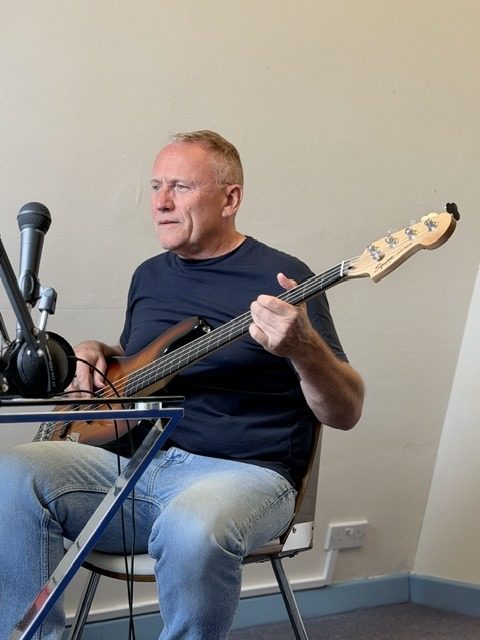
Although you wrote all of the music and lyrics yourself, you used generative AI tools to help complete the vocals and drumming and build the wider band around your compositions. What was it like emotionally and creatively to use technology in such a personal project, and how did you make sure the technology remained a tool for your artistic intentions rather than becoming the defining feature of the music?
Music by Jeremy:
I couldn’t have achieved the same unfiltered emotional output if I had been working with a human band, so the tech has been important for me to get past this fear. Having said that, there are collaborative things I miss from the band environment, so there is definitely a place for both.
There are times it takes some effort to keep the ‘silicon session band’ in its place, and I regularly remind myself that everything is about the Songs, so there’s a lot of virtual tape left on the studio floor.
Oliver:
You have described AI as a “prosthetic” that allowed you to realise a band you could not assemble in person. How did working within that limitation affect your creative decisions, and did it ultimately change the way you thought about what an independent artist can achieve from a home studio?
Music by Jeremy:
The advent of AI has already tipped an already challenged music industry into turmoil, so this is the million-dollar question.
Fully AI generated music is pretty terrible and I find it helpful in creative terms to view AI as a cliche machine. I think the industry as a whole has been very slow off the mark and should bear a large part of the responsibility for the flood of AI slop from the streaming platforms and airwaves. But I think AI also offers the industry a way out of its current malaise.
Like our modern economy as a whole, the system seems to reward a very small number of artists inordinately well and leaves a vast number of talented and hard-working people with nothing. It also broadly fails to serve the consumer in any meaningful way.
The enormous cost of recording and launching a new artist means that the record companies want to mitigate their investment risk and so are programmed to seek out the ‘sure thing ‘, which definitely isn’t going to be anyone taking a risk musically.
Well-used AI tools can fill this gap. ‘Scenes from a Well Worn Path’ would have cost tens of thousands of pounds to make and produce to this standard by traditional routes. There is a massive likelihood that it will never make any meaningful money at all, so who would carry that risk (other than a delusional old man – but let’s not go there 😂)?
We are in the middle of the storm right now, and there is much that will evolve over the next couple of years, but my position is optimistic. If it gives talented songwriters an opportunity to get their work into the marketplace that wouldn’t otherwise exist, I think it can benefit the artists and the consumers.
Oliver:
Creating an entire double album independently requires a very different level of commitment from writing a handful of songs. What were the most difficult moments during the writing, recording, and production of these four sides, and what kept you committed to completing such a large artistic statement?
Music by Jeremy:
If I’d realised just how hard it was going to be, I’m not sure if I would have started! I released Side One probably a bit before I was really ready but it made sure the commitment was there!
I think it’s also fair to say that I wasn’t expecting the extent of the positive response that it received. So I found myself having to deliver something worthy of the press it was getting.
The whole album is now complete, mastered, and ready for release, and the last couple of months have been exhausting, but I think it tells some important truths about compassion and understanding that the world and particularly the media are very short of at the moment.
Oliver:
Side One received extremely positive responses for its passion, wit, emotion, honesty, and humanity. After hearing how people responded to the first part of the project, did that reaction change the way you approached Side Two, or did you feel it was important to remain completely faithful to the vision you had already established?
Music by Jeremy:
I think I’ve answered most of this in the previous question. I was absolutely overwhelmed by the responses. I have remained with my original vision but it’s also true to say I have had to work very hard to justify the faith people are showing in my work.
Only one real change was from the comprehensive misunderstanding of ‘The Story of a Mistress’ across reviewers. The song is a painful confessional around alcohol dependency, but on reflection the signposts were too subtle. So I’ve reworked a couple of tracks to make sure the underlying meanings had less potential for misunderstanding….
Oliver:
As this is your debut as Music by Jeremy, you are introducing audiences to a very developed body of work rather than gradually revealing your identity through several smaller releases. What have you discovered about yourself as an artist through creating such a substantial first statement?
Music by Jeremy:
I think the most striking thing is finding my confidence as an artist. I have exposed things about myself that I wouldn’t previously have shared with the people closest to me – many not even to myself. To have complete strangers not just accepting but even encouraging me has been an incredibly powerful and moving experience.
Oliver:
There is a strong sense throughout your writing that meaningful change requires courage, particularly when people have to confront the distance between their expectations and reality. What has making this record taught you about change, honesty, and the things people sometimes have to acknowledge before they can move forward?
Music by Jeremy:
I think exactly that. As a more mature person, it’s incredibly easy to be ‘preachy,’ and I’ve put huge efforts into avoiding that for the album – and in my life more generally. And if you’re going to talk about having the courage to be honest with yourself and accept change, not doing it stops being a realistic option!
Oliver:
With Side Two arriving on 25th September and Sides Three and Four following on 25th October and 25th November, the story of this album is still unfolding for listeners. What do you hope people understand about the larger picture as they move from one side to the next?
Music by Jeremy:
The Sides have distinct personalities and my hope is that the piece stands as a complete piece of art when it’s viewed as a whole. The title was very intentional and takes the listener from my teenage years to me now. It does have an ending, but the ending is also a beginning.
Oliver:
When listeners spend time with these songs, what do you hope stays with them beyond the music itself? Are there particular questions, feelings, or reflections you would like the record to leave people considering about their own lives?
Music by Jeremy:
On a personal level, I’d love to think that sharing my own struggles might give someone a perspective to help them feel good about life.
More grandly, I hope that people find something to stop and think that there’s always another point of view and it would be easier to engage with that if we were just a bit nicer to each other.

Oliver:
Looking beyond the completion of this four-part release, what does the next chapter of Music by Jeremy look like for you, and how would you like your songwriting, musical identity, and relationship with listeners to develop from here?
Music by Jeremy:
I mentioned earlier that I want the end of ‘Scenes from a Well Worn Path’ to be a beginning. I would love to get these songs played live in some way (if anyone reading this is interested, please contact me!).
Although I have huge affection for this album, the last couple of months have been exhausting, and the emotional tank is thoroughly empty. But I have started on some new material, and there will be another album in 2027. It has a working title and will be more traditional in format, although I’m not quite sure yet what form it will end up taking.
The thing for sure is that my musical biography is done. I am personally at a time of significant change in my life, so what comes next will be very much rooted in my present.
“Jeremy’s approach turns a home studio into a space for unusually open songwriting, where lived experience, curiosity, technology, and reflection meet without losing sight of the song itself.”
~ Oliver (DULAXI Team)
EDITORIAL PERSPECTIVE
There is something compelling about the way Scenes from a Well Worn Path – Side Two places intimate songwriting alongside wider observations about society, relationships, media, and change. The acoustic foundation gives the material a familiar human centre, while the unusual production process creates room for Jeremy to pursue ideas beyond the limitations of a conventional home recording setup. More than anything, the project feels shaped by a willingness to examine contradiction rather than resolve it too neatly.
~ Oliver (DULAXI Team)
CLOSING
Our conversation with Jeremy offers an unusually open look at the ideas and experiences behind Scenes from a Well Worn Path – Side Two. From the quiet setting of an acoustic guitar in the garden to the much larger questions surrounding technology, creativity, human connection, and modern life, the project reflects an artist using songwriting as a way to examine both his own experiences and the world around him.
Thank you to Jeremy for taking the time to speak with DULAXI and for sharing such thoughtful insight into the making of this release and the wider four-part project. As Side Two continues the story begun with Side One, listeners can follow the journey through the forthcoming third and fourth sides and discover how the complete work ultimately comes together.
For readers discovering Music by Jeremy for the first time, this is a project worth experiencing in its intended sequence, allowing each side to contribute to the larger story. And for those who have already followed the journey from Side One, Side Two offers another opportunity to spend time with Jeremy’s songwriting, ideas, and evolving artistic identity.
Thank you for spending time with DULAXI. We hope you enjoyed getting to know more about Jeremy and the world behind Scenes from a Well Worn Path – Side Two. Stay with us for more conversations with artists whose music has a story worth hearing.