
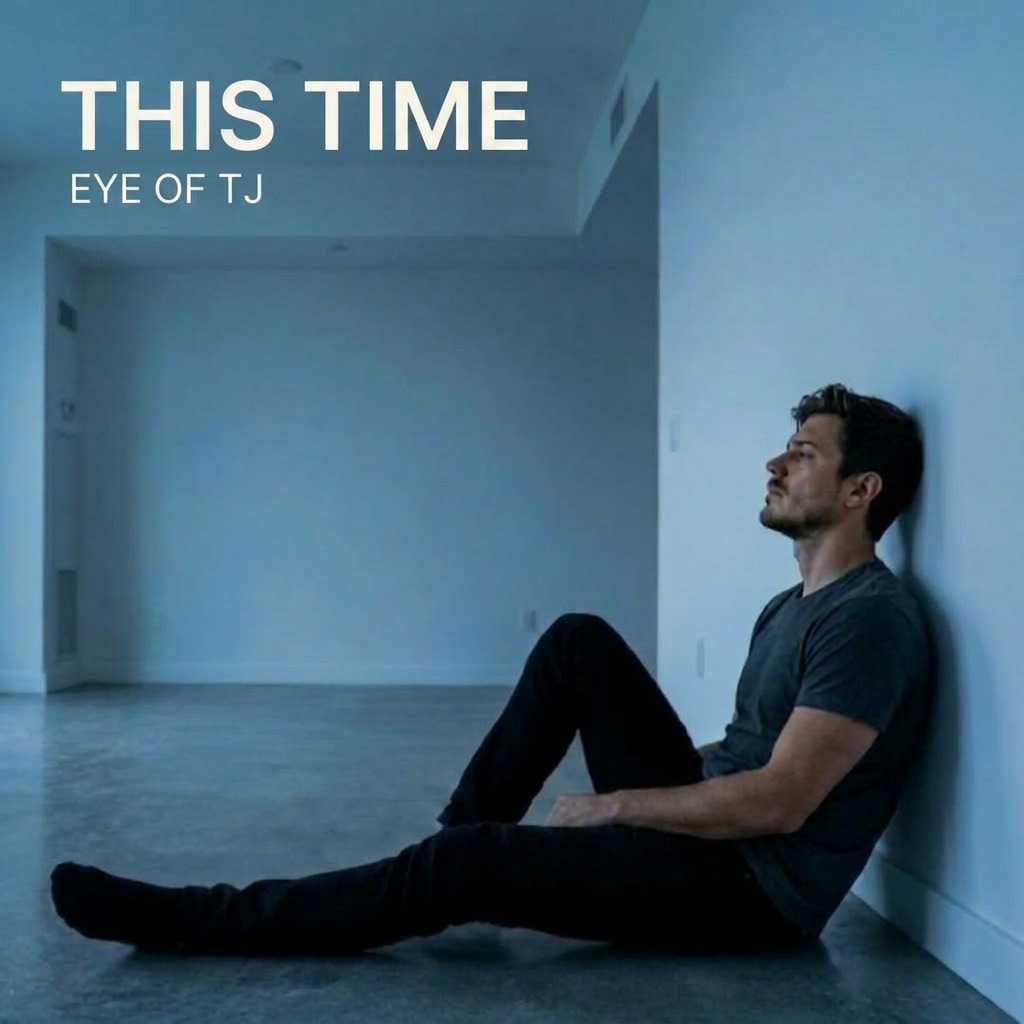
Hello everyone, it’s your host Oliver from DULAXI, and today I’m delighted to be joined by Eye of TJ, the Mobile, Alabama-based project known for blending gritty storytelling with expansive rock sounds and what he describes as “Cinematic Grit.” His latest release, “This Time,” arrived on 28th August 2026 as the lead single from the forthcoming album Endless War, due in September 2026.
With its return to a more definitive rock sound, “This Time” marks an important point in Eye of TJ’s continuing evolution. The release follows the country/rock EP Knowing the Risk, released in June 2026, and introduces a heavier, more guitar-driven direction built around emotional honesty, personal experiences, and stories of relationships that have reached their breaking point.
Before we begin our conversation with Eye of TJ, here’s what you need to know about today’s featured project.
About Eye of TJ
Based in Mobile, Alabama, Eye of TJ has developed a musical identity around the stories people often struggle to say out loud. His work brings together anthemic 2000s-inspired rock, Heartland storytelling, alternative rock, and country-rock, with gritty vocals and atmospheric production forming the foundation of what he calls “Cinematic Grit.” Rather than treating personal experiences as isolated stories, Eye of TJ uses them as a way of exploring emotions that listeners can recognise in their own lives.
The project has already built meaningful momentum independently. Eye of TJ surpassed the 50,000-stream milestone on Spotify during his debut era and has now reached nearly 100,000 total career streams. His debut album, Everything I Didn’t Say, has exceeded 30,000 streams, with “Letting Go of You” becoming a breakout moment within the catalogue. The project has continued to develop through a body of work centred on relationships, heartbreak, emotional aftermath, and the silence that follows difficult endings.
That evolution continued with Knowing the Risk, a country/rock EP released in June 2026. While that project explored another side of Eye of TJ’s musical identity, the forthcoming Endless War moves decisively back toward rock. “This Time” serves as the first major statement of that transition, surrounding Eye of TJ’s gritty vocal delivery with expansive melodic guitars and a larger sonic scale.
At the centre of “This Time” is a difficult emotional realisation. The song examines what happens when trying to help someone else begins to damage the person doing the helping. Its story is not simply about the end of a relationship, but about the gradual recognition that devotion can become self-abandonment when one person continues carrying the emotional weight for both people.
That idea connects closely with Eye of TJ’s wider approach to songwriting. His music often begins with real experiences and difficult emotions, but the intention is not simply to document his own life. Instead, those experiences become starting points for stories that other listeners can see themselves inside. His concept of creating “widescreen movies for the ears” reflects that approach, with songs designed to give emotional experiences a sense of place, movement, atmosphere, and scale.
“This Time” also introduces the larger emotional world of Endless War. The album’s title points toward an internal struggle that extends beyond a single relationship. Love, hurt, old trauma, self-preservation, and the difficulty of knowing when to stop fighting all become part of that larger story.
With “This Time” opening the door to Endless War, Eye of TJ is continuing to build a catalogue that turns personal struggles into something listeners can recognise, question, and perhaps use to understand their own experiences a little better.
Having this brief introduction to today’s featured project, I’m sure both new listeners and longtime fans are excited to hear directly from Eye of TJ. So, without further ado, let’s begin today’s interview.

INTERVIEW SESSION
Oliver:
Growing out of Mobile, Alabama, and building Eye of TJ around stories that often remain unspoken, what experiences in your own life first taught you that music could be a way of giving those difficult or uncomfortable emotions a voice?
Eye of TJ:
I think music is a way that everyone can express themselves, even when they don’t really know how to say what they’re feeling. I’ve always loved listening to a song and having that moment where I’m like, “Damn, this song understands me.” I think one of the most powerful things about music. You can hear somebody singing about something they went through and somehow it becomes your story too.
For me, songwriting became a way of taking things that were difficult to talk about and putting them somewhere. Sometimes it’s easier for me to write something down than to sit across from somebody and try to explain exactly what’s going on inside my head. I don’t necessarily write because I have all the answers. A lot of times I’m writing because I’m trying to understand the feeling myself.
And if somebody else hears it and thinks, “I’ve been there too,” then it becomes bigger than just my experience. That’s really what I love about music. You can take something very personal and somehow make another person feel less alone.
Oliver:
You have built your identity around raw storytelling, gritty vocals, and what you describe as “Cinematic Grit,” turning personal struggles into something listeners can experience almost like a widescreen story. Where do you think that instinct for emotional honesty comes from, and what do you feel you are trying to say about yourself through the stories you choose to tell?
Eye of TJ:
I think a lot of it comes from just being very open and honest in my songwriting. I don’t really want to hide behind the song. If I’m going to write about something, I want to actually go there. Even if it’s uncomfortable.
A lot of what I write is based on real-life stuff, but at the same time, it’s not just about me. These are things that happen to everybody. People fall in love, people get hurt, people stay in situations longer than they should, people try to fix things that maybe can’t be fixed. Everybody has some version of those experiences.
I think that’s where the “Cinematic Grit” idea comes from for me. I want the song to feel like you’re watching something happen. I want you to hear the emotion, but I also want you to picture it. Maybe you’ve lived that exact story, or maybe you’ve lived something completely different that gave you the same feeling.
Ultimately, I think I’m just trying to be honest about who I am and what I’ve been through. I’m not trying to pretend I’ve figured everything out. I’m just turning the things I’ve experienced into songs.
Oliver:
Your earlier work, including the country/rock EP Knowing the Risk, showed one side of your musical identity, while your current “Rock Pivot” takes you toward a heavier, more guitar-driven direction. What changed creatively or personally that made this the right moment to lean back into rock, and what does rock allow you to express that your previous sound could not?
Eye of TJ:
I think the biggest difference is that these songs on Endless War feel a little more personal to me. There are still elements of that breakup story that have been part of my songwriting, but this time there’s another layer underneath it. A lot of these songs connect to older trauma and things that have stayed with me longer than I probably realized.
Rock just gives me a place to let that emotion get loud.
There are some feelings where a softer song works, but there are other feelings where you almost need the guitars to hit you in the chest. That’s what I wanted this time. I didn’t want to hold everything back. I wanted the music to have some weight behind the words.
Knowing the Risk was important because it helped me figure out what I wanted to say and how I wanted to say it. But with Endless War, I feel like I’m getting closer to the sound that really feels like me. It’s heavier, it’s more guitar-driven, but it’s still built around the songwriting. That’s the part I don’t want to lose.
Oliver:
Your music sits between anthemic 2000s-inspired rock, modern Heartland storytelling, alternative rock, and country-rock, yet the emotional centre remains very personal. How do you balance those different influences while making sure Eye of TJ still feels like one clearly defined artistic identity rather than simply a combination of genres?
Eye of TJ:
I think it’s mostly in my songwriting and staying true to who I am. I don’t really sit down and say, “Okay, today I’m going to write an alternative rock song,” or “Today I’m going to write a country-rock song.” I start with the story and the emotion.
The music kind of follows from there.
I’ve always loved different styles of music, so naturally they’re going to show up in what I do. You can hear different influences, but I think the common thread is always going to be the way I tell a story. That’s what makes it Eye of TJ.
The guitars can get heavier. A song can have more of a country feel or more of an alternative-rock feel, but if I’m still writing honestly and putting my own experiences into it, I think people will know it’s me.
Oliver:
“This Time” approaches heartbreak from an interesting perspective because the central conflict is not simply losing someone, but gradually losing yourself while trying to save them. What personal or emotional truth did you want to capture through that idea of the fixer becoming broken in the process?
Eye of TJ:
I think sometimes you can care about somebody so much that you start putting their problems ahead of your own. You convince yourself that if you just try harder, if you just stay a little longer, if you can somehow get them through whatever they’re dealing with, everything will eventually be okay.
But while you’re doing that, you don’t always notice what it’s costing you.
That’s really what “This Time” is about to me. It’s about reaching that point where you realize you’ve been so focused on trying to save somebody else that you’ve started losing pieces of yourself.
And that’s a hard thing to admit, because when you’re in it, you don’t necessarily see yourself as being damaged. You see yourself as helping. You see yourself as loving somebody.
Sometimes the hardest part is realizing that loving somebody doesn’t mean you have to destroy yourself trying to save them.
Oliver:
The line, “I kept trying just to pull you through while I was losing pieces too,” feels like the emotional turning point of the song because it captures both love and exhaustion in the same moment. What does that line represent to you, and how did you arrive at the language needed to express something that can be difficult to admit when you are still emotionally invested in someone?
Eye of TJ:
That line is probably one of the most important lines in the song to me because it says exactly what the relationship was doing to the person telling the story.
There is still love there. That’s the important part. It’s not, “I never cared about you.” It’s actually the opposite. I cared enough that I kept trying to pull somebody through whatever they were going through, even when I was struggling myself.
But eventually you have to look at what that’s doing to you.
I think sometimes we don’t realize how much of ourselves we’re giving away until there’s not much left. You keep saying, “Just one more time. I’ll try one more time. Maybe this time things will change.” And eventually you realize you’ve been saying that for a long time.
That line came from trying to say something simple and honest. I wasn’t trying to make it sound clever. I wanted it to feel like something somebody would actually say when they finally admit the truth to themselves.
Oliver:
There is a recurring idea in your work of “the silence after the final word,” where what happens emotionally after a relationship ends can become just as powerful as the ending itself. How does that space of silence influence your songwriting, and what do you find there that you might not be able to express while a relationship is still unfolding?
Eye of TJ:
I think you understand a lot more after everything gets quiet.
When you’re actually in the middle of a relationship or a conflict, you’re reacting. You’re trying to fix things, you’re defending yourself, you’re trying to understand the other person. There’s so much noise that sometimes you don’t have the space to really understand what happened.
Then everything stops.
And that’s when all those thoughts you’ve been pushing down start coming back.
That silence can be uncomfortable, but it’s also where a lot of songwriting comes from for me. That’s when you start looking at the relationship differently. You start asking yourself what you could have done differently, what you should have seen, what you were holding onto, and maybe most importantly, what you lost along the way.
Sometimes the final conversation isn’t actually the end of the story. The silence afterward is where you finally understand what the story was about.
Oliver:
With “This Time” serving as the lead single for Endless War, the song seems to introduce an album built around a larger emotional conflict rather than simply presenting another standalone heartbreak track. What does “This Time” establish about the world and emotional journey you want listeners to enter when they hear the full album?
Eye of TJ:
I think “This Time” is a good introduction because it tells you pretty quickly that this album is going to be personal.
It’s not just a collection of breakup songs. There’s a bigger story underneath it. There are relationships, there’s hurt, there’s old trauma, there’s trying to understand yourself, and there’s that constant fight between wanting to hold onto something and knowing that holding onto it might be hurting you.
“This Time” kind of opens that door.
It gives you the feeling of somebody who’s been fighting for something for a long time and is finally starting to realize that the fight itself is changing them.
I want listeners to go into Endless War feeling like they’re stepping into a story. Hopefully by the end, they don’t just hear what happened to me. They find pieces of their own story in it too.
Oliver:
The title Endless War carries a much heavier image than a conventional breakup record, especially when placed alongside the idea of relationships becoming emotional battlefields. What does that “war” represent in the larger story you are telling, and what made that metaphor feel like the right way to frame this next chapter of Eye of TJ?
Eye of TJ:
The “war” isn’t really about two people fighting each other. It’s more about the internal battle that can happen when you’re stuck in something that keeps hurting you.
You can love somebody and still know the relationship isn’t healthy for you. You can want to leave and still want to stay. You can know something needs to end but keep hoping that somehow it will become what you wanted it to be.
That’s a war.
And sometimes that war isn’t just about the relationship. It’s about everything you carry into the relationship from before it even started. Old wounds, old trauma, things you never really dealt with. Those things can follow you.
Endless War felt right because the album isn’t about one single moment. It’s about that prolonged emotional battle—the fighting, the losing, the trying again, and eventually figuring out when you have to stop fighting.
Oliver:
The production of “This Time” places massive walls of melodic guitars around your gritty vocal delivery, creating something that feels both intimate and expansive. How did you approach building that contrast between the vulnerability of the story and the sheer scale of the rock arrangement?
Eye of TJ:
For me, the big rock sound actually makes the vulnerability hit harder.
The lyrics are personal and they’re talking about something that can be very quiet and very internal. But the emotion behind it isn’t necessarily quiet. Sometimes when you’re hurting, everything inside you is screaming even if you’re standing there saying nothing.
That’s what I wanted the music to represent.
The guitars give the song that bigger feeling, but the vocal keeps it grounded in the story. I didn’t want the production to cover up the emotion. I wanted it to amplify it.
There’s something I really like about taking a very personal lyric and putting it inside a huge rock arrangement. It almost makes the emotion feel larger than the person experiencing it. Like you’ve taken something that’s happening inside one person’s head and turned it into something you can actually hear.
Oliver:
You have described your music as creating “widescreen movies for the ears,” which suggests that the production is intended to make listeners feel as though they are inside the story rather than simply hearing it. When you were developing “This Time,” what sounds, textures, or arrangement choices were most important in creating that cinematic sense of emotional movement?
Eye of TJ:
I want my songs to feel like they have scenes in them.
When I write, I’m not just thinking about the words. I’m thinking about the feeling of the moment. What does this look like? What does it feel like to be standing there? What’s happening before the line? What’s happening after it?
With “This Time,” I wanted there to be that feeling of the emotion building. You’re hearing somebody who’s been holding onto something, and as the song moves forward, you feel that pressure getting bigger.
That’s where the guitars become important. They can create that sense of scale without taking away from the story.
I think that’s what I mean by “widescreen movies for the ears.” I don’t want someone to just hear a breakup song. I want them to picture the room, the person, the memories, the argument, the silence afterward. I want the song to put them somewhere.
If I can make somebody close their eyes and see their own movie playing while my song is playing, then I’ve done what I wanted to do.
Oliver:
Moving from the country/rock character of Knowing the Risk into the more definitive rock direction of “This Time” must have involved making some clear creative choices about what to keep and what to leave behind. What did you discover about your own artistic instincts during that transition, and how has the experience changed the way you approach your music?
Eye of TJ:
I discovered that I don’t have to choose between being a songwriter and being a rock artist. The songwriting is the foundation, and the sound can evolve around it.
Knowing the Risk taught me a lot. I learned what worked for me and what didn’t. I learned more about my voice and the kinds of stories I wanted to tell.
With Endless War, I stopped worrying as much about whether something fit into one particular box. I started thinking more about whether it felt like me.
And I think that’s a big part of growing as an artist. You have to be willing to try things and sometimes be wrong. You have to be willing to leave something behind if it isn’t where you want to go anymore.
“This Time” feels like me taking another step toward figuring out exactly what EYE OF TJ is supposed to sound like.
Oliver:
Your debut album Everything I Didn’t Say surpassed 30,000 streams, while “Letting Go of You” became a breakout moment, and your wider catalogue has moved toward nearly 100,000 career streams. How have those milestones affected your relationship with the people listening to your music, particularly knowing that stories rooted in your own experiences are beginning to become part of other people’s emotional lives?
Eye of TJ:
Honestly, it’s still kind of crazy to me.
When I write a song, I’m sitting there with my own experiences and my own emotions. I’m not thinking about thousands of people eventually listening to it. So when you look at the numbers and realize that all these different people have pressed play, that’s pretty incredible.
But the numbers aren’t really the part that means the most to me.
It’s knowing that somebody somewhere connected with something I wrote.
Because once a song is released, it’s not completely mine anymore. It becomes part of somebody else’s life. Somebody might listen to “Letting Go of You” after a breakup. Somebody might hear “This Time” and realize they’re going through something similar. Maybe somebody listens to it late at night when they’re trying to make sense of something.
That’s the part that means everything to me.
The streams are a great milestone, and I’m proud of them, but behind every stream is a person. That’s what I try to remember.
Oliver:
Reaching the 50,000-stream Spotify landmark during your debut era and continuing to build momentum independently can be encouraging, but growth can also bring pressure to repeat what worked before. How do you protect the honesty that initially defined Eye of TJ while allowing yourself the freedom to take risks and move into a new musical era?
Eye of TJ:
I think the easiest way for me to protect the honesty is to not chase the numbers when I’m writing.
If I start writing a song thinking, “I need to make something that sounds like my biggest song,” then I’m already doing it for the wrong reason.
I have to start with the story.
If the story needs a big guitar, give it a big guitar. If it needs something quieter, make it quieter. If it sounds different from what I did before, that’s okay.
I think the danger is trying to recreate a moment instead of creating something new.
I’m proud of what Everything I Didn’t Say did, and I’m grateful that people connected with it. But I don’t want Endless War to be Everything I Didn’t Say again.
I want people to hear the growth.
If I’m being honest, taking risks is probably part of staying honest. Because sometimes being honest means admitting that you’re not the same person you were when you wrote the last album.
Oliver:
Your songs often turn deeply personal experiences into situations that listeners can recognise in their own lives, which may explain why the emotional themes have connected beyond the specific stories behind them. When someone tells you that an Eye of TJ song helped them process a relationship, loss, or something they could not put into words themselves, what does that kind of response mean to you as the person who originally had to live and write through that emotion?
Eye of TJ:
That means more to me than I can really explain.
Because usually the reason I wrote the song in the first place is because I was trying to process something myself. So when somebody comes back and tells me that the same song helped them process something, it feels like the emotion went full circle.
There’s something really powerful about knowing that something painful you went through can eventually help somebody else.
Sometimes people don’t need advice. They just need to know somebody else understands.
If one of my songs can make somebody feel less alone for three or four minutes, then I’m proud of that song.
And honestly, that’s probably the biggest reason I keep doing this. The numbers are exciting, the releases are exciting, seeing your name on Spotify is exciting—but somebody saying, “Man, I needed this song,” that’s the stuff that sticks with you.
Oliver:
There is a particular kind of strength in “This Time” because its message is not about winning an argument or changing another person, but recognising when continuing to fight for someone is costing you too much of yourself. What have you personally learned about self-preservation, boundaries, and letting go through the experiences that have shaped this music?
Eye of TJ:
I’ve learned that you can’t save everybody.
I think that’s a hard lesson for people who naturally want to fix things. You see somebody hurting and your first instinct is to help. You think if you love them enough, support them enough, or stay long enough, you can somehow make everything better.
But you can’t do the work for somebody else.
And you also can’t keep sacrificing yourself just because you care about somebody.
I’ve learned that having boundaries doesn’t mean you don’t love someone. Sometimes walking away is actually the healthiest thing you can do—for yourself and sometimes even for the other person.
Letting go doesn’t always mean you stopped caring. Sometimes it means you finally realized that continuing to hold on is hurting both people.
I think “This Time” is me recognizing that. You can fight for someone for a long time, but eventually you have to ask yourself whether you’re still fighting for the relationship—or whether you’re just fighting because you don’t know how to let go.
Oliver:
Looking at the evolution from Everything I Didn’t Say through Knowing the Risk and now into Endless War, there is a clear sense that Eye of TJ is becoming more confident in combining emotional storytelling with larger, more ambitious sounds. How do you think you have changed both as a person and an artist throughout that progression?
Eye of TJ:
I’ve definitely become more comfortable being myself.
When you’re starting out, I think you spend a lot of time wondering whether you’re doing things the “right” way. You compare yourself to other artists. You wonder what people are going to think. You wonder whether a song is good enough.
Over time, you start realizing that the most important thing is whether the song feels honest.
Everything I Didn’t Say was me getting a lot of those thoughts out. Knowing the Risk was another step and showed me another side of what I could do. And now Endless War feels like I’m taking everything I’ve learned and pushing it further.
I’m more confident in the sound. I’m more comfortable with the darker and more personal subjects. And I’m not as afraid to let the music get big.
But underneath all of that, I’m still the same songwriter. I’m still writing about people, relationships, pain, love, mistakes, and trying to figure life out.
I think I’ve just gotten better at saying what I actually mean.
Oliver:
As Endless War arrives in September and this new rock chapter begins, what do you want the next stage of Eye of TJ to sound and feel like, and what parts of yourself, your storytelling, and your musical identity are you determined to explore further as you continue building this project?
Eye of TJ:
I want the next stage of EYE OF TJ to feel bigger, but I don’t mean bigger just for the sake of being bigger.
I want it to feel more honest, more confident, and more like I’ve stopped worrying about what I’m supposed to sound like.
I want the guitars to be loud. I want the songs to have that cinematic feeling. I want the vocals to still have that grit and emotion. But most importantly, I want the stories to remain real.
There’s still a lot of stuff I haven’t written about. There are experiences I haven’t fully explored yet, and there are probably things I haven’t even figured out how to put into words.
That’s exciting to me.
I don’t know exactly where EYE OF TJ is going to be a year from now or five years from now, but I know I want to keep growing without losing the reason I started writing songs in the first place.
I want to make music that makes somebody stop what they’re doing and think, “Damn. That’s me.”
If I can keep doing that while making the music bigger, heavier, and more ambitious, then I think I’m headed in the right direction.
And Endless War is really just the beginning of that next chapter.
“This Time” captures the moment when endurance stops looking like strength and begins to look like self-erasure, giving Eye of TJ’s new rock direction a deeply human centre.
~ Oliver (DULAXI Team)
EDITORIAL PERSPECTIVE
What stands out about Eye of TJ’s current direction is the way the larger rock sound gives his personal storytelling room to expand without losing its intimacy. “This Time” carries the weight of its subject through its guitar-driven arrangement, while the conversation reveals an artist becoming increasingly confident in trusting his own voice. The result is a project where genre remains flexible, but the emotional purpose stays clear: tell the story honestly, make it feel real, and allow listeners to find themselves somewhere inside it.
~ Oliver (DULAXI Team)
CLOSING

Our conversation with Eye of TJ offers a thoughtful look into the person and creative instincts behind “This Time” and the forthcoming Endless War. From his approach to songwriting and emotional honesty to his decision to embrace a heavier rock sound, the discussion shows an artist continuing to understand his own voice while allowing the music to grow around it.
Thank you to Eye of TJ for taking the time to share these experiences, creative ideas, and personal reflections with DULAXI. “This Time” is an important introduction to this new chapter, and Endless War promises to continue that story when the album arrives in September.
For readers discovering Eye of TJ for the first time, this is a good moment to experience the music for yourself and follow where the project goes next. And to everyone who spent time with this interview, thank you for being here with DULAXI.
From Oliver and the DULAXI Team, we look forward to bringing you more conversations with artists whose stories deserve to be heard.