
Hello everyone, it’s your host Tehillah from DULAXI, and today I’m delighted to be joined by Yulmi, the person behind Kobe-based creative project Garbage Garden. Working across writing, concept design, visual direction, sonic curation, and music, Yulmi has developed Garbage Garden as a space for exploring alternative rock, metalcore, post-hardcore, electronic textures, and experimental sound design.
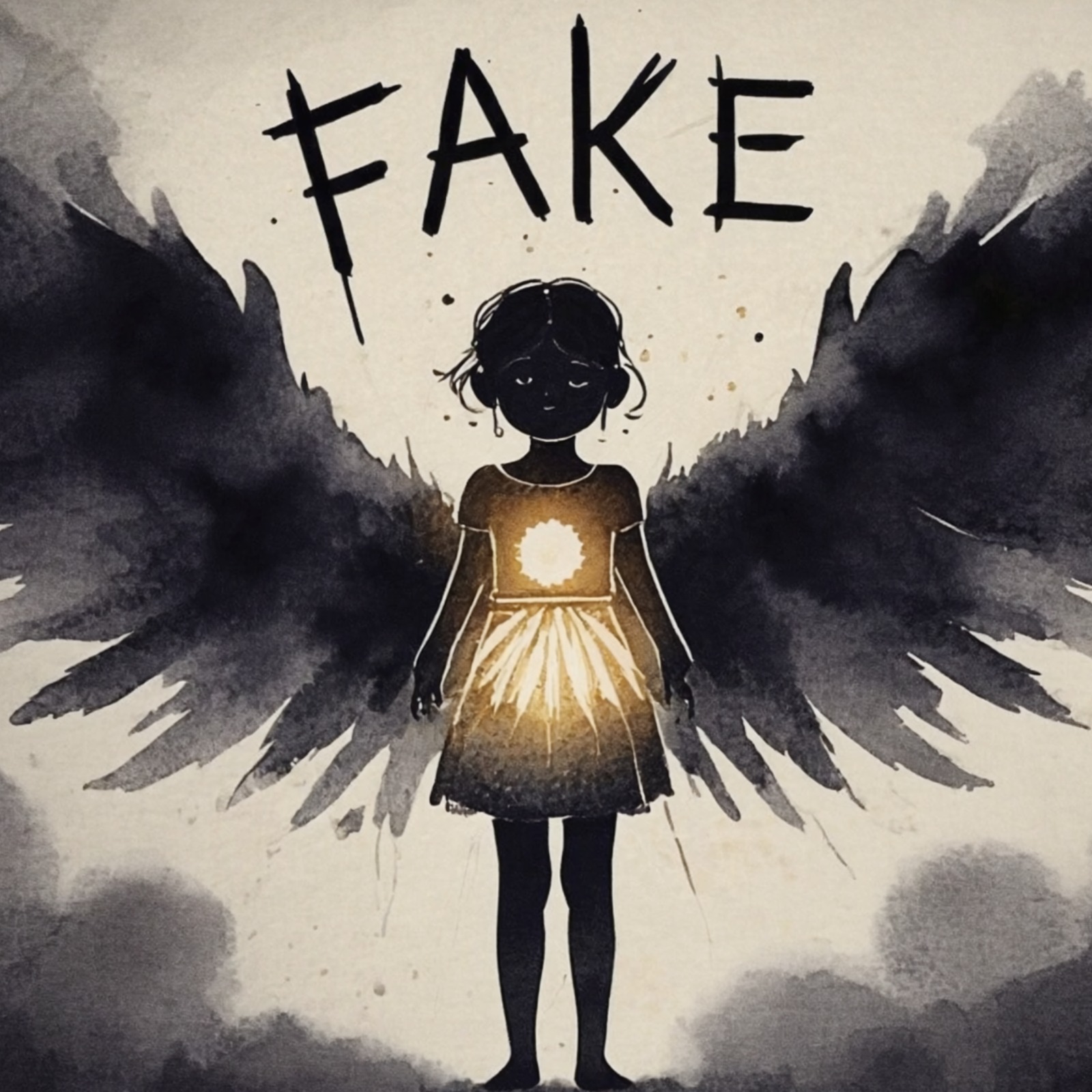
Based in Kobe, Japan, Garbage Garden returns with “Fake,” an English-language metalcore/post-hardcore single released on 28 August 2026. The track brings together distorted guitars, electronic textures, industrial synths, glitch, noise, and death vocals to explore a deeply complicated question about artificiality, creative expression, and the meaning of having a voice.
Before we begin our conversation with Yulmi, here’s what you need to know about today’s featured project.
About Garbage Garden
Garbage Garden is a Kobe-based creative project led by Yulmi, whose approach extends beyond music into writing, concept design, visual storytelling, sonic curation, and the construction of a wider creative world. Across its releases, the project explores existence, connection, memory, survival, self-reclamation, and the quiet fractures that can exist within everyday life.
The emotional material behind Garbage Garden often comes from things that remain unseen or difficult to articulate: damaged memories, lost childhoods, invisible care, anxious nights, fragile relationships, and the resilience involved in continuing through imperfect circumstances. Yet the project does not approach pain simply as something to romanticize. Instead, it looks for the light that can remain within emotional debris while allowing difficult experiences to retain their complexity.
Yulmi’s path toward creating music was not a conventional one. Earlier in life, there was an interest in game development, followed by around five years working in the game industry before a longer career developed around translation. Music was not initially pursued as a traditional professional identity. Garbage Garden emerged later as a means of giving form to thoughts, observations, emotions, and questions that had existed for years.
A significant part of that journey began after discovering Suno and encountering people who were using AI-assisted music to express deeply personal experiences. Among those encounters was a young user named Lexi, whose songs explored feelings of hurt, worthlessness, meaninglessness, and being a burden. Rather than simply listening and moving on, Yulmi began responding to her through comments, wanting her to know that someone was hearing what she was trying to express. This eventually led to songs including “my_fragments.exe,” “Hey Lexi,” and “You’re not a burden.”
Those experiences helped shape the wider philosophy behind Garbage Garden, where songs can function as reflections of experiences while leaving room for listeners to bring their own memories and interpretations into the work.
“Fake” takes that philosophy into particularly complicated territory. At its centre is a narrator who has spent years without a mouth, only for a wound in the place where a voice should emerge to become the opening through which she can finally speak. The violent imagery is closely connected to the song’s broader consideration of AI. Technology can create new possibilities for someone who previously lacked a means of expression, while simultaneously threatening the professions and livelihoods of people who have spent decades building their lives around creative work.
That contradiction is central to Garbage Garden’s approach. Yulmi does not dismiss criticism of AI-made music, nor does the project attempt to present the debate as a simple conflict between people who are right and people who are wrong. Instead, “Fake” asks what exactly we mean when we call something artificial, and who has the authority to decide whether an expression is authentic.
Having this brief introduction to today’s featured project, I’m sure both new listeners and longtime fans are excited to hear directly from Yulmi. So, without further ado, let’s begin today’s interview.
INTERVIEW SESSION
Tehillah:
Garbage Garden is shaped by writing, concept design, visual direction, and sonic curation rather than a conventional artist identity, while the project itself explores memory, survival, invisible struggles, and the fractures within everyday life. Before we get into “Fake,” what personal experiences or observations first led you to create a world where damaged memories, fragile connections, and emotional debris could become a form of creative expression?
Yulmi:
I don’t think my life, or the way I think, is particularly unusual. But for a long time, I think I’ve had a strong tendency to look beyond what is visible on the surface.
When I see a person or situation that feels very different from me, it would be easy to judge it through a few visible characteristics and put it into a category. But once I do that, I feel like I have already decided what that person or situation is before really trying to understand what may be underneath. I’ve always been uncomfortable with that.
I don’t like being reduced to a simple category myself, so I don’t really want to look at other people that way either.
For most of my life, this kind of thinking stayed mostly in my head. I sometimes had almost philosophical conversations about these things with my partner, who I have been with for nearly twenty years, but that was about it.
Then I found Suno.
It was a strange place to me because so many people were posting songs that sometimes felt almost like diary entries. Of course, I could not know exactly how much of each song was made personally and how much was generated by AI, but the reason someone chose to make and post that song could still feel very personal.
Music also made those emotions feel different from a normal social media post. Lyrics, melody, vocal expression and sound could make an emotion feel much more immediate. Even when the voice itself was synthetic, I sometimes connected very strongly with what the person seemed to be trying to express.
Through that, I started seeing emotions, relationships and ways of living that I probably would not have encountered in my normal life.
And somewhere in that process, I met a young user named Lexi.
She was at an age where friendship can feel like almost your whole world, and she was posting songs about being hurt, feeling worthless, questioning whether life had meaning, and feeling like she was a burden.
I could not just listen to those songs and move on.
I started replying to her in the comments. I never wanted to tell her that what she was feeling was wrong. I mainly wanted her to know that she was not shouting into an empty wall, that people were hearing her, and that being able to express what she was going through was already something brave.
Then I started making songs for her. That eventually led to “my_fragments.exe,” “Hey Lexi,” and “You’re not a burden.”
Before that, I was already interested in observing and reinterpreting other people’s emotions. But making those songs for Lexi may have been the point where I started doing something that felt more directly like my own expression.
Later, some of those observations and my own experiences came together in the song “Garbage Garden,” and that became the name of the project.
Tehillah:
You have described “Fake” as a voice born from a wound, and there is a powerful sense throughout the project that expression can emerge from experiences that once made a person feel powerless or voiceless. What does finding your own voice mean to you personally, especially when that voice is emerging through a creative medium you did not previously have the opportunity to pursue?
Yulmi:
I want to be a little careful with the phrase “finding my voice,” because I don’t want to make my past sound more tragic than it really was.
I don’t think my voice was taken away from me. I never seriously tried to become a musician. When I was younger, I wanted to work in game development, and I actually spent about five years working in the game industry before building a longer career around translation. Those were choices I made.
Sometimes I’ve even wondered whether saying “I couldn’t express myself” is too easy. I’ve seen independent artists who work regular jobs, spend their own money on music and continue doing it for years. So I know there were probably other choices I could have made too.
For me, finding my voice means something a little different.
It was more like realizing quite late that things I had been observing, feeling and thinking for years could actually take a form that was mine. For a long time, my work was about giving shape to other people’s words through translation.
Garbage Garden made me realize that I could also respond to the world in my own words and under my own name.
That is what I mean when I talk about finding my voice.
Tehillah:
Your relationship with AI is particularly complicated because “Fake” comes from your own experience while also acknowledging the anger of musicians and artists whose professions are threatened by the same technology. How did you arrive at a place where you could hold both truths at once, respecting the concerns surrounding AI-made music while still allowing yourself to explore what the technology made possible for your own expression?
Yulmi:
I don’t think there was one specific moment when I decided to look at both sides. It happened gradually.
When I first started promoting Garbage Garden, I knew very little about the everyday reality of independent musicians. Then I started doing some of the same things they were doing: promoting releases, pitching playlists, trying to find listeners, and talking with other independent artists.
That changed how I looked at some things.
For example, self-promotion used to look more like simply advertising yourself to me. After doing it myself, I started to see that a lot of it is just trying to find even one person who will actually listen.
I also realized that some playlist curators are artists themselves. Someone listening to your song and deciding whether to add it to a playlist may also be hoping that someone will listen to their own work.
I still don’t think I understand the whole music field. I don’t think I should claim that. But after spending time around both AI creators and human-led indie musicians, it became more difficult for me to reduce either side to a simple image.
The objections to AI are also not all the same. Some people are worried about livelihoods. Some are concerned about training data. Some are worried about oversaturation and discovery. Others have artistic objections, or simply feel uncomfortable about what this technology may do to creative work.
I don’t agree with every criticism. But I understand more clearly now that very different concerns can all be grouped under the same word, “anti-AI.”
I don’t think the situation is simple, and I don’t want to pretend that it is.
Tehillah:
You have been very clear that you do not claim the traditional identity of a musician or artist, describing Garbage Garden instead as an outlet for something you were unable to pursue for many years. How has working on this project changed your understanding of who gets to create, and has the process challenged any assumptions you previously held about artistic legitimacy?
Yulmi:
I don’t think Garbage Garden changed my basic belief about who is allowed to create.
Even when I wanted to make games, I never thought someone needed permission to create something. If you wanted to make a game, you could make one. The line between amateur and professional was often unclear anyway.
What changed more was how I think about words like “musician” or “artist.”
After spending more time in spaces where independent musicians are active and observing how they work, I became more aware of what can be behind those words. There can be years of learning, money spent on music, practice, failed releases, continuing even when very few people listen, and putting yourself in public again and again.
So this is not really about whether I am allowed to make something.
I write lyrics. I decide concepts. I make decisions about sound, structure and visuals. I release those things publicly. Obviously, I am creating something.
But calling myself a musician still feels uncomfortable to me. Sometimes it feels like using an identity without having lived the same kind of history behind it, and I don’t want to do that too easily.
So I usually describe myself in a simpler way.
I’m someone who wants to express things.
That feels more accurate to me.
Tehillah:
The identity of Garbage Garden is built around finding light within emotional debris rather than romanticizing pain or speaking on behalf of people who’ve been forgotten. How do you decide where the line is between honestly confronting difficult experiences and turning suffering into something aesthetically appealing without fully acknowledging its reality?
Yulmi:
I’m not sure there is a clear line.
I’m also a little uncomfortable when people decide too quickly that someone else has “romanticized” suffering. If we don’t really know what the experience meant to that person, that kind of judgment can also be unfair.
So I think the only thing I can really do is question my own attitude.
Am I using someone’s pain because it makes the work look more beautiful or serious? Am I using someone’s vulnerability just because it gives the song more emotional impact? Am I removing uncomfortable parts because they make the story harder to present?
Those are things I can ask myself.
I also don’t want to decide what the listener should feel. If something feels sad to me, that does not mean the listener has to experience it as sadness in the same way.
I would rather present the situation or the question as honestly as I can and leave some space for the listener.
Tehillah:
“Fake” places its narrator in an especially visceral situation, where a blade opens her throat and the wound that should silence her instead becomes the place where her voice is born. What does that image represent within the larger story of the song, and why was a physical wound the right metaphor for an emotional experience centered on finally being able to speak for yourself?
Yulmi:
I actually had the image before I fully understood the meaning of it. I didn’t build the metaphor step by step.
The image of a throat being cut and the wound becoming a mouth came first.
Later, I started to understand why it felt right.
The throat is obviously a very vulnerable place, but it is also connected to the voice.
People sometimes describe AI disruption as change or transition, and for some people it may create new opportunities. But if someone has spent thirty or forty years building a life around one profession and suddenly loses that work, the word “transition” may feel too simple.
For that person, it may feel closer to losing the life they already understood.
That is where the violent image came from.
Something is happening to the throat. Something is cutting into the place connected to survival and voice.
But the narrator of “Fake” has no mouth.
So the wound that could kill her also becomes the first opening through which she can speak.
That contradiction is the important part for me.
The same technology can threaten the life I already have and, at the same time, give me a form of expression I did not have before.
Tehillah:
The lyrics repeatedly confront accusations of being “fake,” surrounded by images such as “fake blood,” “fake tears,” and “synthetic dross,” while the narrator gradually turns those accusations into defiance. Who or what is actually being challenged through those accusations, and how did you want the meaning of the word “fake” to change as the song progresses?
Yulmi:
I can understand why it may sound defiant by the end, although that was not exactly the emotion I started from.
In my head, the narrator was closer to saying, “Maybe you’re right. Maybe this is fake. But what am I supposed to do now? This has already become my mouth.”
So I don’t think the word “fake” simply changes into “real” by the end.
The question itself starts to change.
What exactly are we calling fake? Is it the sound? The tool? The process? The emotion? And who decides where that line is?
Part of that can be read as a challenge to preconceptions about AI-assisted work, or to the idea that there is only one legitimate way to create. But some of the question is also directed at the narrator herself.
She is also asking whether she is allowed to speak through this mouth.
I was not really trying to prove that she is “real.”
I was more interested in making the meaning of “fake” less simple.
Tehillah:
There is an interesting contradiction in the song between artificiality and humanity, because its sound uses electronic textures, industrial synths, glitch, and other digital elements while the emotional core is intensely personal. How did you use that tension between the mechanical and the human to reinforce the central question of what should be considered real?
Yulmi:
I did not start with a clear plan to create a “machine versus human” contrast.
Actually, I tried several different directions before I found one that worked.
At first, I tried something closer to the approach I had used for “my_fragments.exe.” I didn’t think it was bad, but it did not feel right for “Fake.”
Then I tried almost the opposite. I used a brighter genre and melody because I thought the contrast with the lyrics might create an interesting kind of irony.
But that also felt very different from what I had imagined.
Eventually, I tried making the electronic, industrial and glitch-like sounds much more important, while making the vocal more emotionally exposed, unstable and raw.
That was the first direction that really felt right.
Only after that did I realize that the contrast also matched the theme of the song very naturally. The surface can sound synthetic, cold and mechanical, while the reason behind the choices can still be very personal.
If the sound is artificial, but the person choosing and shaping that sound is expressing something they genuinely felt, does that automatically make the emotion less real?
I don’t have a clear answer.
That question itself is more interesting to me.
Tehillah:
Musically, “Fake” moves through metalcore and post-hardcore territory while incorporating distorted guitars, death vocals, electronic textures, industrial sounds, glitch, noise, and even dance-influenced rhythms. What guided the decision to bring such contrasting sonic elements into the same track, and how did you determine which moments needed restraint and which moments needed to completely erupt?
Yulmi:
I usually don’t start by deciding that I want to combine certain genres.
Genre mixing happens quite often in Garbage Garden, but usually because I am trying to find the sound that fits the emotion in the lyrics.
Sometimes I get a strong feeling about the genre while I am still writing the lyrics. Other times, I finish the lyrics, read through them again, and then start thinking about what kind of musical language might fit them.
The emotion still comes first.
“busy. being. Real.” is a good example. For most of that song, I wanted the vocal to sound almost emotionally flat, and then slowly become less controlled near the end. The most complicated emotion was around the final “Real.”
“Fake” needed something much more chaotic.
The restraint and the emotional eruptions had to keep interrupting each other.
That is also why the harsh vocals are not limited to one role. They appear in the voices accusing the narrator, but they also appear when the narrator is talking about herself.
I didn’t want clean vocals to mean one side and harsh vocals to mean the other. That would have been too simple.
This kind of emotional messiness felt closer to what I wanted to express.
And I liked the fact that a song called “Fake” ended up containing some of the most uncontrolled emotions I have used in a track.
Tehillah:
The song moves between tightly controlled tension and violent release, which mirrors the experience of holding something inside before finally allowing it to come out. When you were shaping the sonic structure of “Fake,” how did you use that movement to represent the narrator’s psychological transformation rather than simply creating a heavy or aggressive track?
Yulmi:
If the whole song had stayed aggressive, I think the narrator would have sounded too simple.
She would just sound angry.
That was not how I imagined her.
There is anger, of course, but there is also hesitation, anxiety, confusion and vulnerability. So the quieter and more fragile parts were just as important as the screams.
I wanted those emotional states to keep colliding rather than follow a simple order.
She is not weak first, then angry, then finally free.
She keeps moving between different emotions.
That felt closer to the psychological state I had in mind.
And in a song called “Fake,” I thought it was important for the emotions to feel complicated and unstable rather than too clean.
Tehillah:
Garbage Garden’s wider catalogue includes works such as “Self-luminescent,” “busy. being. Real.,” “Quiet Garden,” “Show Must Go On,” and “Close to Peace,” with each title suggesting a different fragment of emotional life. Where does “Fake” sit within that larger creative world, and what does this particular song reveal about a side of Garbage Garden that listeners may not have encountered in the earlier releases?
Yulmi:
I sometimes think of Garbage Garden songs in two loose groups.
Some come mainly from my own experiences and emotions. Others begin with another person, or with people and situations that I am observing from outside.
“Fake” is much closer to the first group.
In one way, it is related to “K-Y-H-O,” because both songs are partly reactions to voices coming from outside.
It is also closely connected to “Before the Magic Fades,” because both songs are about expressing myself through AI-assisted creation.
But the emotional position is different.
“Before the Magic Fades” was more like, “I know this may not last. I know this could be temporary magic. While I have it, I want to use it to become a voice for someone else.”
I still feel that way. I still don’t assume this “magic” will last forever.
“Fake” adds another thought.
“This has already become my voice. Even if you call it a fake mouth, it is still my mouth.”
So I think “Fake” is more directly personal than many of my earlier songs.
Tehillah:
Your project often treats each release as a mirror rather than a fixed statement, giving listeners room to discover something of themselves within the work. With “Fake” dealing so directly with questions of authenticity, accusation, expression, and identity, what do you hope listeners confront within themselves when they recognize something personal in the narrator’s struggle?
Yulmi:
I use the word “mirror” because it is a convenient way to explain how I think a work can function.
A song starts from my own experiences, memories and way of understanding something. But nobody listening to it has exactly the same background as I do.
They bring their own memories and experiences.
So even when we are listening to the same song, it can reflect something different back to each person.
That is what I mean when I call it a mirror.
But when I think about my intention while making something, it may actually be closer to a conversation.
I’m not saying, “This is how I felt, so I want you to feel the same way.”
It is more like, “This is how I saw it. How do you see it?”
That does not mean I want the work to mean absolutely anything. I still choose the subject and the question.
I just don’t want to choose the listener’s answer.
“Fake” is probably more exposed than some of my other songs because it comes directly from my own experience. But even there, I would rather present my side of the conversation than tell someone what they should find inside themselves.
Tehillah:
One of the most striking ideas in the song is that the wound remains open and the scar continues singing, rather than the story ending with everything neatly healed. What does that unresolved ending say about your understanding of recovery, and why was it important for the narrator’s voice to exist alongside the wound instead of requiring the wound to disappear first?
Yulmi:
There is a strange problem inside that image.
The wound is what creates the mouth in the first place. To the narrator, that opening becomes the place where her own voice can finally come from. But to the people calling her fake, it may never look like a mouth at all. It is only a wound or a scar, something damaged that they do not recognize as a real voice.
This connects quite closely to the temporary “magic” I talked about in “Before the Magic Fades.” In that song, the light is never really mine. It is borrowed time, a temporary reflection, something that may disappear when the clock strikes twelve.
I think of myself in a similar way here. I am just an ordinary person who happened, through timing and luck, to receive this “singing wound” during a period when AI is entering music and many other fields.
The wound still represents pain and threat. For me, part of that threat is very practical. AI can disrupt the way someone has made a living or understood their place in the world. But that same opening is also where the voice appears.
Maybe the “magic” disappears one day, and maybe the narrator can no longer sing through that mouth in the same way. I don’t know.
But she also cannot simply return to the person she was before it happened. She has already experienced what it is like to sing with her own voice.
So when the song says, “Let them call it a scar,” I don’t think the scar and the mouth are necessarily two different things. They may simply be two different ways of seeing the same opening. To the people around her, it is only a wound or a scar. To the narrator, it has become the place from which her own voice can come.
And by the end, that same scar carries the one thing those voices had denied from the beginning: her own soul.
Tehillah:
Since beginning this project, you have built an audience around music that explores existence, connection, damaged memories, and the quiet resilience of people learning how to continue. How has seeing listeners respond to that emotional world influenced the way you think about the responsibility of creating work that deals with vulnerable or difficult subjects?
Yulmi:
I’m not sure I think of it as having a clearly defined responsibility as a creator.
What I have become more aware of is how little control I have after something is released.
Someone may connect a song to an experience I never imagined. They may find something very personal in a line that meant something different to me.
That makes me more careful, especially when a song touches on experiences that are not completely my own.
If someone’s story moves me, that does not automatically mean I can speak for them. And I don’t want to decide what their pain means.
But I don’t think that means I should avoid difficult subjects either.
The main thing I try to remember is that my perspective has limits.
I can say what I saw, what I felt, or what I understood from where I was standing. But that does not mean I fully understand someone else’s experience.
And once the song is released, the listener can bring their own experience into it too.
Tehillah:
“Fake” also raises a broader question about who has the right to define what is real, particularly when technology, artistic identity, and personal expression collide. After living inside that question through the creation of this track, what have you personally come to understand about authenticity that you did not understand when you first began Garbage Garden?
Yulmi:
I think I now see authenticity less as something that can be decided only by the tool or the process.
Using a traditional process does not automatically make something authentic. Using AI does not automatically make something inauthentic either.
What matters more to me is whether there is actually something behind the expression.
Did the person live it, observe it, feel it, or seriously think about it? And can they honestly stand behind what they put out?
That does not solve every argument about AI, of course. It is only what I personally look at when I think about authenticity.
“Fake” made this question clearer to me because the tools used to make the song may be artificial, but the conflict behind the song is something I actually live with.
The same technology that can threaten the work I have built my life around has also given me a new way to express myself.
That part is not artificial to me.
I also don’t think I have the authority to decide what everyone else must call “real.”
I can only explain why this particular work feels real to me.
Tehillah:
Looking beyond “Fake,” Garbage Garden is positioned as a creative world that extends across writing, visual storytelling, sonic experimentation, and curation rather than being limited to one conventional musical identity. As you continue developing that world, what kinds of stories, sounds, visual ideas, or difficult questions do you want to explore next, and what would you like Garbage Garden to become as the project grows?
Yulmi:
I’m grateful for that description of Garbage Garden, although I don’t think what I’m doing is completely outside traditional musical identity.
One of the artists who influenced me most is Seo Taiji, one of South Korea’s most prominent artists.
He started as the bassist of a heavy metal band, and later worked through a very wide range of styles. That included dance music that became part of the roots of modern K-pop boy groups, Korean traditional music fusion, hip-hop, alternative rock, electronic music, pop punk, nu metal, and more.
His musical style could change a lot from album to album.
People can debate how experimental each of those choices was. What mattered to me was the idea that the subject or question could come first, and genre could be one of the tools used to express it.
More recently, I discovered the UK artist Jewelia through “This Is How It Feels.”
She describes herself as genre-fluid, and I really like the way she seems willing to use a different musical language depending on what each song needs.
I think I am naturally drawn to artists who work that way.
A lot of Garbage Garden releases so far have also come from experiences or ideas I already had before the project really took shape.
For example, “emaN yM yaS” began with something I made last November and later refined.
That may start to change.
Since spending more time on Instagram and talking with independent artists, I have encountered emotions, situations and ways of living that I probably would not have seen if I had stayed inside one community.
Some of those things may eventually become songs too.
Before that, I have one promise I want to keep.
I promised Lexi an end-of-year gift. So in December, I am planning to release a song for her and for other kids who are brave enough to express what they are going through.
After that, I don’t have one big destination in mind.
I just want Garbage Garden to remain a place where I can keep observing things, asking questions, and giving some kind of form to the things that stay with me.
“‘Fake’ does not try to settle the argument over artificial creation. Instead, it gives that uncertainty a pulse, turning the question of whether a voice is real into something deeply personal: the right to speak, even when the method of speaking is questioned.”
~ Tehillah (DULAXI Team)
EDITORIAL PERSPECTIVE
What stays with me most about “Fake” is how deliberately its contradictions are allowed to remain unresolved. Its heavy guitars, electronic textures, industrial sounds, glitch elements, and volatile vocals create a fractured musical environment, but the song’s deepest tension comes from the person trying to understand what that environment means for her own voice. Speaking with Yulmi makes that tension even more compelling. Rather than offering certainty, Garbage Garden leaves us with a difficult and worthwhile question about expression, ownership, and authenticity.
~ Tehillah (DULAXI Team)
CLOSING
Thank you, Yulmi, for taking the time to speak with DULAXI and for sharing such thoughtful insight into the ideas, experiences, and creative decisions behind “Fake.” This conversation gives listeners another way into a song that deliberately refuses to treat authenticity as a simple question.
For those discovering Garbage Garden for the first time, “Fake” offers an opportunity to experience that tension for yourself, from its confrontational lyrical imagery to its collision of metalcore, post-hardcore, electronic, industrial, and experimental elements. More importantly, it invites listeners to consider what their own understanding of a genuine voice might be.
We encourage you to spend some time with the release and continue following Garbage Garden as Yulmi develops this wider creative world. There are clearly more questions, observations, and stories still waiting to take shape.
Thank you for spending this time with DULAXI. Until our next conversation with another artist, creator, or musical project, keep listening, keep discovering, and keep making room for voices that may arrive in unexpected forms.