
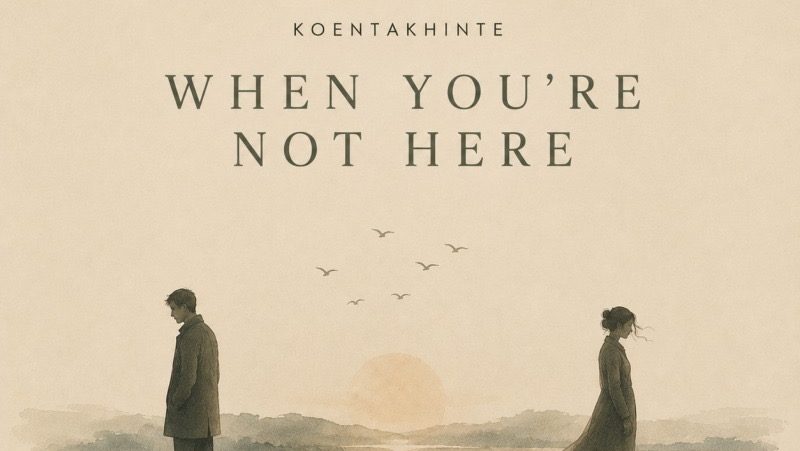
Released on 28th August 2026, “When You’re Not Here” by Koentakhinte is a deeply intimate exploration of absence, identity, connection, and the emotional traces people leave behind. Rather than presenting loss through exaggerated drama, the song finds its emotional strength in restraint, creating a reflective space where the smallest details carry enormous significance. Built around acoustic guitar and an understated arrangement, the track asks a deceptively simple but profoundly human question: how can the world continue exactly as it always has when the absence of one person has changed everything inside you? That central question gives the song its emotional direction, allowing Koentakhinte to explore the strange experience of seeing familiar rooms, routines, and surroundings remain untouched while one’s internal world has been fundamentally transformed. The result is a song that feels less like a conventional statement about grief and more like a quiet conversation with oneself.

The acoustic foundation plays an important role in establishing this atmosphere. The guitar carries a warmth and organic quality that immediately gives the composition an intimate singer-songwriter character, while the restrained instrumentation prevents the emotional message from becoming overwhelmed by production. There is a deliberate spaciousness throughout the arrangement, allowing the silences to become almost as expressive as the sounds themselves. This approach mirrors the emotional reality at the centre of the song: when someone disappears from our lives, the physical world often remains frustratingly unchanged. The rooms are still there, everyday objects remain where they were, and time continues moving forward, yet everything feels different because the person who gave those surroundings meaning is no longer present. Koentakhinte translates that emotional contradiction into music with considerable subtlety, creating a melancholic soundscape that feels contemplative rather than excessively sorrowful.
The vocal performance deepens that sense of closeness, with Koentakhinte delivering the lyrics in a raw, conversational, and emotionally vulnerable manner. His voice feels less like someone presenting a carefully constructed performance and more like someone thinking aloud, allowing the listener to occupy the same emotional space as the narrator. This quality becomes particularly powerful when the lyrics focus on the unconscious habits that remain after someone’s departure, such as instinctively turning to speak to them before remembering they are no longer there. Those moments give the song an extraordinary sense of realism because grief is presented through ordinary human behavior rather than grand declarations. The songwriting also gives the track a strong narrative progression, beginning with uncertainty and questioning before gradually arriving at a more mature understanding of what the relationship represented. The emotional journey is therefore not simply about missing someone, but about recognizing how their presence influenced the person left behind.

Lyrically, “When You’re Not Here” ultimately moves beyond the conventional idea that losing someone means losing a part of yourself. Its most meaningful realization is that another person can become deeply woven into our identity without possessing or defining us. The song gradually transforms its understanding of absence, suggesting that the influence of someone important can remain even after their physical presence has disappeared. This makes the track particularly compelling because it does not portray connection as dependency. Instead, it considers how relationships contribute to our growth and help reveal aspects of ourselves that might otherwise remain undiscovered. The final emotional perspective therefore carries a bittersweet sense of gratitude. What initially feels like an unbearable void becomes evidence of having shared something meaningful, and the memory of that connection becomes part of the narrator’s continuing identity. In this sense, the song offers a gentle form of healing without ever becoming simplistic.
“When You’re Not Here” also sits naturally within Koentakhinte’s ongoing “Quiet Stories” collection, a body of work centered on what it means to be human and the subtle experiences that shape identity, vulnerability, relationships, and connection. The single follows “Quiet Colors,” which received coverage from international independent publications including Indie Dock Music Blog, The Real Ding, and Iggy Magazine. Across this artistic world, Koentakhinte draws from singer-songwriter, folk, Americana, and indie-pop traditions while consistently placing the lyric and emotional truth at the centre of his music. His creative philosophy is particularly evident in the way his songs approach uncertainty. Rather than giving listeners predetermined answers, his writing begins with questions and creates room for audiences to discover their own interpretations. Even the release’s black-and-white visual identity reflects this approach, stripping away unnecessary distraction and emphasizing expression, ambiguity, and reflection.

When You’re Not Here Beautifully Transforms Absence Into Reflection, Revealing How Love, Memory, And Connection Continue Shaping Who We Become Long After Goodbye
~ Faithfulness (Dulaxi Team)
That philosophy becomes a natural introduction to Koentakhinte, the artist name of Dutch singer-songwriter Koen Ruiter, whose musical journey carries the perspective of someone returning to songwriting and recording after many years away from releasing music. A graduate of the Utrecht Conservatory, Ruiter brings an educated musical foundation to a style that nevertheless feels remarkably accessible and emotionally direct. Based in Utrecht, Netherlands, his work combines the traditions of the classic singer-songwriter with contemporary indie-pop sensibilities, creating songs that feel personal while leaving enough emotional space for listeners to see themselves within them. “When You’re Not Here,” captures that artistic identity with particular clarity. It is quiet without being empty, melancholic without becoming hopeless, and deeply personal without excluding the listener. Most importantly, it understands that some people do not simply disappear when they leave; their presence continues through the lessons, memories, and parts of ourselves they helped bring into existence.
For more information about Koentakhinte, click on the icons below.