
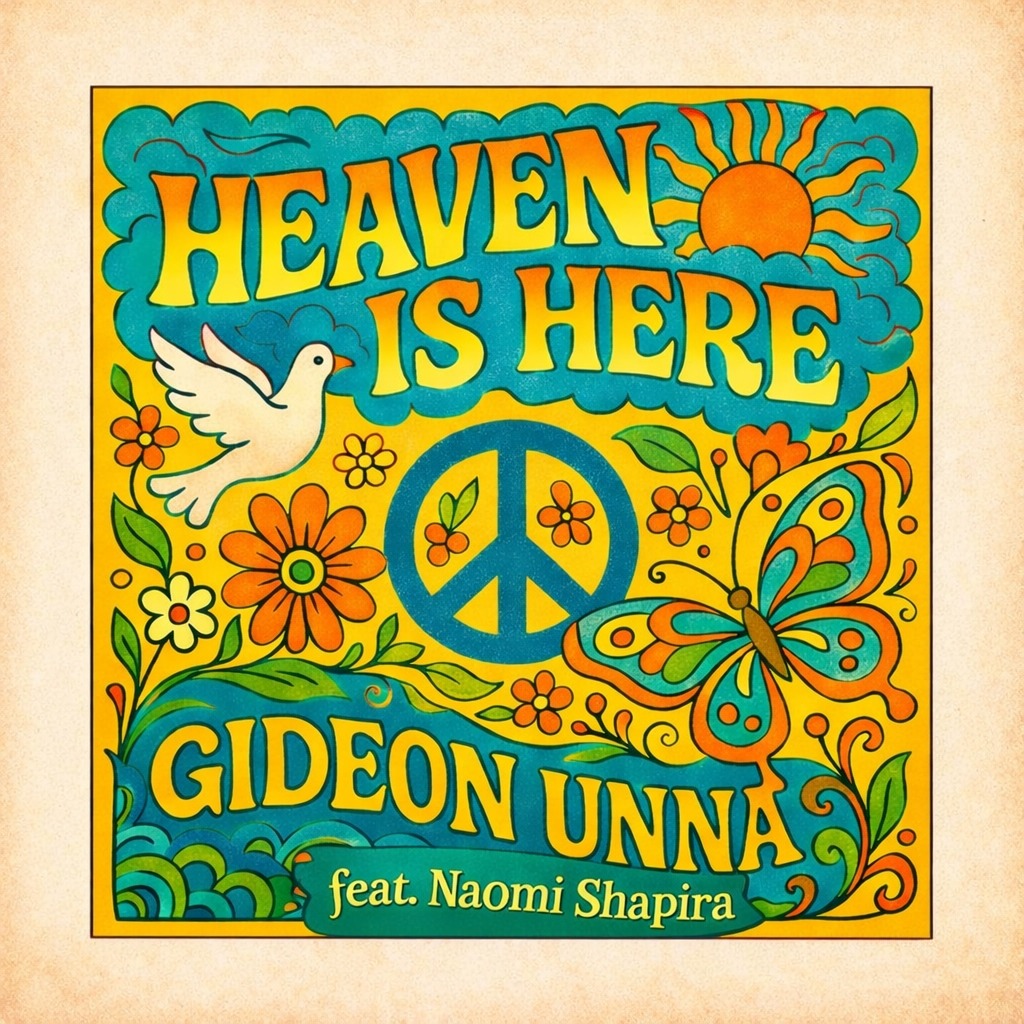
Hello everyone, it’s your host Tehillah from DULAXI, and today I’m delighted to be joined by Israeli musician, songwriter, and singer Gideon Unna, whose work brings together Israeli music, Jewish spirituality, traditional melodies, and contemporary songwriting. Based in Kibbutz Ein Carmel, Gideon has developed a distinctive artistic voice through songs that explore love, spirituality, consciousness, faith, and human connection. Today, we are discussing his latest original single, “Heaven Is Here,” featuring Naomi Shapira, released on 13 May 2026.
The single occupies a space between folk-pop, soft rock, indie folk, soul, and singer-songwriter music, drawing on the warmth of earlier musical eras while engaging with deeply personal and spiritual questions. Written by Gideon on guitar at his kibbutz home, the song developed through a collaborative creative process involving longtime partner Lior Medan, vocalist Naomi Shapira, and producer and mixer Yoav Asif.
Before we begin our conversation with Gideon, here’s what you need to know about today’s featured project.
About Gideon Unna
For Gideon Unna, songwriting appears to begin with curiosity. His music has grown from a longstanding desire to examine questions that are often difficult to answer directly: What gives life meaning? What is love? Where does faith reside? Can heaven be experienced within ordinary existence? These questions have become central to an artistic journey shaped by both his Israeli surroundings and his engagement with Jewish spirituality, traditional melodies, and contemporary music.
Gideon’s relationship with music began early. Growing up on Kibbutz Ein Carmel, he absorbed the sounds played by his parents, including the music of the Beatles, 1960s harmony groups, Israeli music, and the broader musical culture that surrounded his family. His father, who was born in New York and grew up during the 1960s, introduced him to music from the era, while his mother, who grew up on a kibbutz, shared his appreciation for both international and Israeli music. Those early experiences helped shape the harmonic and melodic sensibility that continues to appear in his work.
His songwriting has also been inseparable from personal experience. Loss during his teenage years led him to think more deeply about spirituality and heaven, while a significant relationship in his early adulthood and its eventual ending forced him to confront difficult questions about love, loss, and the meaning of life. A long journey through India, life in a mud house in the desert, and other experiences subsequently became part of a broader process of inner exploration. Music emerged from that journey as a way of expressing the discoveries he was making.
That search for meaning is particularly evident in “Heaven Is Here.” The song began simply, with Gideon writing its words and melody on guitar at his home on the kibbutz. From there, longtime creative collaborator Lior Medan developed the arrangement with AI-assisted production. Gideon’s approach to technology is nuanced, however. While he is generally opposed to excessive reliance on AI, he felt that its use in this particular production could exist alongside the human performances and creative decisions that ultimately define the record.
Naomi Shapira became an important part of that human dimension. Her delicate vocal contribution provides another emotional perspective within the song, while the relationship between her voice and Gideon’s gives the recording much of its tenderness. The track was recorded at Yoav Asif’s intimate home studio in Moshav Tzrufa, where Yoav also handled the mixing and mastering. According to Gideon, Yoav took the original tracks created by Lior and ran them through analog equipment, a process that contributed to the song’s distinctive character.
That philosophy extends beyond music. Gideon has spent around twenty years volunteering with people who are ill and vulnerable in residential homes, hospices, and hospitals, sometimes through music and sometimes through simple acts of kindness. His creative work therefore exists alongside a wider personal commitment to bringing what he describes as light and generosity into the world.
“Heaven Is Here” also sits within a wider group of songs exploring related questions. Alongside “Modest Love” and “What Is Love,” it forms part of Gideon’s continuing exploration of love, meaning, generosity, and the possibility of bringing more goodness into everyday life. Rather than treating these subjects as abstract concepts, his songwriting approaches them as questions to be lived.
Having this brief introduction to today’s featured project, I’m sure both new listeners and longtime fans are excited to hear directly from Gideon. So, without further ado, let’s begin today’s interview.

INTERVIEW SESSION
Tehillah:
You come from Kibbutz Ein Carmel, study music at the University of Haifa, and have built your songwriting around questions of love, faith, consciousness, and human connection. Before “Heaven Is Here,” what experiences or moments in your life made you begin looking at everyday existence as something that deserves to be examined rather than simply lived through?
Gideon Unna:
Even as a child growing up on the kibbutz, I was observant and often wondered about the meaning of life. During my teenage years, I lost several people who were very close to my heart. Those losses led me to search more deeply for things such as spirituality and heaven.
More than anything, when I was around twenty, I had a girlfriend from Germany named Maren. I loved her very much, and we lived together on the kibbutz for two and a half years. She originally came as a volunteer and stayed. When our relationship ended, something inside me broke. I remember asking myself, “What is the meaning of life if, in the end, love comes to an end?”
Through living with that question, taking a long journey through India, living in a mud house in the desert, and having many other experiences, I began to find the answers that felt right to me. My creative work also began to take shape through that inner discovery and light.
Tehillah:
You often begin writing with nothing more than a guitar and a question, which suggests that curiosity is as important to your creative process as melody. When a question first appears in your mind, how do you recognize that it has enough emotional weight to become a song rather than simply remain a thought?
Gideon Unna:
I think there are several ways to approach writing a song. Sometimes it begins with a melody, sometimes with an idea for the lyrics, and sometimes with both at once. For example, Heaven Is Here arrived with the words and melody more or less together. I didn’t struggle with it much, if you can put it that way, because writing a song is more an act of love than a struggle.
In the case of this song, there was a successful union between the melody and the lyrics—at least in my eyes. As I said, writing a song is an act of love, and that is how it should be experienced: an act of love with language, words, and music. When everything comes together, it gives birth to the fruit of that love—a child—and that child is the song.
Tehillah:
Your music draws from the warmth of 1960s harmony groups such as The Mamas & the Papas and The Carpenters, while your own work also carries spiritual and philosophical ideas. What is it about the innocence, optimism, and melodic warmth of that era that feels so compatible with the deeper questions you want your songwriting to explore?
Gideon Unna:
First of all, this is the music I grew up with and absorbed from my parents. My father was born in New York and grew up during the 1960s, and he has always been deeply passionate about great music. My mother grew up on a kibbutz and also loves this music, as well as Israeli music. At bedtime, she used to play the Beatles for me on a Walkman. I couldn’t fall asleep without them, and there is no doubt that this shaped my harmonic and melodic sensibility.
I feel less connected to most of today’s popular music. I often find myself looking back with nostalgia—and that, too, is part of my heaven.
Tehillah:
“Heaven Is Here” began very simply, with you writing the words and music on guitar at the kibbutz before sending the song to longtime collaborator Lior Medan. What did the earliest version sound and feel like to you, and what did you hear in Lior’s arrangement that made you realize the song could become something larger without losing its original spirit?
Gideon Unna:
What Lior did sounded amazing from the very first second. Generally, I’m against the excessive use of AI, but here it was combined with the genuine human vocals of the wonderful Naomi Shapira and Lior Medan’s arrangement. Perhaps most important of all was the mixing and mastering by Yoav Asif. He took the original tracks Lior had created and ran them through analog equipment. I think that’s what gave the song its distinctive 1960s character.
Tehillah:
The idea at the heart of the song comes from your understanding of Adam and Eve and the possibility that the Fall can be viewed as a fall in consciousness rather than the literal disappearance of paradise. How did that interpretation develop for you, and what made music feel like the right way to explore such a complex spiritual idea?
Gideon Unna:
The idea is that Adam and Eve lived in the Garden of Eden and were commanded to cultivate and protect it. After they sinned, God asked Adam, “Where are you?” Of course, God knew where Adam was physically. To me, the question is really: Where are you inwardly? Where does your heart lie?
Adam then blamed Eve for what had happened. In short, they lost their connection to the Source—to the absolute love we call God. I believe that part of the return to that Garden comes through spiritual work: through practices such as Aikido and yoga, through ecology and community, and certainly through music.
Why did I choose music to express such a philosophical idea? Simply because music is the art form I practice and study. If I were a sculptor or a painter, the idea would probably have found its expression in a sculpture or a painting.
Tehillah:
There is a fascinating difference between saying that heaven exists somewhere beyond this life and suggesting that it may already be present in ordinary existence if we simply become more aware of it. What changed in the way you looked at the world when that idea became important to you?
Gideon Unna:
I am a follower of Rabbi Nachman of Breslov, who taught around 250 years ago that heaven and hell can both be found in this world. I believe we have the ability to choose between them through the way we live our lives and the way we perceive them.
Like so many people, life has not always been easy for me. I have experienced loss, heartbreak, and illness. Yet every day, I choose to see this world as heaven—or at least as a reflection of the higher heaven, whose existence I certainly do not deny.
My belief is that if you create a kind of heaven here through optimism and positive action, then this is also what you will inherit in the world to come.
Tehillah:
Your song takes a deliberately different philosophical direction from John Lennon’s “Imagine,” which famously asks listeners to imagine a world without heaven. What interested you about answering that idea from the opposite position, and how did you make sure “Heaven Is Here” remained your own statement rather than simply becoming a response to another artist’s work?
Gideon Unna:
In fact, the song was not written as a response to John Lennon at all. I only made the comparison with “Imagine” later, when I needed to describe “Heaven Is Here” in the press release. Before that, Lennon’s song had not been part of my creative process. So “Heaven Is Here” was always my own statement; the contrast with “Imagine” simply became a useful way of explaining its philosophy afterwards
Tehillah:
Scott McKenzie’s “San Francisco” was another important reference point, particularly for its combination of optimism, freedom, idealism, melody, and atmosphere. Which emotional quality from that song mattered most to you, and how did you translate that feeling into a song about appreciating life in the present?
Gideon Unna:
This is a song that has influenced me deeply. To me, it is perfect—the production, the performance, and of course the lyrics and melody. It has truly stood the test of time. Every single time I listen to it—and I really mean every time—it still does something to me. It is simply a masterpiece.
You actually named its influence in your question: optimism, freedom, and idealism. I connect deeply with all three, both in my own creative work and in the way I think about life.
Tehillah:
The 1960s inspiration extends beyond the sound of the record into the visual identity, including the colorful, flower-filled atmosphere associated with that era. What did you want the artwork to communicate about the song before a listener had even heard it, and how closely did you think about the relationship between the visual world and the musical message?
Gideon Unna:
I designed the cover myself, and the message was very much about the flower-child spirit: peace, long hair, women in summer dresses, and the Summer of Love.
Tehillah:
The recording journey itself unfolded through a chain of personal connections: Lior arranged the song, Amy Shapira suggested her daughter Naomi, and the project eventually found its way to Yoav Asif’s home studio. What did that sequence of relationships mean to you, and how did each person’s contribution change the song in a way you could not have predicted at the beginning?
Gideon Unna:
I was actually talking to Yoav Asif about this recently. On this particular song, beyond writing it and bringing everyone together, I wasn’t as involved in the production as I have been on other songs, where I also played and produced. I told Yoav that knowing how to connect people and bring the right collaborators together is a skill in itself—one that can lead to a result you can truly be proud of.
Tehillah:
Naomi Shapira was not simply added as a voice to complete an arrangement; her performance became an important part of the emotional identity of the recording. What did you hear in her interpretation that finally gave the song the human quality you had been looking for?
Gideon Unna:
First of all, Naomi is beautiful inside and out, just as this song aspires to be. Unfortunately, she preferred not to have her photograph used in the publicity, but I believe it is the beauty of her soul that makes the song feel so warm and gentle.
Tehillah:
Recording at Yoav Asif’s small home studio in Moshav Tzrufa gave the sessions a more intimate atmosphere than a large commercial facility might have provided. How did that environment affect the way the vocals were recorded and the way the musicians interacted with the song, and what do you think listeners can hear in the finished record because of that setting?
Gideon Unna:
I believe listeners can hear a living, loving heart—a combination of my heart, Naomi’s, Lior’s, and Yoav’s. They are all loving, sweet people. You can write endlessly about musical equipment and recording techniques, but in the end, it all comes down to heart and soul.
Tehillah:
“Heaven Is Here” is ultimately an invitation to notice life, cherish it, and become more awake to what is already around us, yet the song avoids sounding like a simple motivational message. How did you preserve the seriousness and depth of the idea while keeping the music warm, accessible, and emotionally uplifting?
Gideon Unna:
Some things cannot be explained rationally. Even for me, it feels like a kind of magic. Just as I cannot explain the mystery of life, I also find it difficult to analyze or explain how a profound idea can be expressed in a way that is accessible and uplifting. All I can say is that it comes from my soul, after many years of studying and exploring music.
Tehillah:
You have connected “Heaven Is Here” with “Modest Love” and “What Is Love,” describing the three songs as part of a wider search for love, meaning, and human connection. What does each of those songs allow you to ask that the others cannot, and what larger question about being human begins to emerge when they are considered together?
Gideon Unna:
“Heaven Is Here” asks whether heaven can be found in this world. “Modest Love” explores a humble kind of love—love without ego—while “What Is Love” asks the most direct question of all: what love truly is, and what gives life meaning. Together, the songs ask how we can live with love and generosity, and perhaps bring a little more heaven into this world.
We are now in Elul, the month of mercy and forgiveness in the Jewish tradition. At this very moment, at three in the morning on Shabbat, people are beginning to wake up and go to synagogue. Your question connects me to that spiritual tradition—the Jewish tradition—from which I come and draw inspiration.
I remember John Lennon once saying in an interview, without intending it negatively, that the worlds of culture and music were, in some sense, an extension of the Jewish religion. I have tried to understand exactly what he meant, although I am not sure I fully do. It is certainly true—and I hope this is not misunderstood—that Jewish people have played a significant role in shaping modern culture.
In our tradition, however, the essential idea is to do things l’shem shamayim—for the sake of Heaven—and not for our own glory. I try to create and live from that place: to bring one more drop of light and generosity into the world. I try to do this through my music, but also through acts of kindness. For around twenty years, I have volunteered with people who are ill and vulnerable in residential homes, hospices, and hospitals—often through music, but not only through music.
For me, if I have been fortunate enough to bring light to even one soul, for even one moment, then I have done something meaningful in this world.
Tehillah:
Yoav Asif’s reaction that he could not stop listening because the song made him feel so good is especially meaningful given that he encountered the song while recording and shaping it. When someone involved in the creation experiences the exact emotional response you hoped the finished listener would have, what does that tell you about whether the original intention survived the production process?
Gideon Unna:
It tells me that we did something right throughout the entire journey and creative process. I believe the journey is more important than the final result, and if the path is honest and worthy, then the result will naturally be worthy as well.
Tehillah:
You have said that you try to live by the principles you write about, from appreciating life and caring for others to raising children with love and continuing to search for truth. As “Heaven Is Here” begins its life beyond the studio, how do you want your music to challenge people not only to feel something, but to reconsider the way they actually live?
Gideon Unna:
That is a wonderful question. Just before bedtime, I asked my two sons, who are nine and five, what their dreams were. I also have a three-year-old daughter. My eldest son said he wants to make music and learn to play every instrument. My younger son did not quite understand the question, but then they asked me what my dream was.
I told them that my dream is for them to fulfill themselves and always seek ways to live lives filled with goodness, meaning, learning, and kindness toward others. Thinking about it now, that is also what I wish for my listeners: to dream, to love, and to keep searching for ways to do good.
“Gideon Unna turns a deceptively simple idea into an invitation to pay closer attention to the life already unfolding around us, allowing nostalgia, spirituality, collaboration, and personal experience to meet in one warm musical statement.”
~ Tehillah (DULAXI Team)
EDITORIAL PERSPECTIVE
“Heaven Is Here” feels most compelling when its musical simplicity and philosophical ambition meet. The guitar-led foundation, gentle vocal interplay, and 1960s-inspired sensibility leave room for Gideon’s central ideas to breathe rather than overwhelming them with production. Speaking with Gideon also reveals that the song belongs to a much wider personal search involving love, spirituality, loss, service, and consciousness. That connection between the music and the life behind it gives the release an unusual sense of sincerity.
~ Tehillah (DULAXI Team)
CLOSING
Our conversation with Gideon Unna offers a deeper understanding of the ideas behind “Heaven Is Here” and the personal journey that brought the song into existence. From childhood memories of music and difficult experiences of loss to questions of spirituality, love, consciousness, collaboration, and the meaning of everyday life, Gideon’s reflections reveal an artist who approaches songwriting as part of a much larger search for understanding.
Thank you to Gideon for taking the time to share these thoughtful insights with DULAXI and for allowing us to look beyond the finished recording and into the experiences, relationships, and ideas that shaped it.
We encourage readers to spend time with “Heaven Is Here” and discover the song for themselves, particularly if its questions about presence, gratitude, love, and the possibility of finding something extraordinary within ordinary life resonate with them. We also look forward to following Gideon’s continued artistic journey as he explores these questions through music and beyond.
Thank you for spending this time with DULAXI. We hope you enjoyed getting to know Gideon Unna and the story behind “Heaven Is Here.” Until our next interview, keep listening, keep discovering, and keep making room for the stories behind the music.