

Hello everyone, it’s your host Oliver from DULAXI, and today I’m delighted to be joined by Paul Hashemi, the songwriter and driving creative force behind Philadelphia-based alternative rock band Faint Halos. Blending alternative rock, indie rock, melodic pop-rock, and Americana influences, Faint Halos released their third single of the year, “Honeybee,” on September 25, 2026. Serving as the closing track on the band’s forthcoming self-titled album, scheduled for release in November, the song brings together a long personal history, an unconventional songwriting approach, and the collaborative energy of a band that continues to discover new possibilities within its music.
Before we begin our conversation with Paul Hashemi, here’s what you need to know about today’s featured project.
About Faint Halos
Faint Halos began taking shape after Hashemi returned to songwriting in 2020, following approximately fifteen years away from music. His decision to write again emerged during a period marked by the aftermath of the pandemic, the effects of social media on human relationships, and wider political and societal uncertainty. These experiences influenced his desire to create songs that explore loneliness while helping listeners feel less alone. Rather than offering simple answers to complicated questions, his songwriting examines the contradictions of modern life, including the tension between connection and isolation, personal understanding and uncertainty, and the desire to find meaning in an increasingly overwhelming world.
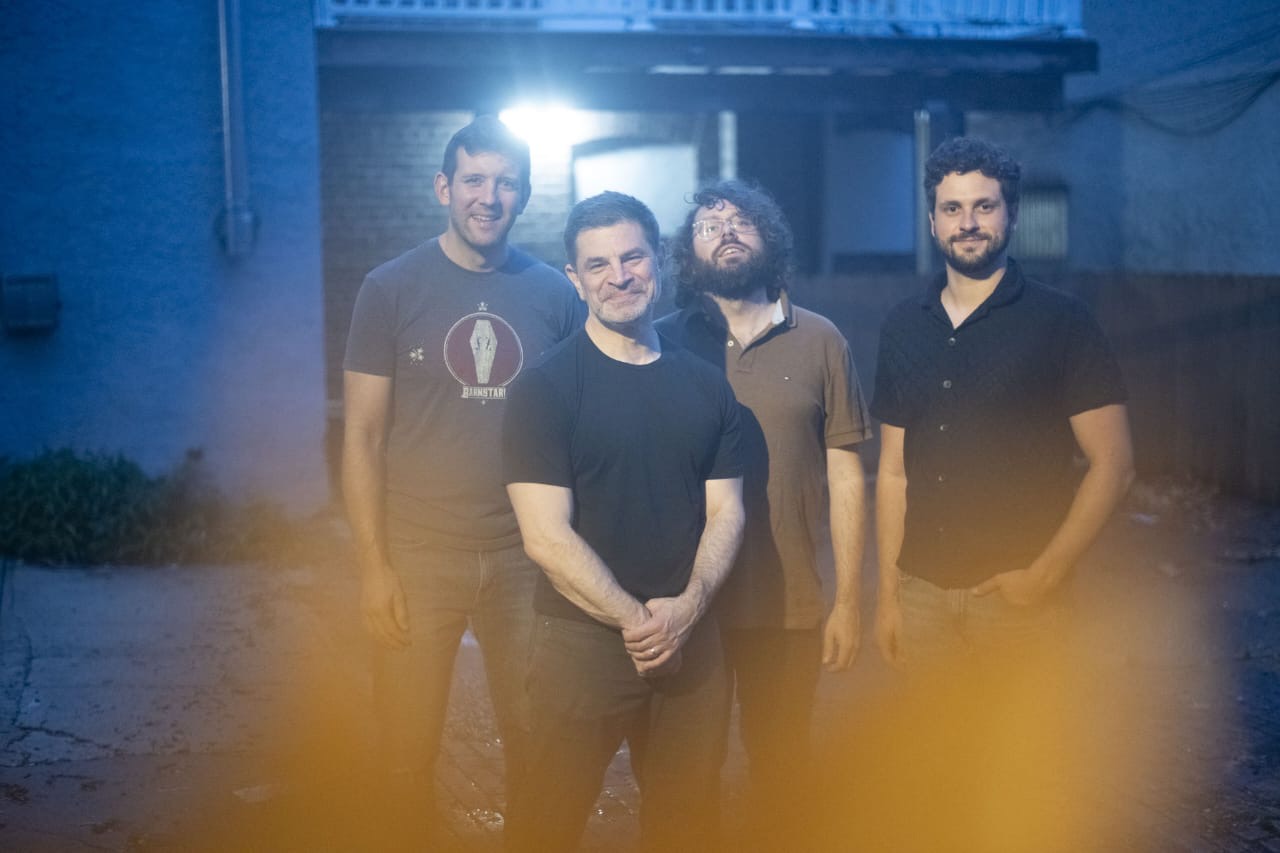
Originally built around Hashemi’s songwriting, Faint Halos gradually developed into a collaborative four-piece band as bassist Miguel Padro, drummer Bill Hallinan, and guitarist Matt Cieljka joined the project. Each musician brought a distinct approach to the group’s developing sound, encouraging the songs to grow beyond their original arrangements. What began with elements of electronic bedroom pop-rock gradually expanded to incorporate Americana influences and a more direct, guitar-driven rock sound. The musicians’ contributions have also shaped the band’s live identity, where arrangements remain open to experimentation and individual performances can develop in response to the atmosphere of a particular room or audience.
The band’s latest single, “Honeybee,” holds a special place in this evolution because its story stretches back to 2007, shortly before Hashemi’s previous band, The Daybreak Line, played its final show at Iota in Arlington, Virginia. Written during that earlier period, the song remained an important reference point for the kind of music he hoped to make when he eventually returned to songwriting. An earlier version appeared on the first Faint Halos EP, but the full band later revisited the composition for the forthcoming album, recording a more organic arrangement that allowed each musician’s personality to shape the performance. With its unusual structure, restrained lyrical approach, and memorable closing passage, “Honeybee” stands apart from the band’s more straightforward material while offering a glimpse of the musical direction Hashemi had envisioned from the beginning.
The song’s unconventional construction reflects the instinctive way it came together. Rather than following a predictable verse-and-chorus pattern, “Honeybee” develops through contrasting sections that move between quieter passages, fuller band arrangements, instrumental moments, and an expansive ending. Its lyrics have also remained open to interpretation, with Hashemi viewing the song as a reflection on entropy and the inevitable breakdown of things, while some listeners find something uplifting in its message. This coexistence of melancholy and reassurance reflects the wider concerns behind Faint Halos’ songwriting. As the third single in the band’s current release cycle, “Honeybee” also serves as the closing statement of the forthcoming self-titled album, following a final single planned for October.
Having this brief introduction to today’s featured project, I’m sure both new listeners and longtime fans are eager to hear directly from Paul about the experiences, creative decisions, and musical ideas behind this distinctive release. So, without further ado, let’s begin today’s interview.
INTERVIEW SESSION
Oliver:
Paul, you spent approximately 15 years away from playing music before eventually finding your way back to songwriting. What was happening in your life during that period, and how did returning to music in 2020 change your relationship with creativity and self-expression?
Faint Halos:
Awesome question. The short answer is, my kids were young and my job was insecure. I lost my day job in the 2008 financial crisis, and it took me a while to get back on my feet. Music was kind of a luxury I couldn’t afford, and it wasn’t until later that I realized how much I needed it.
Oliver:
Before Faint Halos, you were part of The Daybreak Line, whose final performance took place at Iota in Arlington in 2007. Looking back at that chapter of your life, what did making music mean to you then, and how does that compare with what it means to you today?
Faint Halos:
It’s interesting – it’s not just me that changed, but the whole atmosphere around the music industry. It’s never been so easy to reach people, and it’s never been so hard to be “sticky”. I think my writing has gotten better as I aged, but getting people to stop scrolling is hard now. Our music is sometimes a “slow build” and I think that’s part of the expression – I wouldn’t want to undermine that to chase a fad, but it definitely feels harder to get people to sit still and listen these days. So long story short, I know that I have to work harder to get people to hear the music, but I’m willing to do it because I think our storytelling and sonic signature have gotten better.
Oliver:
You began writing again during a period shaped by the aftermath of the pandemic, social media culture and wider political and societal uncertainty. How did living through those circumstances influence the subjects you wanted to explore in your songwriting, particularly your desire to write songs about loneliness that could make other people feel less alone?
Faint Halos:
I have been immersing myself in some of the social science literature, from Bowling Alone back in the 90s to more recent stuff, especially Derek Thompson, and basically, our civilization is in a crisis. Social media has really destroyed basic processes that we use to experience empathy, to shape the way we communicate and bond. I don’t really blame the companies, to be honest; it’s not like they’ve done this on purpose. But we are just in a new era that our brains and guts aren’t built for. So I find myself dwelling on what we’ve lost and what we’ve gained in the exchange, and trying to grapple with what it means for human relationships going forward. The simultaneous feelings of togetherness and loneliness, presence and absence, these are all modern contradictions that we have to work through.
Oliver:
You initially started Faint Halos as a musical project built around your own songwriting, but over time Miguel Padro, Bill Hallinan and Matt Cieljka became part of the band. How did each musician’s arrival change the creative atmosphere, and what did you discover about your songs when other musicians began interpreting them?
Faint Halos:
I’ve always been torn between two impulses as a writer – first, that a ‘good song’ can just stand on its own, but second, that sonics matter and great sound design and orchestration can bring a feeling to a song that’s above and beyond what was there to begin with. When we started playing live, we needed to fit the songs themselves – some of which I had been playing solo acoustically for a little while – into the band context. We found that simplifying some of the parts and letting each musician’s personal style come through, made it a lot more dynamic and interesting to listen to. Each of them plays their instrument really differently (and generally a lot better!) than I would.
Oliver:
Your description of songs having their own gravity is an interesting way of understanding musical connection. You suggest that a great song can draw people, memories and associations into its orbit. What makes a song possess that kind of pull for you, and how do you recognise when something you have written has a life beyond your original intentions?
Faint Halos:
I really got that confidence from my bandmates. We used the time-honored method of Craigslist to build the band, and each one of them said something similar when we initially connected – that they felt like the songs were really strong and that’s why they reached out here, and not to the other dozen singer-songwriters trying to put a band together. We didn’t know each other – the songs literally pulled them in, and now their playing is literally reshaping the songs. The solar system metaphor made perfect sense to me.
Oliver:
Your musical identity has developed from the electronic bedroom pop-rock of the earlier Faint Halos releases towards the Americana-influenced sound of I Can See a Million Lights and the more unfiltered guitar-driven energy of your recent work. What prompted this evolution, and how do you decide which elements of your original sound should remain as the band continues to develop?
Faint Halos:
As I mentioned, our live sound was a big part of it – it’s really hard to have a lot of things going on in a four-piece band, and we don’t necessarily want to have to coordinate with even MORE musicians. And so we were really choosy on the record about when to add something beyond two guitars, bass, and drums. I think by the end, most songs had at least a little subtle keyboard work, usually a Rhodes piano; a few songs have synths, but even there, most of what you’d hear is actually done on guitar. I brought in a drum loop for one song but it got voted down, and I’m glad – there’s more space and it came out great.
Oliver:
“Honeybee” has an unusually long history compared with your other songs. You first wrote it shortly before The Daybreak Line’s final performance in 2007, and it remained connected to that earlier period before eventually finding its way into the Faint Halos catalogue. What do you remember about the circumstances in which the song first appeared, and why do you think it stayed with you for so many years?
Faint Halos:
I talked about this on our Substack… basically that song felt different than the other stuff we were playing at the time, and even during my long break from music, I’d think to myself, “someday, I want to be in a band where we play music like Honeybee”. I think it was the depth and complexity of the music, and its anthemic nature, that I wanted to replicate.
Oliver:
You describe “Honeybee” as one of the most unique songs in your catalogue, partly because of its unusual structure, its single proper vocal chorus and its distinctive outro melody. What was your experience of writing something that seemed to arrive fully formed, without following the more conventional songwriting patterns you were accustomed to?
Faint Halos:
When I write, I try to just close my eyes and hear, “what comes next?” So I’ll come up with a melody and chord structure for a verse, maybe a particular rhythm, and then I’ll try to envision what it turns into. Often you want contrast – if the verse is low with a quick-moving, busy melody, the chorus will go up into more soaring extended notes, for example – but sometimes you choose a build or a drop, something similar but different enough to be interesting.
For Honeybee, I’d get to the end of each section and the next thing would appear. The intro is a quiet solo singer with a fingerpicked guitar; that flows into a huge band-crashing-in progression; that flows into a bouncy second verse; that flows into the big chorus; that flows into a jaunty bridge; that flows into a quiet guitar instrumental; that flows into a big dramatic solo; and so forth. And I sort of realized that even though it made perfect sense to me, there wasn’t necessarily a repeated structure of verse-chorus-verse to the song.
Oliver:
You initially worried that the melody might have come from something you had heard elsewhere, eventually comparing that feeling of familiarity to Paul McCartney’s experience with “Yesterday.” What was it about the song that made it feel familiar to you, and how did you eventually become confident that it was an original creation?
Faint Halos:
Just that feeling of deja vu. You have to be careful because it’s easy for things to get stuck in your head; it took me a while to decide, no, this is actually mine.
Oliver:
You make an interesting comparison between the structure of “Honeybee” and Journey’s “Don’t Stop Believin’,” particularly the way the first chorus is instrumental before the vocal chorus appears later. What attracted you to building the song around that arrangement, and how does withholding the expected chorus affect the listener’s experience?
Faint Halos:
Like I mentioned above, it just felt natural – it wasn’t really a conscious choice. But I think that section serves the function of ‘introducing the band’ and the major-key harmonic structure at a point where you’re not really ready for the full chorus. Then when the chorus does come in, it feels comfortable even though it’s only the first time you’re hearing it.
Oliver:
You also associate the bridge with Wilco because of the relationship between its rhythms and melody. When you are writing, how consciously do you draw on musical characteristics you admire in other artists, and how do you make sure those influences become part of your own musical language rather than simply reproducing something familiar?
Faint Halos:
I mean, there are very few truly new ideas, right? So I walk around most days with Wilco and Husker Du and Def Leppard and Charli XCX and whoever else rattling around in my head. I’ve honestly kind of given up on being precious about being “original” – at some point your mix of influences is basically original in and of itself. This song has elements that remind me of Journey, Wilco, the Beatles, Prince, and Radiohead. I have no idea if other people hear the same things. If I sat down to try to sound like any one of those bands, it might sound derivative – but the mix in my head is my own.
Oliver:
One of the most interesting things about “Honeybee” is that its lyrics seem to invite very different interpretations. You personally hear a sad reflection on the inevitable march of entropy, while other listeners have found something uplifting in it. What does the idea of entropy represent to you, and what makes you comfortable allowing listeners to discover meanings that may differ from your own?
Faint Halos:
I’m a little older than the typical indie rocker, and I’ve come to accept the limits of my control in the world. “Things just break down” is sad, but also a kind of liberating statement of acceptance. It’s a little bit sad but acknowledges that we all just do the best we can. I still do find it jarring when people tell me, “I love that song, it’s so happy!” They must be hearing something different from me, but that’s okay!
Oliver:
You have described your usual writing approach as straightforward and confessional, making the more obscure lyrical character of “Honeybee” something of a departure. What made you approach this song differently, and did writing with less direct explanation give you a different kind of freedom?
Faint Halos:
Even though this song was written a really long time ago, it was one of my earliest experiences of just writing for a good feel. The word “Honeybee” just fits that spot in the chorus so perfectly. I never really knew what it wanted to mean – are we talking about a literal bee? Is this a term of endearment? A metaphor for somebody busily trying to create stability in an unstable world? I actually don’t really care – it’s all of these, and none of these.
Oliver:
The outro melody is particularly important to your description of the song, and you jokingly compare it to your own version of “Purple Rain,” imagining it playing for ten minutes while the credits roll in a film. What is it about that particular musical passage that makes it so memorable to you, and how did you develop it into the song’s closing statement?
Faint Halos:
Not to get too “music nerd” on you, but I think the chromaticism of the progression just takes you for a nice ride that keeps changing direction. The first pass through the chords it uses a D minor; and in the next it goes to D major before resolving back to the minor again. It gives it a nice circular pattern and every time the change comes it feels slightly surprising.
Oliver:
You originally recorded a version of “Honeybee” for the first Faint Halos EP, but after the full band came together, there was a shared feeling that the song deserved a more organic and natural recording for the album. What changed when Miguel, Bill and Matt brought their individual musical contributions into the arrangement, and how did you approach preserving the original character while allowing the song to grow?
Faint Halos:
The structure didn’t change at all, but we simplified a bit and made it more of a “jam”. There are really good things going on with every instrument. There’s one spot where, in the cycle I mentioned above, the band goes to the D major but Matt’s solo hits a note in the minor chord – at first I cringed and felt like it was a mistake, but now I think it’s one of the coolest spots on the album. Those kinds of “happy accidents” don’t happen when you’re doing stuff on your own.
Oliver:
Your live performances are described as constantly adapting to the room, the crowd and the mood, with the band willing to take risks and reshape songs from one show to another. How much freedom do you give yourselves to depart from the recorded arrangements onstage, and can you recall a performance where a spontaneous change took a song somewhere unexpected?
Faint Halos:
We try to balance being spontaneous and just trying new stuff as a band. For a few of our songs – two specific examples being “Don’t Leave a Light On” and “Last Scenes of the Resistance” – we have really different arrangements for the beginnings of the songs that we use live, because we’ve got the space and time to build a mood. We love having the right to revise those things and try new ones. We’re constantly pushing and prodding at the songs to see if we can create new memorable moments live.
Oliver:
“Honeybee” is your third single in the current release cycle and will serve as the closing track on your upcoming self-titled album in November. What made it the right song to close the album, and how does its long personal history connect with the wider collection of music you have created for this new chapter of Faint Halos?
Faint Halos:
The whole band saw this as the closer from day one – it just has this kind of statement ending that almost feels like the “closing argument” to our whole sound. In that sense, if I started this band thinking “I want to make more music like Honeybee”, this being the closer is saying, “see, this is where we were headed this whole time.”
Oliver:
With one more single planned for October before the full album arrives in November, you are approaching an important milestone for the band. As you look towards that release, what do you hope listeners discover about Faint Halos through the complete album, and what would you like this evolving musical project to become in the years ahead?
Faint Halos:
Releasing an album as an unknown band in 2026 feels insane. Most people who ever hear us will, in all likelihood, hear a song on a playlist or a Spotify mix or something. But we really wanted to do a full-length LP because we felt like our music fits this medium. We’re not going to go viral on TikTok because I’m doing backflips or something. But maybe those aren’t the fans we want anyway. We’re looking for people that want connection, that listen to our music and hear themselves in it and will listen on repeat. That’s what I do with albums I love and I hope others do that with this one.
“Some songs take years to find the place they were always meant to occupy. With ‘Honeybee,’ Faint Halos bring an old creative instinct into the present, turning a long-held musical idea into a shared statement about change, acceptance, and the unexpected ways a song can continue to grow.”
~ Oliver (DULAXI Team)
EDITORIAL PERSPECTIVE
“Honeybee” offers an intriguing look at what happens when a composition survives beyond the circumstances in which it was first written. Its unconventional structure gives the instrumental passages room to develop, while the interplay between the musicians brings a sense of discovery to the arrangement. Hashemi’s openness about the song’s meaning also highlights an important part of Faint Halos’ creative identity: music does not have to offer a single interpretation to establish a genuine connection. As the closing track on the upcoming album, “Honeybee” links the band’s early ambitions with the collaborative sound it has developed over time.
~ Oliver (DULAXI Team)
CLOSING
A sincere thank you to Paul Hashemi for joining us at DULAXI and sharing the personal history, creative decisions, and musical ideas behind “Honeybee.” Our conversation has offered a closer look at a song that has accompanied him across different stages of his life, as well as the collaborative process that has allowed Faint Halos to develop its identity as a band.
For listeners who have not yet experienced “Honeybee,” the single offers an opportunity to discover the band’s distinctive approach to songwriting and the many interpretations that can emerge from a single composition. With the forthcoming self-titled album scheduled for November and another single expected in October, there is more to look forward to as Faint Halos continues this next chapter.
Thank you for spending your time with us and supporting the artists whose stories and music we are proud to share. This has been Oliver from DULAXI, and we look forward to bringing you more conversations with musicians, songwriters, and creative minds from around the world. Until our next interview, keep listening, keep discovering, and keep supporting the music that speaks to you.